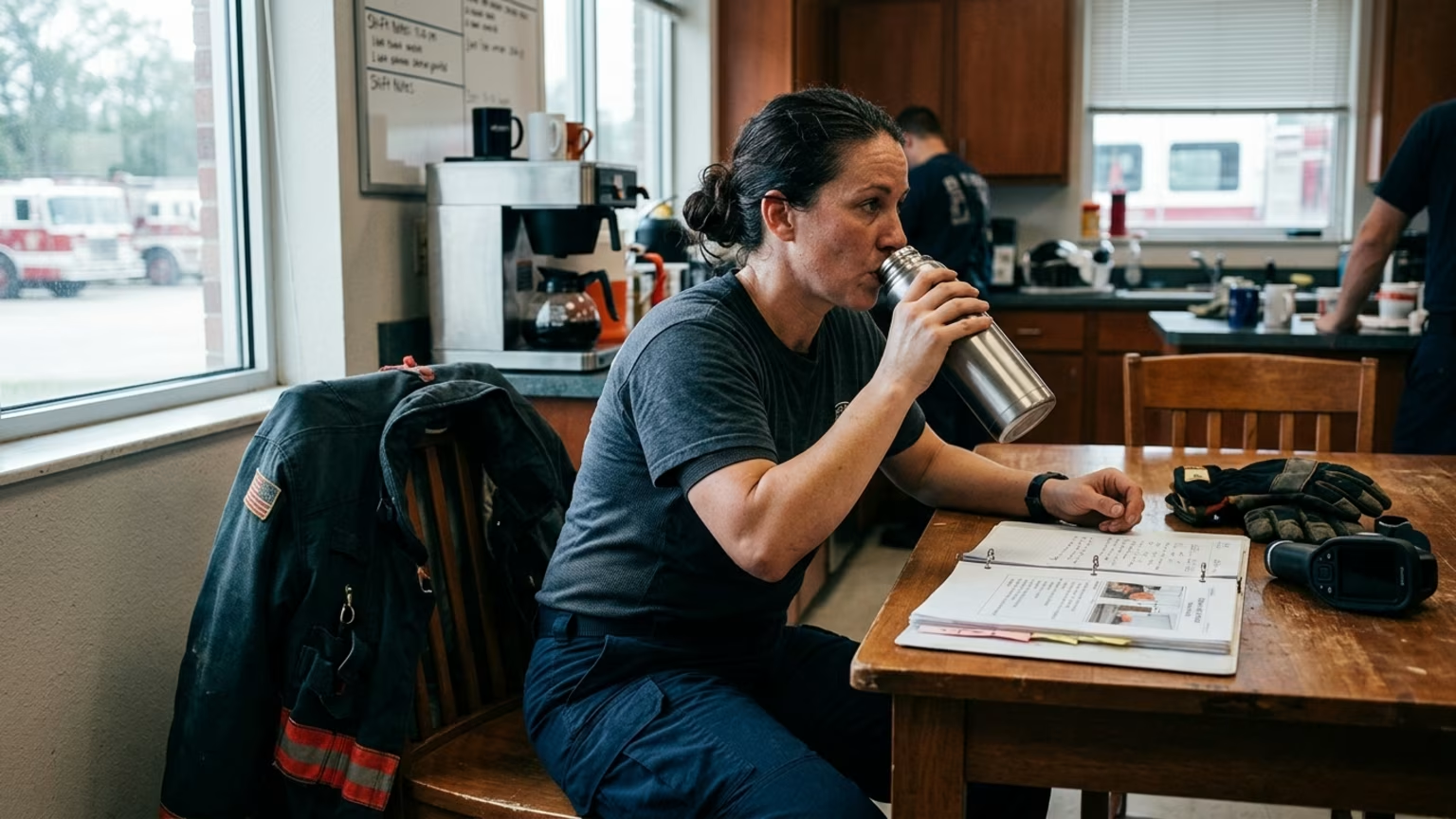

A local Louisiana house fire demonstrates the limits of pre-shift hydration and highlights the severe physiological strain of working in 75-pound turnout gear.





On June 8, 2025, WBRZ reported that six firefighters were treated for heat-related injuries after fighting a house fire in Brusly, Louisiana, the previous day. The residential response required personnel from three separate fire departments to coordinate suppression efforts under a reported 104-degree heat index, demonstrating the severe physiological toll of summer operations.
The primary operational takeaway from the Brusly response is that baseline fitness and prior hydration cannot fully insulate emergency personnel from the dangers of extreme heat exposure. According to WBRZ coverage of the incident, West Baton Rouge EMS Chief Mike Chustz explicitly noted that even hydrated and physically prepared personnel can quickly become overwhelmed by thermal strain in harsh conditions.
This practical observation aligns directly with current assessments of occupational heat exposure in physically demanding fields. A 2026 article in The Conversation examining heat impacts on wildland firefighters reinforced this exact limitation. The publication noted that while adequate hydration supports sweating and circulation, it cannot independently prevent overheating. When the human body gains heat from the environment and generates internal heat through exertion faster than it can release it, thermal injury becomes an immediate threat.
Structural firefighters face a unique physiological disadvantage in these scenarios due to their protective equipment. U.S. Department of Health and Human Services CHEMM guidance explains that prolonged use of personal protective equipment drastically increases a responder's overall heat-stress risk. The extra layers required to survive a fire environment severely limit natural heat dissipation. Because the body relies heavily on evaporating sweat to cool the skin, creating an impenetrable barrier around the responder traps that metabolic heat inside. Recognizing early symptoms and committing to continuous self-monitoring are critical components of surviving prolonged operational responses when the ambient temperature is already elevated.
Understanding how heat accumulates during an active response requires looking at both external and internal factors. The external burden on the Brusly fireground was significant. WBRZ noted that the incident occurred under a 104-degree heat index at 10 a.m. The fire badly damaged the home of former Brusly Town Council member Don Neisler, requiring immediate and aggressive interior operations to mitigate further damage. Addressing a fully involved residential structure in those ambient conditions immediately places responding crews at a physiological disadvantage.
The internal heat generation is equally punishing. Navigating a fireground requires intense muscular exertion, and every movement generates metabolic heat. When that internal heat production is paired with high external temperatures, the cardiovascular system must work exponentially harder to pump blood to the skin for cooling.
If the environment is hotter than the body, or if the individual is encased in insulated layers, this cooling mechanism fails. This physiological failure point is exactly why maintaining adequate water intake is only one piece of a much larger operational puzzle.
The Brusly incident provides a clear view of how severe environmental conditions force mandatory changes to standard incident management. Managing personnel across multiple agencies under extreme heat demands strict control over work cycles. Firefighters from Plaquemine and Baton Rouge assisted West Baton Rouge during the incident, working alongside personnel from the Brusly Police, Addis Police, and the West Baton Rouge Sheriff’s Office.
Chustz indicated that rotating crews in and out of the active fire zone was absolutely necessary to maintain basic safety. He estimated that 15 to 20 minutes inside a burning structure was about all most people could tolerate under those specific environmental constraints. While this time frame represents a local operational judgment rather than a tested universal work limit, it accurately highlights the rapid onset of physical exhaustion. Incorporating strategic protocols for hydration under heat, protective gear and long calls remains essential for crews operating near these physiological boundaries.
The extreme weight and insulating properties of standard firefighting equipment drastically reduce cardiovascular work capacity. WBRZ noted in its general context of the event that turnout gear can weigh up to 75 pounds. Forcing the body to carry this additional mass accelerates fatigue and increases the amount of internal heat generated by basic physical movements.
Furthermore, this equipment is explicitly designed to trap heat to protect the wearer from external thermal threats like flashovers and direct flame impingement. However, WBRZ also reported that temperatures inside full protective gear can exceed 150 degrees. Operating under this kind of enclosed thermal load requires immediate physiological interventions the moment a crew member exits the hot zone and moves to rehabilitation.
To address this immediate recovery need, practical cooling logistics must be built directly into the initial response apparatus. Chustz noted that local departments deliberately stock their trucks with ice-cold water. This operational choice allows firefighters to rehydrate immediately after leaving the extreme heat. Rapid access to cold fluids helps lower internal core temperatures and begins restoring the critical fluid volume lost through aggressive sweating.
A persistent assumption in occupational health is that established cooling protocols work equally well across all physically demanding professions. However, the chaotic realities of emergency response frequently challenge the broad application of standard heat-stress interventions. Medical researchers are increasingly recognizing this disconnect between clinical data and fireground reality.
A 2026 scoping review published in the Journal of Occupational and Environmental Medicine examined the available evidence surrounding occupational heat-stress prevention. The comprehensive review identified 90 different studies covering various intervention methods. These analyzed studies evaluated administrative work-practice controls, active cooling techniques, and structured rehydration strategies.
Crucially, the scoping review found that most of these 90 included studies were conducted in highly controlled laboratory settings. This laboratory-heavy evidence base presents a significant limitation when attempting to apply the overall literature directly to field operations. A controlled clinical environment with a treadmill and static temperatures rarely replicates the unpredictable, dynamic exertion of an active fireground. Laboratory studies also struggle to account for the sudden spikes in physiological strain that occur when a routine suppression task suddenly escalates into a complex emergency.
Because clinical studies struggle to capture these operational variables, fire departments must interpret broad health guidelines cautiously. Protocols that work efficiently for construction workers or agricultural laborers wearing standard breathable clothing often fail completely for firefighters wearing impermeable turnout gear. Recognizing this scientific gap is vital for incident commanders, who must adapt evidence-based guidelines to the harsh realities of their specific environments.
The events documented in Brusly, combined with supporting federal health guidance, offer clear parameters for managing high-temperature responses. Fire departments and emergency medical services must integrate specific, non-negotiable precautions into their daily routines as summer weather intensifies.
Incident commanders should proactively manage work intervals based on environmental conditions and physical load, rather than waiting for personnel to report exhaustion. Chustz observed that 15 to 20 minutes inside was a realistic tolerance limit for the Brusly response. While departments must establish their own policies based on local conditions, leaders should avoid pushing crews to the absolute limit of their physical endurance before initiating a mandatory rotation.
Immediate access to fluids is a fundamental logistical requirement. Departments should follow the practical steps outlined in the Brusly response by stocking frontline apparatus with ice-cold water for immediate use. Waiting for an external rehabilitation unit or a dedicated support vehicle to arrive delays critical cooling during the most vulnerable post-exposure window.
HHS CHEMM guidance strongly highlights the necessity of symptom recognition during prolonged responses. Personnel must be trained to identify early signs of heat strain in themselves and their operational partners. Ignoring early indicators like a headache, profound fatigue, or dizziness directly compromises team safety and can quickly lead to a life-threatening medical emergency.
Frontline personnel must fully understand that drinking water before a shift does not grant immunity to thermal injury. The Conversation clearly noted that hydration cannot prevent overheating if heat gain exceeds the body's physiological cooling capacity. Preparedness is essential, but it must be paired with aggressive in-shift management and a willingness to step back when the physical limit is reached.
The response to the Brusly fire demonstrates the ongoing tension between operational duty requirements and strict physiological limits. Moving forward, the fire service desperately needs more field-based research to validate effective cooling and recovery strategies. As the 2026 scoping review observed, the fact that the majority of the 90 analyzed intervention studies relied on controlled laboratory conditions leaves a massive gap in practical knowledge.
Bridging the gap between laboratory science and active fireground realities must become a priority for occupational health researchers. Future studies need to evaluate cooling interventions while personnel are actually encumbered by heavy turnout gear in unpredictable thermal environments. Until that field data matures, incident commanders must continue relying on strict rotation policies, immediate cold-water access, and continuous symptom monitoring to keep their crews safe. Maintaining clear guidelines around fatigue and driving after shift also remains crucial, as accumulated heat exposure heavily compounds systemic exhaustion across a long career. Evaluating organizational readiness frameworks points toward addressing the specific environmental stressors that prevent personnel from establishing proper heat, hydration and sleep recovery between severe assignments.
Addressing the accumulated physical toll of severe heat exposure is a necessary step in planning for physical capability and an active life after retirement or leaving service. Navigating the physiological impacts of extreme thermal strain requires practical interventions rather than general advice, and Rescuris provides the evidence-led framework needed to protect career longevity. Explore Resources
Rescuris publishes evidence-aware guidance for firefighters, police officers, paramedics and other first responders on fitness, recovery, sleep, nutrition, stress resilience and long-term capability.






Read practical guidance on first responder fitness, recovery, sleep, nutrition and resilience for demanding work and a long, active career.
read the blog
