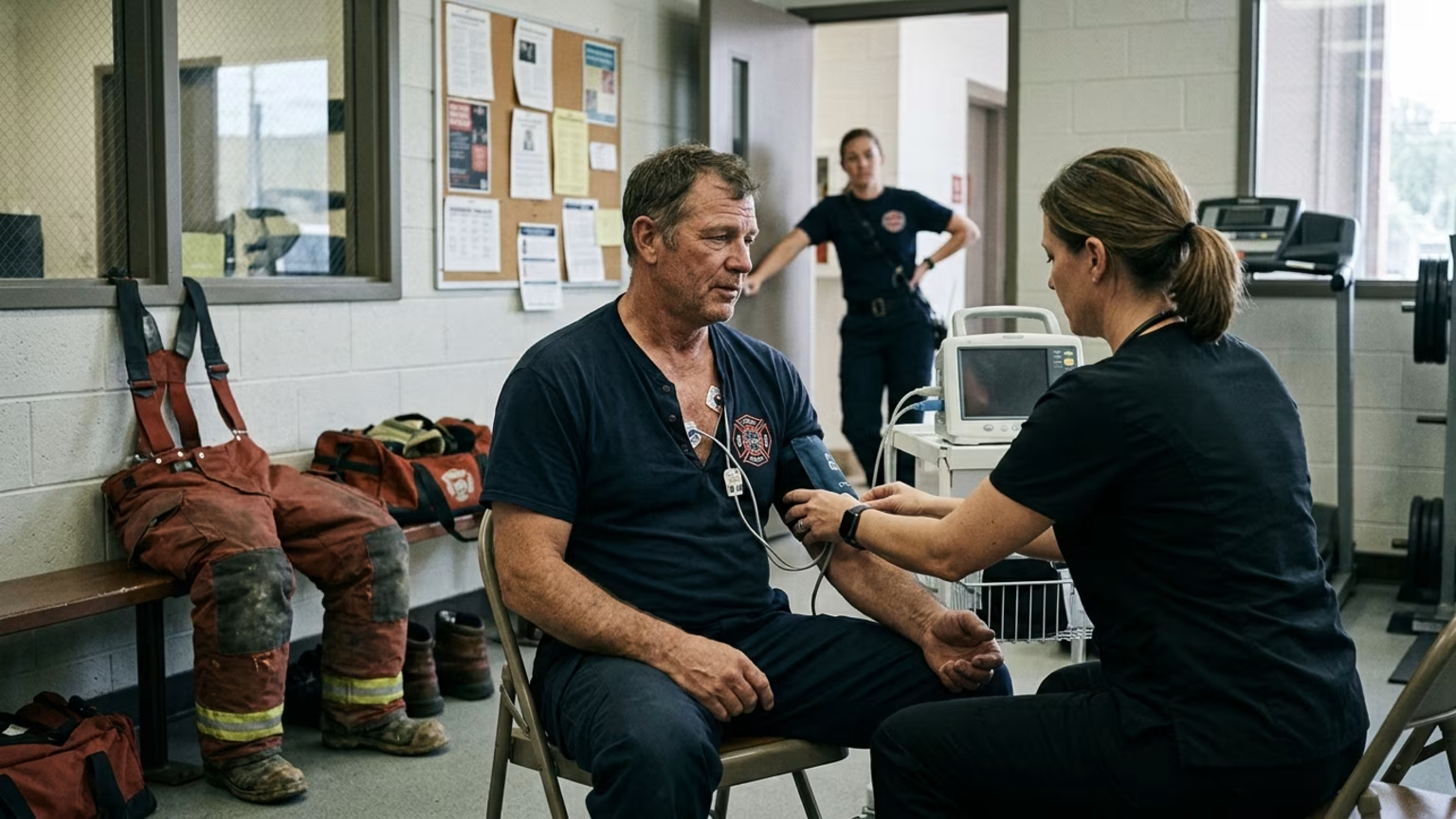

An Illinois firefighter’s training emergency prompts a measured look at medical response planning, cardiac research and the limits of routine screening.





A Rutland-Dundee Townships Fire Protection District firefighter was in critical condition after a serious medical emergency during training in Kane County on Oct. 21, 2026, Shaw Local reported. The outlet’s Oct. 22 report said the firefighter was taken to an area hospital.
District Chief Christopher Reedy said firefighters “were there for one of their own.” He said the department’s focus was on the firefighter, the firefighter’s family and department members. According to the report, neighboring departments were covering district stations while the district said emergency services for residents continued without interruption.
The immediate story concerns a firefighter receiving hospital care and a department supporting its members. The wider prevention discussion concerns how medical response planning and occupational health fit around demanding training. A Cedars-Sinai report published on Oct. 21, 2026, provides relevant context for that discussion through research on firefighter cardiac deaths.
Cedars-Sinai reported that its researchers reviewed U.S. Fire Administration records documenting 3,401 on-duty firefighter deaths from 1990 through 2025. They found that 43% were cardiac in origin. That finding establishes the substantial place of heart-related deaths within the records reviewed.
The report also described a separate analysis of trends before the COVID-19 pandemic. For 1990 through 2019, researchers found that the odds a given on-duty firefighter death was heart-related rose 2.2% per year. Overall on-duty deaths fell during that period.
Cedars-Sinai also reported that cardiac deaths as a proportion of all deaths in the general U.S. population fell 1.3% per year over the period described. These findings concern patterns within mortality records. They give the profession a reason to examine cardiac health without supplying an explanation for every medical emergency.
The Cedars-Sinai report raised a specific concern about routine screening. Researchers said standard exercise stress tests used in annual firefighter physicals may not detect some conditions, including excess heart-muscle enlargement. The report also noted that training-related heart-muscle changes may complicate the distinction between athletic adaptation and potentially dangerous conditions.
Senior study author Alan Kwan described a possible “blind spot” in routine firefighter heart screenings. He also pointed to the value of identifying treatable conditions. The report therefore raises a question about what screening detects, rather than documenting a successful change in screening practice.
Shaw Local’s account did not identify the firefighter or disclose the specific medical condition. It did not describe the exercise, response timeline or medical resources on scene. The report establishes that the emergency happened during training, not that training caused it or that a particular safety measure was absent.
The Illinois incident and the cardiac-death research are separate evidence. Neither source connects this firefighter’s emergency to a cardiac diagnosis. They also do not establish that an annual screening would have predicted the event or that a particular screening protocol would have prevented it.
The 43% figure describes the share of recorded on-duty deaths that were cardiac in origin. It is not an individual firefighter’s chance of experiencing a cardiac event during training. The Cedars-Sinai account also does not provide enough methodological detail here to independently assess the study or determine which screening changes departments should adopt.
For department leaders, the operational translation is a review of medical response planning rather than an immediate prescription for different testing. The Illinois emergency is a reasonable prompt to examine how that planning applies during demanding exercises. The review should start with the department’s own documented arrangements.
Medical response belongs in the training discussion alongside the exercise’s intended purpose. A useful planning question is how a department accounts for a participant needing urgent care during scheduled training. That is a question about preparation, not an allegation about what happened in Kane County.
The reported station coverage also deserves careful attention. Shaw Local described neighboring departments covering stations while the district focused on its firefighter and members. That is a documented example of support around this emergency, rather than evidence of a newly adopted policy or a model every department must copy.
For individual firefighters, the screening discussion belongs with qualified clinicians who can interpret personal circumstances. The useful aim is to understand what an assessment addresses and what questions remain for clinical judgment. A news report should not become a reason to choose a particular test without that conversation.
This also fits a broader approach to maintaining capability across a career. Training performance and long-term health deserve attention within the same plan. Neither needs to become a competition over who tolerates the most strain or asks the fewest questions.
Irregular work remains part of that planning context. Rescuris’s discussion of fitting exercise around shift-work sleep addresses the practical tension between training and recovery. Here, the relevant principle is to consider the working life around training rather than treating the exercise session as the entire picture.
The approved reporting supports a focused set of discussion points. These are questions for departmental review and occupational-health conversations, not a medical protocol or a finding that the Illinois district’s arrangements were inadequate.
What medical response planning applies to physically demanding training? Leaders can examine how their existing arrangements address an emergency during an exercise. The purpose is to make the planning explicit without filling gaps in the public account with assumptions.
The discussion should remain anchored to actual departmental arrangements. A general concern about training risk is not enough to select a particular staffing model or medical-coverage requirement. Those decisions need a basis beyond this incident report.
How are the purpose and limits of routine screening explained to firefighters? The Cedars-Sinai findings support asking that question during occupational-health discussions. Personal decisions about further assessment belong with qualified care rather than a universal recommendation drawn from a headline.
The conversation can focus on what information an existing assessment provides and what a clinician considers relevant to the individual. The goal is a clearer understanding of the assessment, not reassurance based on a test’s name alone.
How are the affected firefighter’s family and department members included in the response? Reedy’s stated focus gives this question a direct connection to the reporting. Support deserves a place beside operational continuity rather than being treated as separate from it.
For readers considering the human side of a colleague’s emergency, questions about support after difficult events provide a related editorial discussion. The starting point here is respect for those involved. Concern about a colleague’s health should not become a test of anyone’s toughness or commitment.
Together, these questions keep the discussion concrete. Departments can examine planning while firefighters raise clinical questions through appropriate care. Neither task requires speculation about the affected firefighter’s diagnosis or personal health history.
The research leaves a broader question about how firefighters’ cardiac assessments should develop. Study author Susan Cheng said further research is needed and that it remains unclear why firefighters appear at risk for the condition discussed in the report. That uncertainty identifies a research task rather than a settled explanation.
One open question is which findings would help clinicians distinguish training-related heart changes from potentially dangerous conditions. Another is whether a different screening approach would lead to better clinical decisions and health outcomes. Detecting an abnormality and demonstrating a benefit from changing screening are different evidence goals.
Future evidence would be most useful if it connected assessment findings with meaningful outcomes. It would also need to clarify who benefits from a changed approach and how clinicians should interpret results. Those are criteria for judging evidence, not a claim that a particular follow-up study has been announced.
The Illinois report brings urgency to the conversation because a firefighter required hospital care during scheduled training. The enduring questions concern preparation and clinical assessment: how should departments evaluate their medical response arrangements, and what evidence would justify changing routine screening?
Medical uncertainty during training calls for careful discussion rather than pressure to prove toughness. Rescuris connects research on stress resilience with career longevity for emergency-service professionals, helping readers distinguish useful guidance from motivational claims and mental-health stigma while keeping demanding work and long-term health in the same frame.
Rescuris publishes evidence-aware guidance for firefighters, police officers, paramedics and other first responders on fitness, recovery, sleep, nutrition, stress resilience and long-term capability.






Read practical guidance on first responder fitness, recovery, sleep, nutrition and resilience for demanding work and a long, active career.
read the blog
