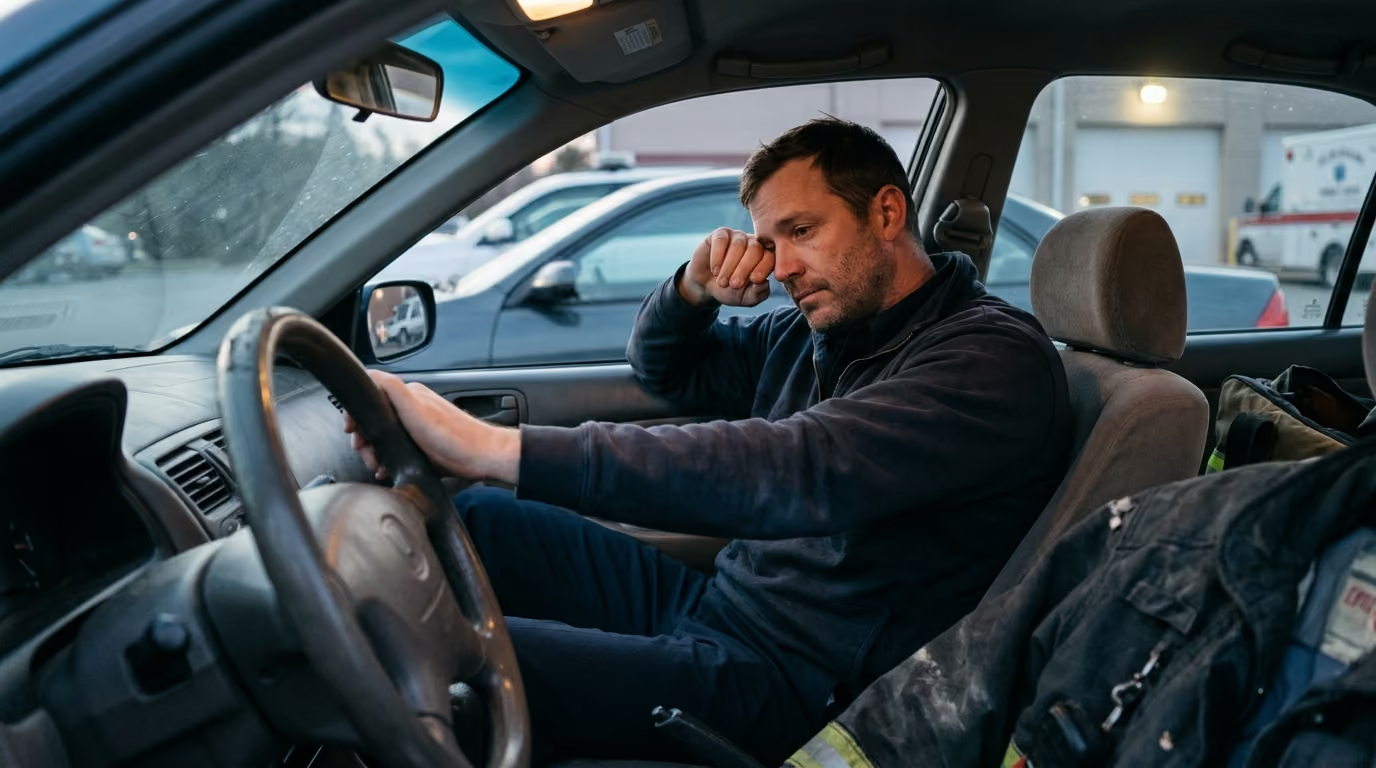

Heading home after an intense overnight shift requires assessing your alertness and biological fatigue levels to prevent fatal drowsy driving accidents.





Post-shift driving safety is an objective evaluation of biological alertness, reaction time, and hazard perception before operating a motor vehicle. It is not a demonstration of personal resilience, dedication, or professional stamina.
Operating a personal or emergency vehicle while severely fatigued creates extreme roadway risks for emergency personnel and the public. When an individual finishes a demanding shift, biological sleep pressure, circadian timing, and cognitive depletion converge.
This comprehensive guide examines the physiological mechanisms of post-shift fatigue. It outlines the clinical evidence behind drowsy driving, provides structured pre-drive self-assessments, and establishes clear stop-driving criteria. It also details practical countermeasures, organizational responsibilities, and long-term recovery practices to keep emergency responders safe across an entire career.
The primary rule of post-shift driving is simple. If you experience lane drift, drooping eyelids, repeated yawning, wandering thoughts, or gaps in your trip memory, you must pull over in a safe location immediately.
Being off duty does not mean you are safe to drive. Safe driving requires continuous visual tracking, rapid micro-adjustments, and sharp hazard detection. Fatigue degrades these cognitive faculties long before a driver experiences an uncontrollable urge to fall asleep.
Willpower cannot override the biological need for sleep. Physical tricks like rolling down the window, turning up the stereo, or blasting cold air provide only brief sensory stimulation. They do not restore neurological alertness or reduce stopping distances.
If you are uncertain about your driving capacity, do not turn the key. Pull into a designated parking area, use an evidence-based coffee-nap protocol, request alternative transportation, or sleep at the station until you recover functional alertness.
According to the National Institute for Occupational Safety and Health (NIOSH), driver fatigue represents a major occupational hazard across industries. NIOSH reports that as many as one in five fatal motor vehicle crashes in the general population involves a fatigued driver.
Data from the National Highway Traffic Safety Administration (NHTSA) estimated that approximately 91,000 police-reported crashes involved drowsy drivers in 2017. These crashes resulted in roughly 50,000 injuries and nearly 800 fatalities. In 2021, NHTSA recorded 684 deaths directly attributed to drowsy driving, representing 1.6 percent of all roadway fatalities.
NHTSA notes that fatigue-related collisions are consistently underreported. Standard police accident reports and emergency room records rarely capture biological fatigue metrics. Therefore, official statistics represent only a fraction of the actual collision burden.
Occupational data from NIOSH on shift patterns shows that accident and error risks rise by approximately 28 percent on night shifts compared to day shifts beginning after 7:00 a.m. Evening shifts show a 15 percent increase in risk. Extended wakefulness degrades nervous system processing in a manner directly comparable to chemical intoxication.
The Federal Transit Administration reports that 17 hours of continuous wakefulness produces cognitive impairment equivalent to a 0.05 percent blood alcohol concentration. Remaining awake for 24 continuous hours mirrors a blood alcohol concentration of 0.10 percent. That level exceeds the legal driving limit in every state.
These equivalencies illustrate how prolonged duty hours slow reaction times, narrow peripheral vision, and impair situational judgment. Sleep deprivation is not identical to intoxication, but its operational risks behind the wheel are just as dangerous.
Emergency response work imposes unique physiological demands that amplify the risk of motor vehicle collisions during the commute home. Public safety work requires continuous 24-hour community coverage, forcing personnel into irregular schedules, rotating shifts, and mandatory holdovers.
Research published in public safety reviews shows widespread sleep disruption across frontline disciplines. In peer-reviewed surveys, 59 percent of firefighters reported chronic sleep deprivation, and 23 percent met criteria for insomnia.
Similar sleep deficits appear in emergency medical services and law enforcement. Roughly 64 percent of EMS providers and 51 percent of police officers report poor baseline sleep quality. These high baseline deficits leave responders with little biological buffer during demanding duty cycles.
The nature of emergency service work masks underlying exhaustion through temporary neuroendocrine activation. During an emergency call, sympathetic nervous system activity surges. Epinephrine, norepinephrine, and cortisol flood the circulation to support high physical and cognitive performance.
When the shift ends, this hormonal surge drops rapidly. The parasympathetic state takes over, unmasking intense sleep pressure. A paramedic or firefighter may feel completely alert while clearing the station bays, yet experience debilitating sleepiness ten minutes later on a quiet highway.
Monotonous driving conditions accelerate this cognitive decline. High-speed highways, smooth pavement, and repetitive visual fields remove the external stimulation that kept the responder awake on duty. The brain rapidly drops into lower arousal states, creating an ideal environment for microsleeps.
Commute distance adds further operational risk. High housing costs often force public safety professionals to live far from their response districts. A 60-minute commute after a 14-hour night shift forces an already compromised nervous system to perform complex navigation across heavy morning traffic.
Emergency apparatus operation carries its own distinct demands. Operating a heavy rescue vehicle, ladder truck, or police cruiser involves high speeds, complex navigation, intersection management, and continuous radio traffic.
When fatigue compromises an emergency vehicle operator, the potential for catastrophic multi-vehicle accidents increases significantly. Recognizing how circadian disruption and extended shifts impair psychomotor function is essential for protecting crews and civilians alike.
Managing transportation risk requires clear distinctions between related physiological states. While responders often use the terms interchangeably, fatigue, sleepiness, and sleep inertia represent distinct biological conditions with different implications for driving safety.
Fatigue is a state of reduced mental or physical capacity resulting from prolonged exertion, emotional stress, circadian disruption, or sleep restriction. A fatigued responder may experience heavy limbs, slowed cognition, and emotional depletion.
Fatigue impairs executive function, risk assessment, and lane positioning. However, a fatigued person is not necessarily on the verge of falling asleep immediately. They may feel entirely awake while suffering from slow reaction times and poor hazard perception.
Sleepiness describes the biological drive to enter sleep. It is regulated by two distinct internal mechanisms: homeostatic sleep pressure and the circadian timing system.
Homeostatic sleep pressure builds continuously during every hour of wakefulness as the neuromodulator adenosine accumulates in the brain. Circadian sleepiness is governed by the suprachiasmatic nucleus, which drives biological dips in alertness.
The primary circadian low occurs between 2:00 a.m. and 6:00 a.m. with a secondary dip occurring in the mid-afternoon. When high homeostatic sleep pressure coincides with the morning circadian nadir, the urge to sleep becomes overpowering. This dual pressure creates the classic conditions for involuntary microsleeps.
A microsleep is an involuntary, temporary lapse of consciousness lasting from a fraction of a second up to thirty seconds. During a microsleep, the brain briefly disengages from environmental input.
A vehicle moving at 65 miles per hour travels nearly 100 feet in a single second. A three-second microsleep means the vehicle travels the entire length of a football field without human control or obstacle detection. The driver rarely realizes the lapse occurred until the vehicle drifts onto a rumble strip or leaves the road.
Sleep inertia is the temporary grogginess, disorientation, and cognitive impairment experienced immediately upon waking. It occurs most severely when waking from deep, slow-wave sleep or after naps taken under high sleep pressure.
During sleep inertia, reaction times and spatial reasoning can be worse than those observed after total sleep deprivation. EMS fatigue guidelines indicate that naps under 10 minutes produce negligible sleep inertia. Naps lasting between 15 and 120 minutes offer greater physiological restoration but require a mandatory waking buffer before driving.
Fitness for duty and fitness to drive are separate assessments. A responder may successfully complete patient charting or clean station tools while lacking the visual reaction speed required for high-speed highway driving.
Before starting your personal vehicle after shift, run through a structured five-factor self-check.
Review your total sleep duration over the preceding 24 and 48 hours. NIOSH recommends a minimum of 10 consecutive hours of off-duty recovery time per day to allow for seven to eight hours of consolidated sleep.
If you obtained fewer than four hours of fragmented sleep over the past 24 hours, your risk of a fatigue-related driving error is substantially elevated. Chronic sleep debt accumulated across consecutive night shifts lowers your threshold for microsleeps.
Calculate the total elapsed time since you last woke from consolidated sleep. Do not simply count the hours of your scheduled work shift.
If you woke at 6:00 a.m. worked an overtime day shift, covered a night holdover, and prepared to drive home at 8:00 a.m. you have been awake for 26 continuous hours. Under FTA benchmarks, your cognitive impairment matches or exceeds a 0.10 percent blood alcohol concentration. You are biologically unfit to operate a motor vehicle.
Identify where your trip falls along the biological circadian curve. Driving between 2:00 a.m. and 6:00 a.m. carries the highest statistical risk for catastrophic run-off-road collisions.
The immediate post-shift window from 7:00 a.m. to 9:00 a.m. is also hazardous. Responders face the combined burden of high homeostatic sleep pressure, a fading adrenaline response, and heavy commuter traffic.
Evaluate the cognitive, physical, and emotional intensity of the shift. A shift involving continuous structural firefighting, high-stress tactical operations, or multiple pediatric resuscitations rapidly drains mental reserves.
Physical dehydration, prolonged heat stress, and heavy equipment loads accelerate central nervous system fatigue. Even if call volume was low, hours spent performing monotonous dispatch or administrative tasks can prime the brain for sleepiness once you enter a quiet vehicle.
Consider the specific demands of your travel route. A 15-minute drive on well-lit surface streets presents a lower risk profile than a 75-minute drive along rural, unlit highways.
Inclement weather, heavy rain, dense fog, road construction, and stop-and-go traffic demand intense visual concentration. If your planned route requires sustained vigilance in poor conditions while you are already fatigued, arrange an alternative transportation plan before leaving the parking stall.
Fatigue degrades self-awareness, leading many drivers to overestimate their alertness. Responders often attempt to push through the final miles of a commute, believing that familiarity with the road protects them.
NHTSA explicitly identifies specific behaviors that indicate a driver is dangerously impaired by sleepiness. The appearance of even one of these warning signs demands an immediate stop in a safe location:
Never bargain with the distance remaining on your trip. The thought "I am only ten minutes away" is a cognitive trap. Many fatal drowsy-driving crashes happen within miles of a responder's home, where familiarity causes vigilance to collapse.
If you hit a rumble strip or miss a turn due to inattention, the drive has already failed the safety threshold. Treat that event as an active near-miss. Signal, slow down, and exit the roadway into a secure rest stop, lighted fuel station, or park-and-ride facility immediately.
When fatigue sets in during post-shift travel, responders often rely on informal folk remedies. Evaluating these tactics against occupational evidence reveals clear boundaries between physiological solutions and ineffective distractions.
Several common habits create a false sense of security without restoring cognitive function:
Scientific reviews confirm that environmental stimulation provides only a few minutes of superficial sensory distraction. These tactics do not clear adenosine from brain tissue, do not restore reaction time, and do not stop microsleeps. Relying on them increases crash risk by delaying a necessary stop.
NHTSA and sleep researchers recommend a specific emergency countermeasure when a driver becomes sleepy: the coffee-nap protocol. This intervention combines the chemical stimulant effects of caffeine with the adenosine-clearing benefits of a short nap.
To execute the protocol correctly, follow these four distinct steps:
This protocol works through complementary biological mechanisms. Ingested caffeine takes roughly 20 to 30 minutes to pass through the gastrointestinal tract and cross the blood-brain barrier.
A 20-minute nap allows the brain to clear accumulated adenosine from neural receptors without entering deep, slow-wave sleep. When you wake, the adenosine load is reduced, and caffeine binds to the newly cleared adenosine receptors.
After waking, step out of the vehicle and walk around for five to ten minutes. This short buffer allows residual sleep inertia to dissipate before you re-evaluate your capacity to drive.
The coffee-nap protocol is an emergency bridge, not a replacement for consolidated sleep. It provides a temporary window of improved alertness lasting 60 to 90 minutes. It does not erase accumulated sleep debt, and its effectiveness drops sharply if repeated multiple times in a single shift cycle.
Caffeine remains a valuable operational tool when used properly. EMS fatigue management guidelines recommend access to caffeine during extended and overnight shifts to support alertness.
However, using caffeine indiscriminately throughout the end of a shift creates severe downstream problems. Consuming high-dose energy drinks or coffee within three hours of shift completion disrupts daytime recovery sleep.
Responders who flood their systems with stimulants to survive the drive home often find themselves unable to achieve deep sleep once in bed. Mastering strategic caffeine protocols helps maintain alertness on shift while protecting essential daytime rest.
Sharing the drive home with a coworker can reduce continuous driving exposure, but only under specific physiological conditions. For shared driving to be safe, the relief driver must be genuinely rested and fully alert.
Rotating driving duties between two exhausted responders who just worked the same 24-hour shift simply splits the hazard between two impaired operators. An exhausted passenger cannot serve as an effective safety monitor because their own hazard detection and attention systems are offline.
If both responders are sleep-deprived, alternative transport or station rest is mandatory.
Managing fatigue cannot rest solely on the individual choices of frontline personnel. NIOSH emphasizes that fatigue risk management systems require structured administrative controls, institutional policies, and active supervisory engagement.
Workplace fatigue that begins during an assigned shift remains an organizational safety concern until the responder reaches home safely.
Administrative scheduling practices represent the most effective barrier against severe operational fatigue. Shift design must account for total sleep opportunity and recovery intervals between work blocks:
The evidence-based EMS fatigue panel recommends shifts shorter than 24 hours whenever operational conditions allow. A systematic review concluded that shorter shifts yield more favorable fatigue outcomes compared to shifts of 24 hours or longer.
Where 24-hour rotations remain necessary, agencies must build internal relief structures and protected resting periods into the daily operational schedule. Reviewing national occupational safety baselines provides agencies with actionable benchmarks for shift design.
Agencies should provide dedicated, quiet, and dark sleeping quarters within stations, permitting personnel to take short naps during long tours. EMS guidelines recommend that leadership grant clear operational permission for strategic napping during shifts exceeding 12 hours.
Providing clean rest facilities also gives personnel a safe place to sleep after shift completion. A responder who feels too exhausted to drive should have access to station bunks or quiet rest areas without time restrictions or administrative friction.
Departments should institute non-punitive fatigue reporting policies. If a responder recognizes that cumulative overtime, call volume, or personal sleep disruption makes driving dangerous, they must be able to report that condition without fear of disciplinary action.
Forward-thinking public safety agencies implement emergency transportation programs:
Supervisors must actively evaluate their crews during morning shift handovers. Rather than assuming silence means readiness, supervisors should ask direct questions:
Normalizing these conversations removes cultural stigma. It reframes fatigue management as an essential operational safeguard rather than a question of individual toughness.
Examining common operational situations highlights how the five-factor risk assessment and stop-driving protocols function during real-world service.
A firefighter completes a grueling 14-hour overnight shift involving multiple structure fires and fragmented rest. At 7:30 a.m. they begin a 40-minute highway drive home.
Ten miles into the trip, the right tires hit the shoulder rumble strip. The driver feels a surge of adrenaline, shakes their head, rolls down the window, and tells themselves they are only twenty minutes from home.
The Correct Action:
The driver must recognize that hitting the rumble strip represents a definitive safety failure. Rolling down the window and relying on adrenaline will not prevent a subsequent microsleep.
The responder must signal, take the next exit, park in a safe commercial lot, and execute a 20-minute coffee-nap or call a family member for a ride. The remaining distance must never override an active sign of sleep onset.
A paramedic crew works a severe multi-casualty motor vehicle collision during the final two hours of a 12-hour shift. The crew operates with high focus and rapid decision-making throughout the response and hospital handover.
Upon returning to quarters, handing over equipment, and clocking out, the driver sits in their personal truck. Within five minutes of driving on an open arterial road, their eyelids become heavy, and their eyes burn.
The Correct Action:
The paramedic must recognize that high sympathetic tone masked their underlying sleep debt during the emergency call. The end of the call allowed the nervous system to shift toward parasympathetic recovery, causing an immediate drop in vigilance.
The provider should return to the station, inform the oncoming supervisor, and rest in an open bunk room for 60 to 90 minutes before attempting the commute. Managing cumulative physiological wear is part of managing cumulative physiological stress across a demanding career.
A police officer recovering from a minor training injury takes an over-the-counter antihistamine and an anti-inflammatory medication before a mandatory overtime patrol shift. While the officer feels mentally alert during briefings, their reaction time slows, and heavy drowsiness develops three hours into the shift while performing mobile patrol.
The Correct Action:
The officer must recognize that over-the-counter medications carrying drowsiness warnings interact directly with baseline shift-work fatigue. Relying on energy drinks or high-intensity music will not counter the central nervous system sedation caused by the medication.
The officer must notify their watch commander, step down from vehicle operations, and transition to stationary desk duties or arrange alternative transport home.
To ensure safe transportation, emergency service personnel and organizational leaders must adhere to rigid safety boundaries:
If there is any doubt regarding your alertness, reaction speed, or cognitive clarity, do not drive. Secure your vehicle, notify your chain of command or family, and prioritize rest.
While acute post-shift tiredness is common, persistent, unresolving exhaustion indicates underlying health issues that require clinical intervention. Shift work places intense stress on the neuroendocrine and cardiovascular systems, often exacerbating sleep disorders.
Responders should seek evaluation from a qualified healthcare professional or board-certified sleep specialist if they experience:
Clinical evaluations can identify and treat obstructive sleep apnea, shift work sleep disorder, restless legs syndrome, and endocrine imbalances. Proper medical management, combined with building a shift-specific recovery routine, restores baseline neurocognitive function and reduces roadway risk.
Sustainable capability in emergency services depends on recognizing that human physiology has absolute biological limits. Protecting yourself, your crew, and the public requires treating post-shift transportation with the same discipline, planning, and objective assessment applied to emergency scenes.
Prioritizing sleep recovery over personal bravado preserves your physical longevity, protects your family, and ensures you remain capable throughout your service career.
Allow at least 10 to 15 minutes after waking from a nap before operating a motor vehicle. This recovery window allows sleep inertia to dissipate. Walk around, wash your face with cold water, and drink fluids to verify your cognitive alertness before driving.
No. Chewing gum and drinking cold water provide brief sensory stimulation that lasts only a few minutes. They do not lower adenosine levels in the brain or improve visual reaction times. If you are sleepy enough to need sensory tricks, you are already unsafe to drive.
No. Many fatigue-related collisions occur within a few miles of a driver's destination. When you approach a familiar area, your vigilance drops, and the brain lowers its arousal state, increasing the likelihood of a fatal lane departure or intersection error.
Caffeine temporarily blocks adenosine receptors in the brain, masking the feeling of sleepiness. However, it does not remove accumulated sleep debt or restore degraded cognitive processing. Under severe sleep deprivation, caffeine becomes ineffective at preventing sudden attentional lapses and microsleeps.
Stay connected for research-led guidance on duty fitness, shift-work sleep, injury recovery, stress, nutrition and career longevity. Practical ideas for first responders who want to stay capable on the job, recover well and protect their health for the long run.



Read practical guidance on first responder fitness, recovery, sleep, nutrition and resilience for demanding work and a long, active career.
read the blog



