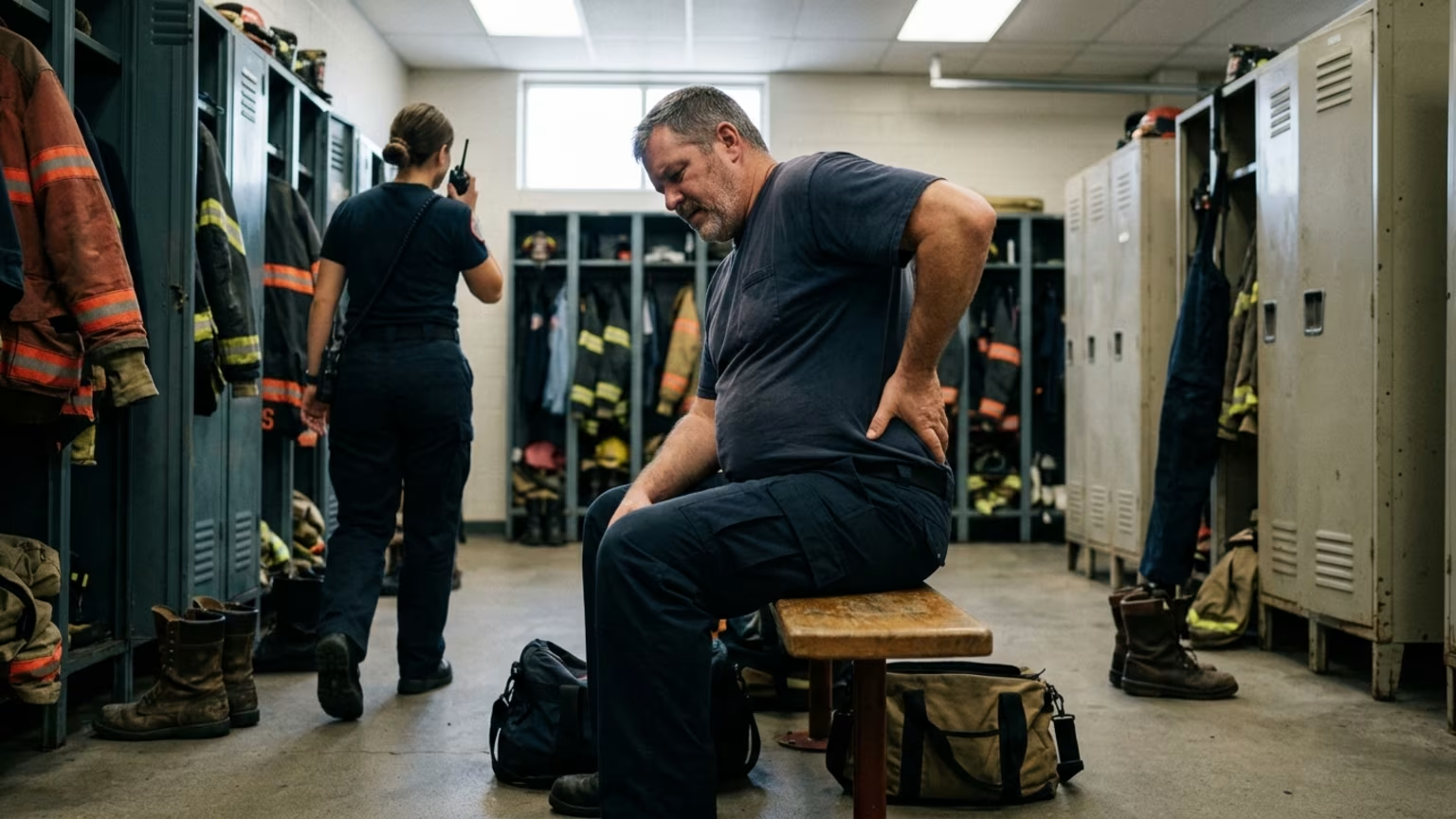

Learn how first responders can distinguish routine post-shift soreness from injuries requiring clinical evaluation using a practical decision framework.





Working through physical pain does not prove operational toughness; it actively compromises long-term duty readiness and guarantees longer periods away from the field. Ignoring functional loss to finish a shift is a severe occupational liability masquerading as dedication to the job.
First responders operate in high-risk environments characterized by irregular schedules, interrupted sleep, and unpredictable physical loads. An entrenched industry norm assumes that joint pain, muscle stiffness, and chronic fatigue are simply unavoidable costs of wearing the uniform. Many emergency professionals rely entirely on their personal pain tolerance rather than objective, function-based movement assessments. They treat recurring discomfort as a standard baseline, ignoring the clear signal that their fundamental movement mechanics are failing.
The expectation to remain constantly available pushes many emergency responders to suppress early warning signs of physical breakdown. When an officer or paramedic feels a sharp twinge during a patient transfer, the immediate instinct is often to stretch it out and keep working. The operational tempo rarely allows for a proper assessment during a busy tour, leading personnel to normalise the discomfort. Over time, this normalisation transforms a highly treatable acute strain into a complex, chronic structural problem.
This stoic mindset often leads personnel to treat all back or joint pain as generic mechanical stiffness. A clinical practice article suggests that most first-responder back pain is mechanical, but that is not a population-wide diagnostic rule. Assuming every ache is identical completely ignores the progressive nature of severe musculoskeletal disorders. This deeply ingrained habit of relying on sheer grit routinely backfires when professionals face complex physical demands over decades of service.
The physical burden placed on emergency personnel is immense, well documented, and distinct from civilian occupational hazards. A 2026 Frontiers in Public Health study reported lower-back pain in 75.0% of firefighter participants. The same study observed shoulder pain in 62.5% and neck pain in 57.5% within the surveyed population. These figures reflect the intense occupational exposure to demanding tasks like patient handling, structural fire suppression, and heavy rescue operations.
Occupational injury risk is an unavoidable reality across both law enforcement and fire service environments. A systematic review cited in a 2026 Frontiers article closely examined musculoskeletal-injury epidemiology among law-enforcement and firefighter recruits during intense physical training. While these recruit-training findings highlight the inherent risks of the profession, they should not automatically be generalized to experienced personnel managing ordinary post-shift soreness. Older responders face different recovery timelines, and their connective tissues respond differently to accumulated duty fatigue than those of academy recruits.
When responders continue performing tasks that repeatedly aggravate a strained area, they subconsciously compensate by altering their fundamental movement patterns. This physiological adjustment loads another body region with unnatural stress, and it significantly reduces precision over safety-critical tasks. The study authors explicitly describe these musculoskeletal disorders as impairing occupational performance and reducing overall quality of life. Furthermore, these unresolved physical issues are heavily linked with early retirement from the emergency services.
Addressing this physiological reality requires specific, targeted interventions rather than generic departmental wellness programs. A review summarized by PEDro found moderate evidence that patient-handling training alone and cognitive-behavioral training alone did not improve musculoskeletal health. In contrast, the authors of the 2026 Frontiers study reported that workplace-based integrative care was feasible and acceptable for firefighters. This highlights the importance of localized professional care over simply telling personnel to lift carefully. Understanding why sheer willpower fails to overcome accumulated physical wear helps professionals accept the strict necessity of clinical support.
The necessary alternative to this culture of stoicism is adopting a structured, function-first decision framework for every physical complaint. A practical risk-screening protocol separates safe self-management from complex situations that require immediate clinical evaluation. The primary checkpoint must always be whether you can perform safety-critical tasks reliably, repeatedly, and without any movement compensation.
Discomfort is likely just routine soreness when it remains mild, begins after a recognizable workload, and does not progressively worsen over time. This category of pain does not alter your normal movement, and it causes absolutely no loss of strength, sensation, or coordination. The safest initial response is relative rest rather than complete inactivity or strict bed rest. Responders should modify the aggravating task, prioritize restorative sleep, maintain hydration, and keep moving comfortably before their next shift.
Understanding the exact timeline of your symptoms helps separate a minor ache from a developing injury. Normal soreness typically peaks within two days of an unusually heavy shift and resolves steadily with basic mobility work and rest. If the discomfort feels symmetrical, predictable, and directly tied to a specific recent exertion, self-monitoring is highly appropriate. The crucial distinction is that standard muscle fatigue never causes your foot to drag, your grip to fail, or your balance to falter during ordinary daily tasks.
You must carefully monitor these mild symptoms before attempting to resume intense physical conditioning routines. A systematic review identified five eligible firefighter studies and reported performance improvements across simulated tasks such as victim rescue, hose advancement, and ladder operations. However, that review explicitly noted that occupational conditioning must be progressive and heavily individualized. Training harder is never a safe or effective response to an unexplained symptom, localized joint pain, or lingering stiffness.
Evaluation is absolutely warranted when pain keeps returning after similar shifts or persists instead of steadily improving over consecutive days. A clinical assessment becomes strictly necessary if the discomfort repeatedly interferes with your sleep or reduces your normal range of motion. You should also seek an immediate evaluation when the pain alters your lifting, carrying, climbing, running, gripping, or patient-handling ability. Getting professional input is critical when deciding whether discomfort is routine post-shift soreness or a serious problem that degrades your readiness.
Documenting your exact symptoms provides your healthcare provider with a much clearer clinical picture during an evaluation. You should track the specific onset time, the duty or training trigger, the exact location, and any aggravating movements that worsen the pain. Noting how the discomfort affects your sleep quality and whether symptoms consistently recur on subsequent shifts is equally important. This precise tracking moves the conversation away from vague complaints and gives your clinician the concrete data needed to recommend an effective recovery protocol.
A responder must critically evaluate whether they can safely don equipment, stabilize a patient, control a heavy tool, or exit a vehicle. The relevant question is never simply whether you can tolerate the pain during a call. The actual question is whether you can execute essential duty movements without putting yourself or your crew in danger.
Certain severe physical symptoms require you to stop the provoking activity immediately and obtain prompt medical advice. A first-responder clinical resource specifically identifies limb numbness or weakness and a foot that catches or drags as symptoms requiring medical evaluation rather than continued self-management. Any new or progressive weakness, tingling, radiating pain, or sudden loss of coordination demands an urgent clinical assessment. You should never attempt to test these severe neurological symptoms by pushing through another heavy workout or demanding shift.
Emergency medical escalation is also strictly required for changes in bladder or bowel control, numbness in the saddle area, or rapidly worsening neurological function. Pain accompanied by fever or chest pressure is another critical escalation signal identified in first-responder-specific guidance. Chest pressure must always be treated as a potential cardiovascular emergency rather than a routine, predictable muscle strain. Finally, worsening pain following a significant fall, violent collision, or major physical trauma warrants prompt professional care.
Some seasoned professionals argue that reporting every minor physical issue creates unnecessary paperwork and disrupts normal departmental flow. They often claim that documenting joint pain makes them look unreliable, fragile, or overly sensitive to the routine demands of emergency work. The prevailing fear is that acknowledging any discomfort will trigger an unwanted medical leave, a mandatory fitness review, or a light-duty assignment. However, trying to conceal or defer these symptoms routinely delays proper assessment and creates a dangerously incomplete medical timeline for the responder.
The stigma around reporting physical pain is deeply tied to the cultural identity of emergency responders. Personnel take immense pride in their physical resilience, and admitting vulnerability feels like a failure to meet the standard. This cultural barrier prevents many officers, firefighters, and medics from accessing the care they need when an injury is still minor. Breaking this cycle requires separating the concept of duty readiness from the harmful practice of ignoring physiological warning signs.
A specific firefighter labor-law case illustrates exactly why timely injury-on-duty documentation matters so much when symptoms evolve unexpectedly. It can be incredibly difficult to know whether early lower-back pain will resolve quickly or become a persistent, career-altering condition. Contemporaneous documentation provides a prudent, factual administrative record if an issue unexpectedly worsens over months or years of service. Taking this simple administrative step protects your long-term occupational options without forcing an immediate, unnecessary medical intervention or surgery.
Your ability to maintain a sustainable, career-long physical training plan depends entirely on accurately assessing your body's functional reality today. Reliable physical function, rather than mere pain tolerance, must always dictate your immediate response to physical discomfort on duty. Ignoring established red flags, masking localized weakness with medication, or treating recurring joint pain as a badge of honor ultimately destroys your operational capability. Responding early to functional decline protects your career longevity, secures your crew members, and preserves your physical independence long after leaving the service.
A resilient emergency service career requires acknowledging that the human body has strict biomechanical limits under heavy load. The decision to step back and evaluate a lingering pain is a strategic choice, not a sign of physical weakness. True operational toughness involves managing your physical assets intelligently so that you remain capable for the duration of your career. By respecting these clinical red flags, you prevent today’s minor strain from becoming tomorrow’s career-ending injury.
Squad leaders and department medical directors frequently struggle to determine if personnel are pushing past safe physical limits, but decision making becomes precise when Rescuris defines the functional thresholds. Conflicting advice that prioritises short-term performance while ignoring long-term health makes injury management difficult, so we deliver practical evidence for maintaining sustainable duty readiness. Explore Resources
Rescuris publishes evidence-aware guidance for firefighters, police officers, paramedics and other first responders on fitness, recovery, sleep, nutrition, stress resilience and long-term capability.






Read practical guidance on first responder fitness, recovery, sleep, nutrition and resilience for demanding work and a long, active career.
read the blog
