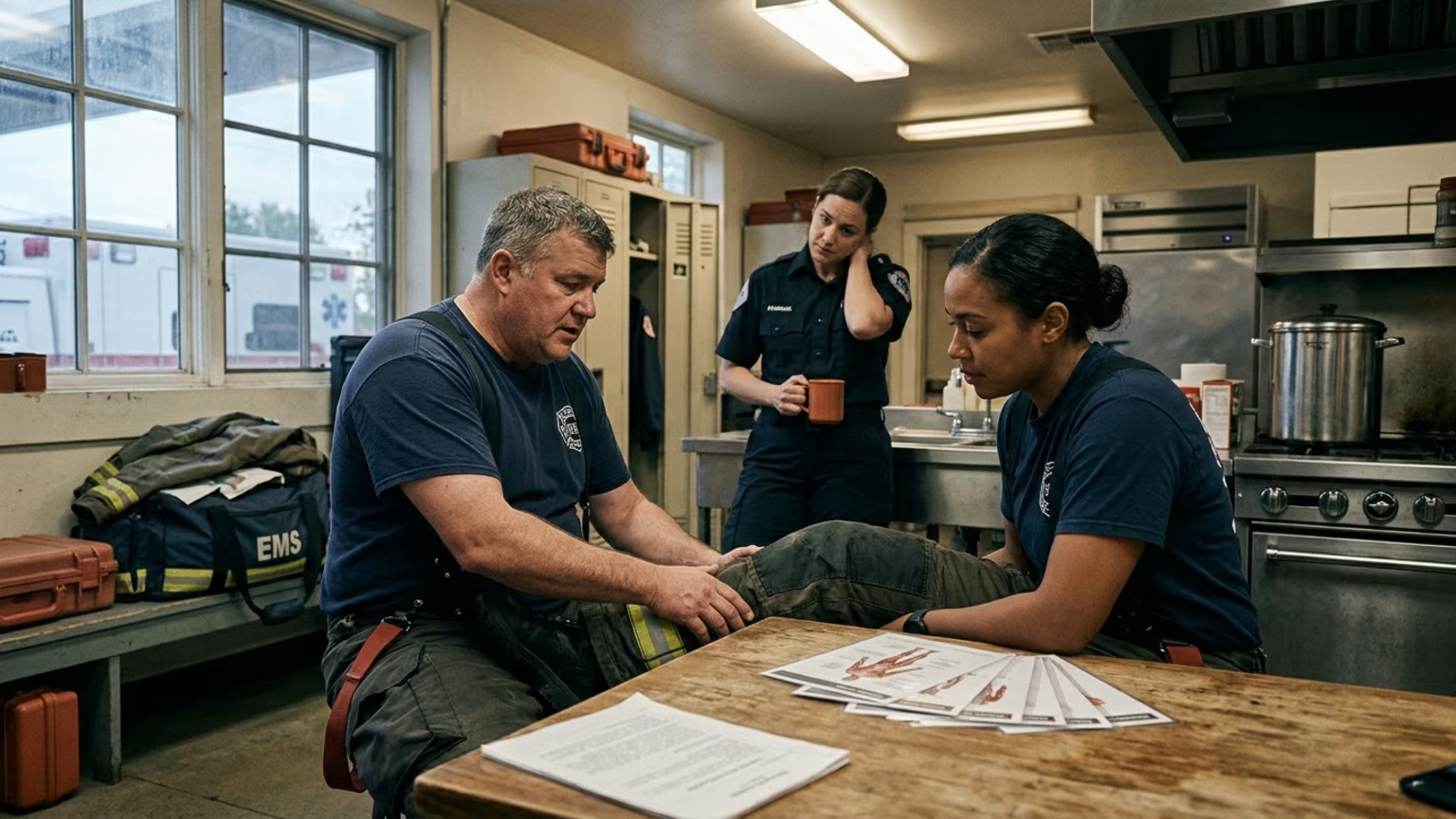

Learn to differentiate normal post-shift muscle soreness from physical injuries requiring clinical assessment to protect your occupational health and capability.





When is post-shift pain just normal soreness, and when does it require professional assessment? Discomfort is likely normal soreness if it is diffuse and allows you to move safely. Conversely, localized pain that worsens or includes neurological changes requires clinical evaluation.
First responders regularly perform tasks associated with work-related musculoskeletal disorders. These physically demanding tasks include manual patient lifting, carrying heavy loads, and awkward-position exertion. Prolonged sitting and vehicle-related vibration also contribute to the physical toll. A NIOSH resource identifies manual patient handling and lifting as causes of work-related musculoskeletal disorders among healthcare workers. The agency describes patient handling as the single greatest risk factor for musculoskeletal disorders in that workforce. First responders routinely face irregular shifts that interrupt their physical recovery windows. This disruption makes it harder for soft tissues to heal between demanding duty cycles.
Normal soreness represents the temporary tissue fatigue generated by these intense physical exposures. When you lift a heavy gear bag or move a patient, your muscles sustain microscopic damage that normally repairs itself over a few days. However, when physical loads exceed your structural tolerance or irritate nervous tissue, the body produces assessment-worthy pain. Recognizing the difference between normal recovery and structural damage is a critical skill for emergency personnel.
First-responder-specific clinical sources identify new or progressive neurological symptoms as reasons to seek prompt medical evaluation rather than self-manage indefinitely. These urgent warning signs include numbness or weakness radiating into an arm or leg, a foot that catches or drags, and new changes in bladder or bowel control. A firefighter- and shoulder-specific source also identifies a shoulder that suddenly gives out and cannot lift the arm as a critical warning sign. Worsening weakness, persistent arm numbness, and night pain that repeatedly wakes the person are symptoms that should be assessed by a physician before routine rehabilitation or manual treatment.
Different duty profiles create distinct physical loading patterns across the body over a long career. A patrol-officer case report emphasizes prolonged sitting, awkward static postures, and asymmetrical duty-belt loading as contributors to recurring one-sided low-back and hip symptoms. Long periods spent in a cruiser, ambulance, or fire apparatus can create gradual stiffness and asymmetrical spinal loading. Recognizing the mechanism of injury helps you map your specific physical exposure to your resulting physical symptoms.
A practical self-assessment focuses on your physical capacity rather than your numerical pain score. You should test whether you can walk normally, climb safely, and grip equipment. You must also confirm you can raise an arm, rotate your trunk, and enter a vehicle without compensation. Emergency nurses’ reported experience provides relevant occupational context for EMS and patient-care personnel facing high call volumes. In one study, pain was associated with repetitive patient handling, prolonged standing, and awkward posture. Workload pressure, shift demands, and limited recovery opportunities were also significant factors.
The same study described pain as affecting movement, posture, and comfort. Researchers noted that symptoms disrupted stamina and daily function rather than being merely a numerical sensation. If you cannot perform routine physical actions, the issue likely extends beyond basic muscle fatigue. You must evaluate what you can still do without deliberately provoking the pain or forcing a range of motion. Tracking your ability to perform daily tasks provides a more accurate picture of your musculoskeletal health than simply waiting for the pain to disappear entirely. This functional self-assessment provides a practical baseline for active emergency personnel. You can repeat these movement checks during your off days to track your physical recovery accurately.
Symptoms that produce a persistent limp, guarded movement, or altered lifting technique warrant professional review. Pushing through a shift with restricted mobility places additional stress on other healthy joints and increases your risk of a secondary injury. Personnel must recognize that functional limitations during basic movements often precede severe acute injuries on duty. Those dealing with established joint issues can consult Training Around Pain: An Evidence-Aware Guide for First Responders to maintain baseline capacity safely.
The available first-responder sources do not establish a precise universal time limit for normal soreness. Instead of watching the clock, you should carefully monitor the recovery trend over the days following a demanding shift. A mild ache that follows an unusually heavy carry or long drive is reassuring if it steadily improves over a normal rest period. Tracking this trajectory helps you separate standard post-shift fatigue from injuries that require clinical intervention.
Pain that does not show a clear improvement trend or requires progressively more restriction to complete normal duties requires occupational-health assessment. If symptoms escalate despite sleep and active recovery, you should arrange a clinical examination. A lack of progress over several days suggests that the tissues are struggling to repair the damage from the physical exposure. Ignoring stagnant or worsening symptoms often leads to longer mandatory recovery periods and extended time away from active duty.
Recurring pain patterns often provide more diagnostic information than the duration of a single flare. A recurring problem during stairs, ladders, or apparatus access is important even if each individual episode settles. Repetition can indicate an unresolved physical exposure, insufficient recovery, an equipment issue, or a structural condition requiring clinical evaluation. If the same physical activity repeatedly triggers progressively earlier or more severe symptoms, you should seek a professional medical opinion. Catching these patterns early allows you to modify your off-duty training and recovery protocols before a minor issue becomes a severe injury. You should discuss these recurring symptoms with your supervisor to identify if duty equipment or shift schedules are contributing to the pain.
Manual patient handling involves unpredictable loads, awkward postures, confined spaces, and extreme time pressure. NIOSH identifies overexertion and patient handling as major contributors to healthcare-worker musculoskeletal disorders. The agency recommends organizational prevention measures, accessible assistive devices, and safe-patient-handling programs rather than relying only on worker training. Agencies should provide friction-reducing sheets, transfer boards, powered stretchers, and mechanical lifting slings to protect their personnel.
Relying entirely on manual lifting mechanics is an insufficient strategy for occupational injury prevention. A systematic-review record covering patient-handling interventions found moderate evidence supporting exercise interventions and multicomponent patient-handling interventions. The same review found that patient-handling training alone did not demonstrate an effect on musculoskeletal health. Individual physical resilience should never be used to compensate for inadequate equipment, short staffing, or poor work design. True occupational safety requires systems that reduce the sheer physical load placed on the responder.
NIOSH has continued to publish first-responder and occupational-safety material, including firefighter safety products and materials-handling resources in 2026. These publications show continuing institutional attention to occupational exposures, equipment use, and injury prevention. Using accessible mechanical assistance protects your joints and spine from cumulative structural damage across a multi-decade career. Prioritizing equipment over manual exertion represents a necessary shift toward sustainable physical readiness. Agencies must maintain this assistive gear to ensure it is always available during critical emergency calls.
Enduring persistent pain without assessment can permanently compromise your physical capacity and force an early exit from emergency service. A study of emergency nurses found that pain was commonly normalized and endured silently to maintain professional responsibility and patient care. Staying on duty while limping or guarding a joint is evidence that you completed a task, but it is not evidence that the underlying problem is harmless. Treating pain as an unavoidable part of the job ultimately shortens careers and reduces quality of life. Medical retirement often follows years of ignored warning signs and accumulated structural wear.
Masking pain with analgesics while repeating the same lifting tasks accelerates joint wear and soft tissue damage. Responders managing these long-term occupational consequences can reference Chronic Pain After First Responder Service: A Practical Recovery and Activity Framework. Taking early action on joint stiffness and muscular pain helps preserve your structural health for life after service. A proactive approach to injury assessment keeps small mechanical issues from becoming permanent physical limitations. You must prioritize your biological recovery to maintain your operational effectiveness.
The cumulative burden of physical wear and psychological stress requires active management across your entire career. A 2026 NREMT announcement described the LIFE Study as long-term research involving firefighters and EMS clinicians who encounter job-related injuries and significant physical and psychological stress. Treating physical symptoms as critical information rather than a test of toughness protects your longevity and mobility for retirement. Acknowledging functional limits early gives you the best chance of rehabilitating a minor strain before it becomes a career-ending disability.
Monitoring your physical recovery allows you to adjust your physical training based on your daily occupational fatigue. Responders looking to align their off-duty workouts with their shift demands should review Autoregulation for First Responders: Adjusting Training to Readiness and Workload. Scaling your physical training variables based on daily fatigue requires continuous evaluation and a structured approach. Applying these principles helps you build long-term strength without compounding the physical strain of demanding emergency duties.
Mistaking progressive neurological warning signs for ordinary muscle fatigue leaves emergency personnel vulnerable to severe occupational injuries, but recognizing functional limits prevents this structural damage. Recovering from accumulated physical wear without losing duty readiness requires a careful approach to biological recovery, and Rescuris delivers the exact clinical translation needed to establish these habits. Explore Resources
Rescuris publishes evidence-aware guidance for firefighters, police officers, paramedics and other first responders on fitness, recovery, sleep, nutrition, stress resilience and long-term capability.






Read practical guidance on first responder fitness, recovery, sleep, nutrition and resilience for demanding work and a long, active career.
read the blog
