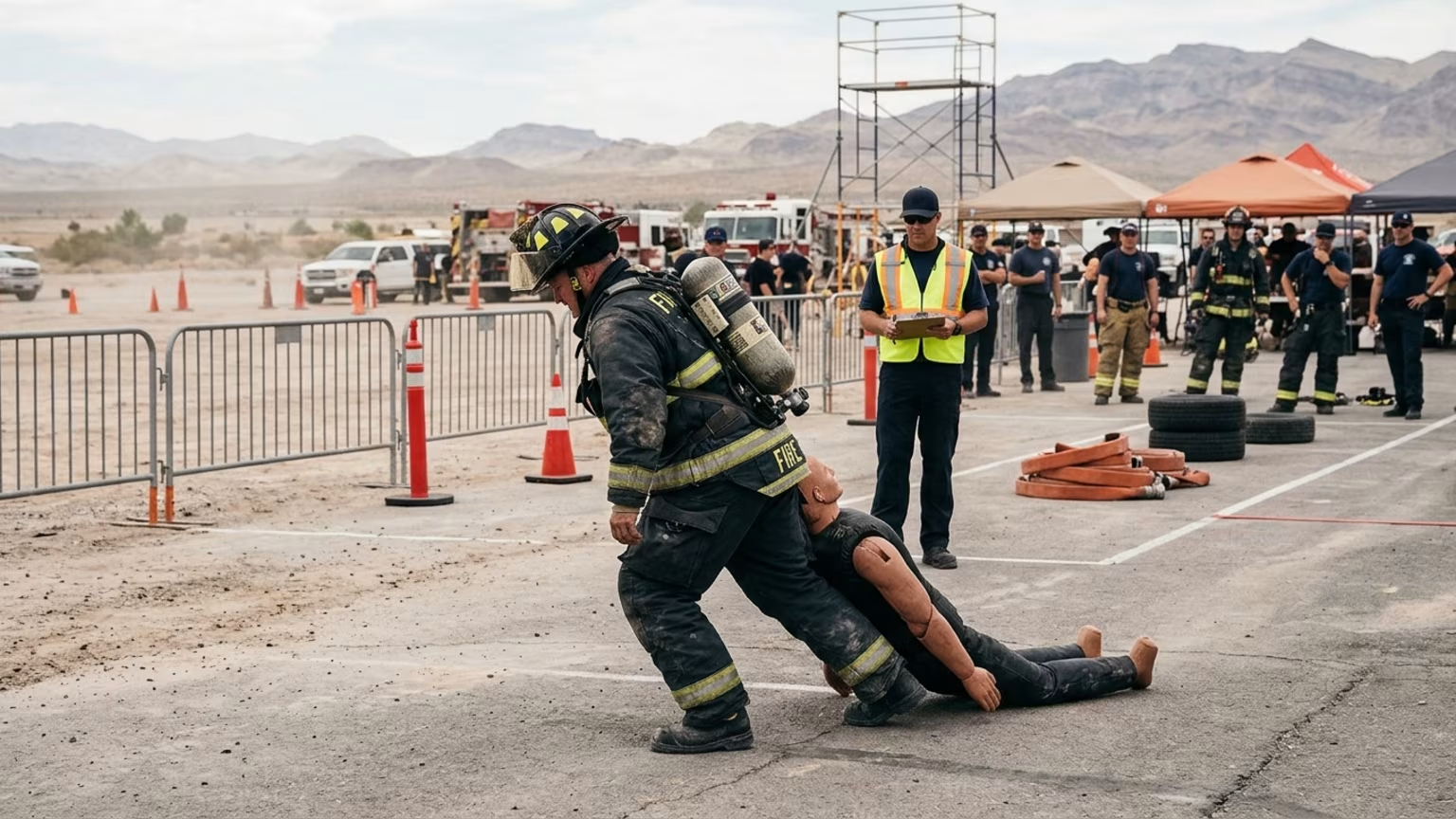

The Las Vegas firefighter championship combines demanding tasks in gear. Read the event facts and the limits of its value as a duty-fitness example.





On October 21, 2026, 8 News Now reported that the 2026 World Firefighter Challenge Championship was underway at the Plaza Hotel & Casino in downtown Las Vegas. The report and FOX5 Vegas coverage described 386 firefighters from 21 countries competing in firefighting gear and self-contained breathing apparatus (SCBA).
8 News Now described the championship as being in its 35th year. Eight Southern Nevada firefighters qualified, giving the international event a local connection. For first responders following the competition, the clearest fitness story is the variety of tasks performed under load and against the clock.
Both outlets described competitors wearing full firefighting gear and SCBA while completing an obstacle course. The reported tasks included:
Taken together, these elements show several different kinds of physical work in the same competitive setting. Climbing is not the same action as hoisting equipment. Chopping and hose dragging add further task variety, while the dummy rescue places moving a simulated casualty within the course.
8 News Now described the course as designed to simulate physical challenges firefighters face during emergencies. That is the reported purpose of the event, not a demonstrated clinical or occupational outcome.
According to 8 News Now, eight Southern Nevada firefighters qualified. They represented Las Vegas Fire & Rescue and Clark County Fire Department, along with North Las Vegas Fire Department and N.T.T.R. Fire. Las Vegas Fire & Rescue hosted the event in partnership with the Plaza Hotel & Casino.
The report identified the competition course as the LION Arena of the Brave. It also described individual, tandem and relay categories. Tandem teams consisted of two firefighters, while relay teams had three to five.
For anyone following the results, those formats matter. An individual entry and a relay entry are different competitive arrangements, so the category belongs alongside any discussion of a result.
The event was scheduled to run through October 24, 2026, in the Plaza parking lot. According to 8 News Now, individual finals were scheduled for October 23. Tandem and relay finals were scheduled for October 24.
The report described the event as free and open to the public. For spectators, the published schedule provides a way to follow the different formats without treating them as the same contest.
These are event reports rather than a validation study. They provide no measured physiological data or occupational benchmarks and do not link contest performance to incident safety or effectiveness. They also contain no findings on injury rates, recovery, sleep or training programs.
The coverage does not describe actual incident duration or heat exposure. It also does not establish how field task sequencing compares with the course or whether departments use it as a formal assessment. A contest result should therefore stay a contest result, not become a fitness-for-duty verdict.
The useful operational translation is descriptive: name the work before discussing the qualities it might require. The championship makes climbing, equipment handling and casualty movement visible in a single setting. That is a more focused starting point than calling the whole event simply a strength test or an endurance contest.
The clock is part of the event, but so are the tasks and equipment. Describing only speed would omit much of what spectators are watching. Describing only the load would omit the timed competitive setting. Keeping both in view gives readers a clearer account of the event without turning it into a universal standard.
For firefighters, this can support a conversation about physical capability connected to the work. The relevant question is which tasks matter to the role under discussion and how qualified personnel assess them. The event supplies concrete examples to talk about; it does not need to supply the answer for every department.
Police officers and EMS professionals can follow the same editorial distinction without treating a firefighting course as their own benchmark. The task description comes first. Any claim about relevance to another role would need its own support, rather than resting on the visibility or prestige of this championship.
A longer view of physical capability also belongs in the discussion. Rescuris treats duty fitness and recovery as connected parts of career longevity. In that framing, a public contest is something to understand in context rather than an obligation to reproduce throughout a working life.
The practical use of this coverage is a qualified conversation, not a copied workout. Readers interested in how the tasks relate to their own work can raise them with department fitness staff or occupational-health personnel. Questions involving an individual's health belong with a qualified clinician.
Useful discussion points include:
These questions keep the focus on purpose. A competitive course can be discussed as a competitive course without becoming a personal self-test. Readers do not need to recreate a loaded tower climb or a dummy rescue to understand what the reporting describes.
That distinction also leaves room for different priorities across a career. Balancing strength, endurance, mobility and body composition is broader than preparing for one event. The appropriate individual approach belongs in a discussion with qualified personnel who can consider the person's role and circumstances.
The central open question is what additional evidence would justify an occupational claim beyond the event description. If this kind of course were proposed for an assessment, the first issue would be the specific decision it was meant to inform. A test used to rank competitors and an assessment used to judge readiness have different purposes.
Another question concerns the relationship between the overall result and individual task capabilities. Does a course time provide useful information about a particular work demand? What would count as evidence that this information helps a department make a sound decision?
Health and training questions deserve their own inquiry. Which outcomes would need to be tracked to evaluate a preparation program rather than merely describe a competition? How would that inquiry account for the wider demands of a responder's working life?
Those are questions for evidence, not conclusions supplied by the Las Vegas coverage. For now, the championship gives readers a clear view of demanding tasks performed together in gear and breathing apparatus. Its value as an illustration is concrete; any broader claim needs to be assessed separately.
Using a competition to frame fitness priorities is a decision Rescuris puts in context through research-led duty-fitness coverage. For emergency-service professionals balancing strength, endurance, mobility and body composition, its editorial guidance keeps demanding schedules and long-term health in view without treating recovery as a secondary concern.
Rescuris publishes evidence-aware guidance for firefighters, police officers, paramedics and other first responders on fitness, recovery, sleep, nutrition, stress resilience and long-term capability.


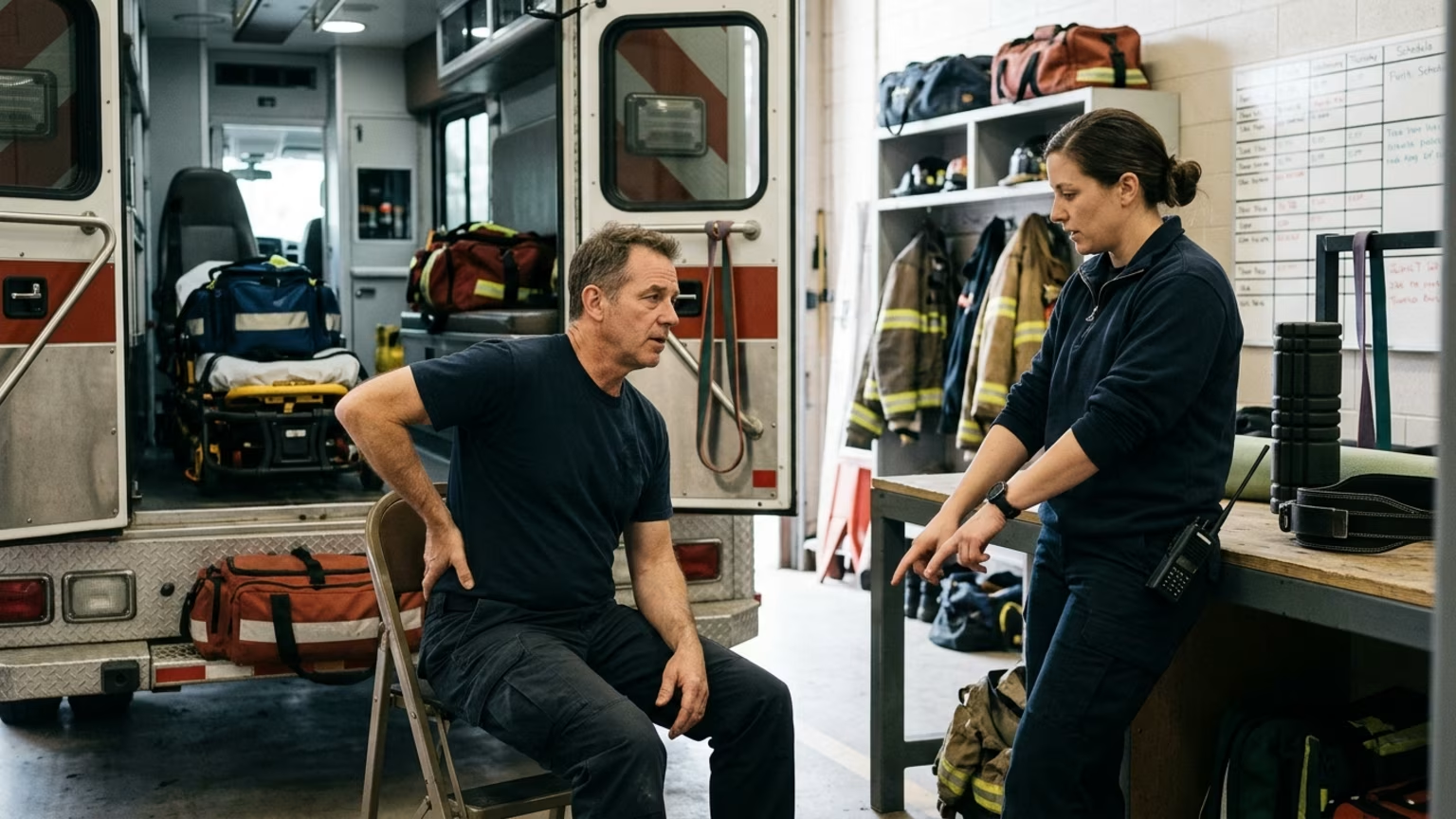



Read practical guidance on first responder fitness, recovery, sleep, nutrition and resilience for demanding work and a long, active career.
read the blog
