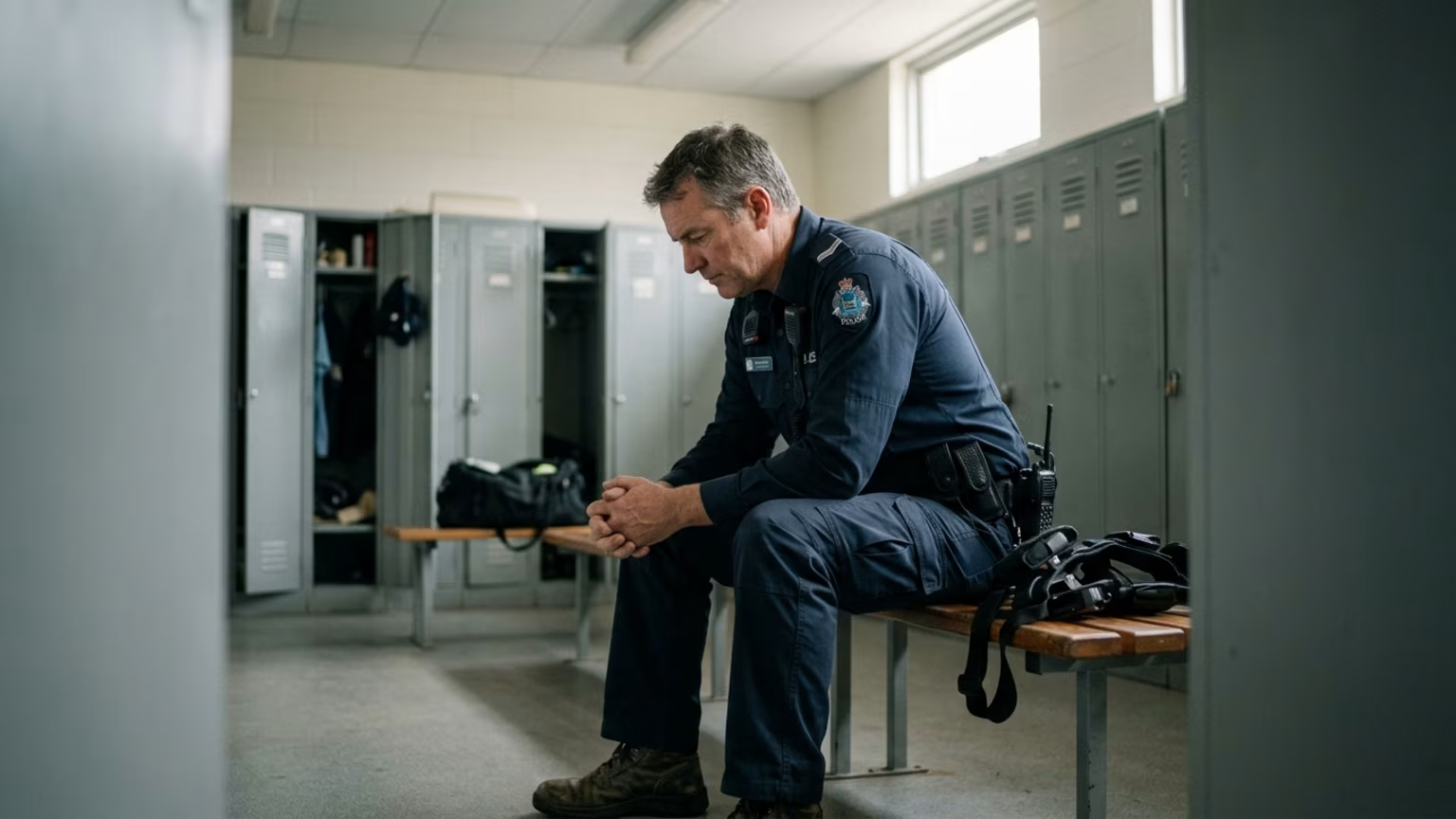

A 2026 study found 38.3% of surveyed Western Australia police officers screened positive for probable PTSD, highlighting the risk of cumulative career trauma.





If you are in immediate danger, call 911. For confidential crisis support, dial 988 (press 1 for the Veterans Crisis Line) or text 838255.
In September 2026, researchers from Edith Cowan University published the Blue Poppy Study in Australian Psychologist. The paper details how surveyed Western Australia police officers report high rates of cumulative trauma. The research team analyzed responses from 1,278 sworn officers to measure occupational stress and post-traumatic stress symptoms. This collaboration involved Edith Cowan University, Murdoch University, and the University of Western Australia.
The central finding of the study is that 38.3% of participating officers scored above the threshold for probable PTSD on a standard screening tool. Researchers used the 20-item PTSD Checklist for DSM-5 and set a cutoff score of 33. The paper notes that this sample represents about 18.5% of the Western Australia Police workforce. The researchers compared this 38.3% symptom rate with an Australian general-population 12-month PTSD estimate of 5.6%.
These results reflect self-reported symptom screening rather than confirmed clinical diagnoses across the entire department. Still, the broader psychological metrics show a highly stressed workforce. According to the study, 23.9% of participants met the threshold for severe psychological distress on the Kessler Psychological Distress Scale. Nearly half of the respondents fell into the low-wellbeing category under the study measures, while only 3.8% reached the high-wellbeing category.
This research marks the first published estimate of PTSD prevalence in the Western Australia Police Force. Lead author Dr Daniel Talbot noted that the findings illustrate how the cumulative impact of trauma can be substantial. The study firmly frames psychological injury as a workforce-wide challenge rather than an isolated problem affecting a few individuals. Such findings highlight the urgent need to overhaul how emergency departments support their personnel.
The data translates the abstract concept of career stress into a measurable accumulation of extreme events. Traumatic exposure was nearly universal among the surveyed officers. More than 90% reported seeing dead bodies during their careers. Almost 80% had seen abused children, and 80% reported seeing victims of serious traffic accidents.
This exposure frequently involves direct, proximal violence that compounds over decades. The survey found that 53.1% of officers had seen someone die in front of them. Furthermore, 50.7% had attended a homicide within the previous five years. Almost half of the respondents had been involved in an incident involving a lethal weapon, defined as a knife or gun.
Physical violence against personnel also continues to escalate. Phys.org reported that serious assaults in the region rose from 14,198 incidents in the 1999 to 2000 reporting period to 48,811 in the 2023 to 2024 reporting period. The study itself examined police assault and sick-leave data across a broad period extending from 1994 to 2024. These rising physical risks mirror the escalating psychological burdens placed on modern first responders.
The timeline of these trends reveals a slow but steady increase in baseline occupational hazards. The researchers examined data spanning three decades to understand how these physical risks have evolved. This historical context provides a clearer picture of the environment modern responders navigate daily. The continuous rise in severe assaults suggests that future personnel will face even greater cumulative threat loads.
Understanding these statistics requires a shift in how administrators view daily operational readiness. The sheer volume of critical incidents means that responders are constantly processing traumatic visual information. Officers rarely have sufficient downtime to fully recover their baseline nervous system function before the next shift. This continuous operational tempo heavily restricts the natural biological processes required for stress recovery.
Such compounding exposure fundamentally changes how departments must approach long-term mental health recovery in policing. The researchers found that adding trauma-exposure variables explained an additional 10% of the variance in symptom scores. Exactly 16.7% of participants had witnessed the shooting or stabbing of a fellow police officer. This reality requires departments to view mental performance across a demanding career as a cumulative operational requirement.
Older practices often treat psychological injury as the result of one exceptionally bad shift. The Blue Poppy Study challenges this framework by demonstrating how repeated exposure drives symptom severity over decades. For example, 15.6% of respondents reported seeing more than 100 dead bodies during their careers. Additionally, 4.6% reported witnessing more than 50 serious assaults, and 4.1% reported more than 100.
Many officers assume that surviving early career trauma means they are immune to future stress. The data suggests instead that the ongoing accumulation of trauma constantly tests a responder's baseline resilience. The study participants had an average of 19 years of service, and half had served for at least 20 years. This supports the growing consensus that psychological wear accumulates much like physical joint damage over a long career.
This long-term perspective fundamentally shifts how agencies should calculate psychological risk. Traditional injury models focus heavily on acute crisis response immediately following a highly publicized event. The survey data indicates that quieter, repetitive exposures are equally corrosive to mental wellbeing. Recognizing this slow accumulation allows departments to implement maintenance protocols rather than waiting for a breaking point.
The study also challenges the assumption that domestic mental health trends mirror international police data evenly. The paper cites a review of police officers across 24 countries that reported PTSD estimates ranging widely from 3.5% to 41.1%. It also notes a British police survey reporting a PTSD prevalence of 20.6%. These variations show how prevalence differs substantially according to population, recruitment methods, and measurement tools.
First responders and their agencies must adapt their daily operations based on this evidence. The study highlights colleague support as the strongest support-related predictor of lower symptom scores. Professor Peter Drummond noted that peer support appears to reduce the impact of trauma on personnel. Agencies must provide early access to help and resources that allow officers to process their experiences effectively.
Peer programs must become structured systems with strict confidentiality and clear clinical escalation paths. Informal conversations in the locker room are helpful but insufficient for severe symptom management. Support variables explained a further 3.9% of the variance in symptom scores within the statistical model. This data confirms that social support directly influences occupational longevity and psychological preservation.
Agencies must clearly distinguish between routine stress management and targeted clinical intervention. While wellness applications and stress management seminars provide basic tools, they cannot treat severe trauma. Professionals showing elevated scores require confidential pathways to properly credentialed trauma specialists. Providing these specialized resources early prevents minor psychological wear from evolving into severe distress.
Supervisors also require significantly better preparation to support their teams. The survey rated supervisors as the least supportive resource after traumatic events. Lower supervisor support was directly associated with higher symptom scores in the regression analysis. Leadership training must prioritize post-incident check-ins, recognizing early sleep disruption, and making timely clinical referrals.
Individual officers should treat psychological recovery as a necessary component of career maintenance. Maintaining physical capability is crucial, and officers should maintain a baseline work capacity conditioning plan. However, physical training cannot substitute for targeted trauma therapy. Officers should establish proactive screening habits long before symptoms force them out of their careers.
Since spouses were rated as the strongest source of support, families need proactive psychological education. Agencies should offer training on recognizing emotional numbing and understanding extreme occupational fatigue. Retired personnel should not assume their risk immediately ends upon leaving the service. The emphasis on cumulative exposure suggests that former responders with persistent sleep problems should seek qualified assessments.
Future studies should track whether structural changes in shift design and early intervention alter these symptom trajectories. The current study relies on a cross-sectional design, which establishes associations but cannot conclusively prove causation. It remains unclear whether low support caused higher symptom scores or if severe symptoms reduced help-seeking behavior. Longitudinal research is needed to observe how specific peer support models directly lower symptom severity over time.
Analysts must also account for the study's sampling limitations when interpreting future organizational data. Participation was voluntary and anonymous, with recruitment conducted through the local police union newsletter. Complete data was only available for 862 participants, leaving approximately 33% of the data missing. These factors highlight why the findings should serve as an operational baseline rather than an absolute diagnostic census.
The authors explicitly state that the high prevalence may reflect specific engagement factors. The lead researcher's background as a police veteran may have influenced participant trust and engagement levels. Officers who felt their trauma was previously ignored might have been highly motivated to participate. These variables highlight why organizations must avoid treating the survey as a definitive medical audit of every serving officer.
Measuring the effectiveness of new interventions will require standardized tracking across multiple jurisdictions. Individual departments currently use varying metrics to assess fatigue, sick leave, and early retirement. A unified approach to data collection would allow researchers to compare recovery protocols more accurately. Until these centralized tracking systems exist, local studies will remain the best available tool for guiding policy.
Future workforce studies must also balance demographic variables more evenly. The local police force's mean service length in 2023 was 12.8 years, with a median of 12 years. In contrast, half of the participating officers in this sample had 20 or more years of service. Tracking more representative datasets will eventually clarify how psychological injury affects early-career professionals compared to seasoned veterans.
Transitioning from severe occupational stress management to physiological recovery often leads professionals to question their baseline endocrine health. Understanding testosterone and hormone claims without assuming testing or treatment is right for everyone remains a significant challenge, and Rescuris translates complex medical evidence into practical frameworks for the field. Explore Resources
Rescuris publishes evidence-aware guidance for firefighters, police officers, paramedics and other first responders on fitness, recovery, sleep, nutrition, stress resilience and long-term capability.






Read practical guidance on first responder fitness, recovery, sleep, nutrition and resilience for demanding work and a long, active career.
read the blog
