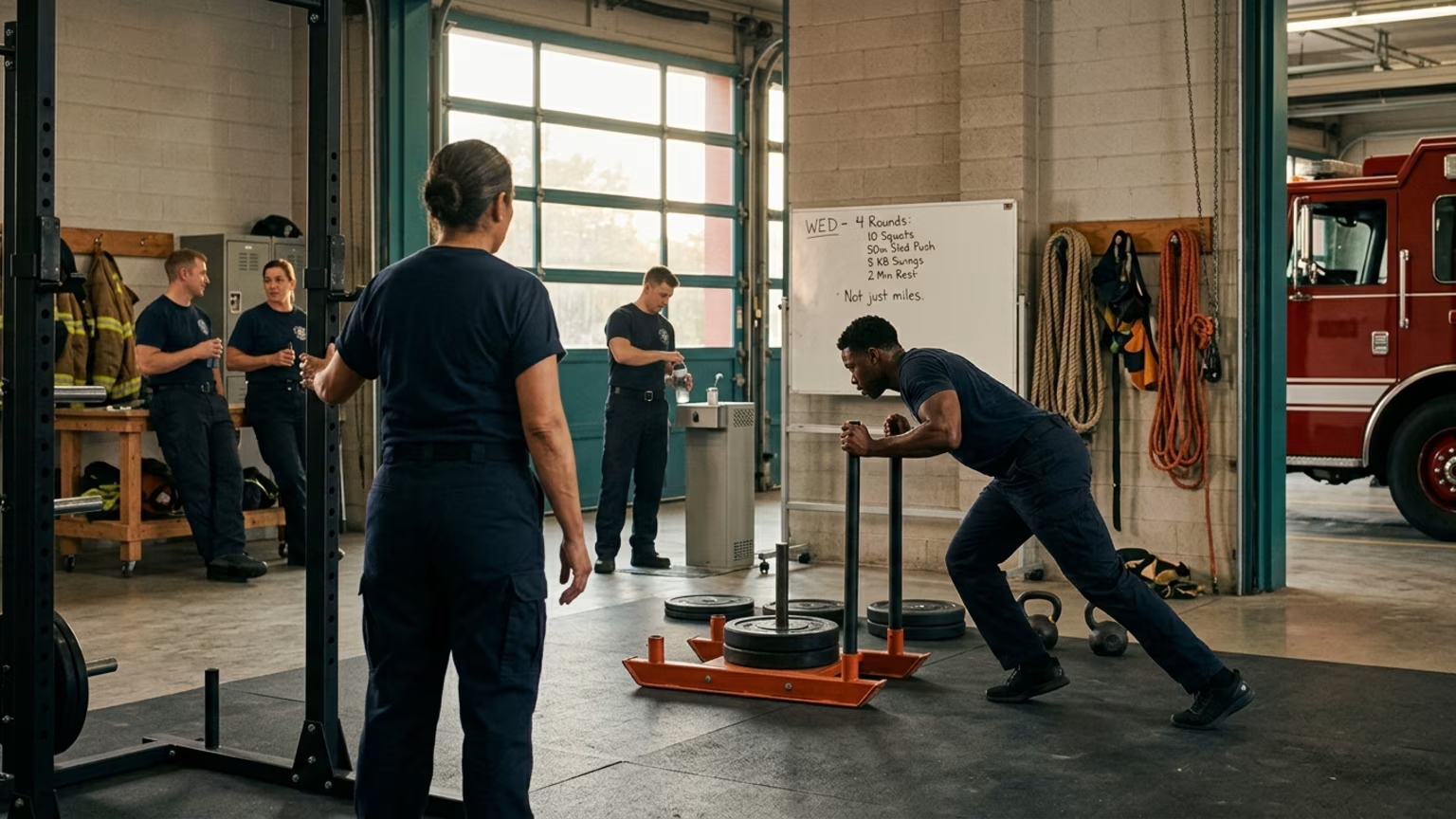

Balancing foundational aerobic work with task-specific conditioning is critical for emergency professionals. Learn how to structure shift-work fitness effectively.





Balancing steady aerobic conditioning with occupation-specific training dictates whether a first responder simply passes a fitness assessment or actually sustains performance during repeated physical tasks on duty.
Steady aerobic work functions as the low-to-moderate-intensity base of an effective duty-fitness plan. It gives the responder a straightforward way to accumulate cardiovascular volume. This approach avoids turning every single workout into a maximal physical event. Cardiorespiratory fitness remains a critical part of the physical demands of emergency services.
This steady method offers a low-complexity option to maintain physical habits during stressful shift periods. The main limitation of steady cardio is a distinct lack of occupational specificity. A run on a treadmill does not replicate the muscular demands of victim rescue or ladder work. General aerobic work builds the central engine but ignores the peripheral muscular endurance required for real duties.
A 2026 scoping review of field-based cardiorespiratory testing evaluated how departments track this foundational fitness. The review screened 140 records and included 14 studies to assess validity and operational relevance. The authors judged the 20-metre shuttle run to have the most favorable overall profile for department-wide monitoring. This test combines high validity with low equipment requirements and excellent indoor feasibility.
The 20-metre shuttle run allows departments to evaluate large groups of personnel simultaneously. It scales effectively for group testing because it requires minimal specialized equipment to administer. A large open bay or an indoor gym provides sufficient space for this evaluation. This simple feasibility makes it a highly attractive option for annual department-wide monitoring.
The review identified treadmill and stairmill tests as robust alternatives for individual assessment, with greater equipment and staffing demands. However, these specific individual tests demand more resources to execute properly. The review suggests semiannual assessment as a possible starting point, while advising local validation. Validating these tests locally is necessary before enforcing strict fitness standards across a department.
This steady method is most appropriate when a responder needs repeatable exposure to cardiovascular stress. Progression should happen by changing one distinct variable at a time. Increasing session duration or weekly frequency is generally safer than constantly pushing the pace. A responder can utilize a stationary bike for 45 minutes at a steady heart rate to promote active recovery.
Conditioning for emergency service requires much more than cardiovascular endurance alone. Firefighting and rescue operations place simultaneous demands on aerobic fitness, muscular strength and muscular endurance. Task-specific conditioning rehearses the specific movement patterns, loads and work-rest structures that match actual duties. This broad category includes high-intensity functional training, loaded carries, circuits and simulated task practice.
A 2026 systematic review identified five experimental studies examining structured training interventions and firefighter task performance. The review reports that these occupation-focused programs were associated with faster simulated fireground performance. Participants demonstrated improved proficiency in victim rescue, hose advancement and ladder operations. These dynamic methods challenge locomotion, bracing and load management at the exact same time.
The review included studies using high-intensity functional training, circuits, nonlinear periodization and complex training. Intervals alternate periods of harder work with periods of planned physical recovery. They are extremely useful when a responder needs to practice changing pace during an emergency. However, the available research summary does not establish that every single firefighter will respond identically to these methods.
Beginners should focus on increasing the quality and consistency of their work bouts first. They should prioritize proper form before adding more repetitions to an interval session. Alternatively, a responder can preserve the number of physical efforts and gradually reduce the recovery time. They should absolutely not increase the intensity, volume and density at the exact same time.
Loaded carries bridge the gap between conventional gym exercises and chaotic occupational tasks. They train the body to manage an external load while moving across unpredictable physical space. Circuits organize multiple physical movements into repeated stations. This format stresses muscular endurance and cardiovascular tolerance simultaneously in a highly time-efficient package.
Targeted occupational training prepares the responder for the physical realities of an emergency scene. However, the main weakness of complex occupational conditioning is the high physiological cost. A circuit might improve cardiovascular tolerance and technical familiarity simultaneously. This complexity makes it harder to isolate exactly which physical quality limits a responder during the workout.
The review authors call for more research comparing protocols and accounting for progression, baseline fitness and concurrent job demands. They note that previous research had focused more heavily on general physical fitness. Investigating the effect of training interventions on task-specific performance remains a critical need. Responders should view task-specific work as a targeted supplement rather than a complete replacement for baseline cardio.
The choice between steady aerobic work and task-specific conditioning depends heavily on recent operational stress. Irregular shift work completely complicates fixed Monday-through-Sunday workout templates. Training decisions must account for recent calls, sleep disruption and upcoming operational requirements. A responder who forces a maximal circuit after a busy night shift risks joint injury rather than forcing adaptation.
Steady aerobic work serves as the primary tool when sleep debt is particularly high. A moderate incline walk or stationary bike ride promotes blood flow safely. It does not demand intense central nervous system recovery from the participant. This makes steady state the best option immediately following extended tours or high call volumes.
High-intensity intervals and task-specific circuits belong on days when the responder is well recovered. These highly demanding sessions should not interfere with scheduled strength training or known heavy operational days. If a responder has a demanding operational-training day scheduled, that day may already provide task-specific exposure. Any additional physical training should support missing qualities rather than duplicate the exact same physical stress.
A practical approach involves identifying the single highest-cost session of the week first. If a responder faces a highly demanding live-fire training exercise, that day provides massive task-specific exposure. The remaining weekly training blocks should then support the missing physical qualities. This strategy prevents a responder from duplicating the same physiological stress multiple times per week.
Applying a structured decision framework helps responders assign a clear primary purpose to each training day. A dedicated base day focuses on steady aerobic work at an intensity that permits controlled breathing. A designated task day involves technical occupational practice with enough recovery to maintain movement quality. A flexible recovery option utilizes easy aerobic work or complete rest depending on actual shift demands.
If sleep quality was exceptionally poor, even a scheduled base day might need to convert into complete rest. Pushing through severe sleep deprivation simply compromises the immune system and delays full physiological recovery. Adjusting the plan based on actual physical readiness is a professional requirement.
The most frequent error in duty fitness is treating every single conditioning session as a competitive event. When fatigue causes movement quality to deteriorate rapidly, the session simply tests exhaustion. Task-specific conditioning should never completely replace the aerobic base or necessary tissue tolerance. A responder who only rehearses a narrow task may fail to develop foundational cardiovascular health safely.
Another common pitfall is changing too many training variables at the exact same time. Responders often try to increase load, volume and training density simultaneously during a circuit. Progression should involve modifying only one of these specific factors at a time. If a loaded carry becomes a pure lower-back endurance test, it stops providing a useful whole-body stimulus.
If a responder tries to maximize speed, weight and duration simultaneously, the risk of acute injury spikes dramatically. Modifying a single variable ensures the body has time to adapt structurally. This disciplined approach prevents the severe connective tissue injuries that frequently derail emergency service careers.
Performance monitoring also introduces potential traps when test results are completely misunderstood by leadership. The 2026 scoping review cautions that submaximal tests have greater error, and that borderline results may require confirmation. The review explicitly warns that field-test estimates may misclassify individuals near fitness cut-points. A single borderline result requires confirmation and should be interpreted alongside recent workload and testing conditions.
Another frequent error is allowing technical precision to degrade completely during high-intensity circuits. When fatigue causes movement quality to deteriorate, the session simply tests pure exhaustion. The priority should always be preserving task quality under fatigue, not creating fatigue for its own sake. A training session that reinforces poor mechanical habits under load actively endangers the responder on duty.
Overlapping high-impact work on consecutive days is a surefire way to accumulate dangerous fatigue. Hard intervals, heavy carries and demanding task simulations place massive systemic demands on the body. Placing several of these intense sessions back-to-back prevents the body from recovering fully. Responders must intelligently separate high-neural work to balance demanding physical workouts with accumulated duty fatigue.
General aerobic health and occupational task mastery represent two completely different physical capabilities. Relying only on a treadmill routine might guarantee success on an annual cardiovascular assessment. However, passing a standard fitness test does not mean a responder can drag a heavy victim safely. A truly capable professional needs the baseline physiological engine and the structural conditioning to apply that power.
The available evidence supports a highly balanced and practical position for emergency personnel. Structured occupation-specific programs are clearly associated with improved simulated fireground, rescue and ladder performance. Meanwhile, standardized monitoring tools like the 20-metre shuttle run track the underlying aerobic capacity safely. Department decisions should rely on validated local procedures and confirm borderline fitness results appropriately.
Ultimately, the primary goal is building a body that can handle unpredictable operational tempos. Balancing steady aerobic conditioning with specific occupational training determines whether a responder actually sustains performance during repeated physical tasks. True work capacity means maintaining movement quality under severe fatigue without sacrificing long-term physical health. Careful fatigue management separates a sustainable career from early physical burnout.
Shift supervisors and wellness coordinators often struggle to balance intense occupational conditioning with the need to protect crew longevity, but that tension disappears when Rescuris builds the framework. Planning for physical capability and an active life after retirement or leaving service requires a careful approach to accumulated physical wear, and we help emergency professionals establish realistic training habits that preserve long-term health. Explore Resources
Rescuris publishes evidence-aware guidance for firefighters, police officers, paramedics and other first responders on fitness, recovery, sleep, nutrition, stress resilience and long-term capability.






Read practical guidance on first responder fitness, recovery, sleep, nutrition and resilience for demanding work and a long, active career.
read the blog
