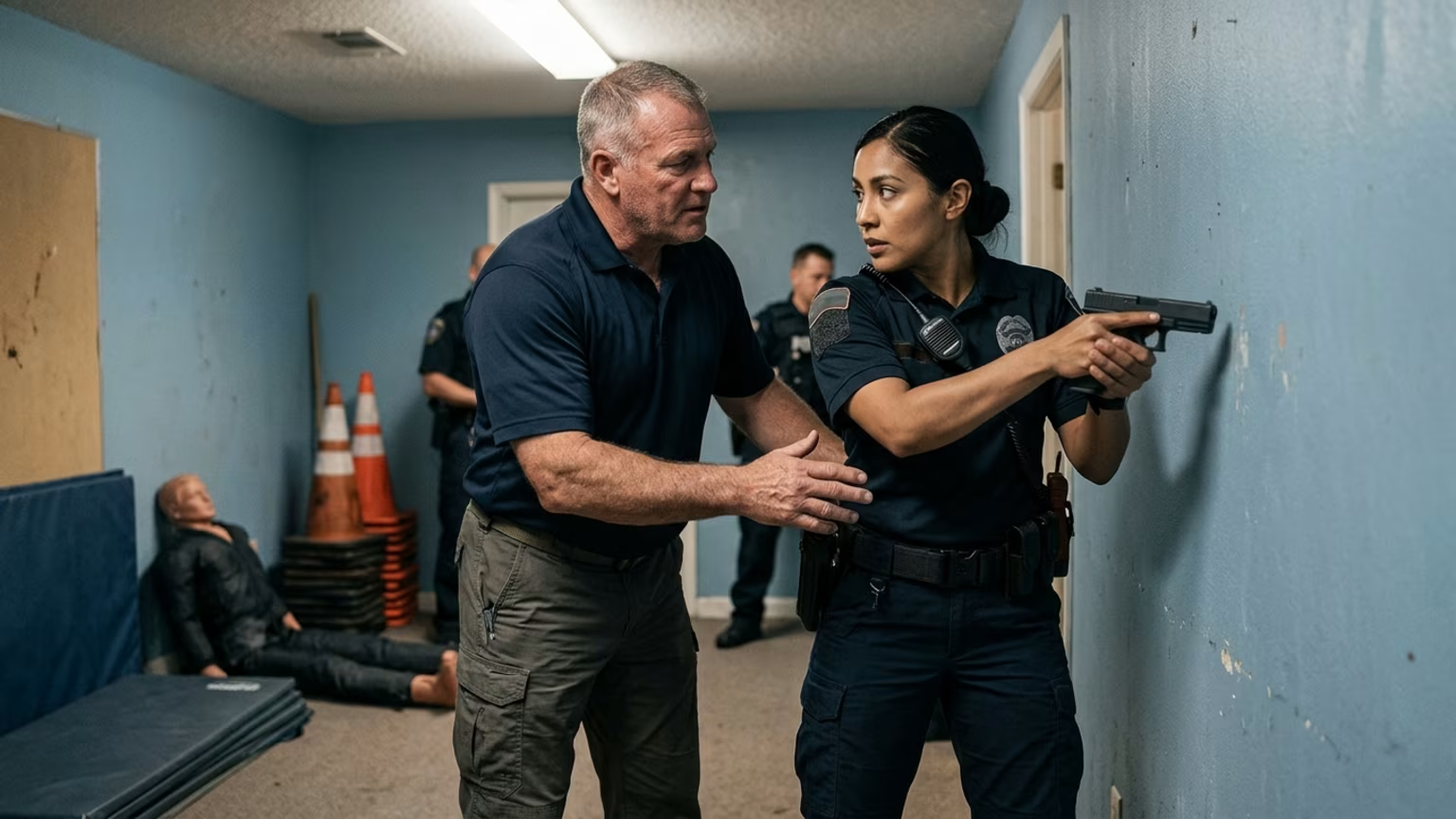

A recent Police1 analysis reveals why high-volume repetitions fail to build durable operational skills and how first responders can train effectively.





On September 16, 2026, Police1 released a Policing Matters podcast episode evaluating whether high-volume repetitions or deliberately varied practice sessions are more effective for building durable operational skills. The broadcast featured Las Cruces Police Chief Jeremy Story and Mike McCaslin of Training for Engagement. Their discussion focused on how law enforcement agencies can optimize limited practice time without sacrificing real-world retention.
The central takeaway from the Police1 broadcast is that repeating a physical movement does not automatically translate into lasting skill retention. Additional equipment and scheduled repetitions certainly create more practice opportunities for emergency personnel. However, the discussion stresses that these repetitions must be technically correct and intimately connected to the decisions officers make on duty. According to Police1, performing well at the exact end of a highly familiar drill often demonstrates nothing more than temporary task familiarity.
It does not guarantee that an officer will retrieve that specific skill successfully when physical movement, urgent communication or time pressure are added. To address this operational gap, Police1 recommends a structured retention framework that moves beyond simple repetition tracking. Effective training must prepare personnel to recognize precisely when a specific physical skill is needed in a chaotic environment. They must then be able to retrieve that skill reliably after significant time has passed since their last training session.
Finally, personnel must adapt the learned movement safely when street circumstances differ drastically from the original practice conditions. This approach shifts the focus from sheer volume toward the quality and adaptability of the practice itself. A related training analysis from Officer.com reinforces this shift away from undifferentiated volume. It identifies spacing, variability, retrieval practice, contextual interference and realistic conditions as crucial design considerations.
Spacing and variability prevent the brain from relying on short-term memory during practice. Contextual interference forces the learner to solve problems continuously rather than executing a pre-planned script blindly. Together, these elements help physical skills become deeply ingrained and accessible during high-consequence encounters. Current training discussions increasingly distinguish basic qualification from broader operational competence.
Police1 identifies weapon handling, one-handed shooting, patrol-rifle manipulation and decision-making as complex abilities requiring consistent practice. However, this practice must be realistic and varied rather than treated as a simple exercise in accumulating numbers. The consensus is that repetitions matter, but their design dictates their actual value in the field.
First responders manage demanding schedules that routinely interrupt consistent physical preparation and skill development. For those navigating irregular shifts, the Police1 guidance validates the use of short, focused training windows rather than exhausting sessions. Brief technical work and frequent refreshers can maintain perishable operational skills highly efficiently. This approach aligns closely with the principles of short readiness sessions for emergency crews managing chronic fatigue.
Rather than accumulating massive volumes of repetitions while physically exhausted, responders can treat the precise quality of each movement as a primary training variable. A shift-fatigued officer or paramedic should focus on technical accuracy first. They should stop the drill immediately if form breaks down. Once the baseline technique is sound, they can add controlled physiological stressors like elevated heart rates or multiple changing targets.
This methodical strategy helps maintain vital capabilities without pushing the body into dangerous, fatigue-driven sloppiness. By designing adaptable fitness systems, personnel can integrate occupational decision-making demands safely. A practical application of this concept involves selecting fundamental actions and setting measurable performance criteria. Instructors can design drills that incorporate contextual interference and varied environmental conditions directly into the practice block.
Examples of these realistic conditions include adding lateral movement, working alongside multiple officers or navigating low-light environments safely. By combining these variables, training coordinators create an operational test that evaluates readiness far better than a static drill. This structured variability forces the brain to process physical tasks actively, building true resilience rather than temporary muscle memory. It also keeps preparation closely tied to the actual demands of emergency response work.
For shift workers, these brief sessions can function as highly focused maintenance blocks inserted between demanding calls. However, they must be followed by periodic variation and delayed retention checks rather than relying solely on same-day validation. Training to absolute exhaustion often builds poor muscle memory, whereas stopping a few reps short preserves technique. The goal is purposeful practice combined with active coaching to keep priority skills sharp.
Many traditional training models assume inherently that a fast, clean final repetition equates to permanent learning. The Police1 and Officer.com discussions challenge this widespread assumption directly and forcefully. They note that strong performance at the close of a defensive-tactics session is frequently a misleading indicator of readiness. An officer might run a static, rehearsed drill perfectly after ten consecutive attempts on a well-lit range.
Yet, they may struggle severely to apply that same technique during dynamic scene decision-making on a live call. Technical proficiency in a highly controlled setting should never be confused with sound tactical judgment in an unpredictable encounter. The older practice of forcing every participant to meet one arbitrary time standard is also facing significant scrutiny. A universal time target can obscure individual weaknesses and strengths, masking underlying mechanical flaws that surface under pressure.
Instead, tracking individual improvement over time provides a much more accurate picture of a responder's actual operational capability. Repetition still retains a legitimate role in foundational motor-skill development and movement memorization. Safe weapon handling requires repeated physical practice before an officer can perform it subconsciously and efficiently. However, accumulating quantity without providing corrective feedback, adding environmental variation or conducting delayed testing is no longer ideal.
A realistic scenario can expose communication problems that a static drill simply cannot reveal. The retention framework introduces a critical test for training instructors. A skill must be assessed long after the initial instruction ends. If an officer cannot recognize the need for a skill or execute it safely a week later, the initial session failed.
A shot time, hit zone or specific qualification score can provide useful performance data for administrative tracking. However, these administrative measures should never be treated as complete, definitive evidence of operational competence. When agencies rely strictly on a singular end-of-day result, they fail to evaluate whether officers can recognize threats and adapt safely. Therefore, shifting the evaluation framework toward retrieval and safe adaptation builds a more resilient workforce over time.
This creates a highly useful distinction between controlled practice performance and genuine operational readiness. Ultimately, a faster final repetition only shows temporary task familiarity rather than true transfer to field execution.
Emergency-service professionals can apply these practical findings directly to their daily shift preparations and physical routines. The most immediate adjustment is to prioritize the strict quality of movement over an arbitrary repetition count. Personnel should adopt a deliberate approach when planning their physical maintenance blocks.
To make short training sessions effective, responders must prioritize technical feedback over mindless volume. Stop the drill immediately if a technique begins to break down due to physical fatigue. Correct the specific error, seek clear feedback, and repeat the task with the necessary correction firmly in place. Once a baseline technical movement is solid, introduce controlled variability safely.
Adding realistic elements like lateral movement or verbal communication demands challenges the brain to process chaotic information. This layered complexity prevents the dangerous false confidence that often comes from repeating the exact same static drill indefinitely. Responders should also use a simple, structured progression before starting any practice block or warm-up routine. Identify the specific action, define the environmental conditions clearly, and establish a measurable standard before the first repetition begins.
This straightforward framework keeps short training blocks highly focused. It prevents the session from devolving into purely physical labor that degrades technical proficiency. By tracking improvement against a responder’s prior performance, agencies can preserve strict safety standards while acknowledging individual capability levels. Finally, personnel must deliberately build follow-up assessments into their ongoing training plans.
A physical skill practiced successfully on a Monday should be tested again several days later under slightly different occupational conditions. If the technique cannot be retrieved quickly after time has passed, it requires additional focused technical work. Retired responders and those training strictly off duty can also apply this scaled, deliberate approach effectively. Prioritizing movement quality and realistic scenarios always serves long-term capability better than maximal volume or complete exhaustion.
The law enforcement and emergency response sectors are actively shifting toward highly blended training models that respect shift schedules. Future discussions will likely focus heavily on how agencies define practical physical tasks for completely uncontrolled street environments. As departments prioritize advanced physical skills during strictly constrained training windows, the operational balance between technical repetition and varied scenarios will remain critical. Observers should carefully track how future training programs incorporate delayed retention checks and variable practice elements moving forward.
Assessing whether fatigued personnel can adapt essential skills days after a session will provide highly valuable data on workforce readiness. Agencies may increasingly demand measurable standards tied directly to tactical accountability rather than relying solely on traditional qualification scores. As the professional conversation evolves, the distinct focus on deliberate quality, constant feedback and safe adaptability will continue shaping preparation methods.
Tracking skill decay rates will also become a more prominent feature of emergency-service training research in the coming years. As departments analyze how quickly unused skills degrade, they can schedule highly targeted maintenance blocks more effectively. This targeted approach prevents personnel from wasting valuable recovery time on redundant drills that do not improve actual field performance. Ultimately, measuring decay helps instructors determine exactly when a specific physical skill requires a mandatory refresher session.
Academy instructors and wellness coordinators frequently struggle to balance limited drill time with long-term skill retention, but that operational friction decreases when Rescuris designs the training framework. Planning for physical capability and an active life after retirement or leaving service requires structured technical maintenance, and we help departments implement deliberate practice models that preserve occupational readiness without compounding shift exhaustion. Explore Resources
Rescuris publishes evidence-aware guidance for firefighters, police officers, paramedics and other first responders on fitness, recovery, sleep, nutrition, stress resilience and long-term capability.






Read practical guidance on first responder fitness, recovery, sleep, nutrition and resilience for demanding work and a long, active career.
read the blog
