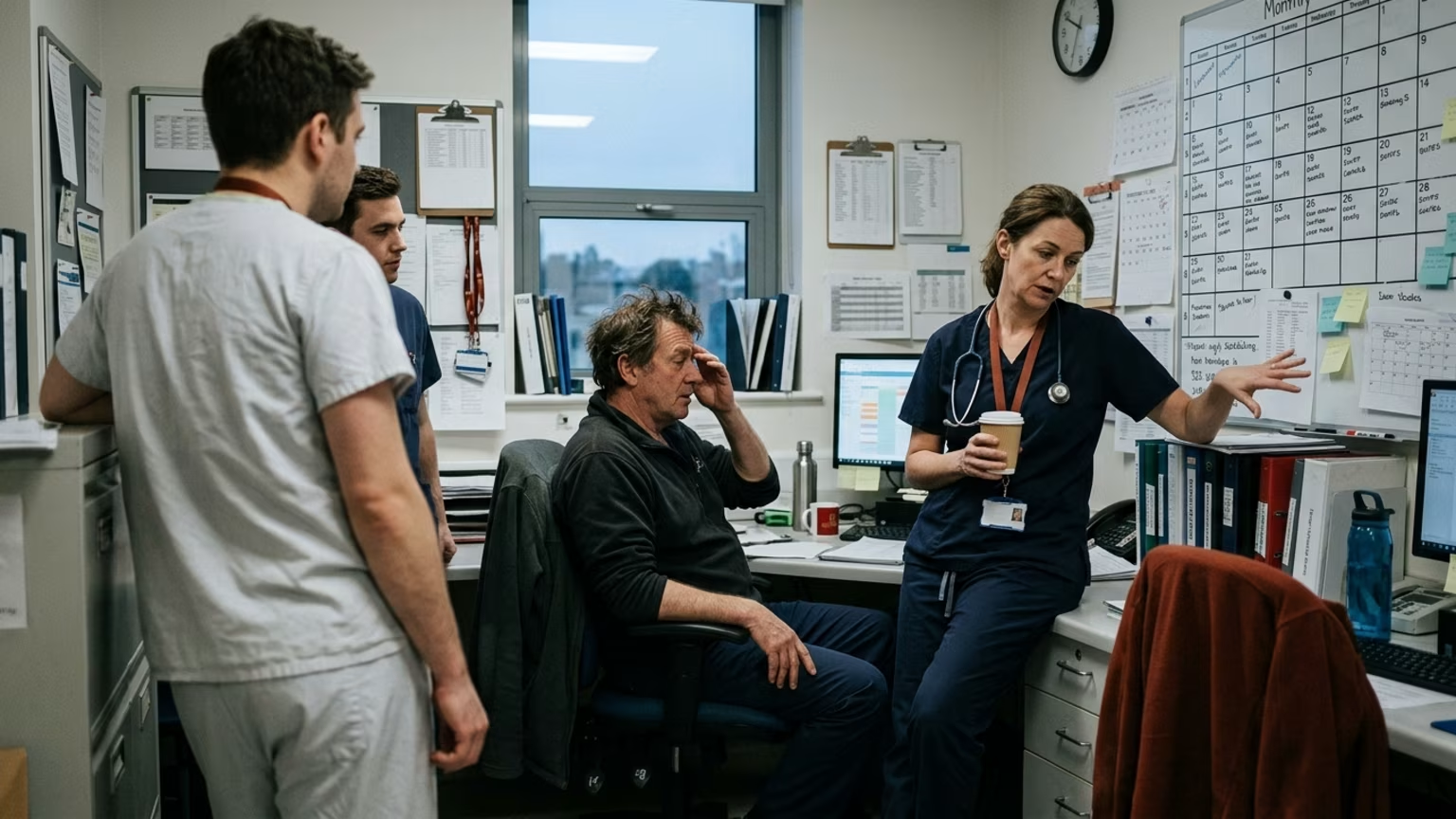

An ACEP analysis frames rotational shift work as a structural workforce issue, highlighting how schedule design impacts emergency service career longevity.





On September 14, 2026, the American College of Emergency Physicians published an analysis presenting rotational shift work as a structural workforce issue rather than merely an individual resilience problem.
The ACEP Wellness Section published its findings after conducting a multicenter mixed-methods study. This analysis combined quantitative survey data with qualitative interviews involving 23 board-certified emergency physicians. The results highlighted a division in how rotational schedules affect daily functioning and career longevity. In the ACEP article’s survey, 61 percent of participating physicians reported little or no negative effect of shift work on work-life balance. Meanwhile, 39 percent reported moderate to severe life disruption.
The qualitative portion of the analysis identified specific factors that dictate how shift work influences medical professionals. The study identified flexibility, autonomy, equity and shift variability as recurring themes. Life transitions, moral injury and organizational challenges also emerged as major factors affecting long-term well-being. ACEP author Lara Vanyo, MD, argued that the central question is not simply whether shift work is unavoidable. She noted that the design of schedules fundamentally changes clinicians’ daily lives and their long-term ability to remain in the profession.
The article framed moral injury in concrete operational terms rather than abstract concepts. It described the psychological burden that develops when rigid clinical obligations repeatedly cause physicians to miss important family events. The central recommendation involves a move toward adaptive scheduling systems that give clinicians more autonomy and perceived equity. This system-level approach is intended to replace the historical reliance on individual coping strategies. The findings represent an ACEP Wellness Section analysis and do not provide the full survey instrument or complete statistical methods.
These findings validate a fundamental change in how emergency-service organizations manage fatigue. Schedule construction, shift transitions, workload distribution and handoffs directly influence whether clinicians can sustain performance. Rigid scheduling and inconsistent paid-time-off policies act as organizational contributors to reduced longevity. Uncompensated sign-out time and off-site charting further compound this daily operational strain. ACEP’s analysis also associates rapidly alternating day and night work with clinical fatigue, anxiety and poorer sleep quality.
A separate University of Missouri study tested a tangible schedule modification for emergency physicians rotating between shifts. The researchers compared a conventional 10 p.m. to 6 a.m. night schedule with an earlier 8 p.m. to 4 a.m. schedule. This study was published in The American Journal of Emergency Medicine under the title “Casino schedules reduce inflammatory biomarkers and improve sleep in emergency medicine physicians during shift work.” The researchers reported that the earlier schedule was associated with improved sleep quality.
Participants in the Missouri study described their sleep as more restorative after the transition to an earlier schedule. The researchers also reported changes in inflammatory biomarkers among the physicians. This offers a concrete scheduling hypothesis that moving the end of overnight work earlier helps preserve sleep during biologically favorable hours. The available public summary does not establish the full sample size or prove that casino scheduling is optimal for every department.
The ACEP article explicitly rejects the idea that individual resilience alone can solve exhaustion. Chaotic schedules, limited control and inadequate institutional support cannot be fixed by better personal habits alone. This challenges the older assumption that shift-work problems are solely personal sleep-hygiene failures. Shift scheduling cannot be separated from workload or organizational design. A theoretically circadian-compatible schedule may still be unsafe if staffing is inadequate or breaks are routinely missed.
Historically, sleep disruption was viewed mostly as a private lifestyle concern for emergency personnel. An Austin public-safety audit demonstrated that sleep disruption is actually a broad workforce issue with serious mental-health implications. The audit reported that disrupted sleep had a high or significant impact on mental health for 73 percent of firefighter respondents. It also affected 58 percent of police respondents and 73 percent of EMS respondents. Because these figures come from a local audit, they should not be used as national benchmarks.
The ACEP analysis suggests that scheduling autonomy has practical value far beyond simple morale improvements. The ability to request shifts, protect vacation time and adapt schedules to health needs forms the core of a sustainable work system. Framing sleep disruption as a systemic performance issue makes it easier for departments to address fatigue without stigmatizing clinicians. Organizations are now examining fairness and recovery infrastructure to sustain their workforce over a full career. Readers looking for structured routines can review how to build a sustainable routine after shift work and emergency service.
Departments and individuals must make actionable adjustments to adapt to the realities of rotational shifts. The most immediate step involves treating the schedule as an active component of the safety system. Evaluators should look beyond total hours to identify rapid day and night reversals, short turnarounds and repeated overtime. Tracking recovery is just as important as tracking physical attendance on duty. Departments should monitor sleep opportunity, missed breaks, post-shift driving risks and general irritability.
Testing schedule changes locally can provide valuable operational data for emergency services. A department could pilot an earlier night-shift endpoint, much like the Missouri study tested casino schedules. Organizations should define outcomes in advance rather than assuming a change works automatically based on biological theory. Metrics to track include sleep opportunity, fatigue ratings and errors. Departments should also monitor sick leave, overtime and retention.
Protecting handoff and documentation time is necessary for preserving brief recovery windows between shifts. Unpaid charting and uncompensated sign-out overlap can extend the workday directly into personal family time. These operational tasks must be included in overall staffing and workload calculations. Making recovery operationally real requires more than just drafting written wellness policies. A quiet rest area or protected meal period should be designed around actual call volume.
Organizations must also plan around life transitions to maintain a reliable and sustainable workforce. Pregnancy, childcare, aging-related responsibilities and family emergencies are not mere exceptions to standard workforce planning. The ACEP analysis identifies adaptability during these transitions as a necessary part of sustainable scheduling. Personnel should seek help when fatigue becomes persistent, especially if they experience recurrent near-miss events or severe mood changes. Proper planning is essential, just as combining baseline physical strength with job-specific drills for emergency responders sustains active physical capability. Developing routines where time-restricted eating windows help first responders counter shift work metabolic strain provides another practical layer of defense.
The emergency sector still requires comprehensive longitudinal evidence connecting occupational stress and health outcomes over time. Current operational frameworks rely heavily on localized analyses like the ACEP survey and specific schedule tests. Future developments will likely focus on how schedule autonomy and recovery protocols affect measurable career longevity. Organizations will need to assess whether targeted adjustments, such as earlier shift endings, produce sustained improvements. The Missouri schedule modification provides an early template for actionable fatigue research.
Departments should track how these biological and structural findings translate directly to field environments. As the evidence base grows, emergency-service professionals will gain better tools to protect their health while managing demanding duty. Readers tracking this topic can review how an ABC broadcast evaluates sleep risks and fatigue strategies for shift workers.
Preserving restorative sleep and limiting inflammatory stress across a long career directly supports active duty readiness. When facing the operational reality of understanding testosterone and hormone claims without assuming testing or treatment is right for everyone, Rescuris converts complex occupational research into practical daily guidance. We help first responders navigate shift fatigue while building sustainable health routines. Explore Resources
Rescuris publishes evidence-aware guidance for firefighters, police officers, paramedics and other first responders on fitness, recovery, sleep, nutrition, stress resilience and long-term capability.






Read practical guidance on first responder fitness, recovery, sleep, nutrition and resilience for demanding work and a long, active career.
read the blog
