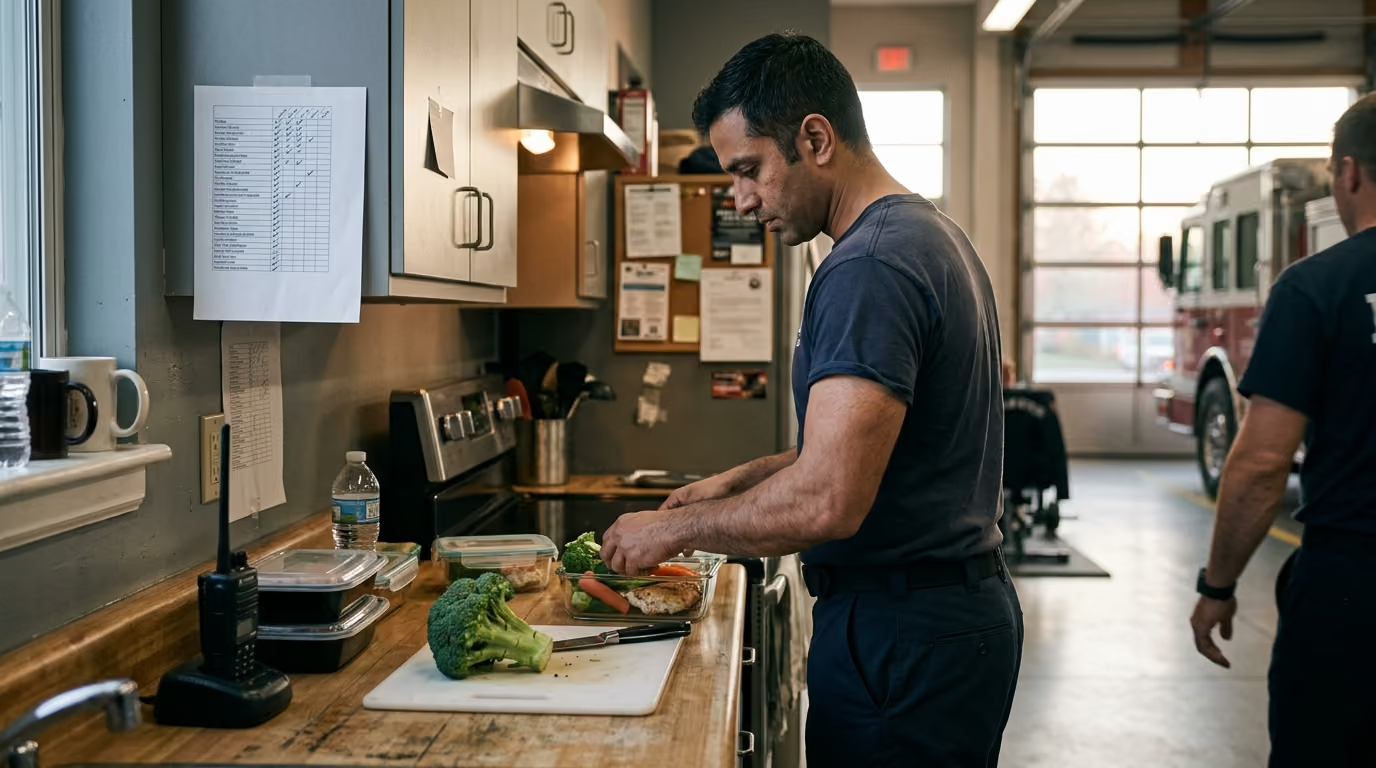

A stable circadian rhythm and structured daily routine help former emergency responders recover from chronic sleep debt and transition smoothly into civilian life.





If you are in immediate danger, call 911. For 24/7 support, call or text 988 and press 1 for the Veterans Crisis Line, or text 838255.
If you have searched for how to fix your sleep, structure your days, or rebuild your health after leaving emergency service or rotating shift work, you already know standard productivity advice falls short. Generic time management books assume a predictable baseline that years of shift work dismantled.
The direct answer is that a sustainable post-service routine must be built as a recovery system rather than a rigid productivity schedule. You cannot immediately force a standard eight-hour daytime routine onto a nervous system trained for irregular waking, autonomic arousal, and high-stakes calls. Sustainable regularity comes from establishing reliable daily anchor points, protecting a long sleep opportunity, pacing physical training, and rebuilding social rhythms before loading your calendar with new obligations.
If you or a colleague are experiencing an acute mental health crisis or thoughts of self-harm, immediate professional support is available. Call 911 for immediate danger, call or text 988 to reach the Suicide and Crisis Lifeline (press 1 for the Veterans Crisis Line), or text 838255. If you have concerns about household safety or access to means during a difficult mental health transition, arrange safe storage of firearms and medications in partnership with a clinician, trusted family member, or department support coordinator.
Leaving emergency service removes the operational schedule, but it does not instantly reset human biology. The human circadian timing system coordinates core body temperature, hormone release, metabolic rate, autonomic tone, and sleep-wake cycles across a roughly 24-hour cycle. Shift work disrupts the relationship between this internal timing system and external environmental signals.
Published evidence demonstrates that irregular work hours create significant, measurable physiological strain. A systematic review and meta-analysis published in occupational health literature established that shift work is associated with 42% higher odds of sleep disturbance overall. The risk is even higher for specific shift patterns. Rotating-shift workers face 48% higher odds of sleep disturbance, while workers on night shifts of eight hours or less face 77% higher odds.
Data from the Centers for Disease Control and Prevention (CDC) and the National Institute for Occupational Safety and Health (NIOSH) highlight how severe operational sleep restriction can be. In a study of U.S. Coast Guard personnel deployed during disaster response, one in three responders reported sleeping five hours or less per night. This level of restricted sleep was associated with three times the risk of depression, slips, trips, falls, muscle strains, and dehydration. Furthermore, research reviewing emergency medical practice indicates that night-shift workers sleep 25% to 33% less than their day-shift counterparts while experiencing significantly lower sleep quality.
To rebuild a functional daily rhythm, you must understand the distinction between three interacting biological factors:
When you leave emergency work, your behavioral schedule changes overnight, but your circadian timing and autonomic nervous system lag behind. Attempting to force an immediate 10:00 p.m. bedtime through sheer willpower often leads to hours of restless frustration. You may be physically exhausted from accumulated recovery debt, but if your internal circadian temperature has not dropped, sleep onset remains elusive. A successful post-service routine works by realigning behavioral cues to guide circadian recovery gradually over weeks.
Emergency service trains the nervous system to maintain rapid sympathetic activation. Firefighters, law enforcement officers, paramedics, and dispatchers spend years responding to unpredictable tones, alarms, and radio calls. This operational posture requires hypervigilance, rapid physical output, and suppressed emotional responses. Over a full career, this working environment creates a multi-layered deficit that cannot be resolved by a short vacation.
This accumulated deficit is best understood as recovery debt. Unlike a single missed night of sleep, recovery debt spans several interconnected physical and psychological domains:
When emergency responders transition out of service, they frequently experience transition shock. In the absence of emergency calls, individuals often report feeling restless, irritable, or guilty when sitting still. Some experience excessive fatigue, while others find their minds racing in quiet environments. Many fall into the trap of filling every open hour with high-intensity home projects, intense workouts, or new high-stress commitments.
This response is a predictable attempt to replace the lost adrenaline and structure of the job. However, stacking new demands on top of an unrecovered nervous system prolongs chronic fatigue. Sustainable progress requires acknowledging that stepping down from operational readiness requires deliberate, structured rest. To explore long-term strategies for navigating post-duty life, review our guide on career longevity and life after service.
Rather than attempting to copy a generic executive morning routine, post-service personnel should construct their schedule using a layered framework. Each layer builds upon the biological stability of the layer beneath it. If higher layers begin to cause fatigue or schedule breakdown, you can strip back your schedule to the foundational layers without losing stability.
The foundation of the entire system is establishing a stable wake window and protecting sufficient time in bed. The American Academy of Sleep Medicine (AASM) notes that planned, consistent sleep schedules are a primary behavioral intervention for circadian rhythm recovery.
First, establish a wake-time range of 30 to 60 minutes rather than an inflexible exact minute. For instance, decide that you will wake between 6:30 a.m. and 7:15 a.m. seven days a week. Keeping wake timing consistent provides the primary anchor for resetting your circadian pacemaker.
Second, protect an adequate sleep opportunity window. Sleep opportunity refers to the total time allocated for resting in bed, whereas sleep obtained is the actual time spent asleep. Public health guidance from the CDC recommends at least seven hours of sleep per night for adults aged 18 to 60, seven to nine hours for adults aged 61 to 64, and seven to eight hours for adults aged 65 and older. Because your sleep efficiency may be reduced after years of shift disruptions, protect an eight to nine-hour sleep opportunity to achieve seven hours of restorative sleep.
Third, harness environmental zeitgebers (time-givers). Expose your eyes to natural outdoor light within 30 to 60 minutes of waking. Natural sunlight suppresses daytime melatonin secretion, sets a timer for evening sleepiness, and elevates morning cortisol appropriately. Pair this light exposure with consistent meal timing. Eating breakfast at roughly the same time every day provides a secondary metabolic cue that reinforces daytime circadian alignment. You can find more details on sleep scheduling in our overview of shift work and sleep recovery.
After leaving emergency duty, physical training must shift from operational readiness to long-term health and joint preservation. Many former responders maintain an all-or-nothing mindset, alternating between punishing physical training sessions and complete sedentary collapse.
World Health Organization (WHO) physical activity guidelines recommend that adults accumulate 150 to 300 minutes of moderate-intensity aerobic activity, or 75 to 150 minutes of vigorous aerobic activity weekly, alongside muscle-strengthening exercises on two or more days. The WHO guidelines also emphasize that any amount of physical activity is better than none.
Structure your training across three developmental phases:
Exercise should serve as a tool for nervous system regulation rather than self-punishment. If a workout leaves you exhausted, irritable, or unable to sleep that night, the training stimulus exceeded your current recovery capacity. For structured guidance on balancing training volume, read about first responder training around shift work.
Emergency service provides built-in social cohesion. Leaving the station, precinct, or base creates an immediate social void that caught many retirees off guard. Without deliberate effort, isolation develops rapidly.
A resilient weekly routine incorporates three distinct levels of social interaction:
Developing relationships outside the emergency services community is vital for identity transition. It allows you to build a personal identity rooted in everyday civilian life rather than past operational status.
Retirement or transition without clear purpose can lead to apathy and loss of direction. However, former responders often make the mistake of overcommitting to demanding new jobs, massive construction projects, or intense volunteer positions immediately upon leaving service.
Organize your meaningful pursuits into manageable categories:
Apply a strict "one major project" rule during the initial months of transition. A suitable initial project has clear start and end points, requires a predictable weekly time commitment, and can be paused without causing a crisis. Avoid projects that recreate the emergency environment of on-call availability, overnight shifts, or extreme emotional pressure.
The final layer involves active monitoring of psychological well-being. When the fast pace of emergency work stops, unresolved traumatic stress, occupational depression, or anxiety often surface for the first time.
A systematic review cited by the Agency for Healthcare Research and Quality (AHRQ) revealed substantial mental health burdens among emergency personnel, reporting pooled prevalence rates of approximately 11% for post-traumatic stress disorder (PTSD), 15% for depression, 15% for anxiety, and 27% for general psychological distress. In addition, the Substance Abuse and Mental Health Services Administration (SAMHSA) estimates that roughly 30% of first responders develop behavioral health conditions over their careers, compared to 20% in the general population.
Your post-service routine must include explicit safeguards:
The most common structural mistake made during post-service transition is filling available time based on ambition rather than biological capacity. A capacity-first framework uses three distinct priority tiers to ensure foundational health is never compromised by secondary activities.
These activities protect basic biological integrity and physiological stability. They must be scheduled first and protected from disruption:
These commitments provide structure, prevent isolation, and build long-term physical resilience:
These pursuits add challenge, income, or skill development. They should only be added once Level 1 and Level 2 tiers have operated consistently for at least four consecutive weeks:
The operating rule of this model is straightforward: if poor sleep, rising pain, or emotional distress occurs, Level 3 activities are temporarily scaled back. Level 1 non-negotiables must never be sacrificed to meet Level 3 deadlines.
Because individual circumstances vary significantly, a single rigid routine cannot fit every individual leaving emergency service. The following schedules demonstrate how the five-layer framework adapts to different health profiles, family responsibilities, and post-service work arrangements.
This schedule is designed for an individual transitioning into part-time daytime employment or consulting without acute injuries or dependent care responsibilities.
When caring for young children while transitioning off emergency service, sleeping in uninterrupted nine-hour blocks is often impossible. The focus shifts to protecting micro-recovery windows and avoiding catastrophic fatigue.
Years of wearing heavy body armor, carrying loaded hose packs, or lifting patients on narrow staircases frequently lead to spinal disc issues, joint degeneration, and chronic pain. An effective routine accommodates tissue limitations without descending into total inactivity.
If hypervigilance, nightmares, or autonomic arousal disrupt your sleep, standard sleep hygiene measures alone will prove insufficient. The routine must focus on steady nervous system down-regulation.
Former responders who thrive on urgency often struggle with the calm pace of civilian life. Without a structured outlet, this boredom can lead to reckless driving, high-stakes financial risk-taking, excessive alcohol use, or volatile interpersonal conflict.
Navigating the post-service transition requires recognizing behavioral pitfalls that undermine recovery.
A major point of frustration is assuming sleep will normalize the first week off shift. In reality, the circadian pacemaker and peripheral metabolic clocks require weeks of consistent light, meal, and wake cues to adapt. Expect the adaptation process to take four to eight weeks. Track your weekly trends rather than judging your progress by a single difficult night.
When sleep difficulties persist, former emergency personnel frequently blame a lack of mental toughness. They attempt to force sleep through rigid bedtimes or punishing early morning workouts. Sleep is an involuntary biological process governed by circadian alignment and homeostatic pressure. It cannot be forced through willpower. When insomnia, snoring, or daytime fatigue persist despite good schedule habits, treat it as a medical concern rather than a personal failure.
Some retirees attempt to recover by staying in bed for 10 to 12 hours, lying on the couch, and avoiding all physical activity. While temporary acute rest is needed after exhaustion, prolonged sedentary behavior worsens joint stiffness, degrades cardiovascular fitness, and weakens sleep pressure. Active recovery, including daily outdoor walking and light mobility, produces far better sleep quality and mental health outcomes than passive bed rest.
Using intense physical training as a coping mechanism for transition stress is common. When high-volume powerlifting, heavy metabolic conditioning, or ultra-endurance training is combined with unresolved sleep debt, the result is often systemic fatigue, tendonitis, or acute injury. Balance your hard training sessions with restorative movement, ensuring your overall workout volume matches your actual recovery capacity. For specific scheduling advice, see our guide on building a shift-specific sleep plan.
Designing an overly rigid schedule where every 15-minute block is micromanaged leads to rapid burnout. Life events, family needs, and physical flare-ups will disrupt rigid plans. Instead of fixed minute-by-minute schedules, structure your days around dependable anchor points: a consistent wake window, a regular morning light exposure, a scheduled movement block, and an evening wind-down routine. Let the hours between these anchors remain flexible.
Building a post-service routine is a supportive lifestyle framework, not a substitute for medical treatment. Working in emergency services carries documented health risks that warrant formal medical oversight.
Consult a qualified healthcare provider if you experience any of the following:
A comprehensive evaluation by a primary care physician, sleep specialist, physical therapist, or licensed mental health professional provides targeted treatment that no lifestyle routine can replicate.
Rebuilding your life after emergency service is a gradual, deliberate process. Do not attempt to overhaul your entire schedule in a single day. Choose foundational behaviors, establish consistency, and build outward as your recovery capacity returns.
At the end of each week, spend 10 minutes conducting a simple traffic-light review to evaluate your progress and adjust your schedule:
Transitioning off shift work is not about proving your productivity in a new environment. It is about systematically restoring the sleep, physical capability, and social connection required to live a healthy, long life after service.
Stay connected for research-led guidance on duty fitness, shift-work sleep, injury recovery, stress, nutrition and career longevity. Practical ideas for first responders who want to stay capable on the job, recover well and protect their health for the long run.



Read practical guidance on first responder fitness, recovery, sleep, nutrition and resilience for demanding work and a long, active career.
read the blog



