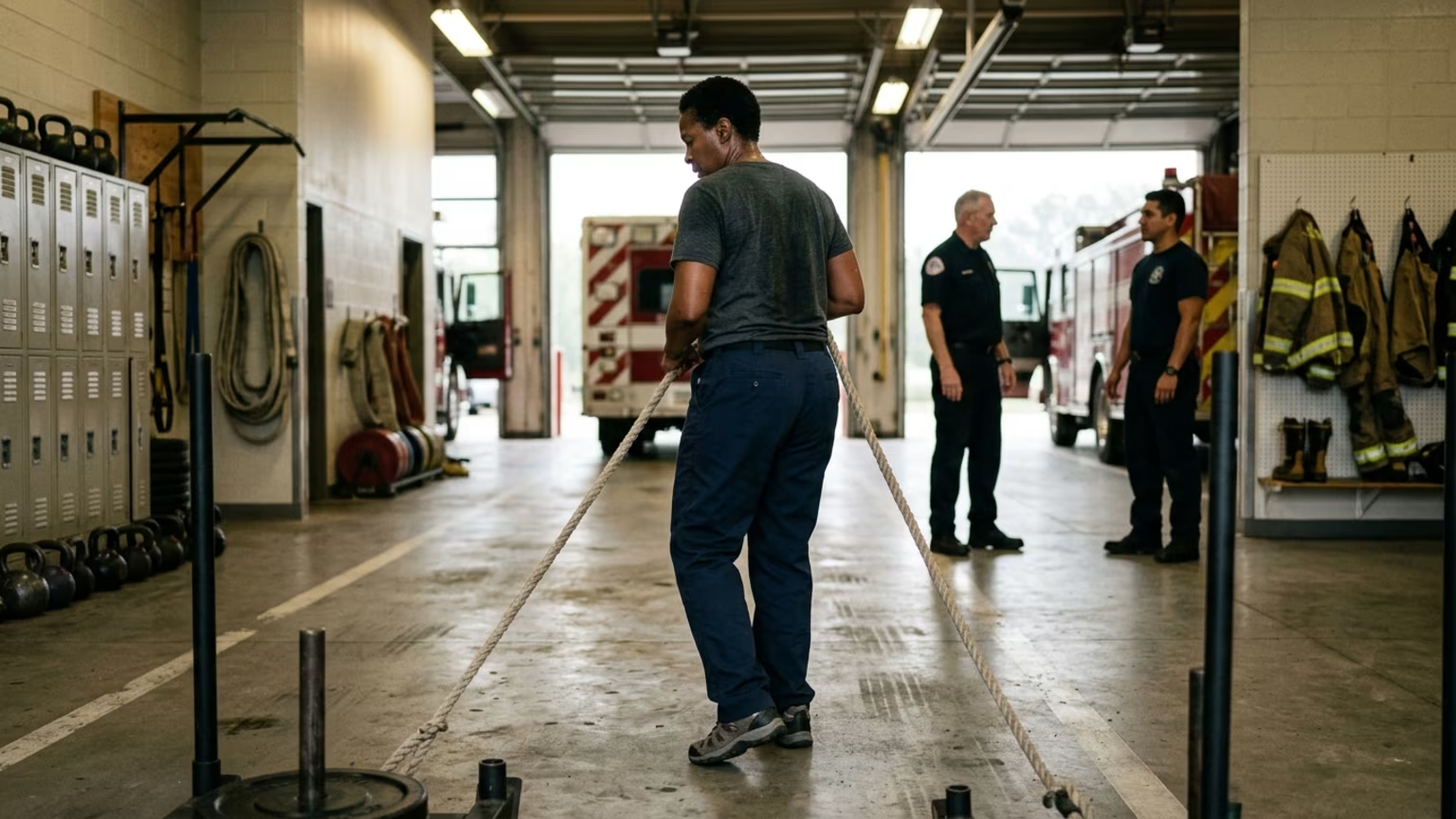

Discover how first responders can adapt physical training for career longevity. Learn to manage shift-work fatigue, monitor cardiovascular fitness, and adjust volume.





The National Registry of Emergency Medical Technicians says its new LIFE Study is intended to examine cumulative health risks across firefighter and EMS careers. Launched on September 14, 2026, this initiative represents a shift toward longitudinal career-health research rather than isolated fitness testing. Career longevity is not just about avoiding immediate injury on a single shift. It requires understanding how years of service compound physical risks for aging emergency personnel.
This longitudinal approach aligns with concerning mortality data in the fire service. One analysis of 2,314 firefighter deaths from 1990 to 2000 and 2002 to 2012 highlighted shifting occupational risks. The proportion of deaths involving myocardial infarction increased from 43.0 percent to 46.5 percent. Meanwhile, deaths among firefighters older than 40 rose from 52 percent to 65 percent over the evaluated timeframes.
The same mortality analysis found that deaths during training increased from 7.3 percent to 11.2 percent across the compared periods. These findings do not prove that rigorous physical conditioning is inherently dangerous. However, they indicate that medical screening, progressive conditioning, and sensible training-load management require serious attention. This is especially true for older responders or personnel returning to duty after prolonged inactivity.
Occupational medical standards like NFPA 1582 help departments evaluate whether personnel can safely perform required duties. Additionally, NFPA 1550 consolidates several emergency-responder health and safety standards. These guidelines provide a necessary framework for occupational safety but do not prescribe a universal strength program. They also do not guarantee that an individual responder is safe to train through persistent joint pain.
Inadequate cardiorespiratory fitness is associated with elevated health and performance risks in the fire service. A 2026 scoping review of cardiovascular monitoring research from 1990 through 2025 identified 14 relevant studies from 140 records. The review concluded that the 20-metre shuttle run offers a practical option for department-wide monitoring. Regular assessment helps identify declining capacity early so responders can adjust their physical preparation accordingly.
Firefighters and emergency personnel face unusually high cardiovascular and neurological demands on duty. Irregular work schedules, heavy equipment, and difficult fireground conditions take a cumulative toll on the human body over time. Firefighter occupational health research links these exact factors with higher rates of musculoskeletal disorders. These physical issues are associated with impaired occupational performance, reduced quality of life, and early retirement.
The autonomic nervous system absorbs significant stress from rotating shifts and overnight emergency calls. Sleep disruption fundamentally changes how the body recovers from heavy physical exertion or psychological strain. Broader occupational fatigue literature identifies poor sleep, shift schedules, and workload intensity as major contributors to work-related fatigue. A responder cannot neatly separate physical training stress from the exhaustion of a demanding operational shift.
Sleep opportunity directly impacts biological recovery and overall training tolerance. In one schedule-specific report, wrist-tracker data showed mean firefighter sleep rising from 6.7 to 7.0 hours per night. This occurred after a transition to a 48/96 schedule at the evaluated department. While this is a specific finding rather than a universal rule, it highlights the direct relationship between schedule structure and baseline recovery.
When sleep is chronically compromised, the body struggles to repair tissue and clear metabolic waste efficiently. A demanding fireground incident, a prolonged patient-handling shift, or a technical rescue evolution acts as additional physical training stress. These concurrent job demands place heavy, unpredictable strain on the musculoskeletal and nervous systems. This reality makes careful physical load management a fundamental requirement for a long career.
The broader evidence base supports adapting first responder training over time rather than abandoning demanding exercise completely. A 2026 systematic review investigated the effects of structured training interventions on firefighter task performance. The researchers found that structured firefighter training programs were associated with better performance on several simulated job tasks.
These structured programs included high-intensity functional training, circuit training, nonlinear periodization, and complex training modalities. Improvements were specifically noted in critical operations like victim rescue, hose advancement, and ladder operations. This demonstrates that targeted physical conditioning directly translates to fireground effectiveness and operational capability. However, the evidence base remains relatively small compared to general population fitness research.
Only five studies met the strict inclusion criteria for the 2026 systematic review of firefighter training interventions. This limited evidence base means that claims about universally perfect training programs remain scientifically unsupported. The authors explicitly called for more research into how program duration and baseline fitness alter training results. They also noted the pressing need to study how concurrent job demands interact with ongoing physical training stress.
These findings validate the use of structured physical preparation for emergency personnel. Improved performance on simulated tasks shows that occupation-specific training yields tangible benefits for active-duty responders. At the same time, the limited number of eligible studies confirms that no single workout routine is universally optimal for every responder. Training must adapt to the individual's changing physical condition and specific duty requirements.
For a responder with accumulated joint wear, training volume must be treated as a strictly limited budget. The goal is to retain enough weekly exposure to preserve capability without adding redundant fatigue. A useful starting point is to reduce hard sets for an irritated region by roughly one-third to one-half for one or two training cycles.
Responders should retain foundational patterns like squats, hinges, pushes, pulls, and loaded carries. They can then reduce accessory volume, failure training, and repeated high-impact conditioning circuits. This approach focuses on building a durable physical foundation while removing sets that cause unnecessary systemic irritation.
Reducing training intensity does not mean making every single session easy or avoiding exertion altogether. A better strategy involves adjusting training to operational readiness based on recent duty demands and available sleep. After adequate rest and a low-demand shift, a responder may perform heavier compound strength work.
After a difficult night shift, that same person should select submaximal strength work or easy aerobic conditioning. Strength can be effectively maintained with controlled repetitions and a small reserve rather than frequent sets taken to failure. High-intensity conditioning should be used selectively for clear occupational purposes rather than treated as a mandatory daily requirement.
Exercise selection should become more specific to the individual responder as a career progresses over decades. The objective is to choose movements that train necessary qualities like strength, aerobic capacity, and trunk control. Responders should actively avoid exercise variations that repeatedly provoke old symptoms or acute joint pain.
When a movement causes recurring pain, the first step is to change the dose, range, tempo, or stance. A painful barbell back squat might be temporarily replaced with a box squat, split squat, or step-up variation. This keeps the primary muscle groups engaged without turning the daily workout into an unnecessary orthopedic test.
Power should be preserved through low-volume, high-quality efforts rather than fatigue-heavy plyometric circuits that strain joints. Depending on symptoms and experience, this may involve medicine-ball throws, controlled kettlebell swings, or short sled pushes. These movements maintain fast-twitch muscle fiber recruitment without exposing aging joints to excessive impact forces.
Low-impact aerobic options help maintain cardiovascular conditioning when running or repeated jumping aggravates a joint. Treadmill and stairmill tests remain robust individual assessment options in fire-service fitness monitoring protocols. The same principle applies to daily training routines, allowing consistent conditioning without causing unnecessary pain or chronic irritation.
The 2026 fire-service fitness review describes regular standardized reassessment as a practical way to monitor training control. Tests like the 20-metre shuttle run can help detect declining aerobic capacity over time before it becomes a severe liability. However, field-test estimates can occasionally misclassify individuals who score near the established fitness cut-points.
A single declining score should prompt careful investigation rather than an automatic assumption of poor occupational health. The scoping review recommends confirmatory testing when high-stakes employment decisions depend directly on the fitness result. The most useful long-term progress markers include symptom stability, repeatable performance, and controlled technique under rising fatigue.
Career longevity requires responders to balance structured, job-specific physical preparation with a realistic accounting of occupational stress, changing recovery capacity, and accumulated physical wear over time.
Sleep disruption from nights, rotating shifts, overtime and unpredictable calls makes physical recovery extremely difficult for emergency personnel. Rescuris helps first responders build functional capability while working within these exact occupational constraints. We translate clinical data into practical programming that respects erratic duty schedules and accumulated physical wear. Explore Resources
Rescuris publishes evidence-aware guidance for firefighters, police officers, paramedics and other first responders on fitness, recovery, sleep, nutrition, stress resilience and long-term capability.






Read practical guidance on first responder fitness, recovery, sleep, nutrition and resilience for demanding work and a long, active career.
read the blog
