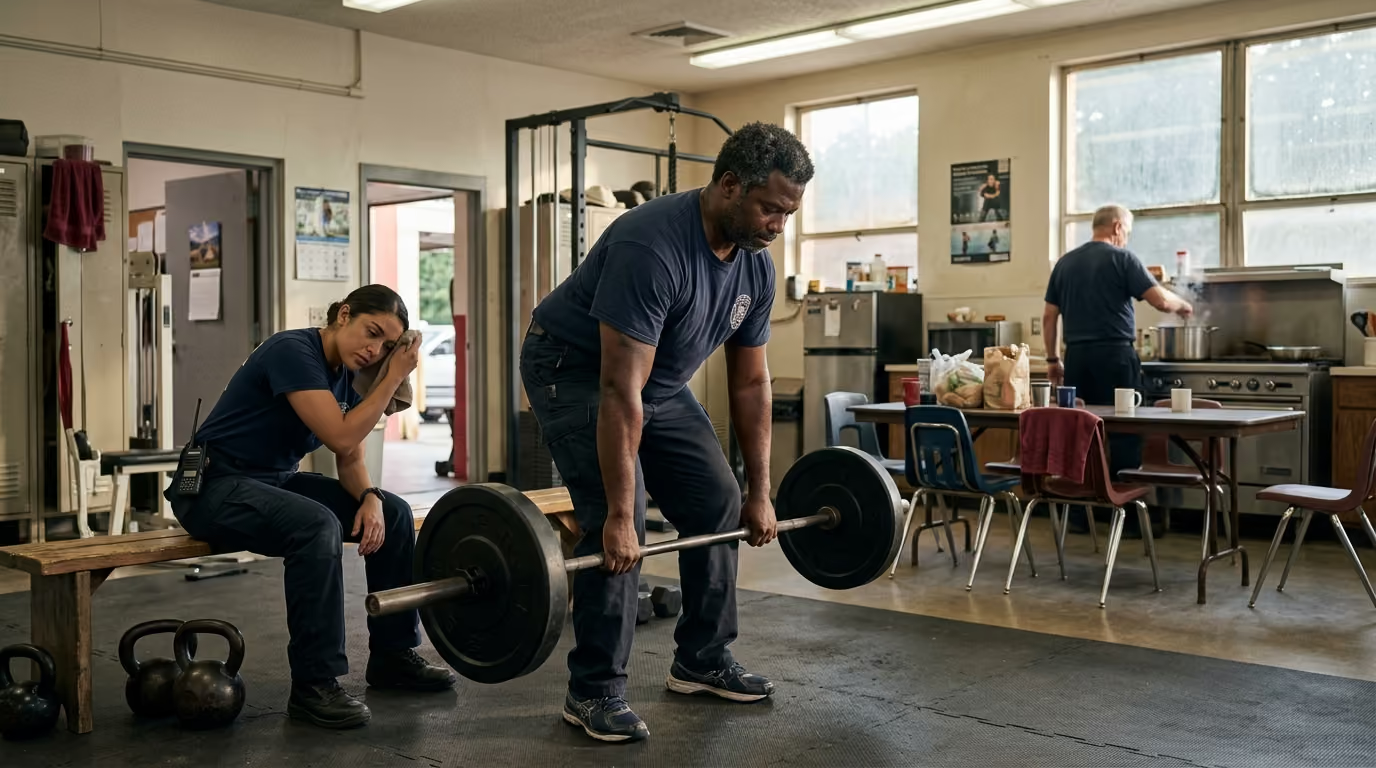

First responders need progressive physical training frameworks to withstand heavy gear, operational fatigue, and chaotic physical demands without suffering career-ending injuries.





Many responders assume that pushing through extreme gym circuits creates an unbreakable body. The operational reality tells a very different story. Line-of-duty data consistently shows that heavy lifting capacity alone does not prevent sprains, tendon irritation, heat exhaustion, or acute back injuries. Real durability is not about surviving a single punishing workout. Durability is the physical and physiological capacity to perform demanding occupational tasks repeatedly, recover efficiently between calls, and withstand an entire career without breaking down.
A durable body requires a systematic progression. You must build foundational movement quality and tissue capacity before adding heavy loads or high-density work. You must then introduce job-specific stressors like protective gear, awkward drags, stair climbs, and crawling in a controlled manner. Training must respect the physiological disruption of night shifts, thermal stress, and unpredictable call volumes.
Physical capacity and operational durability are often treated as identical qualities. They are fundamentally distinct. Capacity reflects what your body can produce under controlled, predictable conditions. It is measured by your maximal squat, your grip strength on a dynamometer, or your power output on a rowing machine. Durability represents your ability to repeatedly express that strength and conditioning under chaotic conditions, environmental heat, heavy gear, and acute fatigue.
Muscular fitness and aerobic conditioning lower the relative physiological strain of emergency operations. When a firefighter with high cardiovascular fitness climbs four flights of stairs carrying equipment, that climb operates at a lower percentage of their maximal heart rate. This physiological reserve leaves more energy for situational awareness and motor control. However, fitness alone cannot eliminate the physical risks inherent to emergency response.
Data from the National Fire Protection Association highlights the reality of occupational injuries. Overexertion and muscular strain represent the leading cause of fireground injuries, accounting for over a quarter of documented incidents. Slips, trips, and falls make up another substantial portion. Outside the fireground, strains and sprains account for roughly six out of ten injuries occurring during routine station duties, non-fire emergencies, and physical training sessions.
These numbers demonstrate that physical training itself can become an injury vector when programmed carelessly. Performing high-complexity exercises under extreme fatigue does not build durability. It merely exposes vulnerable tissues to unnecessary breakdown. Durability is built by methodically widening your physiological buffer across multiple physical qualities.
The International Olympic Committee highlighted that managing physical workloads is critical for athletic health. Sports science literature frequently references workload balance models to explain injury patterns. Sudden spikes in training volume or intensity are linked with elevated soft-tissue injury rates.
A large cluster-randomized trial evaluating 482 elite youth athletes showed that applying rigid, mathematical workload formulas failed to prevent overall health problems. Algorithmic workload management cannot replace individual monitoring, honest symptom evaluation, and professional judgment. For emergency responders, workload encompasses gym sessions, shift length, emergency calls, disturbed sleep, and environmental heat.
Emergency response demands physical output while wearing personal protective equipment and breathing apparatus. Standard structural firefighting gear adds significant external deadweight while encapsulating the body in a thermal barrier. This insulation severely restricts evaporative cooling, which is the primary mechanism your body uses to shed heat during exertion.
When thermoregulation is overwhelmed, core body temperature climbs rapidly. This thermal strain triggers an accelerated cardiovascular response, driving heart rates toward maximum even during moderate physical tasks. Blood volume is diverted to the skin for cooling, which decreases venous return and reduces stroke volume. The result is rapid central and peripheral fatigue, impaired balance, and degraded fine motor control.
Recovery timelines after working in gear are longer than most responders realize. Physiological monitoring shows that returning to baseline heart rate and core temperature after an 18-minute firefighting work cycle can require 50 to 80 minutes of active cooling and rest. Expecting a responder to perform consecutive, high-intensity drills in full gear without structured recovery creates extreme physiological distress.
Sleep disruption compounds these thermal and physical stressors. Shift work, nighttime dispatches, and prolonged operational periods disrupt normal circadian rhythms. Sleeping fewer than seven hours degrades neuromuscular coordination, reduces muscular power, impairs glucose metabolism, and blunts heat tolerance. Responders working irregular rotations must learn how circadian strain and responder sleep debt alter physical capability from day to day.
Training programs must treat sleep debt as an operational constraint rather than an excuse for mental toughness tests. When you are severely sleep-deprived, the central nervous system cannot coordinate complex, high-velocity movements safely. Pushing for personal records after a sleepless shift dramatically raises injury risk without providing meaningful fitness adaptations. Smart training requires modifying session volume and intensity based on daily readiness.
Developing a durable operational base requires clear physiological targets. Fireground tasks, technical rescues, and prolonged patient extrications rely heavily on the oxidative energy system. While an acute task like forcing a door or dragging a victim requires anaerobic power, your ability to sustain work and recover between tasks depends entirely on aerobic capacity.
Occupational physiology research indicates that an aerobic capacity of roughly 42.0 mL/kg/min is the baseline threshold for performing firefighting tasks effectively. Studies examining tactical athletes suggest that maintaining a VO2max above 44.0 mL/kg/min provides an operational reserve. This reserve reduces cardiovascular fatigue during prolonged operations and improves thermal management.
A well-developed aerobic base functions as a recovery engine. It accelerates the clearance of metabolic byproducts, restores phosphocreatine stores, and stabilizes autonomic function between high-intensity efforts. Responders who build this base through low-intensity continuous exercise experience less cardiovascular strain when performing identical tasks in protective gear.
Muscular strength provides the physical foundation for movement control and joint integrity. The American College of Sports Medicine emphasizes multi-joint resistance exercises that engage major muscle groups across multiple planes of motion. Squatting, hinging, pressing, pulling, and carrying constitute the foundational patterns of all emergency response duties.
Strength acts as an operational shield for soft tissues. When spinal extensors, gluteal muscles, and shoulder stabilizers are strong, they absorb external forces before those forces stress passive ligaments, joint capsules, and intervertebral discs. Resistance training also stimulates collagen synthesis, increasing the tensile strength of tendons and fascial networks.
Conditioning must never be limited to single-joint bodybuilding exercises or generic cardio machines. It must systematically build the exact qualities required on duty: multi-directional strength, isometric trunk stability, grip endurance, and sustained aerobic output.
Building durability requires a long-term progression rather than random daily workouts. The following five-phase framework moves systematically from basic tissue tolerance to advanced occupational expression.
Before initiating heavy resistance training, you must establish baseline capabilities and identify structural limitations. This phase screens joint mobility, movement control, and current symptom profiles. It accounts for prior injuries, surgical history, shift schedules, and department equipment requirements.
The objective of Phase 1 is preparing passive connective tissues and motor patterns for future training stress. Volume is moderate, loads are light to submaximal, and the focus remains on technical execution. Exercises prioritize joint stability, eccentric control, and foundational aerobic development.
Progress training variables conservatively. ACSM guidelines recommend increasing training volume by roughly 2.5% to 5% at a time. Master movement quality before adding external load.
Phase 2 builds raw force production, tissue resilience, and cardiovascular stroke volume. You will handle heavier loads using multi-joint barbell, dumbbell, and trap bar movements while maintaining steady aerobic conditioning.
To balance intense training with shift schedules, use structured programming. Review how programming high output capacity workouts alongside low fatigue maintenance sessions keeps responders strong without creating deep physical exhaustion.
Phase 3 introduces training density. You will learn to express strength repeatedly under moderate fatigue while preserving clean movement mechanics. Work-to-rest ratios begin to mimic operational demands.
Only progress one variable at a time. Never increase sled load, interval duration, and round density during the same training block.
Phase 4 bridges gym capacity to field execution. Specific operational movements are integrated into training, including stairs with weight vests, hose drags, crawling drills, and dummy carries.
These operational drills should be introduced gradually. Begin with light weight vests on flat surfaces before progressing to full protective gear, uneven terrain, or thermal exposure.
Phase 5 represents the career-long maintenance phase. Responders do not need to hit maximum lifts every week. The focus shifts to preserving strength, maintaining aerobic conditioning, and autoregulating training based on shift stress.
When call volumes spike or sleep is compromised, use minimum effective dose training principles to maintain physical readiness without overwhelming your recovery capacity. Two focused full-body strength sessions and two aerobic base workouts per week are sufficient to maintain durability.
Emergency response is physically diverse. To build genuine durability, training must systematically develop six primary movement demands.
Lifting heavy equipment or patients from the ground requires a strong hip hinge. Poor mechanics under load transfer shearing forces directly to the lumbar spine. Train the hinge using trap bar deadlifts, Romanian deadlifts, and kettlebell swings. Emphasize a neutral spine, full lat engagement, and powerful glute recruitment.
Lowering loads safely is equally critical. Controlled eccentric lowering builds hamstring and spinal erector resilience. Practice slow, three-second eccentric phases during deadlifts and goblet squats to prepare connective tissues for placing tools and stretchers down with control.
Carrying tools, ladders, fans, and hydraulic cutters places high demands on grip strength, shoulder stabilizers, and the lateral core. Loaded carries build total-body tension while challenging your posture during locomotion.
Progress from bilateral farmer carries to unilateral suitcase carries, offset rack carries, and uneven object carries. Ensure you can walk smoothly without tilting your torso or overstriding.
Dragging charged hose lines or moving unconscious victims requires sustained horizontal force production. These tasks demand strong hip extension, upper-back isometric endurance, and foot traction.
Backward sled drags build knee resilience by loading the quadriceps and patellar tendons without spinal compression. Hand-over-hand rope pulling builds grip endurance, lat strength, and rotational trunk stability.
Climbing stairs with heavy packs, high-rise hose packs, or ladders places immense demands on single-leg strength and aerobic power. Responders must be able to climb stairs without relying heavily on handrails for support.
Focus on driving through the midfoot and heel of the lead leg rather than bouncing off the back toe. This ensures maximum glute and quad engagement while keeping your knee tracking over your second toe.
Navigating smoke-filled rooms, confined spaces, or structural collapses requires crawling beneath obstacles. Crawling demands multi-planar hip mobility, active shoulder stability, and reflexive core bracing.
Integrate rapid positional transitions into training. Practice moving smoothly from a standing position down to a crawl, transitioning to a half-kneeling posture, and standing back up under control.
Standing for hours at extended incidents, staging areas, or traffic control posts creates postural fatigue and lumbar stiffness. Without adequate postural endurance, passive spinal structures bear the load, leading to lower back discomfort.
Build endurance in the postural musculature so that standing upright in duty boots and gear remains effortless throughout extended operations.
Many well-intentioned first responders sabotage their long-term durability by falling into predictable training traps.
The most destructive pitfall is treating every gym session as a mental toughness test. Training should build capacity, not test your breaking point. When you train to complete exhaustion, movement mechanics deteriorate, joint stress spikes, and systemic recovery is compromised. If a major call comes in two hours after an exhausting workout, your operational capability is severely degraded.
Another widespread mistake is neglecting low-intensity aerobic conditioning. Many responders rely exclusively on high-intensity interval training, believing it is the only method that mimics emergency calls. While interval training is important, performing it without a solid Zone 2 aerobic foundation leads to chronic sympathetic nervous system overload, poor heart rate recovery, and elevated resting cortisol.
Proper fueling is also essential for maintaining work output across rotating shifts. Implementing a structured first responder shift nutrition framework provides the metabolic energy necessary to sustain demanding training and recover between emergency calls.
Returning to active duty after an injury requires a structured, criteria-based progression. Feeling pain-free during daily activities does not mean your body is ready to drag a 180-pound victim down a flight of stairs in protective gear.
International sports physical therapy consensus statements emphasize that return-to-activity decisions should be based on objective functional criteria and tissue healing timelines, not arbitrary calendar dates.
Monitor your body's response to training loads using a strict 24-hour symptom tracking rule. Clinical tendinopathy frameworks suggest that mild discomfort (rated 3 out of 10 or less) during loading is acceptable, provided symptoms return to baseline within 24 hours.
If joint stiffness, localized swelling, or sharp pain worsens the morning after training, the applied load exceeded your tissue's current tolerance. Reduce volume or intensity during the next session until the 24-hour response stabilizes.
Applying this progressive framework requires adjusting for individual physical profiles, injury histories, and occupational roles.
Profile: High maximal deadlift and squat strength, but experiences extreme cardiovascular distress and grip failure during prolonged stair climbs and hose evolutions.
Primary Gap: Maximal force production far exceeds aerobic capacity and muscular endurance.
Outcome Marker: Ability to sustain continuous stair climbing and equipment carries at a stable, controlled heart rate without premature grip exhaustion.
Profile: Excellent 5K running times and low resting heart rate, but struggles to drag charged lines, advance heavy hose bundles, or control unconscious casualties.
Primary Gap: Aerobic conditioning cannot compensate for inadequate upper-body pulling force, hip extension strength, and grip capacity.
Outcome Marker: Efficiently dragging a 165-pound mannequin 25 meters with continuous foot drive and stable spinal alignment.
Profile: Following a lumbar strain, daily back pain has resolved. The responder attempts to return immediately to full duty without testing job-specific movement patterns under load.
Primary Gap: Confusing the absence of resting pain with restored occupational tissue capacity.
Outcome Marker: Completing all Delphi return-to-work benchmarks in full gear with zero compensatory movement patterns and normal 24-hour symptom tracking.
Profile: Highly consistent with training, but develops acute shoulder and lumbar issues during a two-week stretch of mandatory overtime and high call volume.
Primary Gap: Failure to autoregulate gym volume when external duty workloads and sleep disruption spike.
Outcome Marker: Sustaining physical readiness across high-call operational periods without developing cumulative overuse injuries.
Profile: Experienced responder returning to structured training after years of administrative duty or deconditioning. High risk of injury if former workout programs are resumed immediately.
Primary Gap: Structural tissues (tendons, ligaments, joint capsules) are not prepared for high-intensity loading.
Outcome Marker: Consistent training for eight weeks with zero soft-tissue flare-ups and measurable improvements in movement control.
Physical training is a foundational pillar of career longevity, but it operates within clear physiological boundaries. No training program can overcome severe sleep deprivation, structural joint damage, or uncontrolled operational hazards.
Understanding how and when to adjust your workouts is essential for long-term health. Using a structured shift-work training decision tree provides clear, objective rules for when to push, when to modify, and when to focus entirely on recovery.
Self-directed training adjustments are appropriate for routine fatigue, mild post-exercise muscle soreness, or general conditioning. However, distinct symptoms require formal clinical evaluation by a licensed healthcare provider, sports physical therapist, or occupational medicine specialist.
Do not attempt to train through these clinical red flags. Early evaluation by an experienced professional allows for accurate diagnosis, targeted rehabilitation, and a safe, structured return to operational readiness.
Building a durable first responder body is not about surviving punishing workouts in the gym; it is about methodically constructing the physical strength, aerobic reserve, and movement quality required to serve your community effectively and enjoy a healthy, active retirement.
Stay connected for research-led guidance on duty fitness, shift-work sleep, injury recovery, stress, nutrition and career longevity. Practical ideas for first responders who want to stay capable on the job, recover well and protect their health for the long run.



Read practical guidance on first responder fitness, recovery, sleep, nutrition and resilience for demanding work and a long, active career.
read the blog



