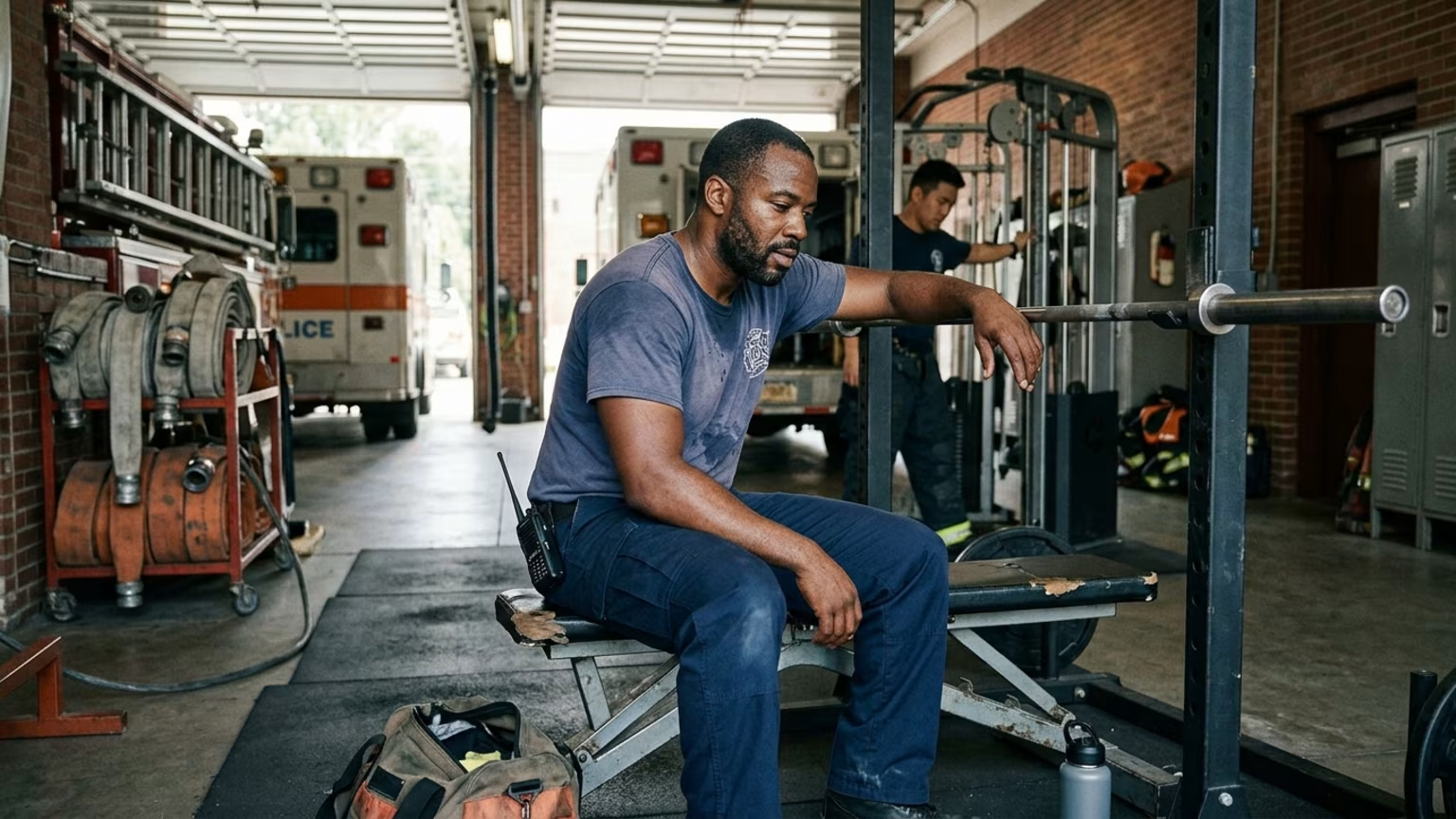

First responders can distinguish productive training stress from occupational fatigue using a practical load-management system based on sleep, soreness and mood.





Deciding whether to execute a demanding physical training session or prioritize immediate rest requires emergency personnel to accurately distinguish productive adaptation from accumulating occupational fatigue.
A hard training session is highly productive when the body has sufficient resources to recover and adapt. The physiological effects of a well-timed workout include localized muscle breakdown, a controlled heart-rate spike and the managed release of stress hormones. When sleep is reasonably stable and recent duty loads are manageable, the body efficiently clears these metabolic byproducts. This process builds physical capability and improves metabolic health over time.
First responders can recognize productive training stress through several human-observable signals. Soreness should feel local and predictable rather than widespread or concentrated in the joints. When a responder begins their session, warm-up movements should feel normal or steadily improve as blood flow increases. Perceived exertion matches the planned workload. This means a moderate conditioning circuit actually feels moderate.
Mood and motivation also remain broadly steady when training stress is productive. A responder might feel typical pre-workout reluctance, but they can still maintain technique under intensity. They exhibit steady breathing and clear decision-making during complex movements like heavy lifts or aerobic intervals. Recent duty exposures and physical training loads have not been unusually high leading up to the session.
Building adaptable physical routines relies on treating exercise as just one variable in a complex occupational landscape. Pushing through temporary laziness builds mental resilience. However, attempting a maximal lifting session on an exhausted nervous system simply adds unrecoverable damage.
Occupational fatigue accumulates when the physical and psychological costs of the job outpace the body's recovery windows. Unlike a structured workout, a chaotic shift forces the body to manage unpredictable physical loads. Responders must also handle interrupted sleep and prolonged emotional stress simultaneously. Layering heavy physical training over this existing burden often creates excessive systemic fatigue.
The physiological result is poor recovery, blunted fitness adaptations and a higher risk of musculoskeletal wear. Sleep disruption is the primary driver of this accumulated strain. A national study of 6,933 firefighters from 66 U.S. fire departments found that 37.2% screened positive for at least one sleep disorder. Firefighters who screened positive had approximately twice the odds of reporting a motor-vehicle crash and more than twice the likelihood of reporting falling asleep while driving.
This data highlights why normalizing persistent sleepiness as merely part of the job creates severe safety risks. Beyond the fire service, law enforcement personnel face similar occupational obstacles to recovery. In a cross-sectional study of 253 police officers in Kerala researchers reported a high prevalence of sleep disorders. They also found strong associations involving occupational stress and lifestyle factors.
While this specific sample should not be used as a universal prevalence estimate, it reinforces the established relationship between demanding duty and compromised rest. A 2026 scoping review examined relationships between 24-hour movement behaviors and mental-health outcomes among adult frontline workers. This review searched seven databases and supports evaluating sleep, sedentary time, light activity and exercise together. A recent review of frontline workers described occupational pressures as associated with burnout and anxiety. The same review identified links between occupational strain, depression, post-traumatic-stress symptoms and sleep disturbance.
Because unpredictable schedules complicate recovery, emergency professionals need practical guidelines to determine their daily training capacity. A quick pre-training check of five core domains can guide the choice between standard physical training, modified activity or complete rest. Responders can rate sleep and soreness alongside perceived exertion to establish a baseline. They should also evaluate their daily mood and recent workload.
Sleep deserves the heaviest weight in any readiness evaluation. Near-normal sleep quantity and quality for an individual supports a standard training session. Poorly timed or repeatedly interrupted sleep strongly suggests a need for recovery or lighter movement. A structured approach to tracking operational stressors helps responders recognize these sleep disruptions before they derail a training cycle.
A Firehouse report on a 48/96 firefighter schedule described mean tracker-measured sleep increasing from 6.7 to 7.0 hours per night. This small change provides useful context for how scheduling impacts rest, though it does not prove that a specific schedule change dictates occupational performance.
Soreness provides the next immediate physical signal. Minimal soreness and normal movement patterns indicate physical readiness for load. Noticeable muscle soreness allows for moderate training. Widespread diffuse soreness, altered movement or concerning joint pain requires active recovery instead. Diffuse pain is often a marker of systemic fatigue rather than simple muscle damage from a previous workout.
Perceived exertion is especially useful when the physical cost of a chaotic shift is difficult to quantify. If a familiar warm-up feels abnormally heavy or easy activity feels unusually hard, the body is signaling accumulated strain. That subjective change should be treated as important information rather than dismissed as a lack of willpower. Responders who notice higher-than-normal perceived effort can replace maximal intervals with easy aerobic work or technique practice.
Mood provides a reliable window into central nervous system fatigue. A generally steady and willing attitude aligns with a green light for training. Feeling notably irritable or mentally flat points toward systemic overload. Unusually anxious or apathetic moods also serve as strong warning signs. Recognizing these psychological shifts helps personnel adjust their approach before physical failure occurs.
Recent workload must include all physical and mental demands rather than just formal workouts. This load includes emergency calls, stacked night shifts and required overtime. Responders must also count prolonged standing, heavy equipment carriage and missed sleep. A randomized police-shift experiment assigned 275 officers in Detroit and Arlington to five eight-hour shifts, four 10-hour shifts or three 12-hour shifts for six months.
The study reported no significant overall differences in work performance, health or work-family conflict among the shift-length groups. However, the same experiment noted that officers on 10-hour shifts obtained more sleep than those on eight-hour shifts. Officers on 12-hour shifts reported greater sleepiness and lower alertness at work.
This indicates that schedule length alone is not a perfect proxy for fatigue, and responders must evaluate their actual sequence of duties. For instance, a schedule with more days off might look better on paper but produce severe exhaustion on the working days. Responders must judge their fatigue based on how they actually feel rather than what a schedule implies. Moderately elevated operational loads call for deloading strategies to manage fatigue, while stacked night shifts demand immediate rest.
One frequent error is relying entirely on wearable technology to dictate training choices. Wearable scores can help identify long-term trends in resting heart rate or sleep duration, but they should never replace direct human observation. Personnel should always assess their own mood, perceived effort and recent duty exposures. A wearable device might generate a high readiness score while the responder feels mentally depleted after a deeply stressful call. The practical rule is to use the wearable metric as a single vote rather than the deciding authority.
Another pitfall is assuming that exercise universally cures shift-related sleep disruption. A review of non-pharmacological interventions for shift workers found a positive exercise association with sleep quality, but only two exercise-training studies were available. Furthermore, the population consisted of shift nurses rather than emergency-service professionals. Physical activity supports long-term health, but heavy training on severely depleted sleep can occasionally worsen immediate recovery.
Using the wrong tools to measure daily fatigue is another widespread mistake. A field-testing review for fire services concluded that the 20-metre shuttle run had a favorable combination of validity, test-retest reliability and low equipment requirements. While semi-annual assessment could be a reasonable starting point subject to local validation, estimates near employment cut-points can be misclassified. More importantly, periodic fitness assessments are not appropriate daily readiness tests for an individual coming off a brutal night shift. Responders must differentiate between passing an annual fitness standard and determining whether they are recovered enough for a heavy workout today.
Some personnel mistakenly believe that caffeine can substitute for genuine recovery. While stimulants mask the subjective feeling of sleepiness temporarily, they do not repair physical tissue or clear metabolic waste from the brain. Over-reliance on heavy caffeine consumption simply delays the onset of severe fatigue, often pushing the crash into the middle of the next shift.
Emergency professionals face conflicting pressures to maintain physical readiness while navigating unpredictable shifts and accumulating fatigue. A structured load-management system helps responders evaluate their capacity to make practical training choices. The goal is to separate productive physical adaptation from the kind of systemic overload that increases injury risk. By treating subjective signals as valid data, responders can protect their physical capabilities and their long-term health.
Disregarding the body's warning signs in the name of discipline often shortens a career rather than extending it. Operational demands will always dictate shift lengths, but responders retain control over how they allocate their remaining recovery resources. Before your next workout after a difficult shift, write down a simple rating of your sleep and soreness. Use that information alongside your general mood to decide whether the planned session is truly the right choice for that specific day.
Planning for physical capability and an active life after retirement or leaving service requires emergency personnel to carefully manage the cumulative toll of unpredictable shifts and heavy physical workloads. Rescuris helps you interpret the physical costs of duty, offering a structured approach to separating productive training stress from occupational fatigue. By applying our evidence-led load-management system, responders can maintain operational readiness today while building the biological foundation for a healthy life outside the uniform. Explore Resources
Rescuris publishes evidence-aware guidance for firefighters, police officers, paramedics and other first responders on fitness, recovery, sleep, nutrition, stress resilience and long-term capability.






Read practical guidance on first responder fitness, recovery, sleep, nutrition and resilience for demanding work and a long, active career.
read the blog
