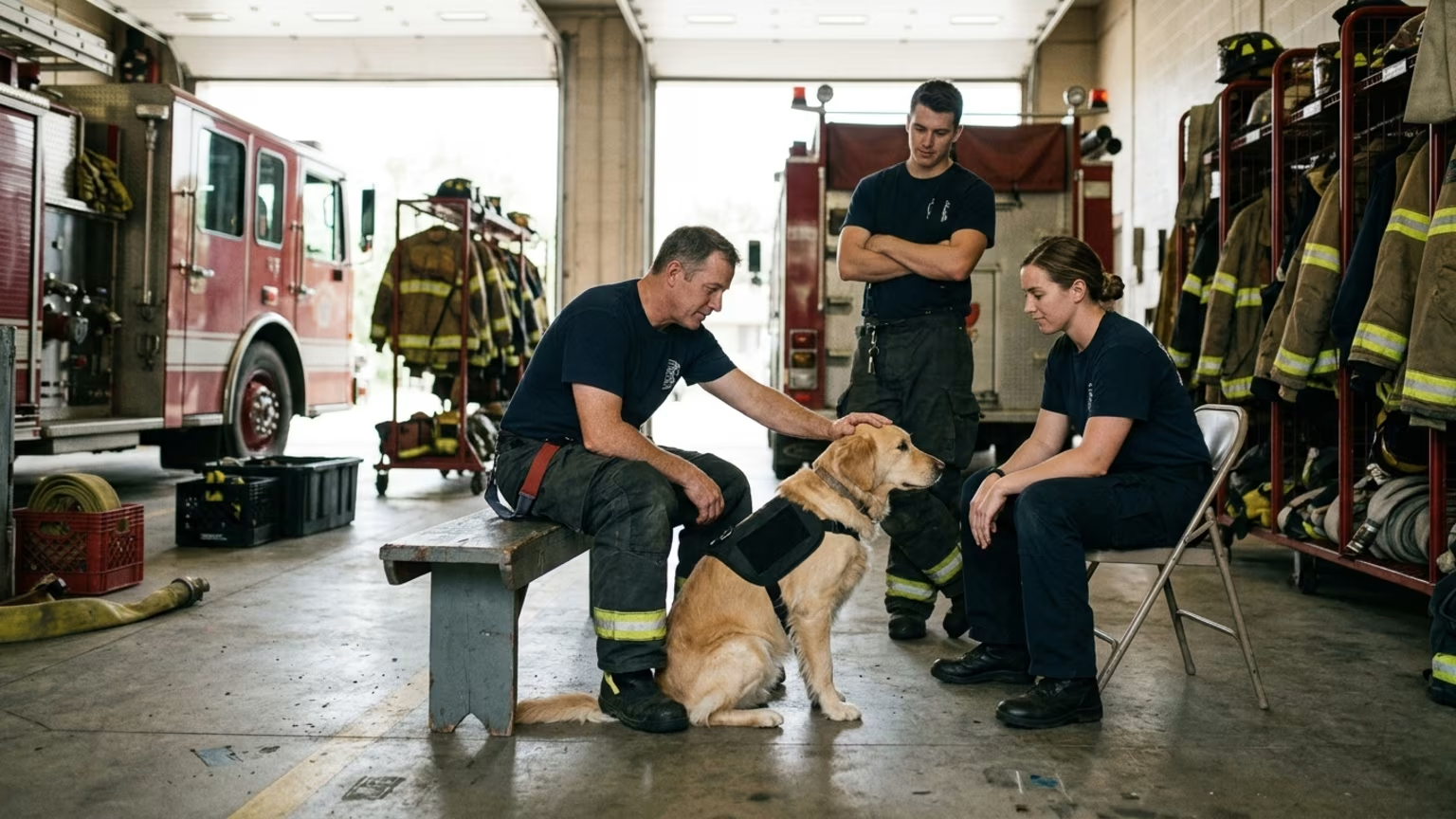

Firefighter support-dog reports describe comfort and easier conversation within peer support. Here is the program design and the evidence behind the claims.





In an account published October 17, 2026, The Star described Laguna Beach Fire’s Critical Incident Stress K-9 (CISK) dog Oro joining a debrief after a prolonged search off Treasure Island. Trained peer supporters and a clinician were there to help responders discuss the call and their reactions. Oro participated alongside that human support.
The gathering brought together firefighters, lifeguards and park rangers. Police, paramedics and dispatchers were also present. Captain Pat Cary said the dog lowered tension and made it easier for people to open up, offering a specific account of how canine support might make an existing support setting more approachable.
According to The Star, Oro is an Aussiedoodle handled by firefighter/paramedic Logan Strook. During the debrief, the dog approached responders and sat or lay near them. Cary’s description focused on the atmosphere in the room and people’s willingness to speak.
The report offered a related perspective from Huntington Beach Fire. Fire Engineer Kane Johnson described Kingman as an “ultimate icebreaker” and said the dog could change the dynamic and provide comfort in a way he could not. Both accounts describe a possible point of connection between responders and the people available to support them.
That distinction keeps the story grounded. The reported benefit was not a dog taking over a clinician’s role or replacing a trained peer. It was a dog participating in a setting where those people were already involved.
For first responder wellness, this is the central idea worth considering: making an initial conversation feel more approachable has a different purpose from providing clinical care. A program can be designed around the former without claiming to deliver the latter.
A separate announcement shows how another department planned to incorporate canine support. On September 30, 2026, Howard County Fire and Rescue Services announced that facility dog Valor and his handlers had completed training hosted by Hero Dogs in August 2026.
The department said Valor would make routine visits and respond with its Peer Support Team after significant emergencies or traumatic events. It described a 35-member team that included uniformed and volunteer personnel. Civilian and retired personnel were also part of the team.
That arrangement gives the dog a place within an identified support structure. The announcement described both routine contact and responses following difficult events, rather than presenting the dog only as a resource brought in after a major incident.
Howard County firefighter Richard High offered a restrained description of the role. He called Valor’s comfort a “small sense of relief in that moment” while acknowledging that the dog could not change what personnel had experienced.
Read together, the Laguna Beach report and Howard County announcement describe a similar design choice. The dog works with people who have support responsibilities. The reported comfort sits within that broader arrangement rather than standing alone.
The Star’s account contains practitioner observations, not a controlled evaluation. It provides no measured symptom changes or validated physiological evidence of benefit. Claims about identifying high cortisol therefore should not be treated as established clinical findings.
Howard County’s announcement documents training completion and intended activities. It does not demonstrate that Valor’s presence improved mental-health outcomes. Across both sources, the distinction is between describing a program and establishing its effectiveness.
The coverage also does not establish national prevalence or a universal training standard. Several department examples and a multi-agency training effort show activity, but they do not show how widely this model has been adopted. The reported training periods describe one program’s arrangements rather than a readiness rule for every department.
These limits leave a useful conclusion intact: the sources document dogs being integrated with peer support and report favorable experiences of comfort and conversation. That is the appropriate foundation for discussing their role.
The operational relevance is the point of contact with support. If a responder finds it easier to sit with a dog nearby and begin talking, that experience deserves attention on its own terms. It does not need to be turned into a claim about treatment to be meaningful.
The Star describes stigma, generational differences and departmental cultures as barriers to seeking support. It also quotes Johnson saying there is “not a ton of buy-in” for CISK dogs. A welcoming encounter and organizational acceptance are therefore separate issues within the reporting.
From an editorial perspective, the useful question is not whether a dog makes a department appear more supportive. It is whether the program connects personnel with the support already available to them. That keeps attention on the relationship between the dog and the surrounding people rather than on the appeal of the animal alone.
This is also why examining how peer support operates belongs beside any discussion of canine programs. The handler’s responsibilities and the role of qualified clinicians remain central. A dog’s presence should not make those parts of the system harder to see.
For an individual responder, accepting contact with a support dog can be a reasonable option if it feels helpful. There is no need to turn that preference into a test of willingness to seek help. Personal decisions about clinical care belong with qualified professionals, whether or not canine support is part of the setting.
The reported programs offer concrete details for departments assessing the idea. The Star says handlers are already certified in peer support through the International Critical Incident Stress Foundation. It also describes designated handler-dog pairings rather than dogs working independently of a human support role.
At a Murrieta training ranch operated by the Patriotic Service Dog Foundation, the report says dogs receive one year of training before pairing with handlers. They then work with those handlers for about six months before going on duty. Founder Tom Tackett was training selected firefighters and dogs from 11 agencies in California and out of state.
Those details put preparation and organizational placement ahead of the public-facing announcement. Based on the reported examples, a useful program review would address the following points:
These are questions about program design and evaluation, not a new operational protocol. Neither announcement changes an individual department’s procedures by itself.
The same wider perspective applies to support that continues beyond the immediate incident. The most visible encounter should not become the entire definition of care. A program description is more useful when it explains the connection between that encounter and the people available afterward.
The next useful analysis should follow the support pathway rather than count favorable reactions alone. When a dog is present, do more personnel choose to speak with a trained peer? Does that contact lead to further support when the responder wants it? How do personnel who prefer not to interact with a dog experience the same service?
Routine visits and post-incident responses also raise different questions. A station visit may be intended to make the team familiar, while a response after a difficult event has a more immediate context. Evaluation should make those purposes explicit before deciding what a successful program looks like.
Attribution matters as well. If a department reports better engagement, how much relates to the dog and how much to the handler or the wider team? If clinical benefit is claimed, which measured outcomes support that conclusion? These questions would help separate a useful access point from a broader claim about health.
For now, the strongest reading of these announcements is straightforward. Oro and Valor illustrate ways departments are placing dogs alongside existing support personnel. Whether that arrangement produces sustained engagement or measurable health benefits remains a question for evidence, not a conclusion to draw from a reassuring encounter.
Treating a support dog as the whole answer risks confusing a welcoming encounter with trauma care. Rescuris uses evidence-aware editorial analysis to help emergency-service professionals assess stress-support claims without motivational pressure or mental-health stigma, keeping the realities of demanding duty and personal recovery central to the discussion.
Rescuris publishes evidence-aware guidance for firefighters, police officers, paramedics and other first responders on fitness, recovery, sleep, nutrition, stress resilience and long-term capability.





Read practical guidance on first responder fitness, recovery, sleep, nutrition and resilience for demanding work and a long, active career.
read the blog
