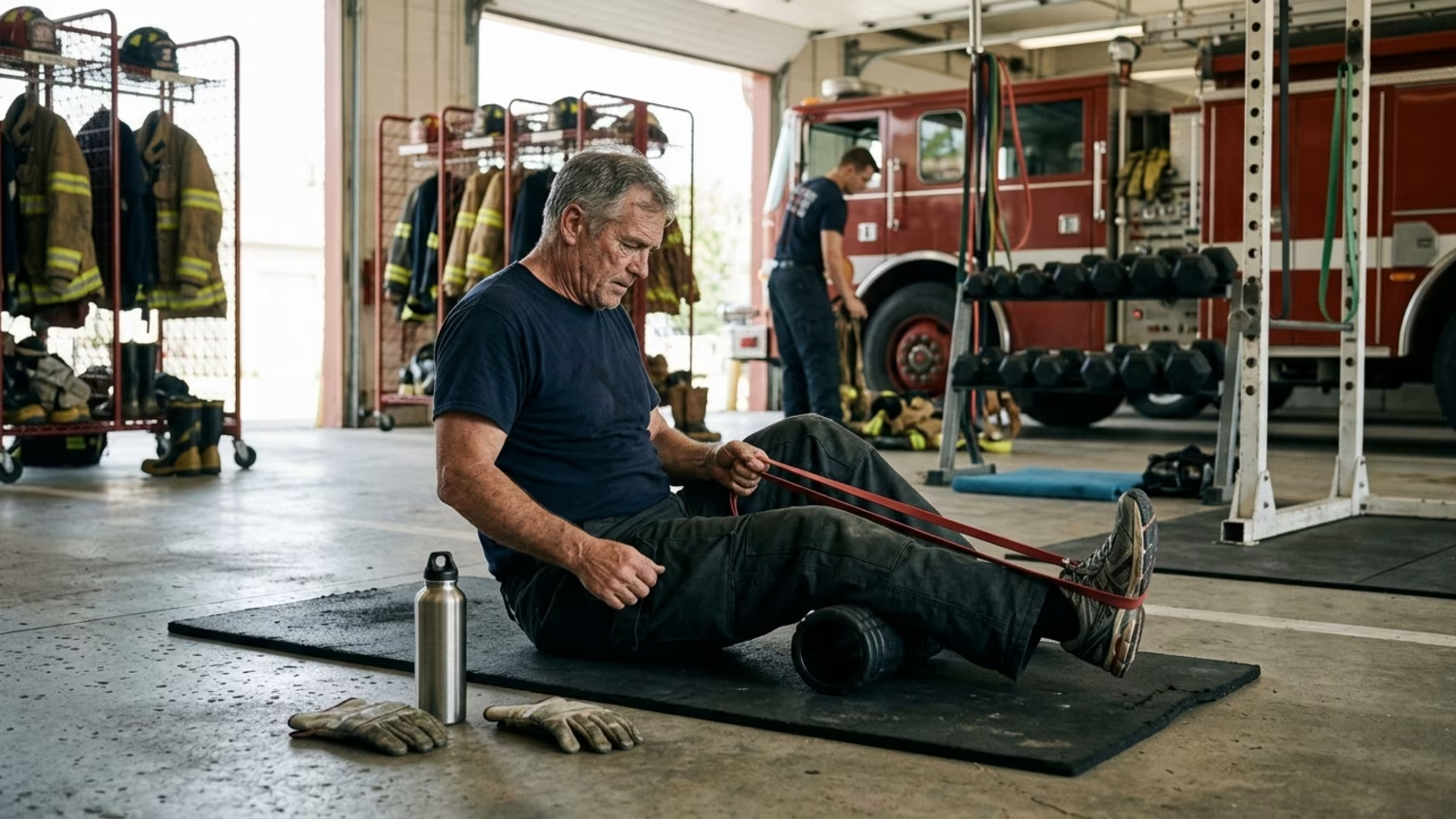

Learn why older adults recover more slowly from training and how first responders can adapt their workout routines to manage aging muscle and shift demands.





On September 15, 2026, The New York Times published a report examining why exercise recovery can slow with age and when older adults should modify their training routines. The article clarifies the physiological changes that contribute to prolonged post-workout fatigue.
The New York Times describes physical training as a controlled stress that forces the body to adapt to new demands. This necessary adaptation happens by remodeling and regenerating muscle tissue immediately following a workout. Researchers cited by the publication suggest that recovery often feels longer for older adults due to two fundamental biological mechanisms. First, aging muscles show a significantly greater susceptibility to exercise-related damage during a session. Second, the body experiences a much slower rate of muscle regeneration in response to that damage.
According to the article, overall muscle mass generally begins to decline in the 30s. The actual physical composition of that muscle also changes over time. Older adults tend to lose more fast-twitch muscle fibers than slow-twitch fibers as they age. Slow-twitch fibers primarily support long steady-state endurance activities, while fast-twitch fibers are responsible for producing sudden force and explosive power.
The disproportionate loss of fast-twitch fibers creates a compounding problem for older adults who train intensely. This structural change leaves older exercisers relying on fewer specific fibers during heavy or explosive efforts. Researchers believe this reliance potentially increases the stress placed on the remaining functional tissue. The New York Times also discusses inflammaging, which is the possibility that chronic low-grade inflammation increases with age.
This chronic inflammation may actively interfere with standard muscle regeneration processes over time. Dr. Asad Siddiqi, chief of rehabilitation medicine at NewYork-Presbyterian Brooklyn Methodist Hospital, explained to the publication that aging exercisers require more intentional maintenance. This medical perspective means that age does not automatically make physical training unsafe for older adults. Instead, older individuals must deliberately manage their preparation, training stress and subsequent recovery protocols.
The specific distinction between fast-twitch and slow-twitch fiber loss is absolutely critical for emergency service professionals. A typical operational shift relies heavily on short bursts of sudden, intense physical force. Climbing flights of stairs with heavy gear, dragging a charged hose and lifting a patient all demand immediate fast-twitch muscle recruitment. If veteran responders are actively losing these specific fibers, their remaining muscle tissue must absorb substantially more stress.
This biological reality means that both mandatory physical training and actual emergency calls exact a heavier toll on the veteran body. The New York Times notes that standard post-exercise soreness and stiffness commonly subside within roughly 24 to 72 hours. However, the publication explicitly reports that these common symptoms may become noticeably more pronounced with age.
For an emergency professional, a standard workout might suddenly overlap with an unpredictable night shift, a technical rescue or a long transport. This exact reality makes delayed physical recovery a true operational hazard rather than a simple personal inconvenience. A workout that once produced only mild fatigue might now create noticeable soreness or a temporary reduction in physical power.
This performance drop is especially true if the training session involves unfamiliar movements, heavy eccentric loads or repeated efforts near complete muscle failure. Understanding these structural changes validates the need for a deliberate approach to adapting first responder training with age and experience. Maintaining long-term physical capability requires treating sleep opportunity, sensible loading and warm-up quality as necessary operational practices rather than optional wellness extras.
While physiological changes happen to everyone, the scientific evidence does not support a rigid recovery timetable based strictly on chronological age. Follow-up coverage by Men's Journal highlighted a 2023 review that examined 27 distinct studies on the subject. These specific studies focused on exercise-induced muscle damage and subsequent recovery in adults aged 65 and older. The comprehensive review found substantial differences among the study results, proving that the recovery process remains highly variable.
The review authors concluded that there was no clear consensus on either the size of the age effect or the exact time older adults require to recover. Interestingly, some findings from the review were entirely counterintuitive to traditional aging narratives. Older men sometimes showed smaller post-exercise strength declines than younger men. Additionally, several separate studies in the review reported less soreness among older participants compared to their younger counterparts.
These findings directly challenge the assumption that every veteran responder over 40 or 50 needs a fixed, identical number of rest days between workouts. Recovery depends on a highly complex mix of individual variables extending far beyond simple age. Training history, baseline fitness, exercise type and sleep quality all dictate how a specific person responds to physical stress.
A 50-year-old responder who trains consistently may recover much faster than a younger responder who is returning after months of total inactivity. Furthermore, the available evidence cautions against treating physical soreness as a perfect measure of tissue damage or duty readiness. The absence of soreness does not guarantee that a responder is completely prepared for maximal lifting, loaded stair work or a high-risk technical task.
The most practical response to these findings is to carefully adjust training stress while fully preserving the physical qualities needed for duty. Reductions in volume or intensity may be necessary when performance declines, but responders should not abandon heavy training altogether.
Because age-related structural changes particularly affect fast-twitch fibers, older responders should absolutely avoid replacing all heavy lifting with easy endurance exercise. A better operational approach is to retain appropriately scaled power training while strictly controlling total session volume and managing overall fatigue. Veteran personnel must be incredibly careful about stacking multiple heavy physical stressors together in a short time window.
Combining a heavy lower-body lifting session, an overnight shift and a demanding operational day creates a recovery cost that easily exceeds what the body can absorb. The core issue is not that any single element is inherently inappropriate for an older adult. The problem arises when the combined biological cost outpaces the body's slower regeneration rate.
Daily soreness provides highly useful feedback, but it should be measured alongside sleep quality, energy levels and actual physical performance output. A practical individual monitoring system might involve tracking whether standard warm-ups feel unusually difficult or whether normal weights move slowly. Personnel might also carefully note if their grip strength is consistently declining over consecutive shifts.
These subjective observations are not a clinical medical diagnosis, but they remain valuable operational signals. They indicate exactly when a responder should consult a shift-work training decision tree to modify their daily routine appropriately. Modifying a workout based on these specific trends prevents acute fatigue from turning into a chronic overuse injury.
A workout should never be judged in complete isolation from the occupational workload that immediately preceded it. Treating an unpredictable shift as a primary physical stressor is absolutely essential for preserving career longevity. This framing means acknowledging that long shifts and limited sleep directly reduce the body's biological capacity to tolerate additional gym stress.
Incorporating a dedicated, well-structured post-shift transition routine is a highly realistic way to manage cumulative physical strain effectively. First responders must evaluate their physical capability holistically, merging their occupational demands with their fitness programming.
The New York Times article does not provide specific protein targets, supplement doses or strict meal-timing protocols for older adults. Writers and trainers should avoid presenting a particular supplement or exact nutrition prescription as established medical guidance based on this specific event. Responders should view all nutritional adjustments conservatively, balancing adequate food and fluid intake against actual training loads and realistic work demands.
Personnel with medical conditions or highly specialized dietary needs should always consult an appropriately qualified clinician or registered dietitian. Furthermore, persistent fatigue, recurrent pain or persistent weakness should not automatically be blamed on normal aging processes. Such severe symptoms can reflect serious illness, medication side effects or sleep disorders that require comprehensive professional medical evaluation.
Moving forward, future research must rigorously track how specific emergency work schedules directly influence muscle regeneration and the inflammaging process. We must follow new studies to see whether age-related fast-twitch muscle loss decelerates when personnel receive dedicated, protected recovery periods during their work cycles. Understanding how systemic inflammation predictably responds to erratic sleep schedules will eventually provide clearer, safer guidance for veteran emergency professionals.
Until that specific longitudinal data arrives, responders must continue to rely on structured, adaptable maintenance routines. The physiological realities of muscle damage and slower regeneration require a highly pragmatic approach to operational readiness. Veteran personnel who intentionally manage their training loads, prioritize sleep and respect their recovery windows will consistently maintain their capability far longer.
Adapting physical training to respect slower recovery timelines directly sustains an emergency professional's operational capability over a long career. When the challenge of separating useful stress-resilience guidance from motivational slogans or mental-health stigma complicates daily readiness, Rescuris formulates clear, evidence-led recovery frameworks. We help veteran first responders translate complex physiological research into practical shift routines without relying on tactical clichés. Explore Resources
Rescuris publishes evidence-aware guidance for firefighters, police officers, paramedics and other first responders on fitness, recovery, sleep, nutrition, stress resilience and long-term capability.






Read practical guidance on first responder fitness, recovery, sleep, nutrition and resilience for demanding work and a long, active career.
read the blog
