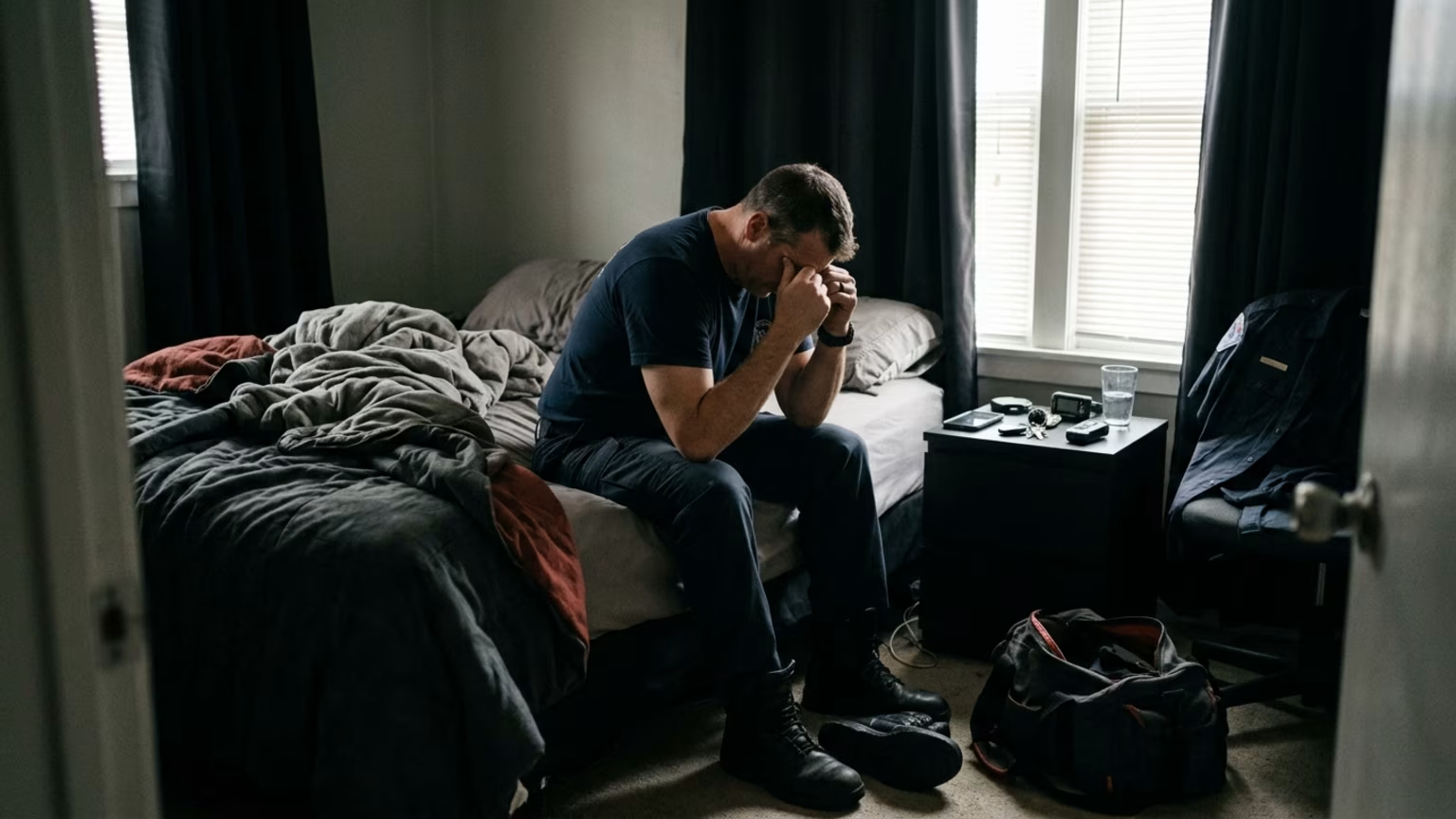

Why daytime sleep is hard after nights, plus evidence-led ways to manage light, noise, caffeine timing and household expectations.





Sleeping after a night shift is difficult because daylight can signal wakefulness despite exhaustion, while noise and household demands can compete with the available sleep window.
NIH describes daylight as an important regulator of sleep timing. Increasing light exposure, including sunrise, can cue cortisol release that prepares the body to wake. Someone finishing nights may therefore be trying to sleep while the environment is sending signals normally associated with being awake.
Exhaustion does not cancel those signals. The practical goal is to protect a realistic opportunity for sleep by addressing light and avoidable interruptions. That is different from expecting tiredness alone to produce a long stretch of daytime rest.
A systematic review published in Sleep examined light exposure and vigilance in shift workers. Of 25 studies, 10 reported statistically significant reaction-time associations with lighting, while 15 found no significant differences.
Those findings concern vigilance rather than proof that a particular lighting routine produces longer daytime sleep. NIH's recommendations are general shift-worker guidance rather than a first-responder-specific trial. Household quiet hours and notification changes are practical applications of that guidance, not interventions with an established sleep benefit for emergency-service personnel.
Make the intended sleep period clear to the household and arrange the bedroom around NIH's recommendation for quiet, cool and dark conditions.
Start with the opportunity that actually exists after duty. An irregular finish time or a household responsibility may limit what is available. A useful plan accounts for those constraints rather than assuming that every post-shift day offers the same uninterrupted block.
NIH recommends avoiding noise and bright light in the bedroom. That makes the room itself a reasonable starting point before considering more complicated routines. Darkness belongs alongside quiet and a cool environment rather than being treated as the only factor that matters.
The distinction between the room and the household is useful. A bedroom can be dark while conversations or routine requests continue outside it. Protecting the opportunity means considering both the physical setting and the expectations surrounding that period.
The research supports the environmental goal. The following household arrangements are practical ways to apply it:
These arrangements do not require a household to become silent all day. They require a shared understanding that the designated period is intended for sleep rather than being automatically available for errands or routine requests.
Where responsibilities cannot move, keep that constraint visible. A short opportunity and difficulty sleeping within that opportunity are different problems. The former calls for a scheduling conversation; persistent difficulty with the latter also deserves medical attention.
Consider them across the shift and the intended sleep period, not only when you reach the bedroom after work.
NIH advises night-shift workers to use bright light at work and light-blocking curtains for daytime sleep. These recommendations serve different purposes at different times. Light during duty and darkness during intended rest are not competing instructions.
As the intended sleep period approaches, reducing bright-light exposure where feasible is a practical extension of that guidance. The planning question is what light exposure belongs to the work period and what can be reduced around rest. This is not a prescription for a particular light intensity or exposure duration.
NIH advises limiting caffeine to the first part of a night shift. That places the decision during duty rather than leaving it until the sleep window has already begun.
The guidance does not supply one clock-time cutoff for every roster. A plan for caffeine use during night duty should therefore remain connected to the shift being worked and the intended rest period. It should not become a universal rule detached from scheduling.
Caffeine access also needs to be distinguished from caffeine timing. Having it available during duty does not mean that using it throughout the shift is consistent with NIH's advice about preparing for daytime sleep.
NIH also advises discussing limits on shift changes with an employer where possible. That recommendation places some responsibility at the scheduling level rather than treating every sleep problem as a bedroom-management issue.
JEMS summarizes EMS fatigue guidance that includes fatigue monitoring and shift-duration limits. It also covers access to caffeine, on-duty naps and fatigue education. These are organizational measures rather than a formula for making post-shift sleep consistently long.
For responders moving between duty patterns, planning the transition between days and nights is a separate scheduling task from protecting sleep after a particular shift. Keeping those decisions distinct makes the planning conversation clearer: one concerns changing schedules, while the other concerns the rest opportunity currently available.
A household agreement cannot decide shift duration. A bedroom adjustment cannot provide an on-duty nap opportunity. Those issues belong alongside environmental measures rather than being replaced by them.
Light-blocking curtains are the specific bedroom tool NIH recommends for shift workers who need to sleep during the day.
Their role is straightforward: help create the dark environment recommended for sleep. They belong within the wider arrangement of quiet conditions and a cool room. Buying a product is not the same decision as agreeing when the room will be used for rest.
The useful question is whether the tool addresses a barrier in the actual sleep setting. For this topic, the supported recommendation is light control rather than an elaborate equipment list or a supplement routine.
It keeps present recovery and long-term health in the same planning conversation, but this evidence does not establish a direct effect on health after retirement.
That distinction matters when sleep advice is judged only by whether someone gets through the next shift. Immediate readiness is one consideration. Whether the arrangement respects ongoing recovery is another. Rescuris's position is that neither should be treated as a reason to disregard lasting health.
For someone approaching the end of night work, the useful planning question also changes. Instead of assuming that a work-era sleep arrangement must continue indefinitely, retirement creates a reason to review it. The editorial priority is a routine suited to the next stage of life rather than loyalty to a schedule built around duty.
NIH advises medical discussion when someone persistently cannot sleep during the day or has difficulty adapting to shift work. That is the appropriate route for personal assessment. Household coordination and a darker bedroom should not become reasons to postpone that conversation.
Seeking qualified care is also separate from deciding whether the household plan was good enough. Environmental planning addresses the opportunity to sleep. Medical discussion addresses persistent difficulty that needs individual consideration.
The next useful topic is how to change a sleep arrangement when night work ends. Protecting daytime sleep during service and planning sleep after leaving nights are related questions, but they are not the same scheduling task.
Read about reconsidering sleep during retirement or a work transition. The useful next step is to identify which parts of the current arrangement exist because of duty and which remain relevant afterward. Keep the focus on a workable rest opportunity rather than carrying every shift-era rule into a different stage of life.
Deciding how to protect daytime rest from competing demands is a scheduling judgement; Rescuris brings research-led perspective to its recovery and longevity implications. When advice favours immediate output over lasting health, its reporting helps emergency-service professionals assess sleep recommendations in the context of irregular duty rather than performance pressure.
Rescuris publishes evidence-aware guidance for firefighters, police officers, paramedics and other first responders on fitness, recovery, sleep, nutrition, stress resilience and long-term capability.






Read practical guidance on first responder fitness, recovery, sleep, nutrition and resilience for demanding work and a long, active career.
read the blog
