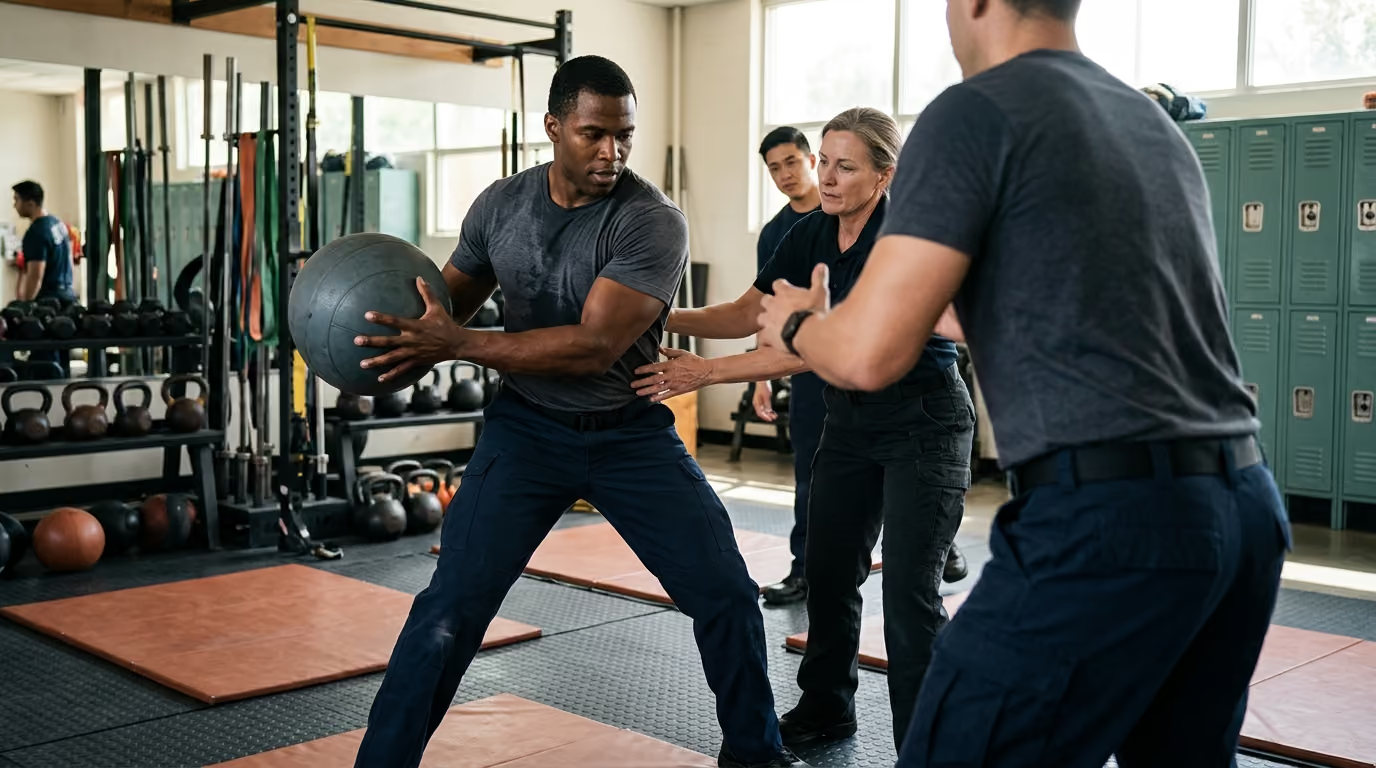

Standard gym sit-ups fail tactical athletes, but targeted trunk stiffness and rotational force transfer protect first responders from high-demand occupational injuries.





Performing hundreds of sit-ups or chasing visible abdominal definition does very little to prepare a first responder for the physical realities of the job. In emergency operations, the trunk rarely functions as an isolated hinge flexing over and over on a comfortable floor mat. Instead, it serves as a structural bridge that transmits force between the ground, the hips, and the upper extremities under chaotic, heavy, and asymmetrical conditions.
Functional core training for firefighters, police officers, and emergency medical personnel requires developing the trunk's capacity to transfer force, resist unwanted motion, produce controlled rotation, and maintain posture under heavy fatigue. Developing true duty readiness means prioritizing multi-planar bracing, anti-rotation, loaded carries, and controlled rotational power while maintaining the ability to breathe under load.
Emergency service work places extreme physical loads on the human body, frequently requiring high force production in compromised body positions. A foundational task analysis of firefighting operations identified frequent occupational demands that directly challenge the trunk. These tasks include lifting and carrying equipment weighing up to 80 pounds, pulling horizontal loads up to 135 pounds, and manipulating tools weighing up to 125 pounds held away from the body.
When carrying or pulling these loads, the torso must act as a rigid conduit. If the trunk musculature cannot maintain tension, force generated by the powerful leg musculature dissipates before reaching the hands. This mechanical failure leads to inefficient movement and significantly increases strain on the passive structures of the spine.
The cardiovascular and metabolic toll of these operations is equally intense. Research demonstrates that demanding firefighting tasks require a mean oxygen consumption of 41.5 milliliters per kilogram per minute, generating peak blood lactate concentrations between 6 and 13.2 millimoles per liter. National fire protection standards recommend a minimum aerobic capacity of 42 milliliters per kilogram per minute to handle these cardiovascular demands safely.
Occupational performance reviews categorize emergency tasks into distinct energy systems. Short, explosive efforts like ladder raises and forcible entry rely primarily on the phosphagen system. Moderate tasks like victim extractions and hose drags place heavy demands on glycolytic pathways. Extended operations, such as high-rise stair climbs while carrying equipment packs, require sustained oxidative capacity.
A systematic review examining simulated firefighting performance confirmed that tasks like stair climbs, equipment carries, victim drags, and ladder raises demand substantial muscular power and anaerobic endurance. When responders fatigue metabolically, trunk stability often degrades first. This breakdown exposes them to acute injury during the most critical phases of an incident.
Occupational surveillance data reinforces the urgent need for targeted trunk training. An analysis of emergency responder injury claims published by the Centers for Disease Control and Prevention revealed clear occupational injury patterns. Police officers recorded the highest overall injury counts, followed closely by career firefighters and emergency medical personnel.
For both police officers and firefighters, back and knee injuries occurred more frequently than shoulder injuries. For emergency medical services personnel, back and shoulder injuries dominated the claims. Across all three responder groups, sprains and strains represented the leading injury category, accounting for 33 to 41 percent of all reported injuries.
The same surveillance data showed injury rates of 8.5 injuries per 100 full-time equivalent workers for police officers and 7.4 injuries per 100 workers for career firefighters. These injuries represent real operational downtime, chronic discomfort, and early career termination. Integrating evidence-based duty fitness programming that targets trunk stiffness and force transfer is a foundational strategy for mitigating these risks.
Standard fitness routines often treat the midsection as a cosmetic showpiece or an isolated muscle group. Gym exercises generally occur in controlled environments with symmetrical weights, balanced footing, and predictable rest periods. On duty, physical tasks are almost universally asymmetrical, unpredictable, and performed under severe environmental stress.
Firefighters carry bulky high-rise hose packs on one shoulder while navigating narrow, smoke-filled stairwells. Paramedics lift bariatric patients from tight bathroom spaces, kneeling on unyielding floors without the leverage to establish a textbook bilateral squat stance. Police officers must maintain balance and physical control during sudden physical alterctions on wet pavement while wearing restrictive body armor and duty belts.
Personal protective equipment significantly alters human biomechanics. Turnout gear, self-contained breathing apparatus, tactical vests, and duty belts add 30 to 70 pounds of external load. This extra weight alters the wearer's center of gravity, limits joint range of motion, and elevates the thermal burden on the body.
Under these conditions, the trunk must constantly adapt to shifting vectors of force. If a responder only trains symmetrical sagittal-plane movements like standard barbell squats and crunches, their system remains unprepared for the torsional and lateral loads encountered in the field.
Respiratory demand represents another critical point of divergence between gym training and emergency operations. During high-intensity tasks, responders frequently work at near-maximal heart rates while breathing against the resistance of a regulator.
Holding one's breath to generate abdominal pressure is effective during a single heavy barbell lift. However, this strategy is impossible during a three-minute victim drag or an extended stair climb. First responders must learn to maintain circumferential trunk tension while continuously breathing hard, preventing spinal collapse without compromising oxygen intake.
Prolonged seated posture also sets a dangerous trap for emergency personnel. Responders often spend hours sitting in patrol units, fire apparatus, or ambulances, which places the hip flexors in a shortened position and reduces active gluteal engagement.
A sudden emergency dispatch forces the responder to transition instantly from static sitting to maximal physical exertion. Without dedicated training that prepares the hips and trunk to coordinate rapidly, the lumbar spine absorbs excessive shear stress during sudden lifting and sprinting efforts.
Understanding trunk mechanics requires defining the physiological strategies used to stabilize the spine. In rehabilitation and strength training literature, two primary motor control strategies are frequently discussed: abdominal bracing and abdominal hollowing. These maneuvers produce very different neuromuscular adaptations and serve different functional purposes.
Abdominal hollowing, often referred to as the abdominal drawing-in maneuver, focuses on pulling the navel inward toward the spine. This action selectively recruits deeper stabilizers like the transversus abdominis and internal obliques at low loads.
Comparative research shows that while hollowing can improve local muscle thickness and motor awareness during low-load rehabilitation, it does not provide adequate stiffness for heavy occupational tasks. Drawing the abdominal wall inward reduces the base of support of the torso, compromising the body's ability to resist heavy external loads.
Abdominal bracing involves a simultaneous, coordinated contraction of the entire abdominal wall, spinal erectors, quadratus lumborum, latissimus dorsi, and pelvic floor. Instead of pulling the stomach in, the responder stiffens the entire midsection outward and circumferentially, much like preparing to take a physical impact to the midsection.
Biomechanics research confirms that abdominal bracing significantly increases trunk muscle co-contraction and enhances lumbar spine stiffness. This circumferential stiffening provides the structural rigidity required to safely lift, push, pull, and carry heavy loads.
Research on trunk mechanics reveals an important trade-off that responders must understand. While abdominal bracing increases spinal stability and reduces displacement during lifting, it also increases compressive loading on the intervertebral discs.
Antagonistic co-contraction between the abdominal wall and back extensors increases joint stiffness, but it simultaneously adds to the cumulative compressive load on the lumbar spine. Consequently, more bracing is not automatically better in every situation.
Responders must develop task-appropriate stiffness. Maximal bracing is appropriate when lifting an unconscious patient from the floor or breaking open a reinforced door with a halogen tool. However, using a maximal brace while walking, climbing stairs, or performing light overhaul tasks creates unnecessary fatigue, restricts breathing, and places needless compressive wear on the spine.
The ultimate goal of training is a tunable core: the neuromuscular capacity to dial trunk stiffness up or down to match the exact demands of the task.
To build a resilient midsection that translates to duty performance, training should be organized around five primary functional vectors rather than isolated muscle groups. These vectors reflect how the trunk functions in real-world environments: resisting unwanted movement in three planes, producing controlled rotation, and transferring force across the kinetic chain.
Anti-extension exercises train the anterior abdominal wall to resist excessive backward arching of the lumbar spine. In the field, anti-extension capacity is required whenever loads are carried in front of the body, when pushing heavy objects, or when performing overhead tool work.
If anti-extension capacity fails, the rib cage flares upward, the pelvis tips forward into an anterior tilt, and the lumbar spine falls into hyperextension under load.
Primary training movements:
Anti-flexion exercises develop the posterior chain and spinal erectors to resist forward rounding of the trunk under heavy loads. Responders need exceptional anti-flexion endurance when performing ground lifts, pulling hose lines, and hauling sandbags or equipment cases.
When anti-flexion fails, the thoracic and lumbar spine collapse into passive flexion. This shifts mechanical stress off the active musculature and places severe shear forces onto the spinal ligaments and discs.
Primary training movements:
Anti-lateral flexion exercises train the lateral stabilizers, including the quadratus lumborum, obliques, and gluteus medius, to resist bending sideways. This quality is tested whenever a responder carries an uneven load, such as holding an extrication tool in one hand, carrying a medical jump bag, or climbing stairs with an offset weight.
The International Association of Fire Chiefs and International Association of Fire Fighters wellness-fitness initiative highlights side planks specifically to evaluate trunk endurance and lateral stability.
Primary training movements:
Anti-rotation exercises train the trunk to resist twisting forces created by the limbs or external loads. In operational settings, a responder must frequently resist rotational torque when operating a charged hose line, handling a struggling subject, or performing single-arm pulling movements.
Anti-rotation training teaches the pelvis and rib cage to remain locked together, preventing hazardous lumbar torsion under load while allowing the limbs to generate force.
Primary training movements:
While resisting unwanted movement is crucial, emergency tasks also require the deliberate production of rotational power. Breaching a door, throwing a salvage cover, swinging an axe, and wrestling equipment out of vehicle compartments demand coordinated rotation.
Effective rotational training teaches power to originate from the hips and pelvis, transferring through a stiffened trunk and out through the upper body. The lumbar spine should remain relatively stable, while the hips and thoracic spine provide the rotational range of motion.
Primary training movements:
Loaded carries and sled variations represent the ultimate bridge between general strength training and occupational duty demands. Unlike floor-based core exercises, carries and sled work challenge the trunk while the body is in motion, demanding continuous adjustments to balance, foot strike, and shifting loads.
Loaded carries develop high levels of whole-body work capacity, grip strength, shoulder stability, and trunk stiffness. A carry is not merely walking with weight; it is a moving stability problem where the trunk must manage vertical, lateral, and rotational forces with every single stride.
Carries can be modified across several dimensions to target specific operational qualities:
Sled training provides a unique training stimulus because it allows high horizontal force production without placing heavy axial compressive loads on the spine. Fireground and rescue tasks, such as victim drags and hose line advancements, are dominated by horizontal rather than vertical force vectors.
Pushing a heavy sled requires the responder to establish an angled, rigid body position from the rear foot through the hips, spine, and hands. If the trunk is weak, force leaks out through the lumbar spine, causing the hips to rise and the torso to buckle.
Backward sled drags directly replicate the biomechanics of a casualty drag. The responder must sit back into their hips, brace their trunk against the tension of the harness or handles, and drive horizontally through the quadriceps and calves.
Hand-over-hand sled pulls using a battle rope build intense anti-rotation and anti-flexion endurance under severe upper-body fatigue.
When responders must balance heavy duty shifts with physical preparation, utilizing a structured shift work training decision tree ensures that high-demand sled and carry sessions are scheduled when physical recovery allows, rather than when the body is critically exhausted.
Trunk training must follow a logical, progressive continuum. Skipping foundational control and moving directly to heavy, dynamic, high-fatigue drills increases the risk of injury and reinforces poor compensation patterns. Responders should progress through four distinct stages of capability.
This level is designed for new recruits, detrained responders, or individuals returning from an injury layoff. The primary objective is to establish neutral spinal alignment, master low-level circumferential bracing, and coordinate breathing without losing trunk stiffness.
Key objectives and drills:
Progression criteria: The responder can complete three 30-second side planks per side, maintain flawless dead bug form for two minutes, and perform a bodyweight farmer carry for 40 meters without postural deviation.
At this stage, trunk stabilization is combined with meaningful upper and lower body resistance training. The responder learns to transmit forces generated by the hips and legs through the torso to move external resistance.
Key objectives and drills:
Progression criteria: The responder can suitcase carry 35 percent of their bodyweight for 30 meters per side without lateral tilt and can deadlift 1.5 times bodyweight with neutral spinal mechanics.
Level 3 introduces task-specific movement patterns, awkward loads, and respiratory challenges that mirror the unpredictable environment of emergency operations. Exercises combine multiple planes of motion and dynamic transitions.
Key objectives and drills:
Progression criteria: The responder can execute complex combination circuits with continuous movement while maintaining steady breathing and technical form.
Advanced responders train trunk stability under conditions of acute metabolic fatigue, asymmetrical loading, and reactive perturbations. The purpose is not to induce exhaustion for its own sake, but to build operational durability when fatigue challenges coordination.
Key objectives and drills:
Managing these intense training sessions alongside erratic duty calls requires understanding the principles of autoregulating training readiness, allowing responders to dial back volume when cumulative shift stress is elevated.
Integrating comprehensive core training into an emergency responder's schedule does not require hours of extra gym time. Trunk work can be woven directly into warm-ups, primary strength blocks, and conditioning finishers.
For responders navigating irregular rotations, structured training around shift work ensures high-output sessions are placed when fatigue is lowest, while low-strain stability work can be performed anytime.
This session places high-force, high-skill movements early in the workout, followed by integrated carries and multi-planar stability work.
This template is ideal for station days, light training days, or recovery windows when systemic fatigue is elevated.
This conditioning circuit combines carries, drags, and rotational power into a continuous operational challenge. Complete 3 to 5 rounds, resting 90 seconds between rounds.
Maintaining this level of functional capability over a twenty-year career requires viewing strength and stability through the lens of long-term career longevity, prioritizing movement quality and joint health over short-term workout numbers.
While building trunk strength is essential for duty readiness, improper core training can cause significant problems. Responders must understand the physical limits, mechanical trade-offs, and safety considerations inherent in spinal loading.
A critical mistake in first responder fitness is training the core to absolute muscular failure through high-repetition floor drills. When the trunk musculature becomes excessively fatigued, the body loses its ability to stabilize the lumbar spine during subsequent movements.
If a responder finishes a high-fatigue core circuit and is immediately dispatched to a working structure fire or heavy extrication call, their exhausted midsection cannot adequately protect the spine. Core training should focus on motor control, stiffness, and repeatable force transfer, rarely ending in complete muscular collapse.
Spinal mechanics also demand respect for individual anatomy and injury history. Lumbar flexion under heavy compression creates high shear stress on posterior disc structures.
For a responder with a history of lumbar disc herniation or nerve root irritation, loading the spine into end-range flexion and rotation during Russian twists or weighted sit-ups is counterproductive. These individuals thrive on anti-movement exercises, neutral-spine carries, and hip-dominant power drills that keep the lumbar spine within a stable range.
Pelvic floor and intra-abdominal pressure management represent another vital safety area. Excessive, uncontrolled breath-holding during continuous physical tasks can cause dangerous spikes in blood pressure and excessive downward strain on the pelvic floor.
Responders must learn to brace circumferentially without locking their vocal cords for extended periods. Breath control must be practiced under load, ensuring that the athlete can exhale smoothly against abdominal tension during exertion.
Fatigue from extended shifts, circadian disruption, and chronic dehydration also impairs connective tissue resilience and motor control. When sleep debt is high, the nervous system recruits stabilizing musculature more slowly.
Responders should avoid attempting maximal-load carries, heavy spinal loading, or high-velocity rotational throws when acutely sleep-deprived. Training sessions during these periods should pivot toward foundational control, mobility, and submaximal carries.
Trunk conditioning is a powerful tool for injury prevention and physical readiness, but it is not a cure for acute spinal trauma or underlying medical conditions. First responders are accustomed to pushing through physical discomfort, but certain symptoms require immediate evaluation by a licensed healthcare professional.
Medical evaluation by a qualified physical therapist, orthopedic specialist, or sports medicine physician is warranted if you experience:
A licensed clinician can perform a comprehensive biomechanical assessment, identify structural pathologies, and design an individualized rehabilitation protocol. Attempting to self-treat acute nerve compression or severe joint dysfunction by forcing heavy bracing or loaded carries will only worsen the injury.
Building a resilient, high-performing trunk ensures you can meet the physical demands of emergency service safely and maintain active capability throughout your entire career.
Stay connected for research-led guidance on duty fitness, shift-work sleep, injury recovery, stress, nutrition and career longevity. Practical ideas for first responders who want to stay capable on the job, recover well and protect their health for the long run.



Read practical guidance on first responder fitness, recovery, sleep, nutrition and resilience for demanding work and a long, active career.
read the blog



