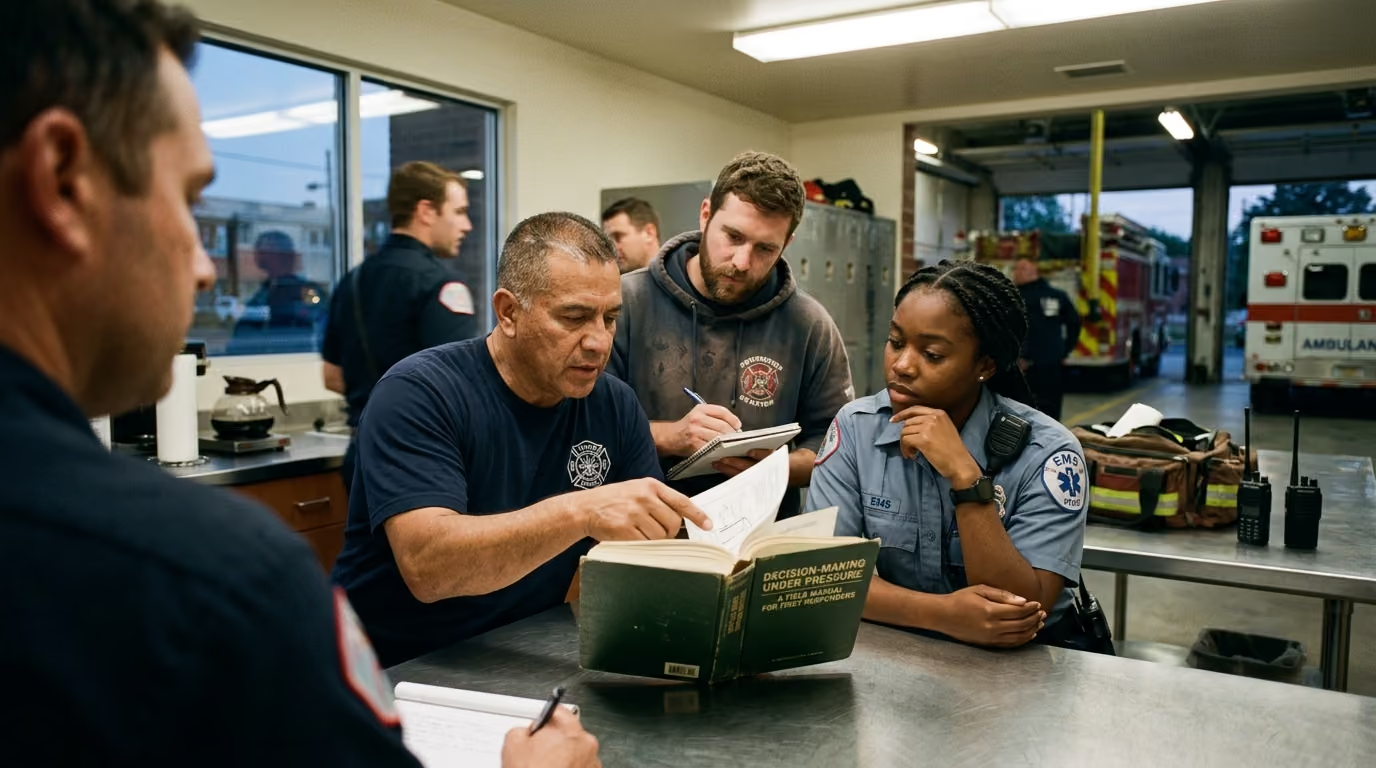

Rapid intuition seems reliable during high-stakes incidents, but acute stress triggers hidden cognitive biases that require structured decision-making frameworks.





If you are in immediate danger, call 911. For 24/7 support, call or text 988 and press 1 for the Veterans Crisis Line, or text 838255.
Most operational training teaches responders that good decisions come from gathering all available facts before acting. In actual emergencies, waiting for complete information is often the most dangerous choice you can make.
Operational environments force personnel to act when data is incomplete, contradictory, and changing by the second. True tactical competence is not the elimination of uncertainty. It is the ability to make sound, defensible choices under strict time constraints, protect against predictable cognitive blind spots, and update your actions as conditions shift.
Under severe time pressure, you do not have the luxury of running exhaustive analyses or comparing dozen-point matrices. High-stakes field decisions require a clear answer near the start of any operation: what is the most defensible, reversible action you can execute right now with the limited data in front of you?
Sound decision-making does not mean getting a flawless result every single time. It means following a disciplined, structured process that accounts for human limitations, balances risk against benefit, and keeps exit paths open.
The central goal in any dynamic emergency is to separate decision quality from outcome quality. An excellent, disciplined decision can still result in property loss or operational setbacks because of volatile, uncontrollable variables. Conversely, a reckless or biased choice can produce a favorable result purely through luck.
Relying on luck creates dangerous habits. When teams evaluate their choices based only on the final outcome, they reinforce sloppy assessments and miss critical warning signs.
A reliable field decision system rests on five operational capabilities:
Understanding this process requires examining how the human brain processes stress and pattern recognition on the fireground, on the street, and in the treatment bay.
Research into emergency decision-making shows that experienced personnel rarely compare multiple competing options during an active incident. Instead, they rely on naturalistic decision-making and recognition-primed models.
Studies show that up to 80 percent of initial fireground decisions are naturalistic and driven by pattern recognition. When an officer steps onto a scene, the brain rapidly matches current visual, auditory, and environmental cues against an internal library of past experiences.
Once a match is identified, the brain generates a workable course of action, runs a rapid mental simulation to see if it fits, and puts it into motion.
Pattern recognition is remarkably fast, but it carries distinct failure points. It works well when an incident matches past experience. It fails when novel hazards are present, when conditions are misread, or when extreme stress cuts short the mental simulation step.
Research on physiological stress demonstrates that intense acute arousal shifts brain activity away from analytical prefrontal executive control toward habitual and intuitive responses. Under high stress, working memory contracts. Responders become less willing to revise their initial theories, even when presented with contradictory evidence.
Studies evaluating high-threat medical triage show that heavy cognitive loads degrade working memory and make responders rely on crude heuristics. Responders under severe strain frequently struggle to execute structured protocols with high fidelity unless those protocols have been drilled into automatic habits.
Experience alone does not eliminate cognitive error. Experimental studies comparing crisis-affected individuals, agency staff, and recognized crisis experts found that while experts performed better overall, they remained vulnerable to specific cognitive biases.
The evidence confirms that no amount of street experience makes an individual immune to cognitive distortion. Real-world capability requires externalized tools, clear communication protocols, and structured team cross-checks.
Cognitive biases are predictable mental shortcuts that distort judgment under pressure. In emergency operations, these biases lead to misallocated resources, compromised situational awareness, and elevated safety risks.
Anchoring occurs when your initial piece of information exerts a disproportionate pull on all subsequent assessments. A common operational example is accepting the initial dispatch text as the definitive scene reality.
If a call is dispatched as a routine kitchen fire, arriving crews may look only for evidence of a stove fire, missing active extension into the attic space. Experimental research demonstrates that even seasoned crisis managers are vulnerable to anchoring effects.
To counter anchoring, commanders must mandate an explicit update check. Ask what new evidence has arrived since the initial report, and determine how that information alters the working theory.
Confirmation bias causes individuals to seek, prioritize, and remember cues that support their current hypothesis while ignoring data that refutes it. Incident command guidance from the London Fire Brigade identifies confirmation bias as a primary reason commanders fail to revise their strategies when conditions change.
If an incident commander believes a structure is unoccupied, they may discount bystander statements or subtle thermal imaging cues suggesting otherwise.
Counter this bias by running a disconfirming evidence scan:
Availability bias occurs when vivid, emotionally intense, or recent memories make a scenario seem far more probable than the objective data indicates. In high-consequence triage, loud, screaming casualties with bloody, dramatic wounds often pull medical attention away from quiet, unresponsive patients suffering from airway blockages or internal hemorrhage.
To eliminate availability bias, rely on systematic triage rubrics rather than emotional prominence. Force a rigid assessment order covering airway, breathing, circulation, and hidden environmental toxicity.
How a tactical problem is described changes the decisions made around it. Describing a scene as an aggressive rescue opportunity encourages high risk tolerance. Describing that same scene as an unstable structural collapse with low survival probability encourages caution and defensive posture.
Crisis research confirms that framing directly alters operational risk acceptance across all experience levels. To counter framing traps, look at the incident through alternative lenses: describe the situation from the standpoint of responder safety, structural integrity, and secondary hazards.
Sunk-cost bias occurs when crews continue pushing an ineffective or dangerous tactic simply because they have already invested time, physical effort, or emotional capital into it. Examples include continuing an interior attack long after structural conditions deteriorate, or maintaining an unproductive extrication pathway because extensive cutting has already occurred.
Cut through sunk-cost traps with a clean-slate query: if we arrived on this scene right now and found these exact conditions, would we begin this operation? If the answer is no, transition immediately.
Withdrawal is an active, controlled tactical decision, not an admission of operational failure.
Action bias is the impulse to do something visible immediately because waiting feels intolerable during a crisis. Omission bias is the opposite error: hesitating to take a necessary, calculated risk because of fear of direct responsibility for an adverse outcome.
Both errors stem from uncontrolled stress. Uncertainty is a massive psychological driver of operational paralysis or wild over-activity.
Make alternative operational choices explicit by defining five distinct options:
Normalcy bias causes responders to interpret early, abnormal warning signs as routine background noise. This looks like treating unusual, highly turbulent smoke as standard burning conditions, or assuming an agitated crowd will remain peaceful despite clear signs of escalating hostility.
Defeat normalcy bias by looking at trends rather than static snapshots. Ask what the scene looks like across a five-minute trajectory and what specific factors will make it worse.
Steep rank hierarchies can suppress vital safety input from junior personnel. If crew members fear embarrassment or reprimand, they will stay silent even when they spot critical hazards.
FEMA National Incident Management System (NIMS) doctrine establishes clear chain of command, but effective teams combine rank structure with psychological safety for safety-critical inputs.
Use graded assertiveness to challenge an operational direction safely:
Field operations require a practical, step-by-step decision sequence that functions when cognitive bandwidth is severely restricted. The PRESS framework provides an operational sequence for dynamic environments:
Your initial priority is establishing baseline scene control, responder safety, and primary positioning. Identify immediate threats to operating crews, patients, and bystanders before committing personnel.
Set up clear escape routes, position apparatus to block traffic hazards, isolate utility feeds, and establish a formal command post outside the hazard zone. You cannot make calm, clear-headed decisions if your physical position is actively compromised.
Managing cumulative duty stress and physical recovery through practical grounding resets between runs helps keep cognitive functions sharp before arriving at high-stress scenes.
Construct a provisional working picture of the incident. Separate what you know with certainty from what is merely reported, inferred, or assumed.
Use five core questions to build your operational baseline:
Label your initial read as provisional. Treating your initial scene read as a temporary working theory makes it much easier to discard when ground conditions contradict it.
Define a compact set of operational objectives. USFA risk management doctrine requires setting tactical priorities based on life safety, incident stabilization, and property preservation.
Do not try to manage ten objectives simultaneously. Choose two or three immediate tactical goals, allocate resources directly to them, and ignore non-essential tasks until primary goals are secure.
Ensure that your operational priorities reflect true proportionality: the expected benefit of an operation must justify the physical risk accepted by the crew.
Select the most workable, defensible action available. Avoid over-complicating the assignment.
State the operational assignment out loud using a clear, standard structure:
Once an action begins, actively scan for feedback. Do not sit back and wait for a catastrophic failure before looking at the scene again.
Reassess your plan whenever you hit an operational trigger:
If the expected tactical cues fail to appear within the predicted timeframe, shift the plan. Sticking with a stalled plan is simply sunk-cost bias in disguise.
Making reliable decisions under extreme stress requires removing ambiguity before you reach the edge of safety. Explicit decision thresholds and operational stop rules take the burden of complex calculation off an overloaded brain.
Responders often ask whether they should act immediately or gather more intelligence. The minimum-information rule provides a clear standard:
Gather more information if:
Act immediately without waiting if:
Communication failures generate severe extra-incident uncertainty. When briefing arriving crews, company officers, or incoming commanders, use a structured one-minute format:
This briefing format creates a shared mental model across the operational footprint. It empowers team members to monitor the exact triggers that dictate tactical changes.
A stop rule is a predetermined condition that instantly halts or reverses an operation without requiring an extended debate. Stop rules are non-negotiable safety guardrails designed to prevent catastrophic failures.
Common examples of mandatory stop rules include:
Stop rules protect crews from emotional escalation. When a stop rule is reached, the plan terminates, crews fall back to a safe boundary, and the operational objective is reset.
When an incident is overwhelming, chaotic, and completely unclear, attempting to solve the entire incident at once produces cognitive paralysis. When you do not know the complete operational plan, determine only the next safe, useful, and reversible action.
Examples of next safe actions include:
Taking one bounded, safe step lowers local chaos, buys operational time, and generates clean information without locking personnel into dangerous, irreversible commitments.
First-responder operations frequently involve multi-agency responses where police, fire, EMS, and public works must collaborate under severe strain. Conflicting organizational cultures, differing priorities, and incompatible communication equipment create massive extra-incident uncertainty.
Emergency incidents involve two completely distinct types of uncertainty:
Commanders must constantly distinguish between these sources. Tactical training addresses intra-incident variables. Resolving extra-incident uncertainty requires deliberate command integration and disciplined interpersonal communication.
When multi-agency friction occurs, establish a unified command post immediately. Placing decision-makers from each discipline in the exact same physical space dramatically reduces communication latency.
Unified command operates on four strict rules:
When leaders fail to integrate command structures, individual units default to freelancing. Freelancing compounds scene chaos, divides limited resources, and exponentially increases the risk of friendly fire or operational accidents.
The true test of an agency's operational capability is how it reviews incidents after the sirens are turned off. A learning organization reviews decisions based on what personnel knew at the moment of execution, not with the benefit of hindsight.
Hindsight bias makes past events seem predictable. When reviewers already know the final outcome, they tend to judge every prior choice as obvious.
Judging field operations solely through hindsight destroys trust, discourages honest reporting, and prevents organizations from discovering the true underlying systemic causes of failure.
A structured post-incident review follows a rigorous four-phase sequence:
Phase 1: Chronological Timeline Reconstruction
Collect all objective data feeds: dispatch timestamps, computer-aided dispatch (CAD) records, radio transmission audio, thermal imaging video, dashcam footage, and personnel accountability logs. Separate when an event physically occurred from when commanders learned about it and when crews acted upon it.
Phase 2: Decision Point Analysis
For every critical decision made during the event, document the operational reality at that specific second:
Phase 3: Performance Shaping Factor Identification
Examine the environmental and human conditions that altered cognitive capacity during the incident:
Phase 4: Corrective Action Implementation
Every review must produce tangible changes. Convert review findings into clear corrective tasks: assign a specific operational change, designate a single named owner, establish a hard completion deadline, and schedule an operational audit to verify completion.
A post-incident finding without an assigned owner and deadline is just an observation. It will not prevent the next failure.
Blameless review does not mean an absence of accountability. A healthy operational review separates reasonable decisions under extreme uncertainty from gross negligence or intentional violations of fundamental safety rules.
Distinguish between five distinct performance categories during post-incident investigations:
Classifying performance accurately prevents leaders from treating system-level failures as individual misconduct while maintaining absolute standards for operational safety.
Cognitive clarity on scene is directly tied to the physiological state of your nervous system. Sleep loss, extended shifts, and unmanaged chronic stress degrade working memory and make decision-makers vulnerable to severe cognitive bias.
Sleep disruption and extended tours degrade executive functioning in ways that mimic alcohol impairment. Fatigued responders miss subtle scene cues, struggle to remember radio traffic, repeat basic questions, and default to rigid, habitual responses.
Data from the Centers for Disease Control and Prevention (CDC) and occupational health research demonstrates that shift work and disrupted circadian rhythms are widespread across emergency services. These stressors directly impair cognitive functioning, physical readiness, and emotional control.
Implementing structured shift routines and following strategic shift-work sleep protocols is a non-negotiable operational practice for keeping decision-making reliable on the street.
When personnel run multiple high-consequence calls on significant sleep deficits, the brain loses its capacity to run the mental simulations required for naturalistic decision-making.
Understanding sleep debt across extended operational shifts helps commanders understand why crews make uncharacteristic errors during the early morning hours.
When operations extend over multiple hours or operational tempo spikes, implement concrete fatigue controls:
Balancing training volume and recovery through managing cumulative physical strain and duty readiness provides the physical foundation necessary to endure high-stress calls without cognitive collapse.
Chronic operational stress does not just affect tactical choices; it takes a profound toll on long-term behavioral health. The Substance Abuse and Mental Health Services Administration (SAMHSA) reports that approximately 30 percent of first responders develop behavioral health conditions, including depression and post-traumatic stress, compared to roughly 20 percent of the general population.
Research from the U.S. Fire Administration (USFA) indicates that up to 20 percent of firefighters and paramedics may meet criteria for post-traumatic stress at some point during their careers.
If you or a crew member are experiencing persistent intrusive thoughts, extreme sleep disruption, overwhelming emotional numbness, or severe behavioral health crises, seek immediate support.
Confidential resources are available 24/7:
The World Health Organization (WHO) identifies Psychological First Aid (PFA) as a humane, supportive, and practical intervention following critical incidents. Systematic reviews evaluating responder well-being programs indicate that while peer support and resilience training are valuable components of agency culture, they are not replacements for clinical care.
Peer support programs help normalize help-seeking and provide operational connection. However, persistent symptoms, acute depression, substance misuse, or functional impairment require evaluation by a qualified, licensed mental health clinician specializing in first-responder trauma.
Protecting your cognitive health and prioritizing evidence-based recovery strategies ensures sustained career longevity both on duty and in retirement.
Building reliable decision-making under intense pressure is not about achieving absolute certainty. It is about applying disciplined habits, maintaining situational humility, and making sound, defensible choices that protect your crew while fulfilling the operational mission.
Stay connected for research-led guidance on duty fitness, shift-work sleep, injury recovery, stress, nutrition and career longevity. Practical ideas for first responders who want to stay capable on the job, recover well and protect their health for the long run.



Read practical guidance on first responder fitness, recovery, sleep, nutrition and resilience for demanding work and a long, active career.
read the blog



