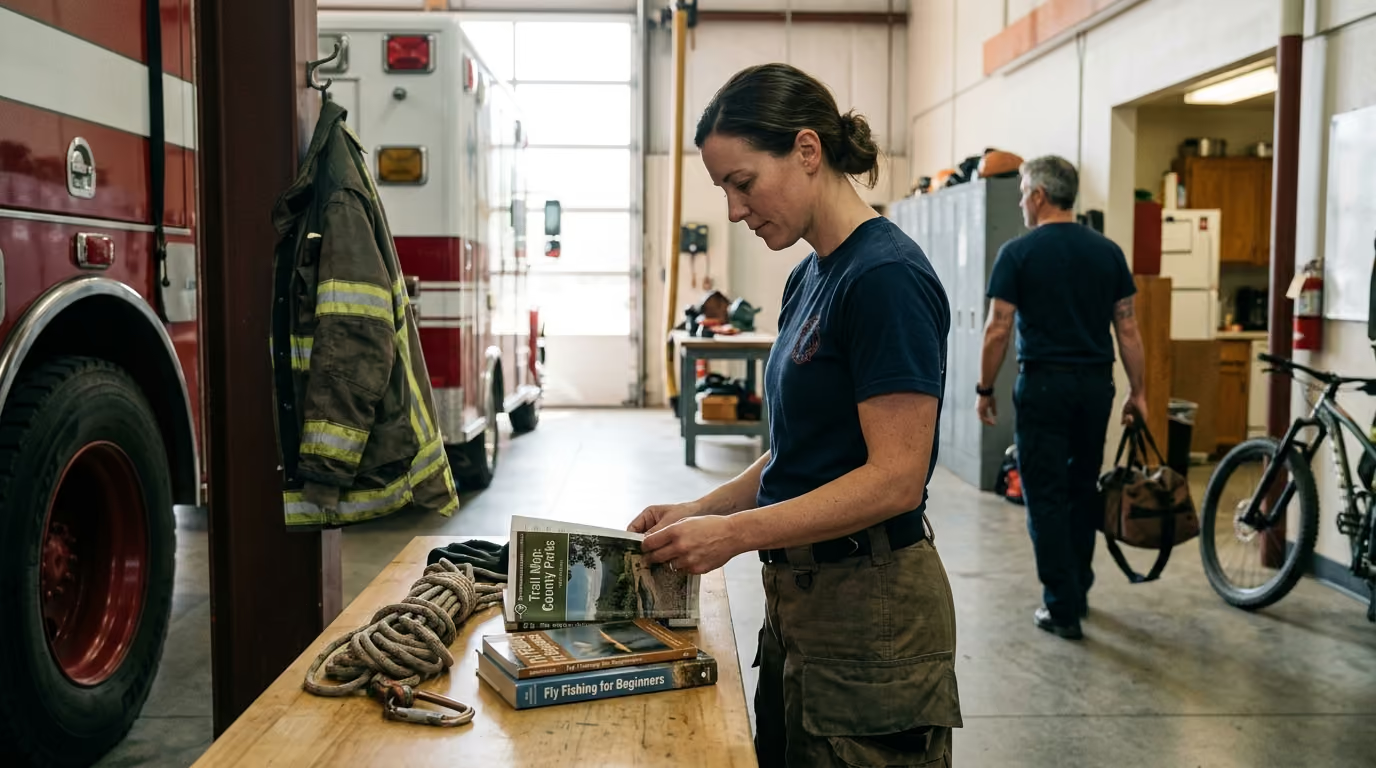

Sustainable sports and active hobbies help former emergency responders protect vulnerable joints, manage recovery costs, and maintain long-term physical health after service.





Many personnel leaving emergency service assume that the best post-duty hobby is the one that most closely mimics the physical intensity or adrenaline of the job. In practice, choosing an activity simply because it tests maximum work capacity is often the fastest route to re-injury, chronic fatigue, and quiet abandonment. A sustainable post-service pursuit is not an endurance test or a proof
of former operational fitness. It is a repeatable, enjoyable practice that respects old injuries, supports nervous system recovery, and fits the practical realities of daily life outside emergency response.
Building a durable recreational routine requires moving past the instinct to treat every workout as a shift readiness test. The primary goal after years of physical strain, night calls, and high-stakes demands is developing movement patterns that maintain physical independence and personal fulfillment for decades.
Recreational exercise does not occur in a physiological vacuum. Years spent lifting stretchers, wearing heavy structural turnout gear, managing combative individuals, or sitting in patrol vehicles accumulate physical wear. When personnel transition toward career longevity and life after service, they carry this mechanical history directly into their leisure pursuits.
Research examining emergency personnel highlights this cumulative load. In studies of active firefighters, high occupational physical activity was strongly associated with the onset and duration of musculoskeletal disorders across multiple body sites. Meanwhile, excessive leisure-time intensity in individuals already managing occupational wear increased problem rates in specific joints. Occupational fitness can protect against acute hazards, but combining high duty stress with unmanaged, aggressive recreational training frequently accelerates joint degeneration.
Data from the City of Cape Town Fire and Rescue Service illustrates how common these joint issues are across an active population. Investigators documented an overall musculoskeletal injury prevalence of 27.4 percent among operational firefighters. Shoulder injuries formed the largest single category, accounting for 35.3 percent of reported problems, followed by multiple concurrent joint injuries at 26.5 percent, and back issues at 14.7 percent. When researchers evaluated activity levels, those reporting active musculoskeletal injuries participated in significantly less vigorous leisure exercise than uninjured colleagues.
These findings point to an underlying reality: injury often forces inactivity if an individual relies only on all-or-nothing forms of recreation. If a person only knows how to train at maximum intensity, an irritated shoulder or arthritic knee halts all physical activity. A sustainable recreational plan distributes physical stress sensibly. It balances cardiovascular health against joint wear rather than loading the exact same tissues that were stressed on duty.
The World Health Organization outlines clear baseline targets for adult physical health. Current guidelines advise accumulating 150 to 300 minutes of moderate-intensity aerobic physical activity per week, or 75 to 150 minutes of vigorous aerobic activity, or an equivalent combination. The guidelines also recommend muscle-strengthening activities that involve all major muscle groups on two or more days each week. Meeting these standards does not require punishing physical extremes. Approaching these benchmarks through moderate, repeatable activities protects cardiovascular and metabolic function without driving joints into flare-ups.
A major mental hurdle for former first responders is separating single-session capability from weekly sustainability. A retired paramedic or former police officer may still possess the aerobic engine and mental tolerance required to complete a grueling 20-mile mountain march, a heavy powerlifting session, or a high-intensity circuit. However, being able to survive a brutal physical session on Saturday does not mean that session is good for your health if it leaves you couch-bound, inflamed, and irritable until Wednesday.
Sustainable recreation is defined by repeatable participation. A viable long-term sport or hobby meets distinct criteria:
Relying on sheer willpower to power through physical deterioration is a common trap in emergency services culture. Understanding how individual willpower fails to overcome cumulative fatigue helps explain why aggressive exercise routines often collapse after retirement or career transitions. When external operational accountability vanishes, purely punitive workouts lose their purpose.
Long-term durability depends on multicomponent fitness. Instead of chasing a single performance metric, such as a maximum bench press or a rapid 5-kilometer run time, sustainable recreation balances several distinct physical traits:
For older adults and individuals with extensive injury histories, health agencies specifically advise integrating varied multicomponent training emphasizing functional balance and strength on three or more days per week. Adopting this philosophy early allows former responders to preserve their physical autonomy. The focus shifts from proving toughness to maintaining fluid, pain-free movement across the lifespan.
Selecting a new hobby or sport should not be an impulsive purchase based on what a colleague is doing. Emergency service personnel benefit from systematic decision-making tools. The SUSTAIN model offers a structured framework to evaluate any candidate sport, recreation, or outdoor activity before committing significant time and financial resources.
Begin with an honest evaluation of current joint mechanics, pain patterns, and cardiovascular parameters. Review past surgeries, disc herniations, rotator cuff tears, knee reconstructions, and chronic soft-tissue limitations. Screen for warning signs that demand formal clinical clearance, including exertional chest discomfort, unexplained shortness of breath, dizziness, or new neurological symptoms such as tingling and numbness. If you have been completely inactive, starting with low-to-moderate intensity pursuits is safer than jumping into explosive movements.
Identify what you genuinely want the activity to provide. Some individuals seek quiet decompression, time alone in natural environments, and freedom from high-stimulation noise. Others need the camaraderie, structured competition, and team banter they experienced in the station or squad room. If your primary goal is stress relief, selecting an intense, highly competitive sport with strict league schedules may backfire. Matching the pursuit to your internal psychological needs is essential for lasting adherence.
Evaluate the specific physical toll the activity extracts from your body. Consider the impact on joint surfaces, the degree of axial spinal loading, the demands placed on the rotator cuff, and the degree of eccentric muscle soreness generated. Account for environmental stressors such as heat exposure, cold water, and travel fatigue. An activity with an exceptionally high recovery cost must be balanced by multiple rest days, which may limit how frequently you can enjoy moving.
Examine how easily the sport can be modified on days when you feel stiff, tired, or short on time. A sustainable pursuit allows you to shorten sessions, reduce velocity, use flatter terrain, or rely on supportive equipment without abandoning the workout entirely. Activities that can only be performed at maximum speed or with heavy loads offer limited flexibility as you age or navigate minor flare-ups.
Evaluate the practical friction associated with the hobby. Consider travel distance to trailheads, boat ramps, climbing gyms, or playing fields. Calculate the true financial investment, including initial equipment purchases, periodic maintenance, licenses, and facility memberships. Consider whether local seasonal weather restricts participation for months at a time. An activity located fifteen minutes from your front door will almost always show better multi-year adherence than a superior sport requiring two hours of driving.
Determine whether the social environment matches your preferences. Some former responders thrive in structured club environments with scheduled practices and clear hierarchies. Others experience group obligations as an exhausting echo of duty schedules and prefer completely solo pursuits. If you choose a group activity, ensure the social culture values longevity, mutual support, and general enjoyment rather than aggressive posturing or reckless risk-taking.
Ask whether the activity offers a clear scaling ladder for future decades. Can aggressive road cycling evolve smoothly into gravel riding, rail-trail touring, or electric-assisted cruising? Can competitive powerlifting shift toward supportive resistance machines and dumbbell strength circuits? The best lifelong pursuits can be adapted continuously without requiring you to abandon the community or skill base you have built.
Aerobic activities based in outdoor environments offer exceptional physical and psychological benefits. They build cardiorespiratory health, expose individuals to natural sunlight and greenery, and provide clear feelings of autonomy. However, each endurance pursuit carries distinct biomechanical demands and injury risks that former responders must navigate carefully.
Walking and trail hiking are among the most accessible forms of outdoor recreation. They offer natural progression across distance, elevation, and terrain complexity while requiring minimal specialized equipment beyond supportive footwear. Trail hiking challenges ankle stability, strengthens the posterior chain, and stimulates balance mechanisms through uneven ground contact.
The primary risk in hiking comes from rapid elevation changes and excessive pack loads. Downhill walking places significant compressive loads across the patellofemoral joint and requires sustained eccentric braking from the quadriceps. Former emergency personnel frequently make the mistake of loading heavy military-style rucksacks immediately, recreating the spinal compression and knee stress of structural turnout gear or tactical vests.
To make hiking sustainable over decades, follow clear guidelines:
Cycling provides robust cardiorespiratory conditioning with minimal ground impact forces. It allows individuals to cover substantial distances, explore regional trail networks, and join organized social groups. Because body weight is supported by the saddle, handlebars, and pedals, cycling is often well tolerated by individuals with knee meniscus wear, hip labral issues, or lumbar disc problems that make running painful.
Despite low impact, cycling is not free from physical stress or injury risk. Systematic reviews of cycling injuries show that soft-tissue abrasions, lacerations, contusions, and hematomas account for 40 to 60 percent of recorded cycling trauma, largely resulting from falls or collisions. Furthermore, poor bicycle fit can cause chronic overuse pain in the cervical spine, lumbar region, wrists, and knees.
Making cycling sustainable requires addressing both mechanical setup and environmental hazards. Prioritize dedicated gravel paths, rail trails, and traffic-separated greenways over busy highways. Invest in a professional bike fit that emphasizes an upright, neutral spine rather than an aggressive aerodynamic tuck.
Electric-assist bicycles (e-bikes) represent an outstanding tool for career longevity. E-bikes allow individuals with cardiac limitations, joint degeneration, or mismatched fitness compared to a partner to modulate hills and head winds easily. They keep people riding consistently across challenging topography without forcing joint strain.
Paddling sports connect participants to waterways, offering calm environments that promote psychological decompression. Maneuvering a kayak, canoe, or paddleboard builds core rotational control, latissimus dorsi endurance, scapular stability, and postural awareness. For former responders who miss technical equipment mastery and purposeful navigation, paddling provides a rewarding focus.
Paddling is often incorrectly categorized as a gentle, low-demand activity. Repetitive forward stroke mechanics, overhead bracing, and torso rotation place intense demands on the glenohumeral joint, rotator cuff tendons, and cervical spine. In individuals with previous shoulder subluxations, AC joint separations, or cervical disc pathology, high paddling volume or poor form can trigger severe flare-ups. Cold water exposure and capsizing also introduce environmental safety risks.
To build a durable paddling habit:
Cardiorespiratory endurance represents only one half of physical longevity. Preserving lean muscle mass, bone mineral density, and reactive joint stability requires dedicated resistance training. At the same time, many former first responders miss the locker-room culture, operational teamwork, and lighthearted competition of station life. Balancing individual strength development with structured group sports requires clear boundaries.
Strength training is the ultimate protective intervention for aging connective tissue. Well-structured resistance programs stimulate muscle protein synthesis, reinforce tendon insertion points, increase bone density, and preserve movement mechanics. The World Health Organization recommends that all adults perform major muscle-group strengthening at least twice weekly.
The primary pitfall for former emergency personnel in the gym is chasing obsolete performance numbers. Attempting to match maximum lifts achieved at age twenty-five while managing fifty-year-old spinal discs and worn shoulder labrums is a common error. Strength training for long-term health should prioritize movement competency and joint preservation over absolute barbell weight.
Adopting the principles of minimum effective dose training allows individuals to maintain muscle mass without exhausting their systemic recovery capacity. Focus on fundamental movement patterns rather than specific competitive lifts:
Always leave one to three repetitions in reserve on working sets. Avoid routine training to muscular failure, which sharply increases connective tissue strain and prolongs systemic recovery times. If an exercise causes joint discomfort during or after the session, swap the movement variation immediately.
Participating in recreational team sports such as soccer, softball, ice hockey, basketball, or touch rugby can fill the social and competitive void left by emergency service. Team sports provide scheduled social connection, playful banter, shared tactical goals, and high-energy interaction. Research on group exercise adherence confirms that social connectedness and shared identity are powerful drivers of lifelong physical activity.
However, team sports carry the highest acute injury incidence of all recreational activities. The mechanics of team sports require unpredictable acceleration, violent deceleration, rapid lateral cutting, jumping, and physical collisions. While an individual may possess excellent linear cardiovascular fitness from cycling or rowing, their tendons, ligaments, and adductors may be completely unconditioned for sudden lateral shearing forces.
Former responders frequently experience Achilles tendon ruptures, hamstring tears, and knee ligament sprains during their initial return to recreational team leagues. To participate safely in team environments:
Recreational physical activity does not need to be strenuous to deliver profound health benefits. High duty loads, chronic sleep fragmentation, and operational wear often leave former responders with heightened baseline sympathetic nervous system tone. Restorative, low-impact pursuits offer vital parasympathetic recovery while maintaining joint mobility, balance, and daily caloric expenditure.
The World Health Organization explicitly notes that replacing sedentary time with physical movement of any intensity produces meaningful health improvements. For individuals managing significant osteoarthritic changes, chronic spinal pain, or systemic burnout, restorative activities often represent the most reliable, sustainable foundation for physical recreation.
Aquatic exercise removes gravitational compressive forces from the spine, hips, and knees. Water buoyancy allows individuals with severe lower-extremity osteoarthritis or spinal stenosis to perform continuous cardiovascular work, leg kicking, and walking drills that would be impossible on dry land. Water resistance also provides smooth, accommodating resistance in every plane of motion.
For individuals with chronic shoulder pathology, standard freestyle swimming can sometimes trigger subacromial impingement due to repetitive overhead internal rotation. In these cases, water walking, aqua jogging with a flotation belt, breaststroke, or targeted kickboard drills provide excellent conditioning without overstressing the rotator cuff.
Mind-body movement modalities combine gentle physical postures, controlled breathing, and concentrated mental focus. Pilates develops deep core stabilization, pelvic control, and spinal articulation. Adapted yoga improves active joint range of motion, down-regulates hyperarousal, and relieves chronic muscular guarding resulting from years of carrying heavy gear.
Tai Chi is exceptionally effective for fall prevention, dynamic balance, and postural control. Health guidelines emphasize multicomponent balance and functional movement for older adults, and Tai Chi systematically challenges weight-shifting, foot placement, and vestibular integration. These low-velocity, controlled practices cultivate body awareness, helping former personnel recognize muscle tension and joint compensation before acute injuries occur.
Recreation does not have to look like a structured sport or formal exercise class. Purposeful outdoor pursuits such as landscaping, vegetable gardening, woodworking, trail maintenance, and wildlife habitat restoration provide substantial physical activity. These hobbies involve frequent kneeling, squatting, carrying moderate loads, bending, and walking over varied ground.
Functional hobbies provide tangible, visible results. A former responder who finds stationary gym workouts boring and pointless often thrives when spending three hours building a garden terrace or clearing local nature trails. The physical movement becomes a natural byproduct of engaging in meaningful, productive work.
Leaving an emergency service career involves a profound psychological and cultural transition. First responder work provides a comprehensive identity, built-in social status, clear operational missions, and daily camaraderie. When personnel retire or transition to other fields, the sudden loss of this social ecosystem can feel disorienting.
Recreational pursuits often serve as the primary bridge during this identity transition. Sociological research on retired firefighters shows that maintaining diverse group memberships and finding new avenues for social identification are critical predictors of life satisfaction and emotional wellbeing. A sport or hobby can replace several structural functions previously provided by the job:
However, former emergency personnel must navigate group dynamics carefully. Many responders experience persistent hypervigilance, social fatigue, or mild sensory overload when placed in large, loud, unstructured civilian groups. If a recreational environment feels chaotic, dismissive, or excessively competitive, it may increase stress rather than relieve it.
Finding healthy community support involves recognizing the difference between constructive shared passion and toxic bravado. You can learn more about establishing supportive social boundaries by exploring how emergency response systems build shared support without falling into destructive tough-it-out mentalities.
Some individuals genuinely need quiet, solitary hobbies to decompress after decades of high-noise, high-stimulation duty calls. Choosing solo fly-fishing, solo road cycling, or individual woodworking is not a sign of unhealthy isolation if it brings mental clarity, restorative rest, and personal satisfaction. The key is matching the social dosage of the hobby to your current emotional needs.
Committing to a new hobby should not require an immediate lifetime contract or a major financial expenditure on high-end equipment. The most reliable method for finding sustainable recreation is treating every new candidate pursuit as a low-stakes, two-week practical experiment.
Rent equipment, borrow gear from friends, or buy basic entry-level items during this testing phase. Execute two to three moderate-intensity sessions per week, and systematically track how your body and mind respond.
After completing your two-week trial, evaluate the activity across ten core criteria. Rate each dimension on a scale from 1 (poor/difficult) to 5 (excellent/favorable):
Total the scores across all ten categories. An activity scoring 40 points or higher represents a highly sustainable primary hobby. A score between 28 and 39 indicates a viable secondary pursuit that may require specific mechanical modifications or equipment adjustments. A score below 28 suggests the activity carries excessive friction, injury risk, or recovery costs, and should likely be reconsidered.
Once you establish a regular recreational routine, use a simple traffic-light protocol to guide daily training intensity and manage flare-ups.
A durable lifestyle routine does not depend on a single sport to meet all physical, psychological, and social needs. Structuring your week around three complementary movement layers provides variety, reduces repetitive tissue strain, and ensures consistency even when life disruptions occur.
If an injury, bad weather, or travel temporarily shuts down your "Meaning Layer," the Foundation and Capacity layers keep your body healthy and conditioned until you return to your primary hobby.
Self-management and sensible progression are foundational for lifelong recreation. However, former emergency personnel must avoid the common trap of trying to self-treat complex orthopedic, neurological, or cardiovascular conditions. If you are navigating persistent pain, our injury and recovery guidance offers further frameworks for structured rehabilitation.
Certain clinical presentations require formal evaluation by licensed healthcare professionals before continuing recreational sports:
Never attempt to push through severe symptoms, mask progressive joint deterioration with high doses of anti-inflammatory medications, or return to high-risk sports when balance, vision, or cognitive clarity are compromised. True professional capability means knowing when to involve clinical specialists to safeguard your long-term health.
Choosing the right sports and hobbies after leaving emergency service is an investment in your career longevity and personal freedom. Matching physical activities to your current joint capacity, recovery limits, and internal values ensures that movement remains a source of lasting vitality rather than ongoing breakdown.
Stay connected for research-led guidance on duty fitness, shift-work sleep, injury recovery, stress, nutrition and career longevity. Practical ideas for first responders who want to stay capable on the job, recover well and protect their health for the long run.



Read practical guidance on first responder fitness, recovery, sleep, nutrition and resilience for demanding work and a long, active career.
read the blog



