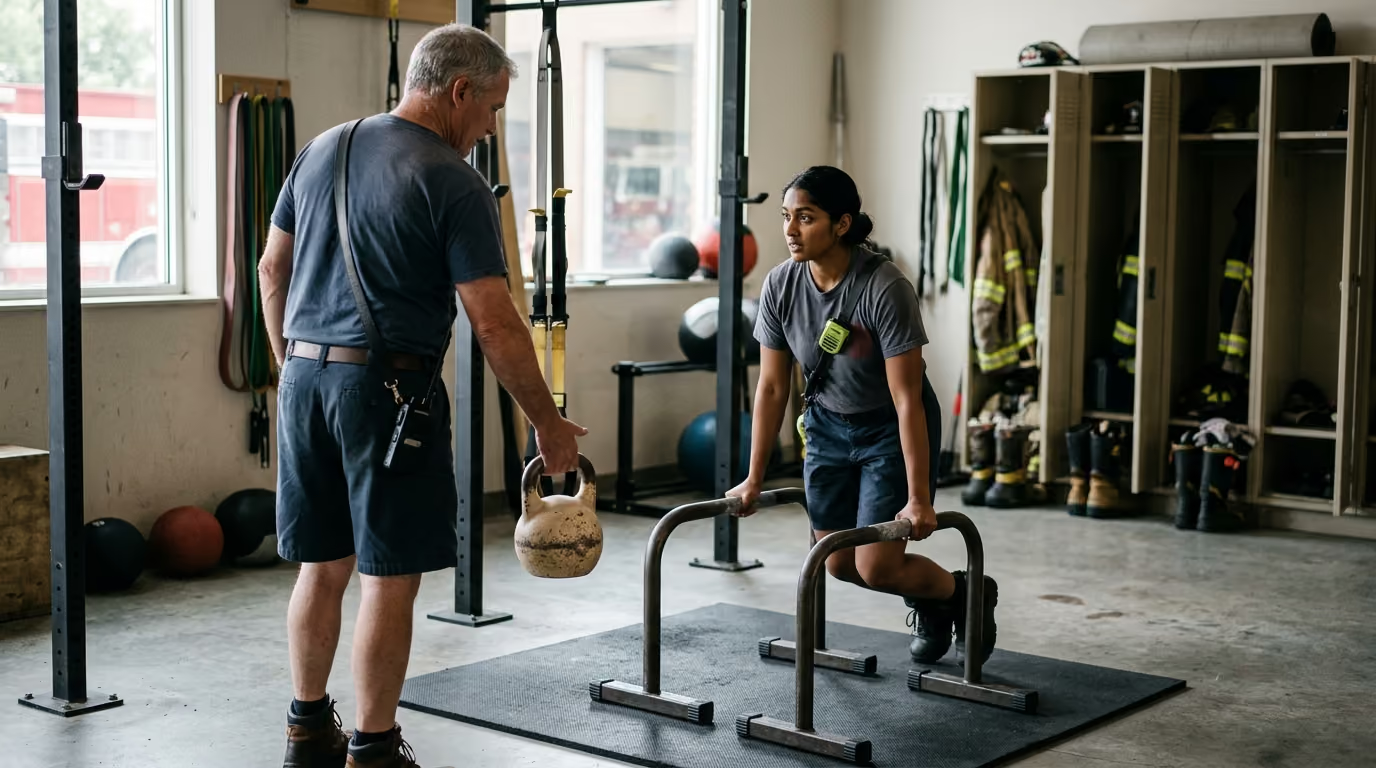

Strength training equipment for first responders ranges from barbells to sleds, offering practical ways to build job-specific power without worsening operational fatigue.





Many emergency service professionals believe that building operational capability requires specialized tactical equipment or an elite barbell facility. In reality, biological systems adapt to mechanical tension, joint velocity, and metabolic stress regardless of the brand name stamped on a weight plate. The most elaborate gym setup is worthless if equipment requires excessive setup time, demands high technical skill during severe sleep debt, or sits unused in a crowded station bay.
The most effective equipment is not the tool that yields the highest single-lift gym score. It is the tool that consistently develops strength, power, work capacity, and joint resilience within the chaotic constraints of shift work. Barbells, dumbbells, kettlebells, cable systems, machines, sleds, bands, and body weight each offer distinct physical adaptations, logistical trade-offs, and recovery costs. Matching the right tool to the right operational objective allows first responders to maintain physical readiness without compromising duty performance.
Peer-reviewed exercise science demonstrates that muscular adaptations depend primarily on mechanical tension, volume, and effort rather than the specific implement used. Current strength training guidance from the American College of Sports Medicine establishes that free weights, machines, body weight, and elastic bands can all develop muscular strength, hypertrophy, and functional capacity when programmed with progressive overload.
Systematic reviews comparing free weights and resistance machines reveal that both modalities produce comparable gains in muscle hypertrophy and general strength. Research shows that strength gains are largely specific to the testing modality. Trainees who practice on barbells test better on barbell tests, while trainees who use machines test better on machine tests. When neutral testing devices measure strength, free weights and machines produce nearly identical outcomes without differences in joint discomfort.
For maximal absolute strength development, Bayesian network meta-analyses indicate that heavier loads above 80 percent of a one-repetition maximum yield the greatest improvements. Hypertrophy occurs across a wide spectrum of loading ranges, provided sets approach a meaningful level of muscular fatigue. Research on elastic resistance confirms that bands produce functional strength improvements across various populations, serving as a viable training tool when external iron is unavailable.
Current exercise science also questions the necessity of training to absolute muscular failure. Evidence indicates that routinely taking sets to failure does not produce superior strength or hypertrophy compared to leaving one to three repetitions in reserve. For emergency personnel, avoiding absolute failure preserves movement quality, limits central nervous system fatigue, and prevents severe delayed-onset muscle soreness that could impair on-duty response.
First responders face physical demands that differ sharply from traditional athletes. Firefighters, law enforcement officers, and paramedics rarely experience scheduled, predictable physical exertion. Instead, personnel must endure extended sedentary periods in vehicles or stations, interrupted abruptly by high-intensity physical tasks requiring rapid force production, awkward carrying, and sustained bracing.
Occupational physical loads create substantial metabolic and mechanical stress. General patrol officers routinely carry duty belts and body armor weighing approximately 10 kilograms. Structural firefighters operate in protective gear and self-contained breathing apparatus weighing roughly 22 kilograms, while specialized tactical police units may carry between 20 and 40 kilograms of operational equipment. Operating under these external loads increases joint impact, elevates cardiovascular strain, and demands high levels of relative strength and trunk stability.
Musculoskeletal injury data highlight the vulnerabilities created by operational duties. Epidemiological studies show that back, shoulder, and knee pain represent the most common musculoskeletal complaints among firefighters, with overall injury prevalence estimates ranging from 9 percent to 74 percent across departments. Lower extremities and the lumbar spine consistently rank as primary injury sites. When shift schedules cause circadian strain and sleep disruption, neuromuscular coordination and recovery capacity decline, increasing injury susceptibility during heavy physical training.
Because shift work disrupts recovery, training equipment selection must account for daily operational fatigue. Using tools that require high technical stability and balance can become counterproductive following broken sleep or strenuous night calls. Selecting tools that offer external stability, low setup times, and joint-friendly movement paths allows personnel to maintain a training program around shift rotations without adding unnecessary injury risk.
Barbells represent the traditional standard for developing absolute bilateral strength. They allow precise, micro-loaded weight progressions and support high external loads across fundamental movement patterns such as the squat, deadlift, bench press, overhead press, and row.
Barbells are particularly useful for building whole-body force reserves, strengthening the posterior chain for heavy lifts or drags, and conditioning the trunk to brace under axial loads. Progressive loading above 80 percent of a one-repetition maximum is easiest to execute systematically with a barbell and plate set.
The trade-offs involve space, setup time, and technical complexity. Barbells require a dedicated squat rack, platform space, safety spotter arms, and plate storage. Setting up and warming up for heavy barbell lifts demands significant time, which can prove difficult during on-shift workouts subject to sudden dispatch tones. Heavy bilateral spinal loading can also pose excessive recovery demands for responders dealing with acute fatigue or lumbar irritation.
Use barbells during structured off-duty blocks, dedicated academy training, or well-rested shift days where the primary goal is developing foundational force capacity. Limit their use when training under severe sleep debt or in cramped station gym bays.
Dumbbells provide exceptional versatility by enabling both unilateral and bilateral training across every major movement plane. They require each limb to stabilize and produce force independently, which helps identify and resolve side-to-side strength asymmetries common in tactical personnel.
Dumbbells excel at unilateral leg training, including split squats, reverse lunges, and high step-ups that mimic stair climbs under load. They are ideal for loaded carries, such as the farmer's walk and single-arm suitcase carry, which build grip endurance and lateral trunk stiffness. Dumbbells also permit natural joint rotation during pressing and pulling, making them gentler on the shoulders, wrists, and elbows than fixed bars.
The main limitation of dumbbells is the progression ceiling. Fixed-weight dumbbell racks consume substantial floor space and often advance in large increments, making upper-body micro-progression difficult. Heavy dumbbells can also become unwieldy to clean into position for overhead or bench pressing without a training partner.
Dumbbells serve as the primary foundational tool for station gyms, residential home gyms, and quick-transition circuits. They allow responders to execute high-value unilateral strength and carry drills without extensive setup or spotter requirements.
Kettlebells feature a displaced center of mass and an open handle design that supports ballistic swinging, clean-and-press movements, and dynamic carrying variations. They combine strength, power endurance, and trunk stability within a compact footprint.
Kettlebells are particularly effective for developing hip-hinge power through swings and snatches without requiring the complex technical coaching of Olympic barbell lifts. Movements like the Turkish get-up, goblet squat, and front-rack carry challenge rotational trunk control and shoulder stability in positions relevant to emergency extraction. A kettlebell circuit allows responders to train aerobic and anaerobic energy systems simultaneously in a small space.
Ballistic kettlebell movements are highly technique-dependent. When personnel perform high-repetition swings or snatches under operational fatigue, technical breakdown can place adverse shear stress on the lumbar spine and shoulders. Kettlebells are also less suitable for precise, heavy absolute strength loading due to fixed jump sizes.
Use kettlebells for power endurance, grip conditioning, hip extension power, and compact station workouts. Teach the fundamental hip hinge and deadlift mechanics thoroughly before progressing responders to ballistic swings or complex overhead lifts.
Resistance machines guide the user along a predetermined movement path while providing built-in external stability. Common machine types include the leg press, hack squat, chest press, lat pulldown, seated cable row, leg extension, and lying hamstring curl.
Machines excel at isolating target muscle groups and accumulating hypertrophy volume with minimal technical coordination. Because the apparatus stabilizes the load, responders can train target muscles close to fatigue without the balance demands or spinal compression of free weights. Machines are valuable for safely strengthening the quadriceps, hamstrings, and upper back following demanding shifts or during musculoskeletal rehabilitation.
The primary drawback of machines is their lack of movement freedom. Fixed paths may not accommodate every individual limb length or joint structure, potentially causing localized discomfort. Machines require substantial floor space, significant financial investment, and regular maintenance, making them difficult to house in smaller emergency stations.
Incorporate machines to safely accumulate training volume, target specific muscle groups without spinal loading, or maintain strength stimulus when systemic fatigue makes free-weight balancing impractical.
Cable machines use weight stacks or plates connected through adjustable pulleys to deliver continuous, omnidirectional resistance throughout a movement arc. They combine the safety of guided resistance with the movement freedom of free weights.
Cables are uniquely valuable for training rotary and anti-rotary trunk stability through exercises like the Pallof press, wood chops, and diagonal lifts. They allow customized pressing and pulling angles that match individual shoulder mechanics, supporting long-term joint health. Cable-resisted marching, rows, and face pulls reinforce postural integrity for personnel who spend prolonged hours seated in apparatus cabs or patrol cruisers.
Cable stations require dedicated vertical wall or floor space and specialized attachments. Resistance levels cannot be compared across different pulley ratios, making absolute load tracking specific to a single apparatus. Cable machines are rarely portable and represent a moderate financial investment for station facilities.
Deploy cables as the premier modality for trunk anti-rotation, shoulder prehabilitation, multi-angle pulling, and low-impact joint conditioning.
Push and pull sleds provide ground-based horizontal resistance with minimal eccentric muscle loading. They allow responders to generate forceful lower-body drive in forward, backward, and lateral directions.
Sled work directly reinforces the mechanics of hose advancement, charged-line pulling, and casualty dragging. Backward sled drags place high metabolic demand on the quadriceps while placing minimal stress on the lower back and knees, making them an exceptional conditioning and knee-rehabilitation tool. Because sled training involves almost no eccentric deceleration phase, it generates minimal muscle damage and soreness, preserving on-duty physical readiness for subsequent shifts.
Sled resistance is heavily dictated by surface friction. A load that slides smoothly on specialized turf may prove immovable on rubber matting or rough asphalt. Sleds require long runway spaces, which may be unavailable inside tight firehouse bays or standard gym rooms.
Use sleds for conditioning intervals, horizontal force production, and lower-body strength endurance. Standardize surface conditions, distances, and rest intervals rather than relying solely on plate numbers to measure progression.
Body-weight training uses the individual's mass against gravity through movements such as push-ups, pull-ups, dips, inverted rows, step-ups, split squats, crawls, and planks. Calisthenics require minimal or no equipment beyond a sturdy overhead bar.
Body-weight exercises directly develop relative strength, which dictates how easily a responder moves their own frame over obstacles, up ladders, or through confined spaces. Push-up variations, pull-ups, and crawls reinforce shoulder girdle integrity and continuous core bracing. Calisthenics can be performed anywhere at zero financial cost, allowing personnel to train during travel, field deployments, or quiet downtime between calls.
The challenge of body-weight exercise lies in precise load management. Adjusting intensity requires altering leverage, limb elevation, tempo, or range of motion rather than adding small weight increments. For heavier personnel or beginners, full body-weight pull-ups or dips may exceed joint capacity, while advanced trainees may find basic body-weight movements insufficient for maximal strength development.
Calisthenics should form the baseline of every responder's movement practice. Use body-weight drills for dynamic warm-ups, relative strength assessment, travel workouts, and high-density conditioning circuits.
Elastic resistance bands provide variable resistance that increases as the material stretches. They are lightweight, highly portable, and adaptable to virtually any environment.
Bands are exceptionally effective for shoulder external rotation, face pulls, banded pull-aparts, hip abduction walks, and terminal knee extensions. They serve as valuable tools for joint warm-ups, corrective exercise, and active recovery routines. When anchored properly, bands allow personnel to perform horizontal presses, rows, and rotational chops without requiring heavy machinery.
Band resistance is non-linear, providing the least tension at the beginning of a movement and peak tension at terminal contraction. This makes precise load tracking and progressive overload difficult to quantify systematically over time. Bands can also wear out, snap, or slip if anchored around abrasive surfaces, creating a minor safety hazard.
Keep resistance bands in duty bags, apparatus storage compartments, and station gym areas. Use them primarily for movement preparation, rotator cuff conditioning, accessory joint work, and travel-friendly training sessions.
Programming strength training for tactical personnel requires mapping specific occupational tasks to corresponding movement patterns and equipment options. Rather than trying to perfectly mimic a job task in the gym, select equipment that develops the underlying force, velocity, and bracing requirements of that movement.
When structuring a comprehensive plan, utilize established strength and conditioning resources to balance general physical qualities with task-specific patterns across the training year.
Real-world emergency schedules demand flexible programming structures that accommodate varied gym setups, available time windows, and fatigue levels. The following five operational scenarios demonstrate how to deploy equipment effectively under common real-world constraints.
Many firehouses and police substations provide limited equipment consisting of a basic dumbbell set, several kettlebells, a pull-up bar, resistance bands, and open bay floor. The goal in this environment is achieving a total-body training stimulus with minimal setup and zero clutter.
This layout builds unilateral leg strength, horizontal pressing, vertical pulling, hip power, and lateral trunk control. It requires only two pairs of dumbbells, one kettlebell, and a pull-up bar.
During off-duty days or dedicated station workout blocks where full facilities are accessible, personnel can prioritize absolute force production using barbells and heavier loading.
This session utilizes barbells for compound strength development while finishing with joint-friendly sled drags and cable core work that avoid excessive spinal fatigue.
When personnel are recovering from a busy night shift with disrupted sleep, technical barbell lifting introduces unnecessary injury risk. A low-fatigue session uses machines, cables, and supported positions to preserve muscular stimulus while minimizing balance and spinal demands.
This approach maintains muscular volume and joint circulation without taxing the central nervous system during acute sleep deficit.
When deployed on wildland fire assignments, out-of-town tactical training, or travel without gym access, personnel must maintain fitness using minimal portable gear. A pair of resistance bands and body weight provide a complete training stimulus.
Altering movement tempos, lever lengths, and range of motion preserves strength and core stability without external iron. Responders looking to streamline their program during high-tempo periods can review strategies for short dose training sessions to keep volume manageable.
When an entire crew or shift trains simultaneously in an apparatus bay, equipment must accommodate varying fitness backgrounds, body sizes, and injury histories. A multi-station circuit with timed intervals allows every individual to work at their appropriate intensity.
Circuits allow scalable progressions at each station. Newer personnel can perform box step-ups and band rows, while experienced responders use heavy goblet squats and loaded cable rows.
Emergency service fitness culture often falls victim to dogmatic thinking regarding training tools. Avoiding common equipment misconceptions ensures programming remains practical and aligned with operational goals.
A persistent myth suggests that free weights are inherently functional while resistance machines are entirely useless for athletic performance. Functional capability is defined by whether a physical adaptation supports duty tasks, not by whether the tool looks rugged. A leg press that safely builds quadriceps strength in an officer managing back pain is highly functional. Free weights and machines should be viewed as complementary tools across a career.
Attempting to make gym exercises look identical to emergency tasks often degrades both training quality and safety. Swapping heavy dumbbells for a full rescue mannequin during everyday strength sets adds awkward instability without allowing progressive overload. Build foundational strength, grip, and power using standardized gym equipment, then practice specific job skills during structured drills.
Turning every training session into a maximal metabolic challenge creates chronic fatigue that competes with duty performance. Consistently pushing sets to muscular failure degrades technical form and extends recovery time. Prioritize consistent movement quality and leave several repetitions in reserve during routine duty training.
Believing that effective training requires one specific brand or implement limits long-term consistency. If a barbell is unavailable, heavy dumbbells or sleds provide an outstanding lower-body stimulus. If dumbbells are occupied, cables and body-weight progressions maintain strength. Focus on loading fundamental movement patterns rather than relying on a single piece of equipment.
Responders who struggle to balance fatigue across demanding shifts can benefit from adjusting workouts to daily readiness, matching session intensity to real-time recovery status.
Resistance training is fundamentally safe when executed with proper technique and progressive loading. However, the intersection of irregular shift work, physical job stress, and high training volume introduces important safety considerations.
Training through acute musculoskeletal pain, joint swelling, or sharp neurological symptoms is counterproductive. If an exercise causes joint irritation, modify the movement path, switch equipment from a barbell to dumbbells or cables, reduce the range of motion, or lower the external load. Never sacrifice movement quality or train through acute joint pain simply to complete a written workout.
Fatigue management is critical for operational safety. Never perform heavy, technically complex free-weight lifts or high-velocity power drills when severe sleep deprivation impairs balance, alertness, or coordination. In states of extreme fatigue, switch to supported machine exercises, light body-weight circuits, mobility drills, or prioritize rest. Safe duty performance and emergency driving always take precedence over gym milestones.
If you experience persistent joint pain, recurring back spasms, numbness, tingling, or pain lasting longer than two weeks, seek an evaluation from a licensed physical therapist or qualified medical professional. A licensed clinician can diagnose underlying pathology, address tissue limitations, and provide structured rehabilitation protocols to restore full capability. Investing in foundational health supports long-term duty fitness development across an entire working lifespan.
Sustainable capability across a long emergency services career comes from consistently loading fundamental movement patterns with appropriate tools, matching training demands to operational reality, and protecting long-term physical health.
Stay connected for research-led guidance on duty fitness, shift-work sleep, injury recovery, stress, nutrition and career longevity. Practical ideas for first responders who want to stay capable on the job, recover well and protect their health for the long run.



Read practical guidance on first responder fitness, recovery, sleep, nutrition and resilience for demanding work and a long, active career.
read the blog



