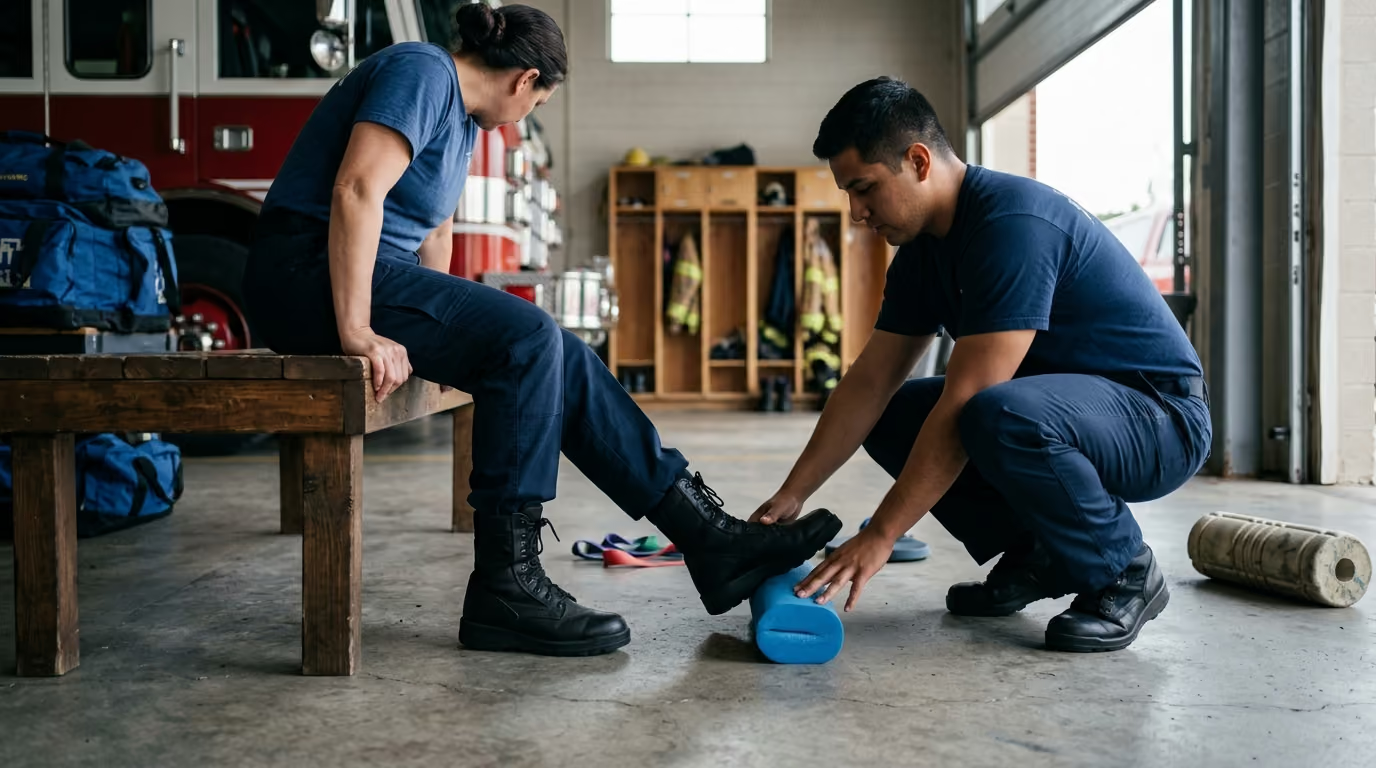

Long-term duty readiness and reduced ankle sprain risks come from strengthening the lower leg against rapid decelerations, heavy loads, and uneven surfaces.





You step down from the apparatus cab onto loose, dark gravel while carrying a heavy equipment bag. Your heel clips a rut in the asphalt, your ankle turns sharply inward, and your full body weight shifts over the outside edge of your boot. That single misstep can mean weeks of modified duty, chronic instability, or compensatory pain up the entire kinetic chain.
Preventing foot and ankle injuries requires building specific tissue capacity to match the extreme mechanical demands of emergency service. Quick fixes like generic gym workouts, passive braces, or soft insoles cannot replace targeted calf strengthening, dynamic balance training, progressive boot conditioning, and structured return to duty protocols.
Data across emergency services show that lower-extremity injuries represent a major portion of occupational trauma and medical leave. Firefighter injury research consistently identifies slips, trips, falls, overexertion, and jumping as primary injury mechanisms. In broader occupational reviews, lower-extremity and back injuries rank as the leading aggregated injury sites across departments.
According to occupational injury reviews, slips, trips, and falls account for roughly 49 percent of all sprain and strain injuries in the fire service. They also account for approximately 43 percent of occupational fractures and dislocations. Sprains and strains remain the dominant injury classification across structural firefighting, emergency medical response, and field operations.
Reports from the U.S. Fire Administration indicate that injuries to the upper and lower extremities account for 41 percent of all fire-related firefighter injuries. Within specified lower-extremity injuries, 54 percent were categorized as strains or sprains. These injuries sideline personnel and create cumulative joint vulnerability that persists across an entire career.
An epidemiological analysis examining 20,987 firefighter lower-extremity injury records between 2014 and 2023 established a clear distribution of anatomical risk:
Research on emergency responders from the Centers for Disease Control and Prevention confirms that sprains and strains predominantly affect the lower trunk, ankle, and knee. These events are most frequently attributed to sudden bodily motion, uneven surfaces, and falls. The evidence supports a prevention strategy that addresses both sudden traumatic events and gradual tissue breakdown from repetitive duty exposure.
When analyzing systemic prevention trials, the evidence for targeted training is robust. A systematic review and meta-analysis of musculoskeletal interventions found that structured balance training produced a 46 percent relative risk reduction for ankle sprains. The same analysis showed that external bracing provided a 64 percent risk reduction among individuals with previous injuries. In athletic field studies involving running and rapid direction changes, neuromuscular training programs reduced ankle injuries by 36 percent per 1,000 exposure hours.
While high-level athletic data provides valuable baseline mechanics, emergency responders operate under different constraints. First responders perform unpredictable movements while wearing heavy, rigid footwear and carrying external loads between 40 and 75 pounds. Integrating this evidence into operational practice requires understanding how structural boots, thermal loads, broken terrain, and shift fatigue modify tissue stress. Exploring injury prevention and physical recovery resources helps bridge athletic research and emergency service demands.
The foot and ankle complex must simultaneously act as a shock absorber, a mobile adaptor to rough terrain, and a rigid lever for propulsion. Emergency service tasks place conflicting biomechanical demands on these structures.
Occupational safety footwear provides indispensable protection against thermal exposure, chemical penetration, puncture wounds, and crushing impacts. Structural firefighting boots, tactical patrol boots, and wildland footwear must meet strict safety standards. However, the protective construction creates unavoidable biomechanical consequences.
A review of occupational footwear literature documented widespread foot discomfort, skin problems, and musculoskeletal strain across high-demand occupations. Symptoms regularly concentrate around the sole, heel, malleoli, calcaneus, and cuboid bones. Heavy protective boots alter normal gait mechanics by restricting ankle range of motion, reducing natural toe extension, and elevating the metabolic cost of movement.
Rigid boot soles prevent normal articulation of the metatarsophalangeal joints during walking and climbing. This rigidity limits the foot's natural windlass mechanism, which normally tensions the plantar fascia to stabilize the medial longitudinal arch. When the sole cannot flex, mechanical stress transfers upward to the Achilles tendon, calf musculature, and anterior compartment of the lower leg.
Tall, stiff boot shafts restrict sagittal plane movement, particularly talocrural dorsiflexion. When ankle dorsiflexion is constrained, the body compensates during squats, lunges, and stair descents by shifting movement demands to the knee and hip. This compensation increases knee valgus collapse and alters lateral foot loading. The extra weight of heavy boots increases the inertia of the lower leg, accelerating muscular fatigue during prolonged foot patrols or extended fireground operations.
First responders regularly operate in low-visibility environments where ground surfaces change without warning. Firefighters navigate wet tile, structural debris, slick vinyl flooring, mud, and charged hose lines. Paramedics and EMTs transport patients across wet lawns, icy steps, gravel driveways, and cluttered domestic spaces. Police officers rapidly transition from smooth vehicle floorboards to broken concrete, grass, and curbs.
A slip occurs when the friction between the boot outsole and the surface falls below the required coefficient of traction. A trip occurs when the swinging foot unexpectedly collides with an obstacle or fails to clear a step edge. Falls frequently combine both mechanisms with visual disruption, shifting patient loads, and delayed muscular stabilization.
Traction is highly surface-specific. A deep, lugged outsole designed for wildland mud may provide poor friction on wet, soapy kitchen tile. Worn outsoles lose their ability to channel liquids away from contact points, increasing hydroplaning risks. When surface cues are obscured by smoke, darkness, or carrying equipment, the central nervous system cannot make anticipatory adjustments to foot placement, forcing the ankle to rely entirely on reactive stabilization.
Emergency response demands rapid transitions from static positions to maximum physical effort. Responders frequently sprint short distances, stop abruptly, change directions, or navigate vertical structures while carrying heavy tools, monitors, or charged hose lines.
Deceleration creates far higher peak forces on the foot and ankle than steady-state running or acceleration. Stopping quickly requires strong eccentric contractions from the gastrocnemius, soleus, and tibialis anterior to absorb momentum. If an ankle lands in an inverted position during braking, the lateral ligament complex experiences extreme tensile strain. The anterior talofibular ligament and calcaneofibular ligament are particularly vulnerable to rupture during combined inversion and plantarflexion.
Stair descent represents one of the most mechanically demanding tasks in emergency response. Descending stairs requires controlled single-leg eccentric loading while gravity accelerates the body downward. Carrying an off-center load, such as a medical bag or hydraulic tool, shifts the responder's center of mass forward and away from the base of support. If ankle dorsiflexion is restricted by a stiff boot, the heel lifts early, forcing the forefoot to absorb the entire impact on the narrow stair tread.
Preventing lower-leg breakdown requires shifting away from isolated, generic exercises toward a systematic capacity-versus-demand framework.
Capacity represents the absolute load, force, volume, range of motion, and fatigue that the lower leg can tolerate without structural breakdown. Demand represents the combined mechanical and metabolic requirements of the shift, including external equipment weight, terrain difficulty, operational speed, and shift duration. Injury occurs when acute or cumulative demand exceeds current tissue capacity.
Building lower-leg resilience requires structured progression across seven core physical dimensions:
The muscular system must generate adequate torque to propel the body and absorb high impact forces during landings or rapid stops. This requires high peak strength in the plantar flexors, dorsiflexors, invertors, and evertors.
The nervous system must rapidly recruit stabilizing muscles around the ankle joint when an unexpected surface perturbation occurs. Proprioceptive pathways from joint mechanoreceptors, muscle spindles, and cutaneous receptors in the foot must respond within milliseconds to prevent joint rolling.
The talocrural, subtalar, and midtarsal joints must possess sufficient active mobility to navigate uneven terrain and steep descents without forcing compensatory joint collapse further up the kinetic chain.
Tissues adapt specifically to the mechanical stress placed upon them. Tendons, ligaments, bone cortex, and muscular compartments require progressive, repeated exposure to duty-specific footwear, stairs, and loaded walking to develop structural density.
Muscular stabilizers lose their firing speed and force capacity as physical fatigue sets in. Conditioning must build local muscular endurance so that the lower leg retains stability during the twenty-third hour of a grueling shift.
Responders cannot rely on flat, predictable gym surfaces. Training must challenge the foot and ankle across variable angles, compliant surfaces, ramps, steps, and restricted spaces.
Tissue adaptation occurs between shifts, not during them. Adequate sleep, proper hydration, active unloading, and tissue care are essential to repair microtrauma before the next tour of duty. Responders can learn to balance training stress and shift recovery by reviewing strategies for managing cumulative fatigue.
The core rule of tissue progression is to advance one variable at a time. Never increase load, speed, volume, and footwear stiffness simultaneously.
A resilient lower leg requires direct training of both large prime movers and small stabilizing muscles. Gym programs that rely exclusively on compound barbell lifts often neglect the specific ankle capacities required for field performance.
The calf complex acts as the primary engine for propulsion and the main shock absorber for the lower extremity. The gastrocnemius crosses both the knee and ankle joints, generating high explosive power when the knee is straight. The soleus crosses only the ankle joint, functioning as a workhorse postural stabilizer and force absorber capable of handling up to eight times body weight during running.
Responders often suffer soleus strains and Achilles tendinopathies because their training focuses entirely on straight-leg calf raises, neglecting the bent-knee position where the soleus dominates:
The human foot contains four distinct layers of intrinsic muscles that support the medial longitudinal arch, stabilize the metatarsals, and dissipate impact forces. Weakness in these small muscles allows excessive pronation, leading to plantar fasciopathy, posterior tibial tendon overload, and shin splints.
Targeted foot training restores active arch control:
Restricted dorsiflexion is a primary contributor to lower-extremity injury. Normal functional movement requires at least 10 to 15 degrees of talocrural dorsiflexion with the knee bent, or roughly 4 to 5 inches of clearance on a standard weight-bearing lunge test.
If the talus cannot glide posteriorly within the ankle mortise during forward knee travel, the body compensates by over-pronating or lifting the heel prematurely. Improving mobility requires combining joint mobilization with soft-tissue lengthening:
Ankle stability depends heavily on proximal control from the pelvis and hip. Weakness in the gluteus medius and deep hip external rotators allows the femur to rotate internally and adduct during single-leg landings, driving dynamic knee valgus and excessive foot pronation.
A complete lower-leg program integrates hip stabilization into closed-chain movement patterns:
Neuromuscular coordination training teaches the body to detect sudden joint displacement and initiate rapid muscular contractions to stabilize the ankle. While balance training has been studied extensively in athletic populations, the principles transfer directly to the unpredictable operating environments of emergency services.
Balance training should progress systematically from stable, predictable environments to unstable, dynamic, and multi-planar tasks.
Begin with static unipedal stability on a solid surface before introducing compliant pads or perturbations:
Quality of movement must always take precedence over duration. If the ankle rolls repeatedly, the hip drops, or the torso sways excessively, the neurological capacity of the system has been exceeded. Step back to a simpler progression to reinforce correct motor patterns.
Footwear represents the direct mechanical interface between the responder and the operating environment. Managing boots, bracing, and skin integrity is just as critical as physical conditioning for injury prevention.
When selecting, evaluating, or issuing occupational footwear, apply a comprehensive five-point audit:
Clinical practice guidelines strongly support prophylactic bracing for individuals with a history of lateral ankle sprains or documented mechanical instability. Meta-analytic data shows up to a 64 percent reduction in recurrent sprains when using external ankle supports during high-demand physical tasks.
Bracing serves as an external mechanical constraint that restricts sudden inversion without significantly limiting functional plantarflexion or dorsiflexion. Semirigid lace-up braces with lateral plastic or metal stays provide the most reliable stabilization inside duty boots.
However, external bracing must never replace comprehensive physical rehabilitation. A brace cannot restore lost dorsiflexion, rebuild calf strength, or recreate proprioceptive feedback loops. Treat bracing as a temporary safety measure during acute return-to-duty phases, or as an operational tool during high-risk field deployments for responders with chronic ligamentous laxity.
Ensure the brace fits comfortably inside the duty boot without creating localized pressure points over the malleoli. Practice wearing the brace-and-boot combination during low-intensity station tasks before deploying on high-intensity operational calls.
Skin breakdown, calluses, maceration, and friction blisters degrade operational capability and alter gait mechanics. When a responder attempts to avoid pressure on a painful blister, they involuntarily limp, shifting unnatural torque to the lateral ankle, knee, and hip.
Maintain lower-leg skin integrity through proactive moisture control:
Returning to emergency service following a lower-leg injury requires a structured, criteria-based progression rather than an arbitrary timeline. While mild grade-1 sprains may resolve in 1 to 2 weeks, severe grade-2 and grade-3 ligament tears, syndesmotic high-ankle sprains, or lower-leg fractures often require 6 to 12 weeks of structured rehabilitation before full operational clearance.
Progress through these five objective stages:
Examining common operational breakdowns helps identify systemic gaps in physical preparation, gear management, and recovery protocols.
A responder maintains excellent general gym fitness, squatting heavy loads and running 5K distances in athletic sneakers. During a multi-alarm fire, the responder ascends three flights of stairs in heavy structural boots while carrying equipment, developing acute Achilles paratendinopathy and anterior shin splints.
A responder sustains a moderate lateral ankle sprain. After 10 days of rest, swelling subsides, and walking feels comfortable. The responder returns immediately to full duty. Two weeks later, while stepping onto an uneven curb, the ankle gives way completely, tearing lateral ligaments and causing a bone contusion.
A wildland firefighter feels localized friction over the posterior heel during the first two miles of an uphill hike. Ignoring the discomfort, the responder pushes forward. By evening, the skin has sheared down to the dermis, creating a deep open wound that becomes infected and forces medical removal from the fire line.
A crew operates inside a multi-story structure for 40 minutes. While carrying heavy equipment down concrete stairs during overhaul, a crew member lands awkwardly on a stair edge, rolling the ankle into severe inversion.
A responder replaces worn, flexible duty boots with a brand-new, ultra-stiff structural boot model and immediately wears them on a 24-hour shift. Within 12 hours, the responder develops severe plantar heel pain, extensor tendonitis across the top of the foot, and calf cramping.
Several persistent training myths undermine foot and ankle resilience across emergency services:
Walking on level, dry surfaces is an exceptionally low-demand movement. Full operational duty requires landing from unexpected heights, braking suddenly on slick surfaces, and carrying shifting loads across broken terrain. Functional clearance requires rigorous, loaded movement testing.
Bracing provides valuable external mechanical support, but it cannot restore active muscular strength, improve joint dorsiflexion, or retrain neuromuscular reaction times. Use bracing as a complement to progressive training, never as a substitute.
Neuromuscular coordination is critical, but the foot and ankle complex must also possess the tissue capacity to generate and absorb substantial physical forces. A complete prevention program must balance proprioceptive drills with heavy eccentric calf strengthening and progressive load exposure.
Excessive, soft midsole cushioning can reduce proprioceptive feedback from the ground, impairing joint position sense and making the ankle more susceptible to rolling on uneven surfaces. The ideal boot provides adequate shock absorption while maintaining a stable, low-profile base of support and firm torsional stiffness.
While gastrocnemius tightness can restrict movement, limited dorsiflexion is often caused by talocrural joint capsule stiffness, anterior bony abutment, or poor motor control. Address ankle restrictions with joint mobilizations, dynamic motor control drills, and loaded end-range eccentrics rather than passive stretching alone.
Building lower-leg resilience across a department requires systemic action beyond individual exercise habits. Departments should establish a comprehensive four-tier operational framework:
Incorporate simple, validated screening tools into annual occupational health exams. Measure weight-bearing ankle dorsiflexion, single-leg balance stability, and calf raise endurance. Identify responders with a history of recurrent sprains to provide targeted, proactive conditioning programs before injuries occur.
Provide structured physical training guidelines that fit into daily shift routines. Encourage 10-minute movement preparation sequences prior to workouts, incorporating dynamic balance, calf raises, ankle mobilizations, and foot intrinsic activations. Ensure station gym facilities support loaded carries, step-downs, and functional strength work.
Audit footwear procurement policies to ensure personnel have access to boots that accommodate different foot shapes, widths, and volume requirements. Maintain clean, well-lit station facilities. Inspect station bay floors, steps, and ramps regularly, applying high-traction non-slip coatings to high-traffic areas. Establish clear replacement cycles for worn-out boots.
Establish clear departmental pathways for reporting lower-leg injuries early. Minor sprains that receive immediate physical therapy, work modification, and progressive rehabilitation resolve far faster than injuries masked by pain medications. Mandate objective, criteria-based functional testing before clearing personnel to return to unrestricted operational duty.
Self-management and preventive conditioning are vital, but acute trauma, severe joint instability, or chronic, escalating pain demand professional medical evaluation from a licensed physician, physical therapist, or orthopedic specialist.
Seek immediate medical evaluation if you experience any of the following clinical red flags:
Never rely on anti-inflammatory medications or analgesics to mask lower-leg symptoms so you can continue working full operational shifts. Suppressing pain signals without addressing underlying mechanical instability, tendon damage, or bone stress fractures can turn a manageable condition into a career-ending injury.
To explore long-term performance strategies across your working life, review our comprehensive guides on career longevity.
Revisit this resource when recovering from an acute lower-leg strain, when breaking in a new model of duty boots, before returning to duty after an extended medical leave, or when designing physical conditioning programs for your crew.
Building resilient lower-leg tissue capacity protects your physical capability on the fireground and patrol line, ensuring you retire with healthy, functional joints for the years ahead.
Stay connected for research-led guidance on duty fitness, shift-work sleep, injury recovery, stress, nutrition and career longevity. Practical ideas for first responders who want to stay capable on the job, recover well and protect their health for the long run.



Read practical guidance on first responder fitness, recovery, sleep, nutrition and resilience for demanding work and a long, active career.
read the blog



