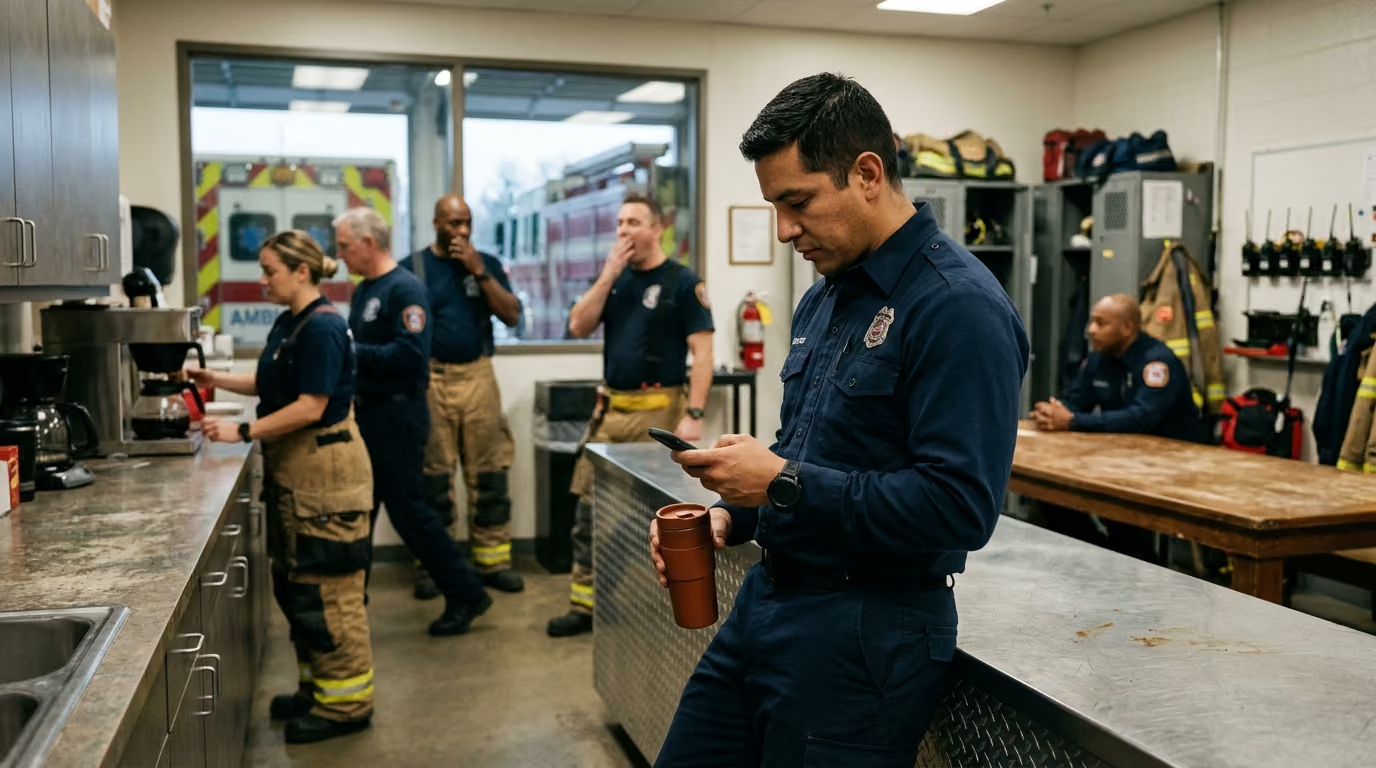

Maximum functional alertness during rapid multi-timezone emergency deployments requires tailored circadian adaptation strategies based on travel direction and mission duration.





Trying to force your biological clock to adapt immediately to a new time zone is often the worst decision an emergency responder can make. When personnel deploy across multiple time zones, standard travel advice insists on immediate local alignment through sheer willpower, heavy caffeine use, and intense daylight exposure. For emergency deployments, this standard approach frequently backfires, creating severe fatigue during high-consequence operational windows.
If your deployment lasts fewer than 48 hours, or if your duty schedule rotates unpredictably upon arrival, attempting full circadian adaptation creates two distinct physiological crises. You force your body through a disruptive phase shift only to reverse it days later. The practical decision comes down to three choices: shift your body clock gradually before departure, adopt local timing upon arrival, or protect a home-time anchor sleep window.
Choosing the right approach depends on travel direction, total time zones crossed, deployment length, and whether safety-critical work begins the moment wheels touch down.
Jet lag disorder is a recognized clinical condition caused by a temporary mismatch between internal circadian timing and the external destination schedule. Symptoms include fragmented sleep, excessive daytime sleepiness, reduced cognitive and physical capability, gastrointestinal distress, and mood changes. Travel fatigue is different. Travel fatigue stems from long flights, dehydration, cramped seating, and prolonged wakefulness, and it usually resolves after one solid sleep opportunity.
Clinical evidence from the Centers for Disease Control and Prevention and the American Academy of Sleep Medicine demonstrates clear directional asymmetries in how the human circadian system adapts. On average, the human circadian clock delays faster than it advances. Westward travel, which requires delaying your sleep and wake times, adapts at an average rate of 1.5 hours per day. Eastward travel, which requires advancing your schedule, adapts at a slower rate of approximately 1 hour per day.
These rates represent population averages rather than guaranteed individual timelines. Individual adaptation speed varies based on age, natural chronotype, prior sleep debt, and strict control over light exposure. Research shows that our internal master clock, located in the suprachiasmatic nucleus, relies on external cues called zeitgebers to synchronize with local time. Light exposure is the most potent zeitgeber, followed by meal timing, physical exercise, and social interaction.
The evidence supporting interventions for circadian adjustment falls into distinct tiers:
Evidence shows that using stimulants to force daytime wakefulness masks fatigue without adjusting the biological clock. Masking can sustain focus for an isolated emergency task, but it does not resolve nighttime insomnia at the destination.
Standard travel advice assumes predictable schedules, private hotel rooms, and control over daily routines. Emergency-service personnel operate under completely different operational realities. Firefighters, paramedics, disaster medical teams, and law enforcement personnel often deploy into chaotic environments with austere living conditions and erratic operational tempos.
Occupational health research demonstrates that emergency personnel regularly carry significant baseline sleep debt before departure. A study evaluating firefighter sleep patterns on 24/48 and 48/96 schedules found that the shortest total sleep times occurred at home immediately before starting a tour of duty, averaging between 5.66 and 5.80 hours. Personnel deploying on short notice often do so after demanding shifts, entering travel already sleep restricted.
Operational factors compound the physiological stress of crossing time zones:
Because emergency responders cannot control call volume or operational timing, travel protocols must prioritize protected sleep opportunities over theoretical circadian perfection. Applying structured shift work and sleep management protocols is necessary to maintain mission capability and preserve physical safety.
Responders must select an adaptation strategy based on mission parameters rather than default travel habits. The three primary operational strategies are gradual shifting, immediate local adoption, and home-time anchor sleep.
Gradual shifting involves moving your sleep, wake, light exposure, and meal times toward the destination time zone for three to four days before departure.
Immediate local-time adoption requires switching directly to destination sleep, wake, meal, and light schedules as soon as you arrive.
The anchor sleep method maintains a protected core sleep period at the same biological time as your home base, regardless of destination local time.
Eastward travel forces your biological clock to advance, requiring you to fall asleep and wake up earlier than your internal clock desires. This direction is biologically demanding because the human circadian pacemaker naturally runs slightly longer than 24 hours. Without deliberate intervention, the body resists advancing its phase, leading to prolonged sleep latency and severe early-shift fatigue.
When operational notice permits, initiate phase advancement three days prior to departure:
Upon arriving at an eastward destination, managing light exposure relative to your biological clock is critical. Exposing yourself to bright light too early in the local morning can hit your body during its biological night, which paradoxically delays your clock rather than advancing it.
If you travel across six time zones east, 07:00 local destination time corresponds to 01:00 at your home base. Getting bright sunlight at 07:00 local time will delay your rhythm, worsening your jet lag. You must wear dark sunglasses during early local morning hours and seek bright light starting around local midday. As your body clock shifts forward over subsequent days, move your light exposure progressively earlier into the local morning.
Avoid heavy meals late in the local evening, as digestion elevates core body temperature and impairs sleep initiation. Keep the sleep environment cold, dark, and quiet to support the early bedtime required for eastward operations.
Westward travel requires a circadian phase delay, pushing sleep and wake times later into the day. Because the natural human circadian rhythm tends to exceed 24 hours, extending your day is generally easier than shortening it. However, westward travel across four or more time zones still produces severe early-morning awakening and late-afternoon cognitive crashes.
Preparing for a significant westward deployment involves delaying your schedule over two to three days:
After landing at a westward destination, the primary operational challenge is staying alert through the local afternoon and avoiding premature awakening at 03:00 local time.
Emergency mobilizations frequently do not permit multi-day circadian adaptation. Mutual aid responses, specialized technical rescue deployments, and incident management support often involve deployments lasting fewer than 72 hours. Attempting to force full adaptation during these brief deployments compromises operational readiness and complicates recovery when returning home.
For short or highly irregular missions, deploy a hybrid anchor strategy that protects operational capability without forcing a full circadian reset:
When teams must begin emergency operations immediately upon arrival, focus on acute fatigue mitigation rather than circadian shifting. Traveling across time zones creates acute sleep debt from transit stress.
Prioritize hydration, as aircraft cabin environments cause rapid fluid loss that impairs cognitive focus and physical stamina. If an operational window allows a 60-minute rest before reporting for duty, take that sleep opportunity immediately. Avoid large, high-glycemic meals right before your first operational briefing, as postprandial somnolence compounds transit fatigue.
Managing circadian adaptation requires precise coordination of environmental and behavioral tools. Light, sleep timing, and chemical stimulants can accelerate recovery when used correctly, but they cause severe operational deficits when misapplied.
Light is the primary environmental time giver for human biology. The timing of light exposure determines whether the circadian system advances, delays, or remains unchanged.
Using polarized sunglasses or blue-light-filtering eyewear allows responders to block unwanted environmental light during critical phase-sensitive transit periods.
A systematic review on shift work in emergency medical services showed that structured napping during working tours reduces subjective sleepiness and restores psychomotor performance. However, waking from deep, slow-wave sleep can cause sleep inertia, a state of grogginess and impaired cognitive function lasting 15 to 30 minutes.
To utilize naps safely during travel deployments:
Caffeine is a potent adenosine receptor antagonist that masks sleepiness, but it does not reduce biological sleep debt or alter circadian timing. Misusing caffeine during deployments leads to fragmented recovery sleep and worsened downstream fatigue.
Follow structured guidelines when managing caffeine during irregular shifts:
Standard jet lag rules assume simple point-to-point travel across moderate latitudes. Emergency deployments frequently introduce complex operational edge cases that require tailored protocols.
Crossing the International Date Line can disorient responders because calendar dates jump forward or backward independently of biological time. A crew traveling across the Pacific may lose an entire calendar day in transit, leading to confusion regarding medication timing and sleep tracking.
Track time using three separate reference points: elapsed mission time, home-base biological time, and destination local time. Schedule sleep, hydration, and nutritional intake based on elapsed time rather than the calendar day to ensure physiological consistency.
Deployments to extreme northern or southern latitudes present unique challenges due to continuous summer daylight or continuous winter darkness. In these environments, natural light cues cannot be used to guide circadian adaptation.
A common operational dilemma occurs when responders travel multiple time zones and are assigned immediately to night-shift operations upon arrival. Standard daytime adaptation protocols will actively harm operational readiness in this scenario.
If you travel six time zones east and immediately work night shifts (20:00 to 08:00 local time), your destination working hours correspond to 14:00 to 02:00 home time. In this case, do not attempt to advance your clock to local daytime. Instead, keep your biological clock closer to home time, which naturally aligns your peak biological alertness with the new local night shift. Use dark sunglasses during the local morning when traveling back to base camp to protect daytime sleep.
Technical specialists, search and rescue dog handlers, and command staff often rotate through multiple operational bases across different time zones within a single deployment.
Repeatedly shifting your circadian pacemaker causes severe internal desynchronization, which impairs cardiovascular function and immune resilience. For multi-stop missions, commit strictly to a permanent home-time anchor strategy. Manage local mission duties entirely through strategic tactical napping, controlled light management, and purpose-driven sleep scheduling.
Fatigue management during emergency travel is a fundamental life-safety issue, not an individual endurance test. Driving heavy apparatus, operating hydraulic rescue tools, and managing critical medical emergencies while experiencing severe circadian misalignment creates unacceptable risks for responders and the public.
Departments and team leaders must integrate systematic fatigue tracking into operational risk management frameworks. Research evaluating measuring operational sleep and fatigue highlights that self-reported alertness is notoriously unreliable. Sleep-deprived personnel consistently overestimate their cognitive capacity and reaction speed.
Strict operational safety guardrails must be enforced during deployments:
Occasional jet lag from an isolated deployment resolves within several days of returning home. However, repeated cross-time-zone deployments can unmask underlying medical vulnerabilities or compound chronic sleep disorders common in public safety personnel.
Consult an occupational medicine physician or board-certified sleep specialist if you experience:
Navigating cross-time-zone deployments successfully requires treating sleep as a vital operational resource rather than an afterthought. Attempting to force rapid adaptation through sheer willpower or stimulant abuse leads to performance degradation and elevated injury risks. Matching your adaptation strategy to deployment length, travel direction, and operational demands preserves tactical capability while protecting long-term cardiovascular, metabolic, and neurological health.
Sustainable duty capability across a long emergency-service career depends on respecting biological limits and executing systematic recovery strategies on every deployment.
Stay connected for research-led guidance on duty fitness, shift-work sleep, injury recovery, stress, nutrition and career longevity. Practical ideas for first responders who want to stay capable on the job, recover well and protect their health for the long run.



Read practical guidance on first responder fitness, recovery, sleep, nutrition and resilience for demanding work and a long, active career.
read the blog



