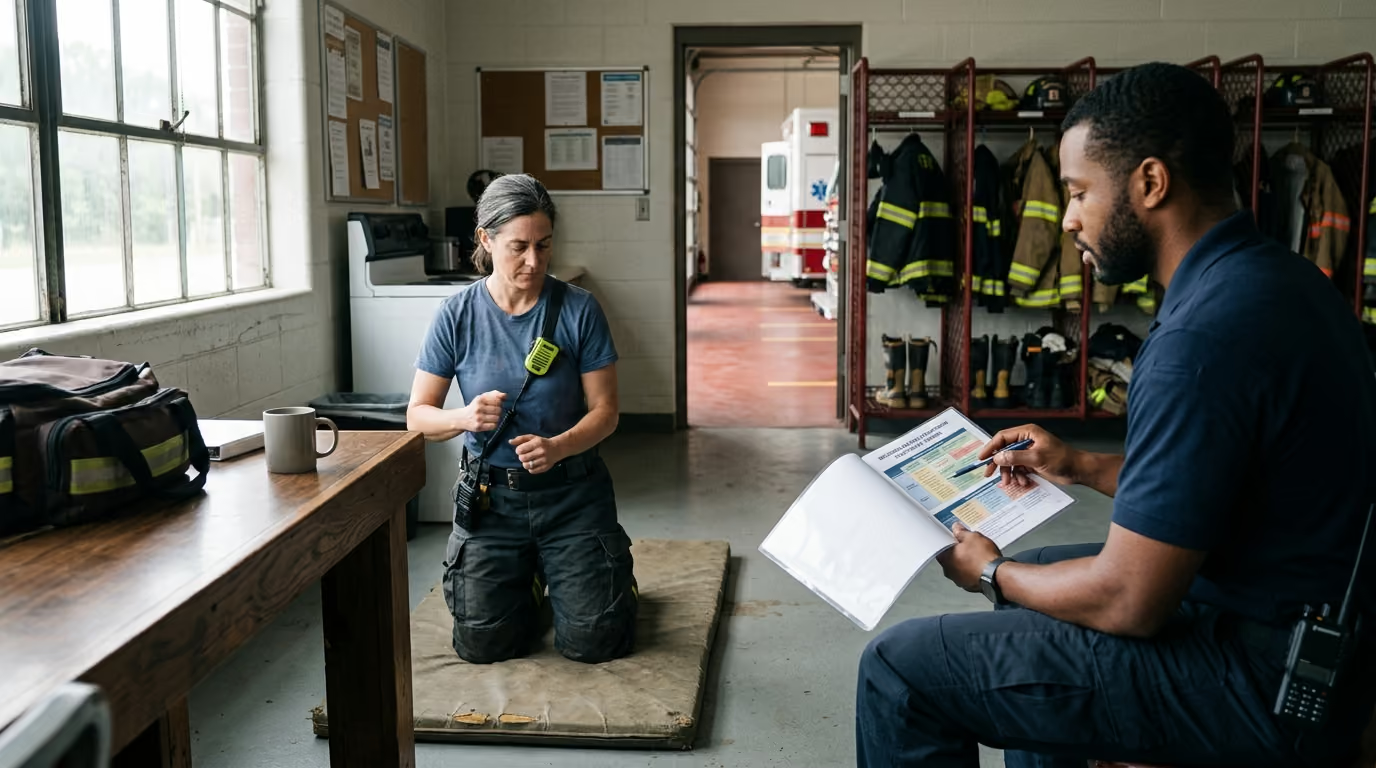

Long shifts and heavy gear wear down the body, making low-impact conditioning vital to build aerobic capacity without compounding joint fatigue or injury risks.





Many emergency service professionals believe that conditioning must hurt your joints to prepare you for duty. Running miles in heavy boots or performing repeated high-impact sprints is often treated as the only valid way to build operational stamina.
In reality, your heart and lungs cannot tell whether you are running on pavement, pedaling an assault bike, pulling a rowing ergometer, or walking up a steep incline. Cardiorespiratory endurance and orthopedic tissue tolerance are separate physiological qualities. When training volume, gear weight, and shift fatigue accumulate, relying exclusively on high-impact running frequently leads to overuse injuries rather than improved job performance.
Low-impact conditioning allows firefighters, police officers, and emergency medical personnel to build high-level aerobic capacity while strictly controlling joint stress. Using low-impact modalities is not a soft compromise or an easy workout. It is an intelligent strategy to build central cardiovascular fitness, recover from demanding shifts, and extend career longevity without breaking down physical structures.
Cardiorespiratory fitness is a critical pillar of first responder safety. Many emergency tasks require prolonged muscular effort, heat tolerance, moving while wearing heavy equipment, and rapid recovery between bursts of high-intensity work.
A systematic review examining physical fitness and occupational injury in emergency responders demonstrated a correlation between higher aerobic fitness and reduced injury risk. The researchers noted that while this positive trend exists, the broader evidence base remains somewhat limited and requires cautious interpretation. In a study on career firefighters, each one-unit increase in absolute VO2max was associated with a five percent reduction in self-reported musculoskeletal injury odds. Although this represents an observational correlation rather than definitive proof that aerobic capacity alone stops injuries, it shows how endurance buffers physical fatigue under stress.
Operational tasks demand substantial aerobic power. Fireground simulations reviewed in a report hosted by the Centers for Disease Control and Prevention indicated that aerobic capacities between 33.6 and 49.0 mL/kg/min are required to perform routine emergency tasks safely. Individual needs vary depending on vehicle assignments, gear weight, and incident complexity. Achieving these fitness levels does not require a single training modality.
To program conditioning effectively, you must understand the distinction between central and peripheral adaptations. Central adaptations include increased cardiac stroke volume, expanded blood plasma volume, greater total hemoglobin, and improved oxygen delivery from the lungs to the bloodstream. These central improvements occur regardless of which muscle groups drive the heart rate into target training zones.
Peripheral adaptations occur directly within the trained tissues. These changes include increased capillary density in specific muscles, greater mitochondrial size and density, local enzyme activity, and specialized tendon stiffness.
A 2026 systematic review and meta-analysis evaluated running and cycling cross-training interventions over short to moderate durations. The researchers found no statistically significant differences in VO2max or general running performance when cycling substituted for running. However, the authors clearly emphasized that evidence does not support complete interchangeability. Cycling develops concentric leg power and quadriceps endurance without foot-strike impact. Running develops eccentric braking capacity, foot and ankle stiffness, and tolerance for repeated ground reaction forces.
Relying entirely on one low-impact modality will maintain your heart and lungs, but it will not prepare your lower extremities for the specific mechanical demands of sprinting, jumping, or carrying heavy loads down flights of stairs. A complete physical preparation strategy combines low-impact conditioning for systemic volume with carefully measured doses of duty-specific movement.
Emergency personnel face operational constraints that civilian training programs rarely accommodate. Extended 24-hour to 72-hour tours, rotating night shifts, mandatory overtime, and unpredictable sleep interruptions place immense strain on the autonomic nervous system.
Sleep disruption alters hormonal regulation, delays tissue repair, and compromises cognitive alertness. A CDC-hosted forum report on public safety work highlighted that irregular hours and chronic sleep debt significantly increase both illness and occupational injury risks. When you are operating on fragmented sleep after a grueling shift, your musculoskeletal tissues are less resilient to mechanical impact. Tendons and ligaments exhibit altered viscoelastic properties under systemic fatigue, making high-impact foot strikes far more likely to provoke inflammation.
Occupational movement during active shifts already imposes substantial physical load. Firefighters climb stairs while carrying high-rise packs, emergency medical technicians perform awkward patient transfers in tight stairwells, and police officers carry 20 to 30 pounds of duty belt gear during long foot patrols. When planning your weekly training, this occupational workload must be counted against your total physical budget.
You can manage these competing demands by aligning your training modality with your current state of readiness. Low-impact conditioning provides a flexible valve to adjust mechanical strain while keeping cardiovascular volume steady.
Understanding how to balance your training around rotational schedules is essential. You can learn more about programming low fatigue maintenance sessions around irregular shifts to preserve duty readiness. Implementing minimal effective dose conditioning principles helps prevent accumulated fatigue from eroding your health over time.
Every conditioning mode distributes forces differently across the skeletal framework. Choosing the correct tool requires matching the mechanical profile of the exercise with your individual injury history and current physical state.
Cycling is an exceptional tool for developing high-volume aerobic capacity and intense anaerobic power without repetitive foot strikes. It places minimal eccentric demand on the leg muscles, which reduces exercise-induced muscle damage and post-workout soreness.
Cycling offers several clear benefits:
Cycling also presents distinct physical trade-offs:
If you experience anterior knee pain, raise the saddle slightly to reduce peak knee flexion angles, and maintain a pedal cadence above 80 revolutions per minute. Responders dealing with flexion-sensitive low back pain often tolerate upright stationary bikes or air bikes better than aggressive road cycling postures.
Rowing engages roughly 85 percent of the body's musculature across a continuous, fluid cycle. It integrates lower-body triple extension, trunk stability, and upper-body pulling strength into a single continuous cardiovascular pattern.
Rowing delivers major performance advantages:
Rowing carries significant mechanical considerations:
Responders with a history of lumbar disc herniation or flexion-intolerant low back pain must approach the rower with care. Keep the drag factor moderate, avoid rounding the lower back at the catch, and maintain an upright trunk posture during the drive phase.
Water provides buoyancy that reduces gravitational loading on joints to near-zero levels. Swimming and deep-water running allow responders to achieve intense full-body conditioning when lower-body weight-bearing is temporarily contraindicated.
Swimming offers unique training benefits:
Swimming also introduces practical and anatomical limits:
If shoulder pain limits standard lap swimming, consider deep-water running using a flotation belt. Deep-water running mimics upright locomotion kinematics without foot contact, providing an outstanding bridge during lower-extremity rehabilitation.
Incline walking preserves natural upright locomotion while dramatically reducing impact forces compared to running. Raising the grade shifts the mechanical emphasis to the calves, hamstrings, and glutes while slowing the foot-strike velocity.
Incline walking provides distinct functional advantages:
Incline walking requires attention to specific tissue stresses:
Keep treadmill inclines between 6% and 12% at walking speeds of 2.5 to 3.5 miles per hour. Always let your arms swing freely rather than holding the display console or side rails.
Mixed-modal conditioning rotates through multiple low-impact tools within a single training session. For instance, a responder might complete five minutes on an air bike, five minutes on a ski ergometer, five minutes of sled dragging, and five minutes of incline walking.
This approach offers significant programming strengths:
A retrospective study on endurance training found that total cross-training hours were positively associated with overall reported injuries, whereas swimming volume was associated with fewer injuries. While this observational data does not prove cross-training causes injury, it highlights that variety can mask excessive total volume. Switching between machines can hide accumulated systemic fatigue, tricking you into working beyond your recovery capacity. Always monitor total training time and work output across the entire session.
Designing an effective conditioning routine requires a systematic decision framework rather than random daily workout selection. Use this five-step process to determine the right low-impact session for any given day.
Clarify what physiological quality you need to develop in the session:
Assess your body for localized pain, stiffness, or active tissue recovery before picking a machine:
Review your recent duty schedule, call volume, and sleep quality over the previous 48 hours:
Understanding the deep impact of sleep disruptions and shift length on physiological fatigue helps prevent the common trap of overtraining an exhausted body.
Adapt your session to the equipment present in your immediate physical environment:
A conditioning session is only successful if it enhances your physical readiness rather than degrading it. Track these recovery markers:
If an exercise leaves you with joint pain or deep localized stiffness that lasts into the next day, modify the duration, resistance, or modality immediately.
Applying the classic FITT framework (Frequency, Intensity, Time, Type) ensures your low-impact conditioning produces predictable adaptations without breaking down physical structures. Guidelines from the American College of Sports Medicine (ACSM) emphasize gradual progression across all training variables to allow connective tissue remodeling.
Monitoring intensity through heart rate alone is unreliable for first responders. Sleep deprivation, thermal stress from firefighting gear, chronic workplace anxiety, heavy caffeine intake, and dehydration all distort heart rate metrics.
Combine technological metrics with subjective intensity tools to regulate your pacing accurately.
Connective tissues adapt to physical stress much more slowly than the cardiorespiratory system. A responder may feel aerobically capable of handling long or intense conditioning bouts weeks before their tendons and joint capsules have built adequate mechanical strength.
Apply the conservative ACSM progression principle of "start low and go slow":
The World Health Organization (WHO) physical activity guidelines recommend that adults accumulate 150 to 300 minutes of moderate-intensity aerobic physical activity, or 75 to 150 minutes of vigorous-intensity activity weekly, along with muscle-strengthening exercises on two or more days. For emergency personnel, these public health targets serve as a baseline foundation. Operational readiness requires additional training focused on strength, muscular endurance, and high-intensity work capacity.
Low-impact conditioning builds an outstanding aerobic engine, but it does not replace the need for dedicated resistance training. Systematic reviews and meta-analyses analyzing firefighter occupational performance show that duty success depends heavily on muscular strength and endurance alongside cardiorespiratory capacity.
Incorporate basic resistance training to protect your joints from impact forces:
Review our detailed guidance on evidence-based injury recovery and physical resilience to align your strength and conditioning routines with long-term orthopedic health.
These real-world case patterns illustrate how to tailor low-impact conditioning to specific operational challenges, injury histories, and scheduling constraints.
Explore our comprehensive resources on duty fitness for emergency professionals to design conditioning programs that support your daily operational demands.
Even well-intentioned conditioning routines can cause setbacks if you fall into common mechanical or conceptual traps.
Low-impact exercises reduce ground reaction impact, but they can still overload specific tissues. A heavy rowing session places massive demands on the lumbar extensors and hip flexors. A hard cycling session heavily strains the quadriceps and patellar tendon. Always ask which tissues are being spared and which tissues are absorbing the mechanical workload.
Some responders switch entirely to low-impact machines and never run, jump, or carry loads again. While this protects joints in the short term, it causes lower-extremity bones, tendons, and muscles to lose their tolerance for impact. When you are suddenly forced to sprint down an alley or leap across a ditch on duty, unconditioned tissues are highly vulnerable to acute tears or fractures. Maintain a small, carefully dosed baseline of impact exposure when you are healthy.
Cardiovascular machines feel simple, leading many athletes to ignore movement technique. Rowers often collapse into extreme lumbar flexion at the catch, cyclists round their shoulders and hyperextend their necks, and treadmill walkers grip the side rails while leaning backward. Poor mechanics on a low-impact machine will cause chronic overuse injuries just as quickly as running with poor form.
Cross-training is a tool for distributing tissue stress, not an automatic guarantee against injury. Accumulating excessive volume across multiple machines without adequate nutrition, sleep, and recovery will still lead to systemic overtraining. Track your overall weekly training hours and match them to your operational workload.
Low-impact conditioning is an effective strategy for managing training volume, but it is not a substitute for formal medical care. Self-managing joint pain or movement limitations through machine cross-training has clear limits.
Seek evaluation from a licensed physical therapist, sports physician, or qualified orthopedic professional if you experience any of the following warning signs:
A licensed clinician can pinpoint the underlying mechanical cause of your symptoms, evaluate joint kinematics, and provide a structured rehabilitation plan that prepares you to return to full operational capacity.
Building sustainable physical capability requires selecting the right conditioning tools for your body, your duty schedule, and your long-term health. When you use low-impact conditioning to manage tissue stress and balance operational fatigue, you protect your body for a demanding career and an active life after service.
Stay connected for research-led guidance on duty fitness, shift-work sleep, injury recovery, stress, nutrition and career longevity. Practical ideas for first responders who want to stay capable on the job, recover well and protect their health for the long run.



Read practical guidance on first responder fitness, recovery, sleep, nutrition and resilience for demanding work and a long, active career.
read the blog



