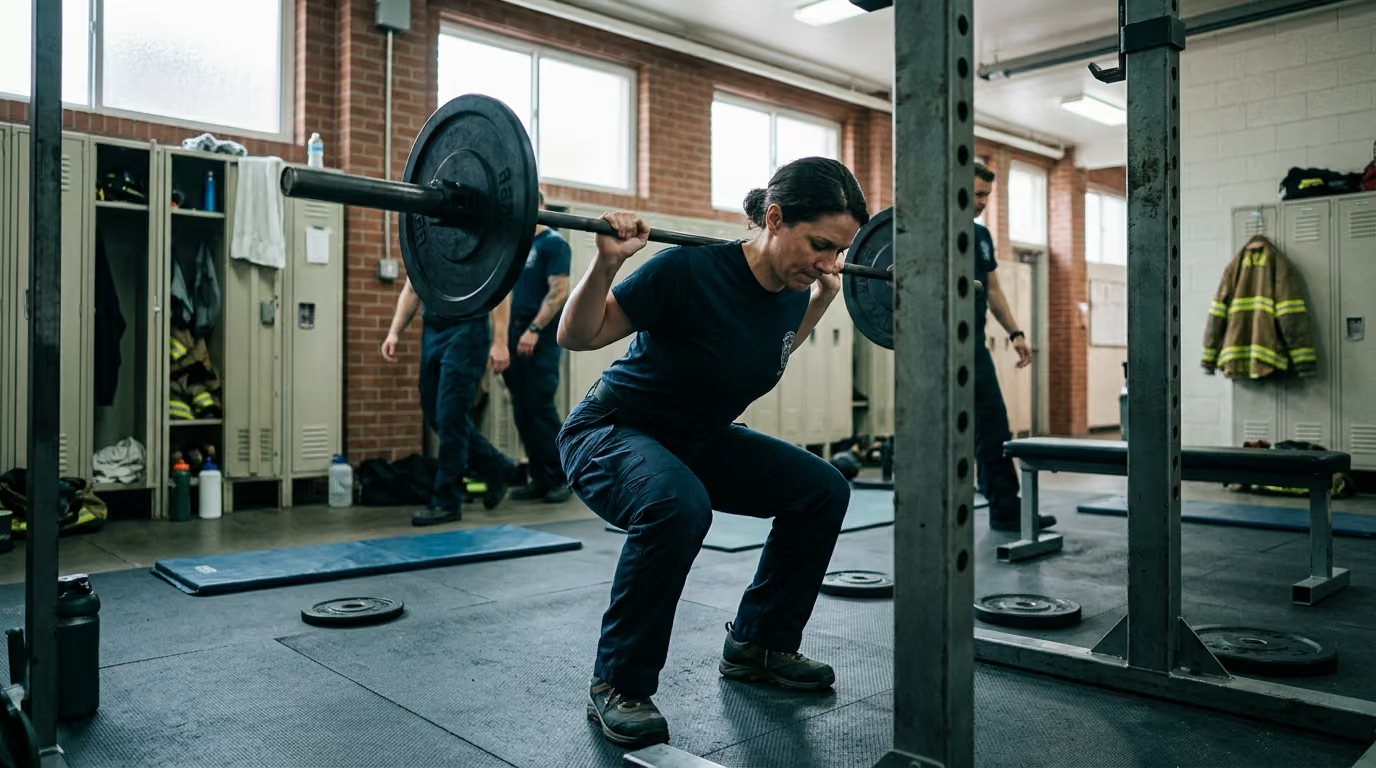

Superior lower-body strength and operational durability on duty are achievable through science-backed exercises tailored to the unique physical demands of first responders.





Many emergency service professionals search for the best way to train their legs for stairs, heavy gear, vehicle exits, and victim drags without burning out on shift. The quick answer is that lower-body training for first responders must build a portfolio of distinct physical qualities. You need maximal strength to lift heavy equipment, rapid power for accelerations and stair climbs, single-leg stability for uneven ground, and muscular endurance for prolonged operations. Relying on a single heavy lift or endless stair-climber sessions is not enough. A balanced program develops bilateral strength, staggered-stance stability, hip-hinge mechanics, and explosive movement while managing duty fatigue.
Lower-body training for first responders is an occupational necessity rather than a bodybuilding goal. Fireground tasks, tactical entries, and emergency medical calls place unpredictable physical demands on the hips, knees, and ankles. Responders must generate high force, absorb sudden impacts, and maintain balance while carrying 40 to 75 pounds of personal protective equipment and tools. These movements occur across various planes of motion and under intense cardiovascular strain.
Ascending stairs or steep terrain while carrying equipment requires forceful hip and knee extension, calf push-off, and single-leg balance. Firefighters ascending a high-rise with hose packs or wildland crews hiking ridgelines operate near their maximal heart rates. The demand combines local muscular endurance with anaerobic power and aerobic capacity. Each step requires the lead leg to lift the responder's body mass plus gear, while the trailing leg stabilizes the pelvis on narrow or unstable surfaces.
Exiting an apparatus, patrol vehicle, or ambulance is a high-force movement performed from a constrained position. The responder must rise from deep hip flexion, rotate past doors or gear racks, plant a single foot on uneven ground, and immediately accelerate. This action places high eccentric and rotational demands on the knees and hips. Training must prepare the lower body to produce force from disadvantageous joint angles without knee collapse.
Emergency personnel spend considerable time kneeling, crouching, crawling, or working from the ground. Rising from these positions while assisting a patient, handling a charged hose line, or wearing tactical body armor requires coordinated strength. Ground recovery is rarely symmetrical. A responder often posts on one knee, drives through the front heel, and braces the trunk against an off-center load to stand upright.
Moving extrication tools, loaded stretchers, oxygen tanks, or ventilation fans requires repeated floor-to-waist lifting. This demand challenges hip-hinge mechanics, grip endurance, and trunk stiffness. As fatigue accumulates across a shift, movement quality can degrade. Responders need sufficient strength reserve so that submaximal operational lifts do not push them to technical failure.
Moving an incapacitated person involves a combination of lifting, horizontal dragging, and backward stepping. Unlike lifting a barbell with a knurled grip, dragging a victim requires overcoming ground friction while leaning backward. This creates unique horizontal shear forces across the feet, knees, and hips. Training must build horizontal force production alongside standard vertical strength.
Exercise science research shows clear links between lower-body physical qualities and first responder job performance. A systematic review and meta-analysis examining firefighter physical performance identified anaerobic capacity, anaerobic power, and lower-body strength as primary determinants of occupational task success. However, the evidence also cautions against viewing any single gym metric as a universal fix.
Research evaluating firefighter stair-climb performance demonstrates that leg strength and power interact with body composition and conditioning. In a study of 41 male career firefighters completing a weighted stair climb in an average of 74.7 seconds, faster completion times were significantly associated with greater leg-extension peak torque, higher peak power, lower fatigability, younger age, and lower body-fat percentage. Another review reported a significant relationship between quadriceps strength and stair-climb times in professional firefighters, with a correlation of r = -0.492. Lower-body strength was also found to predict both hose-drag and stair-climb completion times.
Absolute strength establishes a critical performance ceiling. Studies comparing stronger and weaker firefighters found that individuals capable of deadlifting at least 2.0 times their body weight performed significantly better on physical ability tests. Isometric mid-thigh pull strength also demonstrated a moderate positive correlation with countermovement jump height (r =.519). Furthermore, standing broad jump performance correlates with hose-pulling and stair-carriage tasks.
The evidence is nuanced. A systematic review of firefighter fitness noted that lower-body strength alone was not consistently associated with stair-climb time across every study. This discrepancy exists because climbing speed under load depends on the interaction between muscular strength, power output, aerobic capacity, body weight, and pacing. In addition, research linking physical fitness test scores directly to occupational injury reduction remains limited. While higher strength provides the physical capacity to perform demanding tasks, injury risk is also driven by sleep debt, cumulative shift volume, environmental hazards, and unpredictable movement demands.
For women in emergency services, targeted strength training is equally vital. Research examining female first responders and healthcare personnel emphasizes the importance of developing lower-body power and strength to meet occupational demands and maintain long-term physical readiness.
A practical training plan organizes lower-body exercises by fundamental movement patterns rather than isolated muscle groups. The National Strength and Conditioning Association identifies the squat, hip hinge, lunge, and step-up as fundamental lower-body patterns. Responders should master these baseline movements before adding complex variations.
The squat is a knee-dominant bilateral movement that develops the quadriceps, gluteal musculature, and trunk stiffness. It builds the raw force needed to rise from deep seated positions and brace under heavy external loads.
Staggered-stance exercises bridge the gap between bilateral gym lifts and the asymmetrical demands of emergency work. They develop single-leg drive, hip stability, and deceleration control.
The hip hinge is a posterior-chain pattern targeting the hamstrings, glutes, and spinal erectors. It trains the exact mechanics required for floor-to-waist lifting, victim drags, and heavy tool handling.
Step-ups directly replicate ascending stairs, curbs, ladders, and vehicle tailboards. They demand concentric force production from the lead leg without relying on bounce or momentum.
Carrying awkward loads develops anti-rotation strength and grip resilience. Responders frequently carry gear in one hand while operating a radio, tool, or flashlight with the other.
For those planning their weekly routine, exploring practical duty fitness frameworks provides useful structures for organizing these movements around unpredictable operational shifts.
Maximal strength represents how much force you can produce, but power represents how quickly you can produce it. On the fireground or during tactical operations, speed of force development determines how fast you can clear a threshold, step up a high curb, or accelerate away from danger. Power work trains the nervous system to recruit high-threshold motor units rapidly.
The American College of Sports Medicine recommends power training with moderate loads of roughly 30 to 70 percent of one-repetition maximum (1RM), performed at high movement velocity with full recovery between sets. Novice or unconditioned individuals can develop initial power using light loads (0 to 60 percent of 1RM) and bodyweight jumps.
Power exercises should always be performed early in a workout when the nervous system is fresh. Perform 3 to 5 sets of 2 to 5 explosive repetitions with 2 to 3 minutes of rest between sets. If movement velocity drops, end the exercise immediately.
First responders cannot train like full-time athletes who have predictable sleep and meal schedules. Training must adapt to shift work, night calls, and cumulative physical fatigue. Following a shift work training decision framework helps responders choose the right intensity based on daily recovery status.
A well-rounded program balances three primary loading zones across the training year:
Emergency personnel need both strong legs and high aerobic capacity. To balance these competing demands without excessive fatigue, separate heavy lower-body resistance sessions from high-intensity interval conditioning by at least 6 to 8 hours whenever possible.
Responders working 24/48, 48/96, or 12-hour rotating schedules should focus on a rolling 8-day to 10-day template rather than forcing training into a rigid Monday-to-Sunday schedule. For detailed programming ideas, review strategies for training around demanding shift work.
The golden rule of tactical fitness is to leave one to two repetitions in reserve on almost all working sets. Training to muscular failure generates excessive central nervous system fatigue and muscle soreness. That level of exhaustion can compromise safety and reaction time during a midnight structure fire or high-speed vehicle pursuit. Using autoregulation techniques on duty days preserves physical capability when sleep is disrupted.
Lower-body training must reflect the specific environmental demands of each emergency service branch.
Structural firefighters face short, intense bursts of high-force work while carrying heavy equipment up stairs and through burning structures. Their training should emphasize absolute lower-body strength, heavy step-ups, and explosive power. Wildland firefighters operate in rugged outdoor terrain for 12 to 16 hours at a time. Their programs should emphasize single-leg muscular endurance, step-downs, ankle stability, and loaded uphill hiking capacity.
Paramedics and EMTs perform frequent patient transfers, awkward stretcher lifts, and prolonged kneeling in tight spaces. Training should emphasize Romanian deadlifts, suitcase carries, half-kneeling to standing transitions, and asymmetrical floor lifts to protect the lower back and hips.
Police officers and SWAT operators sprint, jump, breach doors, and clear stairwells while wearing heavy tactical vests. Training should focus on rapid acceleration, unilateral deceleration, lateral lunges, and broad jumps to maintain high agility under load.
As emergency responders age, power output and high-threshold muscle fibers decline faster than raw strength. Older responders should maintain low-volume, high-velocity movements such as kettlebell swings, box jumps with step-downs, and moderate-load trap-bar pulls to preserve leg speed and prevent task-related fatigue.
Female first responders benefit significantly from heavy compound lifting and power development. Programs should build strong hip stabilizers, glute strength, and posterior chain endurance. Responders returning from pregnancy or childbirth require gradual pelvic-floor and core reconditioning before progressing to heavy axial loading or high-impact jumping drills.
To track progress and identify weaknesses, first responders should use standardized physical capacity assessments. These tests should be performed when adequately rested.
power.
To dive deeper into operational physical readiness standards, explore our duty fitness and strength performance hub for evidence-based benchmarking tools.
Strength training builds physical capacity, but it is not an invincible shield against injury. Operational injury risks in emergency services involve chaotic environments, unpredictable patient movements, sleep disruption, and equipment design. Training must be conducted with clear safety margins to avoid creating injuries in the gym that hinder job performance.
Responders experiencing persistent joint pain, nerve tingling, structural instability, or sudden sharp pain during movement should consult a licensed physical therapist or medical physician. Do not attempt to push through sharp joint pain under the belief that toughing it out is part of duty culture. Early physical therapy intervention for hip impingement, patellar tendinopathy, or lumbar strain can resolve issues before they result in lost duty time.
Building occupational lower-body strength does not require rebuilding your entire schedule. You can start improving your duty readiness this week with a few targeted adjustments.
Developing balanced lower-body strength, power, and single-leg stability ensures that you can handle the physical challenges of emergency response today while protecting your joints and physical independence for a long, healthy retirement.
Stay connected for research-led guidance on duty fitness, shift-work sleep, injury recovery, stress, nutrition and career longevity. Practical ideas for first responders who want to stay capable on the job, recover well and protect their health for the long run.



Read practical guidance on first responder fitness, recovery, sleep, nutrition and resilience for demanding work and a long, active career.
read the blog



