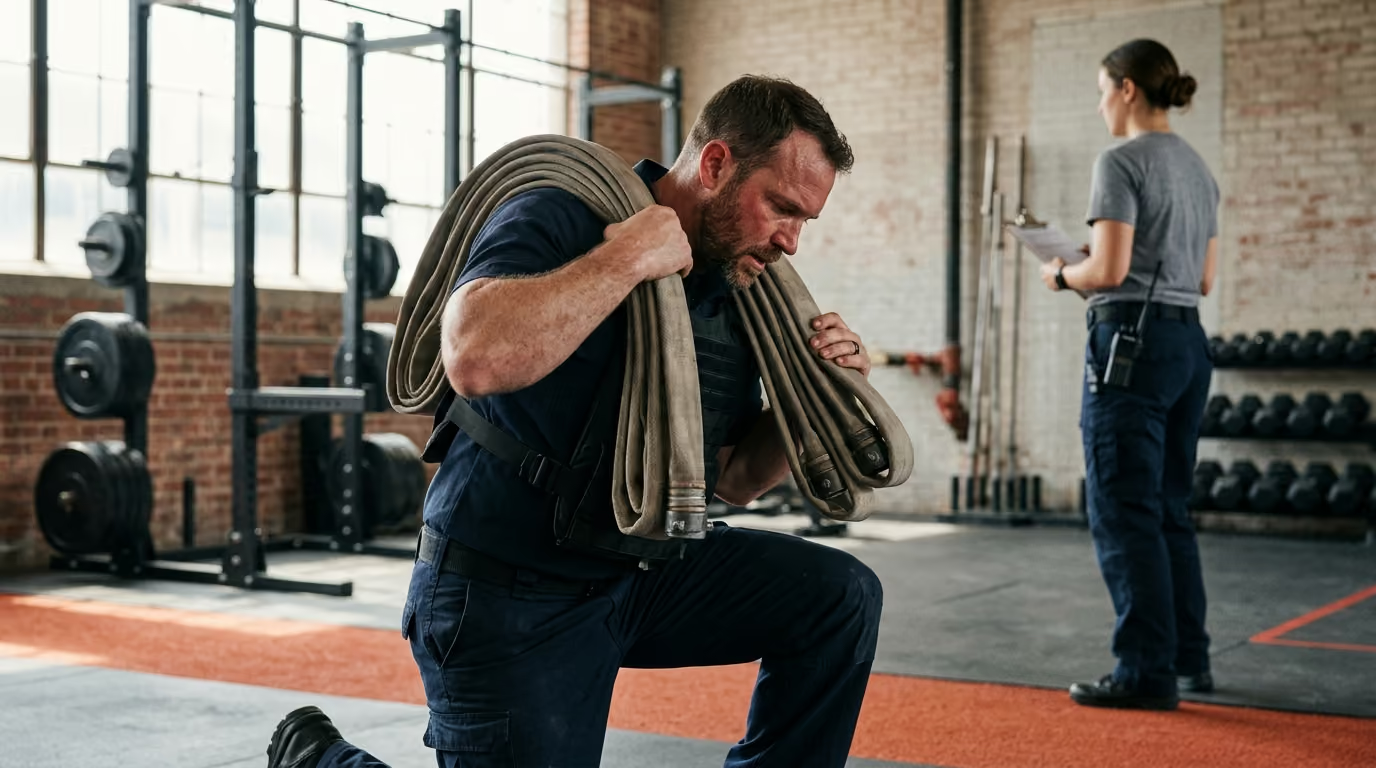

Tactical athletes build physical resilience and operational movement efficiency under heavy loads by mastering fundamental field movement patterns and structured progression models.





Movement quality on duty is not the reproduction of rigid gym form under artificial conditions. It is the ability to organize the human body under heavy gear, unstable surfaces, acute fatigue, and shifting operational constraints.
True movement quality is a capacity-management skill. Responders must balance force output, joint control, sensory awareness, and breathing to complete tasks without avoidable injury. This field manual provides a framework for mastering seven essential duty movements under load, fatigue, and environmental stress.
Load carriage research consistently demonstrates that external mass alters normal human gait, joint kinetics, and overall mobility. When emergency personnel carry heavy personal protective equipment, breathing apparatus, or tactical vests, the body adjusts its baseline mechanics. Studies show that increasing carried mass shortens stride length, increases step width, and slows operational movement speed during both continuous locomotion and agility courses. These changes represent automatic attempts by the central nervous system to widen the base of support and preserve balance.
The physiological and mechanical cost of external gear is substantial. Biomechanical research examining personnel wearing self-contained breathing apparatus reveals significant spikes in joint stress. Walking with a breathing apparatus increases rectus femoris muscle force and hip joint reaction force by nearly 35 percent compared to unloaded walking. During running, these values rise by more than 50 percent for both the quadriceps and the hip joint. These substantial increases illustrate why conventional bodyweight conditioning fails to prepare emergency personnel for the realities of loaded duty.
Fatigue changes movement mechanics before a responder consciously feels exhausted. Occupational studies of simulated emergency tasks show that progressive muscular fatigue causes increased spinal flexion and decreased abdominal wall activation. When the trunk musculature tires, the body transfers mechanical stress away from active muscular stabilizers and onto passive spinal structures, ligaments, and joints. This mechanical shift occurs simultaneously with a decline in dynamic balance and single-leg stability.
Injury epidemiology across emergency services reflects these biomechanical realities. Strains, sprains, and soft-tissue muscular tears represent the largest single category of duty-related injuries in emergency personnel, often accounting for more than 40 percent of reported incidents. Furthermore, slips, trips, falls, and overexertion consistently rank as the primary mechanisms of physical damage on duty. The lower extremities and lumbar spine sustain the highest injury burden, directly mirroring the areas under the greatest mechanical stress during loaded operational tasks.
Evidence also shows that physical fatigue interacts with cognitive processing to degrade movement execution. Sleep restriction and nocturnal shift work diminish postural control, visual-motor coordination, and reaction speed. Even when a responder maintains gross physical output through sheer effort, their ability to scan footing, brake before an obstacle, or recover from a sudden slip degrades. Training movement skills under controlled conditions builds resilient motor pathways that resist degradation under occupational strain.
Operating in structural turnouts, tactical body armor, or wildland gear creates constraints that standard athletic programs rarely address. Equipment packages for emergency personnel range from 10 kilograms for standard police duty belts to 25 kilograms or more for fully equipped firefighters and tactical operators. This external load is rarely distributed evenly around the body center of mass. Front-mounted tool pouches, side-mounted medical kits, and high-riding rear air cylinders continuously pull the responder off balance.
Thermal stress and respiratory restriction compound these mechanical burdens. Working inside protective gear traps metabolic heat, elevating core temperature and accelerating cardiovascular fatigue. At the same time, breathing through a regulator or particulate respirator increases the work of breathing and restricts peripheral vision. The loss of lower visual fields forces responders to navigate uneven ground, stairwells, and rubble without seeing their feet clearly.
Shift work patterns create chronic background fatigue that alters joint position awareness. Research across public safety personnel confirms that nighttime call volume and irregular sleep cycles impair neuromuscular timing. When cumulative sleep debt rises, the central nervous system delays stabilizing muscular contractions around the ankles, knees, and lumbar spine. A foot strike that would be easily absorbed when fresh becomes a potential sprain or fall when fatigued.
Environmental unpredictability prevents the use of textbook exercise form in operational settings. Responders routinely manage slippery surfaces, narrow hallways, low ceilings, and shifting patient loads. In these settings, attempting to maintain an upright, symmetrical posture can cause balance loss or impact with overhead hazards. Capability requires learning how to create wide, adaptable bases of support and controlling movement across awkward angles. Responders who integrate practical duty fitness strategies into their weekly routines protect both their immediate safety and their career longevity.
Operational movement consists of foundational motor patterns adapted to real-world physical constraints. The seven movement frameworks detailed below prioritize task completion, balance preservation, and joint longevity over aesthetic gym standards.
The operational squat is a descent strategy used to lower the center of mass, lift objects from low levels, clear overhead obstacles, or transition to the deck. Unlike a competition powerlift, an operational squat must accommodate a bulky rear load, restrictive turnout pants, and stiff duty boots.
The primary mechanical objective is maintaining whole-foot contact while keeping the center of mass within the base of support. Responders carrying rear-mounted loads must incline the trunk forward to prevent tipping backward. The stance should be slightly wider than shoulder width with feet angled outward to accommodate protective clothing. The descent must remain controlled, using the hips and quadriceps to brake the movement rather than dropping rapidly into bottom-range joint compression.
Ascending from the squat requires driving pressure through the entire foot, keeping the knees tracking inline with the toes. Responders must avoid letting the knees collapse inward or allowing the hips to shoot up before the chest. Breathing must remain continuous throughout the repetition, avoiding unnecessary breath-holding that spikes blood pressure during prolonged tasks.
Under extreme fatigue, maximal squat depth becomes a liability on unstable surfaces. Responders should utilize a moderate-depth squat or a supported squat using available structural surfaces to preserve balance. If the load is asymmetrical or awkward, widening the stance provides immediate passive stability.
The hip hinge is the primary engine for moving heavy, dead-weight loads such as equipment boxes, extrication tools, supply lines, and ground-level patients. It organizes force production around the powerful gluteal and hamstring musculature while shielding the lumbar spine from excessive shear stress.
Executing a functional hinge under load begins with setting a stable foot base slightly wider than the hips. The movement initiates by pushing the hips backward toward an imaginary wall while maintaining a slight, athletic bend in the knees. The trunk remains braced and stable, rotating forward from the hip joints rather than rounding through the lumbar vertebrae. The hands reach for the object while keeping it as close to the body center of mass as possible.
Lifting the load occurs by driving the hips forward and pushing the floor away through the heels and midfoot. Responders must resist the tendency to initiate the lift by hyperextending the neck or jerking the upper back. Controlled spinal flexion may occur when grabbing awkward, ground-level objects, but this flexion must be supported by active trunk bracing rather than passive ligament hanging.
Fatigue degrades hip hinge mechanics by fatiguing the spinal erectors and abdominal wall. When tired, responders often default to bending solely from the spine with straight legs. To counter this breakdown, consciously drop the hips two inches lower, widen the foot base, and secure the load firmly against the body before initiating vertical drive.
Operational environments demand asymmetrical movement. Climbing debris, mounting apparatus running boards, advancing charged hose lines, and stabilizing patients on uneven grades require split-stance control.
A split stance provides exceptional forward and backward stability during pushing, pulling, and tool manipulation. The lead foot establishes firm, flat contact with the deck while the trailing foot remains balanced on the ball of the foot. The distance between the feet must match the environmental terrain. A shorter, wider split stance offers superior balance on slick surfaces, whereas a longer split allows greater forward reach and horizontal force generation.
Deceleration is the critical, often neglected component of lunging. When stepping down from an elevated obstacle or lunging forward to catch a shifting load, the lead leg must actively brake the body mass. Responders should focus on a quiet, controlled foot strike, absorbing impact through the quadriceps, glutes, and calves rather than slamming the heel into the deck. The lead knee must track directly over the middle toes without collapsing inward.
When using tools from a split stance, rotation should occur primarily through the hips and thoracic spine rather than twisting the lumbar spine or collapsing the back knee. If balance wavers due to shifting carried equipment, step the rear foot outward laterally to widen the base of support.
Crawling is a vital operational skill used to navigate smoke-filled structures, access confined technical rescue spaces, and lower profile beneath structural hazards. It is a full-body movement pattern that demands dynamic trunk stability, shoulder endurance, and hip mobility.
The hands-and-knees crawl distributes load across four stable contact points, protecting the air cylinder from striking overhead obstacles. Responders move with contralateral coordination, advancing the right hand and left knee simultaneously, followed by the left hand and right knee. Steps should remain short, deliberate, and quiet. The trunk musculature maintains moderate stiffness to prevent the heavy rear load from causing excessive lateral sway or sagging.
The bear crawl elevates the knees off the floor, transferring weight onto the hands and the balls of the boots. This variation allows faster forward and backward movement across open spaces while maintaining a relatively low profile. It places high demands on the shoulder stabilizers and quadriceps. Responders must keep their hips level with or slightly below the shoulders to prevent the SCBA cylinder from catching on doorways or wires.
The low crawl involves keeping the chest, abdomen, and pelvis close to the deck, propelling the body forward using the inner edges of the knees and forearms. This method offers the lowest clearance and greatest protection in high-heat or compromised environments. Equipment must be secured tightly to the body to prevent snagging, and forward progress relies on steady, rhythmic hip driving rather than erratic pulling from the arms.
Falling or intentionally dropping to the deck is common in emergency operations. Getting back to a standing position quickly while wearing heavy, restrictive gear requires efficient energy management and sound mechanics.
Responders should master three distinct transition pathways:
Unplanned ground transitions often cause disorientation or joint strain. When recovering from the deck under load, never attempt to jump directly upward from a narrow, parallel foot position. Always establish a broad base of support, bring the center of mass securely over the feet, and use the large leg muscles to complete the ascent.
Negotiating barriers, guardrails, charged hoses, and structural rubble requires single-leg balance and dynamic clearance. Overexertion, poor clearance, and balance loss during obstacle navigation are primary contributors to fireground falls and joint sprains.
Safe obstacle clearance follows a deliberate seven-phase process:
Fatigued personnel frequently drop their trailing foot prematurely, catching the boot heel or turnout cuff on the obstacle. To prevent tripping, responders must maintain visual awareness until both feet have completed the clearance and made solid deck contact.
Emergency duties require rapid transitions between locomotion styles, moving from a sprint to a sudden stop, dropping from a run to a crawl, or pivoting while carrying gear. Efficiency depends entirely on eccentric braking strength and center-of-mass management.
Stopping under load requires lowering the hips and taking several short, rapid deceleration steps rather than attempting to plant a single foot and stop immediately. Planting a stiff, extended leg while carrying heavy external mass creates extreme shear forces across the knee joint and frequently results in ligament strains. Lowering the center of mass allows the quadriceps and glutes to absorb kinetic energy progressively.
Changing direction requires pointing the lead foot toward the intended path of travel before driving off the trailing leg. Responders should avoid crossing the feet over one another when turning under load, as this narrows the base of support to zero. Using structured autoregulation and readiness concepts helps personnel recognize when fatigue has slowed their reaction speed, prompting more deliberate footwork during high-speed transitions.
Developing field-ready movement skills requires a progressive training system. Adding heavy tactical gear, maximal speed, and severe fatigue simultaneously leads to compensatory mechanics and avoidable injury. Movement skills should be developed using a six-phase progression model that systematically introduces constraints.
When introducing new movement challenges, adjust only one operational variable at a time. If you increase the carried load, keep the movement path predictable and the surface stable. If you introduce an unstable surface or low-visibility environment, reduce the carried mass and movement speed.
Responders can balance structured strength sessions with short readiness training sessions during busy shift cycles. Micro-dosing movement practice ensures steady technical improvement without compounding duty-related fatigue.
Movement practice must fit logically within the realities of shift work. High-skill, loaded movement drills should be performed when responders are relatively recovered, either on off-duty days or during the early hours of a shift tour.
When planning training across rotating tours, align movement complexity with your overall approach to training around shift work. Degraded-state movement drills should be kept brief, focusing on movement precision rather than metabolic exhaustion.
Mastering movement under load requires understanding mechanical limits and discarding persistent fitness dogmas that do not apply to operational reality.
A common fitness misconception is that the human spine must remain perfectly vertical and straight during all physical tasks. In real-world emergency operations, lifting awkward objects, working in collapsed structures, and crawling through tight spaces make a rigid spine impossible.
The operational objective is dynamic trunk stability and load management, not anatomical rigidity. Responders must learn to brace the abdominal wall and use the hips to absorb forces, even when the torso is flexed or rotated. Injury occurs when an unbraced, fatigued spine experiences sudden, uncontrolled movement under heavy external loads.
Responders often focus entirely on propulsion and speed while neglecting braking mechanics. Overstriding, reaching too far forward with the lead foot when running or stepping down, exposes the hamstrings, knees, and ankles to excessive braking stress.
Carrying heavy gear amplifies these forces. Personnel should focus on maintaining a high stride frequency with feet landing directly beneath the center of mass, allowing the lower-limb musculature to manage ground reaction forces smoothly.
Field training sessions must prioritize motor learning over survival tests. Instructors and individual responders should immediately stop or regress a movement drill when any of the following indicators appear:
Continuing to perform complex, loaded movements past this level of technical failure does not build resilience. It merely reinforces faulty motor patterns and dramatically elevates injury risk.
Physical discomfort is common in demanding occupations, but responders must distinguish between normal muscular fatigue and mechanical dysfunction that requires clinical intervention. Ignoring persistent movement limitations frequently transforms minor soft-tissue strains into career-threatening injuries.
Professional evaluation by a licensed physical therapist, athletic trainer, or occupational sports medicine physician is warranted under specific conditions:
A qualified clinician can identify underlying mobility restrictions, muscular imbalances, or joint pathology. They can design targeted injury recovery protocols that restore structural integrity before returning the responder to loaded operational training.
Heavy turnout gear and breathing apparatus raise your physical profile and shift your center of mass upward. In confined spaces, this top-heavy distribution makes lateral balance difficult and increases the risk of snagging gear on obstructions. To adapt, responders should utilize a wider knee base during hands-and-knees crawling, take shorter strides, and maintain continuous active core tension. Keeping the air cylinder level prevents overhead strikes and preserves clearance in tight corridors.
Carrying an asymmetrical load forces the opposite side of the trunk to work continuously to prevent lateral spinal flexion. When navigating uneven ground, shorten your stride length, slightly widen your foot path, and maintain a conscious abdominal brace. Keep the carried bag as close to the body centerline as possible rather than letting it swing loosely from the shoulder. Whenever operational conditions allow, switch the carry side periodically to prevent localized muscle fatigue from degrading your walking mechanics.
Low-friction surfaces require eliminating sudden horizontal braking and acceleration forces. Responders should adopt a wider base of support, shorten their step length, and keep their center of mass positioned directly over the lead foot upon contact. Avoid hard heel strikes, which easily slip forward on slick decks. Instead, aim for a flatter, whole-foot placement with a soft, slightly bent knee to absorb lateral perturbations before transferring full body weight.
Standard protective gear and breathing apparatus fit individuals of different statures and body proportions differently. Smaller-framed responders often carry a much higher percentage of their body weight in gear, shifting their center of mass higher and restricting functional hip mobility. Taller responders frequently experience greater spinal lever arms during lifting and obstacle clearance. Personnel must adjust their stance widths, step lengths, and transition techniques to match their individual body mechanics and gear configurations rather than copying a single rigid posture.
Sustainable operational readiness is built on the daily discipline of moving with technical precision under real-world constraints. Mastering foundational movement skills under load protects the body against acute trauma, preserves vital energy during critical calls, and ensures long-term physical health across an entire emergency response career.
Stay connected for research-led guidance on duty fitness, shift-work sleep, injury recovery, stress, nutrition and career longevity. Practical ideas for first responders who want to stay capable on the job, recover well and protect their health for the long run.



Read practical guidance on first responder fitness, recovery, sleep, nutrition and resilience for demanding work and a long, active career.
read the blog



