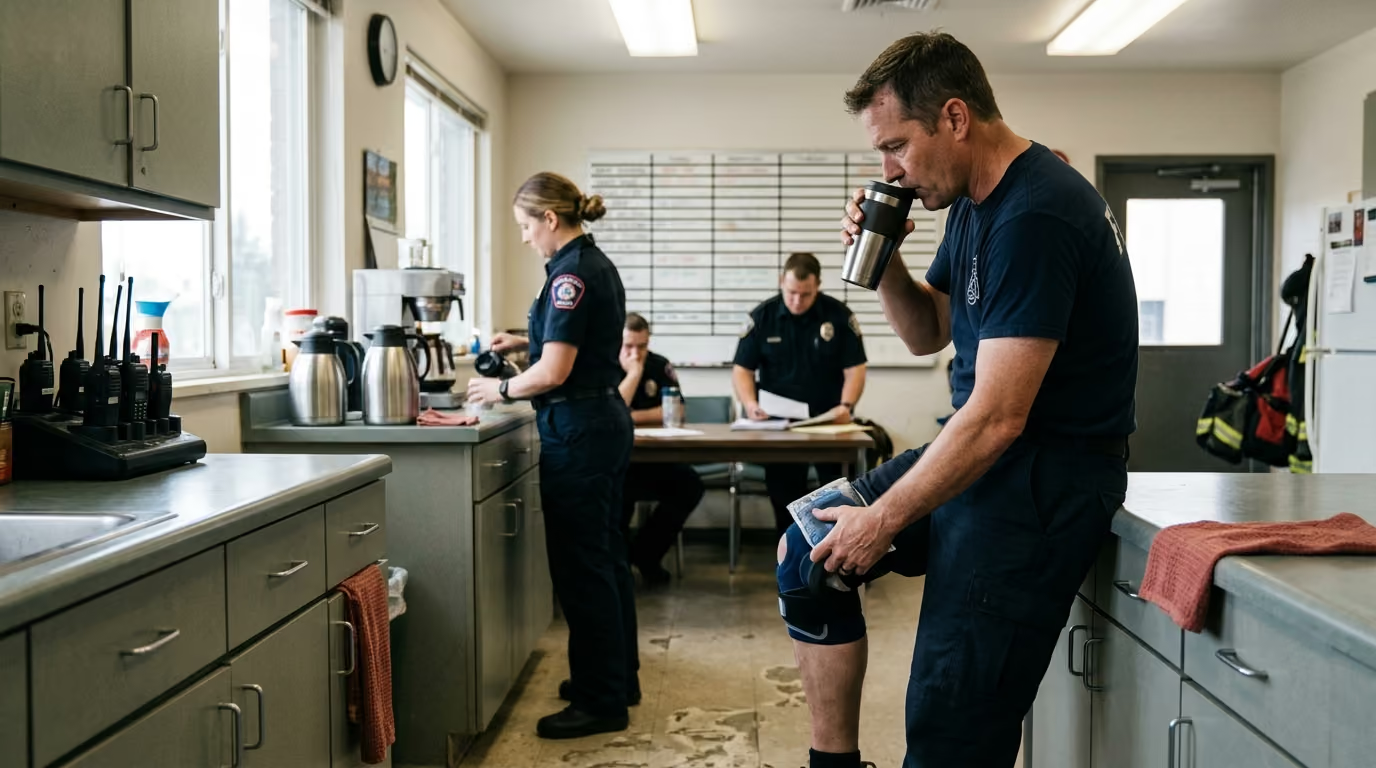

First responder injury rehabilitation bridges the gap between basic clinical recovery and the demanding physical standards required for full operational duty.





A medic steps off the rig onto uneven asphalt with a heavy primary bag, feeling a sharp pop in the ankle. A firefighter catches the full weight of a charged hose line in a stairwell, immediately sensing severe strain across the lumbar spine. An officer engages in a rapid foot pursuit over fences and concrete obstacles, ending up with an acute shoulder subluxation during subject control. In each of these situations, the immediate reaction is often frustration, uncertainty about the future, and concern about duty readiness.
When you walk into an occupational health clinic or urgent care facility, you are frequently handed a generic discharge sheet. The standard advice might instruct you to rest for two weeks, take anti-inflammatory medication, and avoid heavy lifting. For a desk worker, that advice might suffice. For emergency personnel, it falls short of what operational readiness demands. Bunker gear alone weighs forty to fifty pounds before picking up a tool, an entry shield adds significant unilateral load, and a combative patient in a tight hallway does not offer a convenient handle.
Successful rehabilitation for emergency personnel bridges the gap between basic tissue healing and the brutal physical realities of duty. Recovery is not simply about reducing daily pain or regaining normal passive range of motion. It requires demonstrating sufficient capacity, movement control, endurance, and operational judgment under fatigue. Navigating this process demands structured communication with clinicians, clear milestone tracking, precise work restrictions, and active involvement in your recovery plan.
Navigating the healthcare system begins with understanding the terminology used by physicians, physical therapists, and workers' compensation managers. In civilian medicine, the end of treatment often coincides with the resolution of acute pain during activities of daily living. If a patient can sit without back pain and lift a bag of groceries, their clinical care might be considered complete. For an emergency responder, that milestone represents only an early stage in the physical progression back to service.
To manage your rehabilitation, you need to recognize the distinct phases of progress documented in occupational health research:
The National Institute for Occupational Safety and Health notes that vocational rehabilitation, disability management, and work reintegration should start early during the injury cycle. Waiting until an injury feels completely healed before addressing work capacity leads to profound deconditioning. While tissues heal, your aerobic base drops, stabilizer muscles atrophy, and motor control patterns degrade. A structured plan maintains whole-body capacity while protecting the injured structure.
Occupational outcomes improve when care is viewed through a combined biological, psychological, and environmental framework. A strictly anatomical perspective looks only at tendon tears, ligament sprains, or bone fractures. A comprehensive approach recognizes that physical healing is directly influenced by operational stress, sleep quality, fear of reinjury, and administrative pressures.
Systematic reviews on firefighter musculoskeletal health show that physical disorders are strongly linked with operational stress, shift disruption, and elevated body mass index. When you are injured, fear of losing your position or letting down your crew can create significant anxiety. Acknowledging these pressures helps you make objective decisions rather than rushing back before your body can handle operational loads.
Musculoskeletal injuries represent the primary health burden across all emergency response disciplines. Data published by the National Fire Protection Association estimated 53,575 line-of-duty injuries among United States municipal firefighters in 2024. While this represented a 15 percent decrease from the 63,175 injuries estimated in 2023, approximately 9,100 of those 2024 injuries resulted in lost work time.
Fireground operations create a severe injury environment. NFPA research reviewing 2020 through 2024 fireground data documented an average of 20,480 nonfatal injuries per year. Lost work time occurred in 22 percent of those fireground incidents. Interestingly, 51 percent of the recorded injuries were classified as report-only, meaning they did not result in immediate lost time. These report-only injuries frequently involve low-grade sprains and joint strains that, if left unaddressed, accumulate into chronic occupational conditions.
Musculoskeletal disorders show remarkably consistent patterns across international research:
Injury distribution varies by operational role. Occupational injury analyses indicate that emergency medical technicians and paramedics sustain the highest risk of upper-body musculoskeletal disorders, primarily driven by manual patient handling, stretcher loading, and awkward posture in tight compartments. Firefighters show elevated rates of lower-body and spinal injuries from equipment carrying, structural operations, and forced entries. Law enforcement officers experience substantial rates of lower-extremity trauma, especially ankle and knee injuries sustained during pursuits and subject stabilization.
A study evaluating law enforcement ankle sprains revealed that combined ligament injuries and fractures resulted in median lost-work durations of 119.5 and 90 days, respectively. These timelines demonstrate that seemingly routine soft-tissue injuries require extensive physical restoration before officers can safely run, pivot, and handle physical confrontations.
Evidence linking standard physical fitness test scores to injury prevention remains limited. A systematic review on emergency responder fitness tests found weak correlation between standard testing scores and overall injury reduction, although higher aerobic capacity showed modest protective value. A controlled gym test does not recreate the thermal stress, sleep deprivation, heavy gear, and unstable footing of an active scene. Testing gives a baseline, but true occupational rehabilitation must test movements under simulated operational demands.
Understanding these systemic challenges makes it clear why learning practical strategies for injury recovery is essential for anyone building a long career in emergency services.
When you meet with a sports medicine physician, physical therapist, or occupational health specialist, they often have limited insight into what your shift entails. A clinician might know what an ambulance looks like, but they rarely understand the biomechanics of lifting a 250-pound patient out of a bathtub. They might know police officers carry gear, but they do not realize a duty belt concentrates 20 to 30 pounds directly on the pelvis and lumbar spine.
Creating a personal job-demands inventory helps you communicate your real-world requirements to your care team. This inventory breaks your operational role into distinct physical and physiological demands:
Frontline duty requires navigating unstable and non-standard surfaces. You must crawl down narrow smoke-filled hallways, step over debris, climb ladders, and step across deep grade changes. You may need to negotiate roadside ditches in wet conditions or sprint over uneven lawns in low light. These movements require ankle dorsiflexion, knee flexion, hip mobility, and dynamic single-leg balance that cannot be measured simply by walking across a flat clinic floor.
Emergency service requires unpredictable force production. You might carry charged two-and-a-half-inch hoselines, lift hydraulic extrication tools weighing 50 pounds, or carry heavy medical monitors. Law enforcement officers require upper-body grip, pressing, and pulling strength to maintain physical control during resistance. The load is rarely balanced, and handles are often non-existent, requiring high levels of grip and forearm endurance.
Carrying gear and patients demands deep spinal stabilization. You are frequently required to lift from compromised postures, bend over stretchers, rotate while holding equipment, and resist sudden external forces. Protecting the spine requires muscular endurance in the abdominal wall, obliques, and posterior chain rather than brief, maximum core efforts.
First responders do not work in air-conditioned environments with scheduled hydration breaks. Firefighters operate in high heat with structural turnout gear that traps metabolic body heat. Paramedics perform chest compressions in cramped, unventilated bedrooms. Police officers sprint in body armor that restricts natural chest expansion. Rehabilitation must gradually introduce conditioning that challenges both the aerobic and anaerobic systems while monitoring core temperature tolerance.
Emergency work requires rapid triage, split-second safety assessments, radio communications, and tactical decision-making while physically exhausted. If an injury distracts your attention or causes pain spikes during exertion, your situational awareness drops. True functional recovery requires testing your ability to process information, communicate clearly, and make sound judgments while under physical load.
Your rehabilitation target cannot be an average shift. An average shift might involve routine transport, low-stress driving, and straightforward patient assessments. Your body must be prepared for the worst-case call of your career. That means having the capacity to drag an unconscious colleague out of a structure fire, carry a patient down four flights of spiral stairs, or fight for your life on the side of a highway. Preparing for these worst-case scenarios ensures that routine duties remain well within your physical capacity.
Preparing for an occupational medical appointment requires the same precision you bring to an operational call. Walking into a clinic unprepared often leads to vague diagnoses and generic restrictions that do not protect you or satisfy your department.
Arrive at your appointment with organized documentation that provides an objective, detailed view of your injury, your functional limitations, and your operational needs.
Write down the exact sequence of events while the details are fresh:
Avoid relying purely on subjective pain scales. Clinicians hear "my back is an eight out of ten" every day, which tells them very little about your physical capability. Use functional, task-specific statements that clearly describe your actual limitations:
Bring copies of all previous evaluations, emergency department discharge summaries, physical therapy notes, and formal imaging reports. Having direct access to MRI, CT, or X-ray interpretation reports allows your specialist to cross-reference diagnostic findings with their physical exam.
Obtain an official copy of your agency's job description and physical performance standards. Highlight the essential functions, including lifting requirements, personal protective equipment weights, ladder climbs, and physical control tactics. This document allows the clinician to align their clearance decisions with your employer's legal requirements.
When you are sitting in the exam room, you are an active participant in your care. Engaging in shared decision-making with your physician, orthopedic specialist, and physical therapist leads to better recovery plans. Clear questions help establish clear expectations for diagnostic clarity, active rehabilitation, and work clearance.
Using clear communication ensures that your medical team and department leadership share the same expectations, helping you protect your long-term career longevity.
A successful recovery progresses through logical physical stages. Progression must never be determined solely by the calendar or the disappearance of resting pain. Resting pain often subsides long before collagen tissues remodel or muscular power returns.
Advancement through each phase must be earned by hitting objective functional milestones.
The immediate priority following injury is protecting damaged tissues from further trauma, controlling severe inflammation, and establishing a safe baseline of daily movement.
Once acute tissue sensitivity subsides, rehabilitation shifts to restoring normal joint mechanics, basic movement patterns, and foundational muscular endurance.
This phase bridges basic gym movements and the heavy demands of physical labor. The focus shifts to developing force output, rate of force development, and dynamic stability under fatigue.
In this phase, exercises are designed to mirror the actual physical demands of emergency response work.
Managing your training stress during these demanding phases requires balancing physical loading with recovery. Utilizing autoregulation principles to match training to daily readiness provides an effective way to adjust training volume during this phase.
Modified duty is not a vacation from rehabilitation; it is an active phase of physical reintegration.
The final step is the formal authorization of an unrestricted return to operational service.
One of the most dangerous points in an emergency responder's recovery occurs when vague work restrictions are issued. A doctor's note that reads "light duty" or "avoid strenuous exertion" is completely unenforceable in an operational environment. When a high-priority call comes in, a responder operating under vague guidance is often placed in a position where they either perform unsafe tasks or leave their crew short-handed.
To protect yourself and your colleagues, medical documentation must differentiate between capacity, restrictions, and safety precautions:
A properly constructed work capacity form should contain specific, objective parameters:
The restriction must define exact weight limits, lifting heights, and frequencies. For example: "Lifting limited to a maximum of 25 pounds from waist height; no lifting from the floor; no repetitive lifting exceeding 10 repetitions per hour."
Clear guidelines should specify limits on static postures and repetitive motions. Examples include: "No sustained kneeling or crawling; sitting limited to 45 consecutive minutes; walking permitted on flat surfaces up to 30 minutes at a time."
Your documentation must account for protective equipment and thermal stress. Examples include: "No wearing of SCBA or structural turnout gear; no wearing of standard law enforcement duty belt exceeding 10 pounds; no exposure to ambient temperatures exceeding 85 degrees Fahrenheit."
Restrictions must address safety-critical duties. Examples include: "No emergency vehicle operation; no operating near moving traffic; restricted from solo responses; no participation in direct subject restraint or physical tactics."
Sleep loss and shift length drastically alter healing and motor control. Understanding how extended rotations drive fatigue and sleep debt helps illustrate why clinical guidelines often include: "Work shifts limited to a maximum of 8 continuous hours; no mandatory overtime; minimum of 16 hours of rest between consecutive shifts."
These restrictions must be clearly communicated in writing to your direct supervisors. Never rely on informal verbal agreements with shift officers. A shift officer may understand your limits, but a sudden shift reassignment or multi-alarm incident can quickly put you in an unmonitored, hazardous situation.
Not every recovery follows a straightforward orthopedic timeline. First responders frequently face complex injuries that require specialized clinical protocols and interdisciplinary care.
Head injuries sustained during vehicle collisions, structural impacts, or physical altercations represent a serious operational hazard. A responder may look normal and perform well during basic conversation, but their cognitive processing, visual tracking, and vestibular balance may remain severely impaired.
Guidelines from the Centers for Disease Control and Prevention emphasize that return-to-work planning after a concussion must be based on neurocognitive testing and symptom provocation, not arbitrary calendar days. CDC protocols recommend one to two days of relative physical and cognitive rest, followed by a gradual reintroduction of non-contact physical and mental activities.
For emergency responders, concussion protocols must test:
A responder must never return to driving emergency vehicles, carrying weapons, operating at heights, or managing patient medications until neurocognitive and balance performance have returned to verified baselines.
High-energy events often cause multiple injuries, such as a fractured ankle combined with a severe shoulder strain. Standard rehabilitation protocols frequently treat injuries in isolation. Treating them independently often overlooks dangerous compensation patterns. A limping gait shifts excessive load to the uninjured hip and spine, while an unstable shoulder alters lifting mechanics during patient transfers. Your physical therapist must assess whole-body movement patterns to prevent secondary breakdown.
Persistent pain from previous injuries is common in emergency services. When old injuries flare up, the solution is rarely passive rest or relying solely on passive clinic modalities. Long-term management requires assessing total training volume, equipment ergonomics, sleep quality, and movement mechanics. Using minimum effective dose training approaches allows you to maintain strength and joint integrity without overloading irritable joints.
Physical recovery cannot be separated from psychological readiness. Global research estimates that between 10 and 35 percent of emergency responders experience significant mental health challenges, with PTSD rates among firefighters estimated between 17 and 22 percent. Systematic reviews of ambulance personnel demonstrate pooled prevalence rates of 11 percent for PTSD, 15 percent for depression, and 27 percent for general psychological distress.
Experiencing a severe injury, especially one sustained during a violent altercation or traumatic call, can cause hyperarousal, sleep disturbances, and anxiety about returning to the scene. These psychological responses directly alter muscle tone, movement fluidity, and pain sensitivity. Addressing psychological readiness alongside physical rehabilitation ensures a safe, confident return to service.
Career personnel in large metropolitan agencies often have dedicated occupational health teams, on-site athletic trainers, and formal modified duty programs. In contrast, volunteer, rural, and part-time responders often face significant gaps in care:
Rural and volunteer responders must coordinate closely with primary care providers, leverage structured home-based rehabilitation plans, and utilize telehealth consultations to ensure their physical capacity is verified before resuming operational duty.
One of the largest obstacles to effective rehabilitation is the cultural pressure to tough it out. Responders frequently conceal injuries, avoid reporting sprains, or pressure doctors into early clearance because they fear losing overtime, missing out on promotional opportunities, or being viewed as unreliable by their crew.
NFPA fireground data shows that 51 percent of injuries are report-only incidents. When these injuries are ignored, minor soft-tissue strains frequently develop into chronic, career-ending conditions. Documenting injuries early creates a paper trail for workers' compensation protection and ensures that you receive proper care before minor joint irritation turns into permanent dysfunction.
Self-management and structured physical training are critical components of long-term health, but they cannot replace licensed clinical expertise. Recognizing when an injury requires specialized medical intervention is vital for protecting your career and overall wellbeing.
Seek immediate specialized evaluation if you experience any of the following red-flag symptoms:
that fail to improve after four to six weeks of structured conservative care.
When selecting a healthcare provider, look for professionals who understand the operational demands of emergency services. Sports medicine physicians, board-certified orthopedic clinical specialists in physical therapy, occupational medicine physicians certified by organizations like the American College of Occupational and Environmental Medicine, and licensed mental health clinicians specializing in first responder trauma provide the specialized care required for a safe return to duty.
Rehabilitation is an active, demanding process. It requires clear communication, objective physical testing, disciplined execution of daily exercise, and realistic coordination with your department leadership.
When to revisit this resource: Review this guide immediately after sustaining any on-duty injury, before attending your initial medical evaluation, when preparing for a formal work capacity evaluation, or when transitioning between modified and full-duty status.
Building sustainable physical capability requires viewing rehabilitation not as a setback, but as an opportunity to construct a stronger, more resilient foundation that will protect your operational performance throughout your career and into retirement.
Stay connected for research-led guidance on duty fitness, shift-work sleep, injury recovery, stress, nutrition and career longevity. Practical ideas for first responders who want to stay capable on the job, recover well and protect their health for the long run.



Read practical guidance on first responder fitness, recovery, sleep, nutrition and resilience for demanding work and a long, active career.
read the blog



