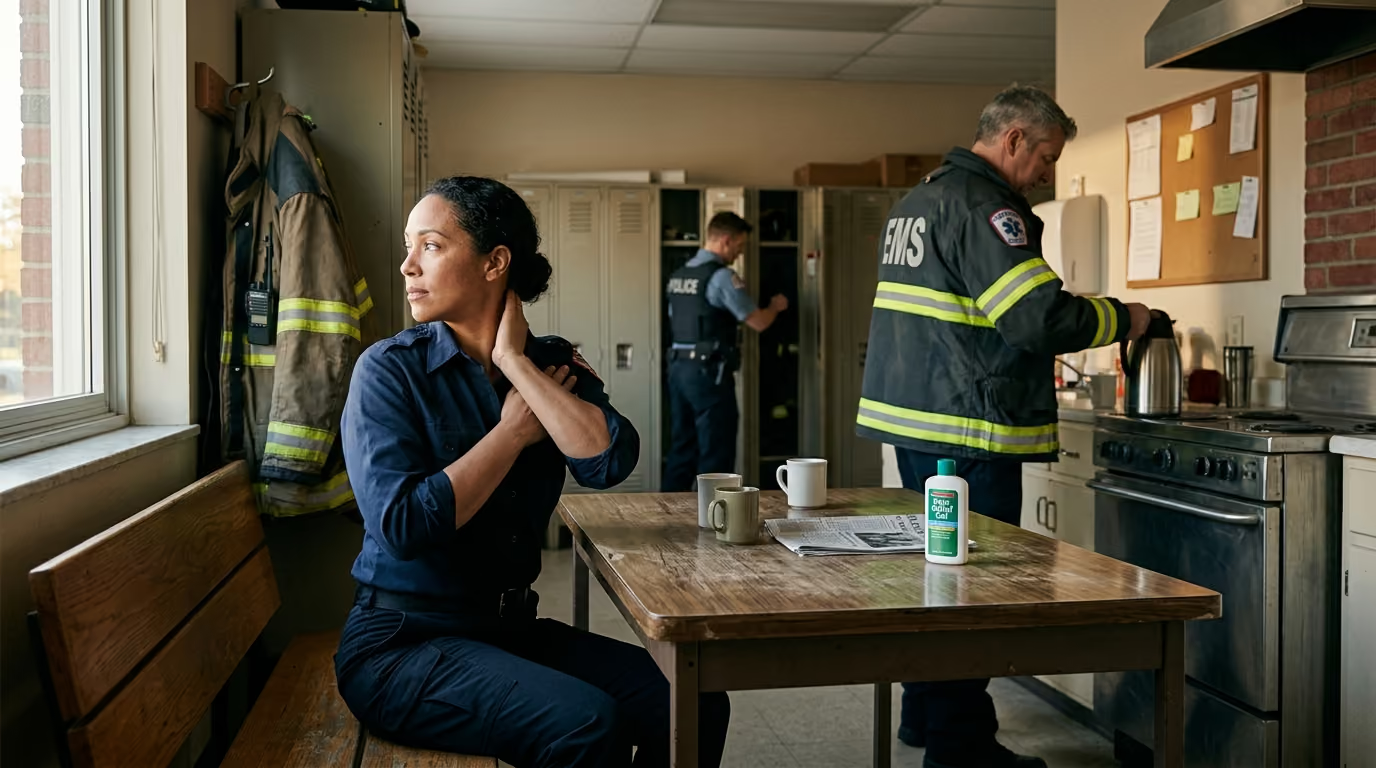

Wearing heavy body armor and specialized helmets on long shifts places severe occupational strain on the spine that requires smart training and gear adjustments.





Neck and upper-back health in emergency services is not a simple question of standing up straight or holding a textbook posture. It is an exposure-management problem defined by heavy gear, elevated lever arms, prolonged seated postures, and forceful patient handling under poor mechanical conditions. This guide examines the biomechanical loads placed on the cervical and thoracic spine across fire, police, and EMS roles. It details how equipment fit, physical capacity, movement variation, and early symptom triage determine whether a responder maintains sustainable spinal health or develops chronic musculoskeletal disorders.
The quick answer is straightforward. Protecting the cervical spine and cervicothoracic junction requires managing external load distribution, varying physical positions throughout shift work, and building targeted endurance in the postural musculature. No single piece of certified gear or isolated stretching routine prevents pain. Long-term capability depends on matching equipment fit to the individual body, keeping work close to the center of mass, and addressing tissue overload before it becomes a career-limiting injury.
The neck and upper back function as a single integrated mechanical system. The cervical spine consists of seven mobile vertebrae that support the weight of the head while allowing movement in multiple planes. Below it, the thoracic spine provides structural stability and anchors the rib cage, while the shoulder blades float over the posterior ribs. The cervicothoracic junction, where the flexible neck meets the rigid upper torso, acts as a primary stress collector when external loads sit on the shoulders or when the head is held forward.
External load represents the actual physical mass of equipment carried by the responder. Internal load describes the muscle tension and joint reaction forces required to stabilize, balance, and move that mass. When a firefighter puts on a helmet or a police officer dons body armor, the internal muscular forces can multiply far beyond the static weight of the gear. If equipment sits far from the spine, the lever arm increases. This forces the deep neck flexors, upper trapezius, levator scapulae, and thoracic erectors to generate sustained tension just to keep the head level.
Occupational strain occurs when physical exposure exceeds the capacity of these postural tissues without adequate recovery. Musculoskeletal disorders in this region rarely arise from a single isolated incident. Instead, they develop from cumulative exposure to static positions, vehicle vibration, asymmetric carriage, and repeated movement under load. Over time, sustained muscle contraction restricts local blood flow, accelerates fatigue, and alters movement mechanics throughout the shoulder girdle.
A useful way to conceptualize this relationship is through risk tolerance. A responder can safely handle heavy gear and demanding tasks when tissue capacity is high and fatigue is low. When long shifts, poor sleep, and back-to-back calls deplete recovery reserves, identical operational loads place tissues at elevated risk. Managing spinal health requires addressing external equipment variables, work tasks, and baseline physical readiness together.
Biomechanical research demonstrates that equipment mass, location, and balance substantially alter spinal kinematics. A study on firefighter helmet mechanics revealed that helmet design directly alters cervical intervertebral angles, cervical lordosis, and available head extension. The researchers identified the center of mass and the moment of inertia as primary drivers of altered neck mechanics. A helmet that places mass high or forward forces the cervical extensors into continuous contraction, restricting upward gaze and increasing joint compression.
Respiratory protection studies show comparable mechanical trade-offs. Research evaluating self-contained breathing apparatus carriage found that SCBA weight reduces lumbar range of motion during tasks like hose advancement and stair climbing. Responders compensated for this restricted trunk movement by increasing hip motion. Furthermore, biomechanical evaluations showed that adjusting SCBA shoulder-strap length altered abdominal muscle force and L4/L5 spinal reaction forces during movement. Small strap adjustments changed how the entire kinetic chain handled the load.
Equipment redesign can reduce these mechanical demands. In a laboratory evaluation of an altered SCBA harness design, researchers observed meaningful drops in trapezius and erector spinae muscle activation. The modified design decreased shoulder pressure by 19.73% to 32.83% and waist pressure by 18.46% to 41.55%, leading to a 59.1% reduction in reported low-back discomfort among participants. While small-sample laboratory findings cannot guarantee universal injury elimination, they prove that load distribution directly influences tissue stress.
Law enforcement studies highlight the widespread nature of these equipment-related symptoms. In a cross-sectional study of Swedish police officers, 41.3% of respondents reported multisite musculoskeletal pain at least once per week. Discomfort from mandatory duty belts had an odds ratio of 5.42 for multisite pain, while body-armor discomfort carried an odds ratio of 2.69. Research hosted by the Centers for Disease Control and Prevention similarly identified the neck and underarm regions as primary sites of armor-related pain. A survey of 53 officers highlighted duty belts, sidearms, radios, and armor as the items creating the greatest perceived physical discomfort.
EMS research reveals a heavy burden of spinal strain linked to patient-handling demands. Systematic reviews of EMS personnel report annual back-pain prevalence between 30% and 66%, with overexertion identified as the leading injury mechanism. A comprehensive scoping review of paramedic injuries confirmed that sprains and strains from stretcher handling and patient extractions represent the most frequent injury categories. Recent cross-sectional research found that 12-month pain prevalence reached 57.9% for the neck and 53.8% for the upper back among surveyed EMS workers. Ambulance studies utilizing Rapid Entire Body Assessment tools identified stretcher lifting as carrying the highest ergonomic risk score among routine paramedic tasks.
A broad systematic review of occupational musculoskeletal disorders across emergency sectors estimated general prevalence rates around 18.36% for neck pain and 6.09% for upper-back pain across mixed cohorts. However, discipline-specific literature consistently demonstrates higher symptom rates when studies account for specific gear configurations and physical task requirements. The evidence indicates that equipment load, balance, and task geometry interact to create persistent musculoskeletal stress across all three emergency branches.
Each emergency discipline imposes unique mechanical constraints on the head, neck, and shoulder girdle. Understanding these operational demands allows for better preventive strategies on duty.
Structural firefighting gear creates a heavily loaded and thermally restrictive environment. When wearing a helmet, SCBA pack, facepiece, and thick protective coat, the responder experiences significant movement restriction. The helmet pushes the head forward, particularly when the rear brim contacts the SCBA regulator or cylinder valve during upward gaze. To see smoke conditions, structural hazards, or upper floors, the firefighter must hyperextend the upper cervical spine or arch the lower back.
The heavy thermal coat and SCBA shoulder harness compress the upper trapezius and restrict natural upward rotation of the shoulder blades. During tasks like crawling, advancing charged hose lines, or operating forcible entry tools, the firefighter works in asymmetrical postures under heavy fatigue. The rigid gear shifts movement demands away from the thoracic spine and onto the more vulnerable cervical and lumbar segments. Dehydration and thermal strain accelerate muscle fatigue, reducing the body's ability to stabilize these joints during sudden, forceful movements.
Police officers carry significant load for extended shifts while alternating between static vehicle seating and rapid physical action. Traditional duty belts concentrate 15 to 30 pounds of equipment around the pelvis and lumbar spine. While transitioning gear to a load-bearing vest can relieve pelvic compression, it transfers that mass directly to the thoracic spine and shoulder girdle.
A vest carrier that fits poorly or sits too high can compress the clavicles and restrict normal rib cage expansion during breathing. Furthermore, duty gear creates asymmetrical loading. Carrying a sidearm, extra magazines, a baton, and handcuffs unevenly forces the trunk muscles into continuous unilateral bracing. In patrol vehicles, officers often sit with their duty gear wedged against contoured seats, rotating their neck toward center-mounted computer terminals for hours. When an officer must suddenly exit the vehicle and sprint or engage in physical control tactics, cold and fatigued neck muscles face immediate high-velocity loads.
Paramedics and emergency medical technicians face unpredictable physical geometries on almost every call. Unlike fire and police personnel, whose loads are primarily attached to the body, EMS providers regularly lift and carry external human loads. Stretcher loading, stair-chair operations, and extrications from tight spaces require high force production while bending, twisting, or reaching.
Carrying heavy medical supply bags and cardiac monitors with one hand or over one shoulder creates substantial unilateral shear forces across the cervicothoracic junction. In the back of an ambulance, providers must maintain awkward forward-bent and twisted neck postures to manage airways, start intravenous lines, or monitor vitals while the vehicle is in motion. The combination of unpredictable patient movement, poor mechanical leverage, and road vibration creates chronic tension through the levator scapulae and rhomboid muscles.
For decades, ergonomic advice focused on maintaining a single ideal posture throughout the workday. Contemporary occupational biomechanics rejects this concept. No static posture, no matter how well aligned, is healthy when sustained for hours. The human spine requires movement to circulate fluid through intervertebral discs, maintain soft tissue elasticity, and prevent localized muscular fatigue.
Occupational Safety and Health Administration guidelines emphasize that awkward postures include prolonged reaching, twisting, bending, overhead work, and remaining in fixed positions. Holding a rigid, upright posture in an emergency vehicle or at a station desk creates continuous isometric contraction of the postural muscles. This sustained contraction restricts microvascular circulation, leading to an accumulation of metabolic byproducts and a sensation of deep muscular aching. Posture variation, which involves deliberately cycling through different supported positions, distributes mechanical stress across different tissue groups.
When completing reports on station computers or mobile data terminals, responders should configure the workstation to support natural alignment. OSHA computer workstation standards recommend positioning the monitor directly in front of the body rather than off to one side. The top third of the screen should sit at or slightly below eye level to prevent excessive neck extension or flexion. Forearms should rest comfortably supported on the work surface, and feet should be flat on the floor with the lumbar spine supported.
On the road, responders should make small adjustments to vehicle seats throughout a shift. Tilting the backrest slightly, adjusting lumbar supports, and altering steering wheel reach changes the load distribution on the upper back and neck. During extended standby periods or post-call paperwork, providers benefit from stepping out of the cab, performing active neck retractions, and unweighting the spine. Using a headset for communications instead of pinching a radio microphone between the ear and shoulder removes another frequent source of unilateral neck spasm.
Responders seeking structured ways to maintain capability around irregular hours can explore physical preparation strategies through first responder training around shift work. Small, consistent adjustments prevent static strain from compounding into chronic structural pain.
Preventing neck and upper-back injuries requires building tissue capacity that exceeds the mechanical demands of the job. Generic upper-body strength training is often insufficient if it ignores the stabilizing muscles of the cervical spine, scapulae, and thoracic cage. Physical training must develop both mobility and multi-directional endurance under load.
Restricted thoracic spine mobility forces the neck to overextend and rotate past its ideal range. Restoring comfortable thoracic extension and rotation allows the head to sit in a balanced position over the torso without compensatory cervical strain. Shoulder blade mobility is equally critical. The scapula must smoothly upwardly rotate and posterior tilt to allow full overhead arm movement without impinging the rotator cuff or overworking the upper trapezius.
Useful mobility targets include gentle thoracic extensions over a foam roller, quadruped thoracic rotations, and active cervical range-of-motion drills. Responders should also work on rib cage expansion through diaphragmatic breathing. Breathing against the resistance of tight body armor or SCBA chest straps often reinforces shallow apical breathing, which overworks the scalenes and sternocleidomastoid muscles in the neck. Controlled deep breathing helps reset resting muscle tone across the upper chest and anterior neck.
The primary job of the cervical and upper thoracic musculature during emergency operations is stabilization, not high-speed movement. Training should emphasize isometric strength and postural endurance rather than heavy neck flexion or extension repetitions. Key muscle groups include the deep cervical flexors (longus capitis and longus colli), the lower and middle trapezius, the rhomboids, and the serratus anterior.
Effective capacity exercises include:
Once basic movement quality and muscular endurance are established, responders should progress to loaded carries. Carries develop whole-body structural integrity and teach the body to maintain spinal alignment while walking under external load. Variations such as farmer carries, suitcase carries, and front-racked carries train the body to resist lateral bending, forward flexion, and rotation.
Suitcase carries are particularly valuable because they mimic carrying a heavy medical bag or equipment tool with one hand. The responder must activate the contralateral oblique and deep spinal stabilizers to keep the shoulders level and the spine vertical. Front-racked or sandbag carries challenge the thoracic extensors to resist the forward pull of the weight, directly building the capacity needed to wear heavy body armor or breathing apparatus.
Responders can balance these strength demands with recovery protocols using the shift-work training decision tree. Conditioning should progressively advance from unloaded mobility to loaded task simulation, giving tissues time to adapt to operational stress.
Musculoskeletal injury prevention is often undermined by common misconceptions regarding gear, exercise, and body mechanics. Avoiding these pitfalls helps responders allocate time and energy toward strategies that produce real results.
National safety certifications confirm that equipment meets strict thermal, ballistic, or structural protection standards. They do not mean that the gear is comfortable or mechanically optimized for every body size and shape. Responders must actively adjust straps, closures, and attachment points to ensure the load sits as close to the body as possible.
Load-bearing vests are widely adopted to alleviate low-back and hip pain caused by heavy duty belts. While vests successfully reduce pelvic pressure, they transfer that weight to the shoulders, thoracic spine, and rib cage. For some officers, this transition trades low-back discomfort for upper-back stiffness, shoulder impingement, or neck tension. Gear distribution must be tailored to individual tolerance rather than treated as a universal fix.
Total mass is only one component of helmet ergonomics. Research indicates that the center of mass and the moment of inertia are equally critical. A slightly heavier helmet that sits balanced and close to the head's natural axis of rotation often causes less neck strain than a lighter helmet with an elevated or front-heavy profile.
When the neck and upper back feel tight, the natural instinct is to stretch the upper trapezius and levator scapulae. However, these muscles are frequently tight because they are chronically elongated and overworked from holding the head and gear upright. Aggressively stretching already fatigued, lengthened muscles can increase instability. Building muscular endurance and improving thoracic mobility provides far greater long-term relief than isolated passive stretching.
Remaining completely sedentary in an ambulance cab or station recliner following a physically demanding call does not accelerate recovery. Static sitting maintains poor tissue perfusion and allows muscles to stiffen in shortened positions. Gentle active recovery, including light walking, mobility drills, proper hydration, and sleep, promotes blood flow and restores tissue health. Understanding the broader operational context through CDC guidance on shift-work recovery helps providers build better rest habits between demanding shifts.
Individual responders can make meaningful adjustments to their habits, but substantial reductions in musculoskeletal disorders require departmental commitment. Agencies must establish systematic processes for selecting gear, auditing tasks, and managing physical risk factors.
Departments should maintain a detailed inventory of all mandatory equipment and operational workstations. This inventory should document:
Equipment procurement should never rely solely on static fitting sessions or catalog specifications. Agencies must evaluate prospective gear during dynamic, task-specific trials. Responders of various heights, builds, and body proportions should test equipment while climbing stairs, advancing hose lines, crawling, entering and exiting vehicles, and operating patient-handling devices. Gathering structured feedback regarding neck clearance, shoulder restriction, and field of vision prevents expensive procurement mistakes.
In EMS and fire-rescue operations, patient handling represents the single largest source of overexertion injuries. The National Institute for Occupational Safety and Health strongly advocates for comprehensive safe patient-handling programs that incorporate mechanical lifting devices. Equipping ambulances with powered hydraulic stretchers, powered load systems, and tracked stair chairs significantly reduces the cumulative physical load on providers' upper backs and necks.
NIOSH safe patient-handling guidance also stresses basic ergonomic positioning during manual assists. Responders should always keep the patient as close to the body as possible and position work directly in front of the torso to avoid dangerous twisting motions under load. Agencies should mandate two-person lifts for heavy patients and establish a culture where asking for lifting assistance is standard operational procedure.
Responders interested in broader health preservation throughout their service can review evidence in the career longevity resource library. Addressing systemic physical demands protects operational readiness across an entire workforce.
Most exercise-induced soreness and postural fatigue resolve with rest, movement, and minor gear adjustments. However, certain symptoms indicate serious structural or neurological issues that require prompt professional clinical assessment. Responders should never work through symptoms that suggest nerve root compression or spinal cord involvement.
Clinical neck pain pathways identify specific warning signs that warrant immediate medical referral:
When a responder experiences non-emergency, persistent aching that lasts longer than two to three weeks, consulting a licensed physical therapist, athletic trainer, or occupational physician is recommended. A qualified professional can assess joint mechanics, identify nerve mobility restrictions, and prescribe individualized rehabilitation exercises. For guidance on safe rehabilitation and returning to full capability, review evidence-based pathways in injury recovery.
Early reporting and clinical evaluation protect both the individual and the crew. Masking symptoms with anti-inflammatory medications while continuing to wear heavy tactical or firefighting gear can turn a minor, manageable disc irritation into a severe, career-ending injury.
Prolonged driving combines static muscle contraction, vehicle vibration, and awkward visual angles. In a patrol car or ambulance cab, your head is often rotated toward a side-mounted mobile data terminal while your spine is compressed against a seat back that may not accommodate your duty belt or body armor. This static holding pattern restricts local blood flow and tires postural stabilizers faster than dynamic lifting, where muscles naturally contract and relax.
Yes. While a load-bearing vest removes pressure from the hips and lower back, it transfers that entire equipment load directly onto your shoulders and upper thoracic spine. If the vest is improperly fitted, too loose, or loaded unevenly, the upper trapezius and levator scapulae muscles must work continuously to stabilize the mass. This sustained mechanical load frequently leads to upper-back stiffness, localized trigger points, and muscle spasms.
Whenever feasible, use a backpack-style medical bag that distributes the weight symmetrically across both shoulders using wide, padded straps and a supportive chest clip. If using a single-strap shoulder bag, alternate the carrying side regularly and avoid resting the strap directly on the base of your neck. For long-distance transfers or facility responses, use wheeled bags to eliminate manual spinal loading entirely.
If your neck tension, occipital headaches, or upper-shoulder stiffness consistently intensify during or immediately after shifts involving prolonged helmet wear, your headgear is likely a primary factor. Inspect the helmet to ensure the center of gravity sits directly over your head rather than tilting you forward. Check that the suspension system is properly adjusted so the helmet remains stable without requiring excessive chin-strap tension or continuous compensatory neck extension.
Protecting your neck and upper back across a long emergency-service career requires viewing spinal health as an ongoing management of daily physical exposures. Matching your equipment to your individual build, incorporating movement variation into long seated shifts, and building multi-directional strength safeguards your capacity for the line of duty and ensures lasting physical capability for life after service.
Stay connected for research-led guidance on duty fitness, shift-work sleep, injury recovery, stress, nutrition and career longevity. Practical ideas for first responders who want to stay capable on the job, recover well and protect their health for the long run.



Read practical guidance on first responder fitness, recovery, sleep, nutrition and resilience for demanding work and a long, active career.
read the blog



