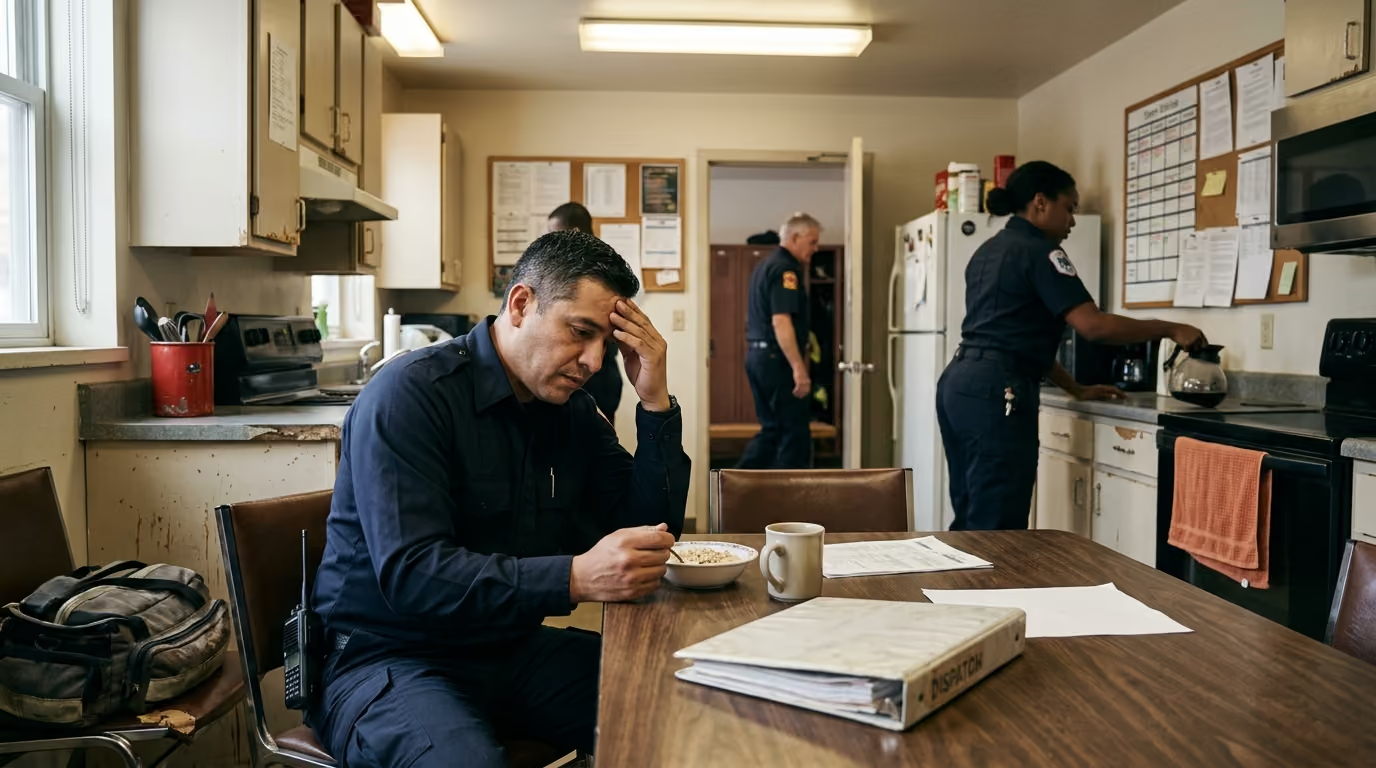

Operational pacing strategies protect first responders from premature fatigue, movement breakdown, and dangerous physiological strain during prolonged emergency calls.





Pacing is the deliberate regulation of physical, cognitive, and thermal effort across an operational period. It is not moving slowly, hesitating during an emergency, or holding back when life safety demands rapid action. Pacing is an active risk-management process that prevents a responder from burning through limited physiological capacity before an incident, shift, or multi-day deployment is complete.
In emergency services, pacing differs from athletic endurance events. An athlete knows the exact distance, the flat terrain, and the location of the finish line. A firefighter, paramedic, or police officer operates under an uncertain mission horizon where the endpoint is unknown, relief may be delayed, and sudden secondary demands can arise at any moment. Regulating output protects the tactical reserve needed to handle unexpected complications, heavy patient transfers, rapid structural withdrawals, or back-to-back emergency calls.
This guide provides an evidence-based framework for managing work output across individual tasks, multi-call sequences, 24-hour shifts, and structured training cycles. It details how physiological fatigue, thermal load, and sleep disruption degrade motor performance and judgment. It also outlines actionable intensity bands, structured recovery protocols, and team-level communication strategies to preserve operational capability without compromising safety.
In exercise physiology, pacing is defined as the voluntary distribution of energy and work output across an entire task. Pacing research shows that humans regulate effort by continuously balancing perceived exertion against the estimated remaining work, current physical capacity, previous experience, and the consequences of failure. Perceived exertion represents the subjective sensation of how heavy and strenuous a task feels at any given second.
Perceived exertion does not always match underlying physiological fatigue. A responder might report low exertion during a familiar task despite suffering from substantial sleep debt or cognitive fatigue. Conversely, wearing heavy protective equipment in high ambient temperatures can spike perceived exertion rapidly even if skeletal muscles have not reached mechanical failure. Data from systematic reviews of occupation-induced fatigue in emergency first responders demonstrate that subjective predictions of readiness become less accurate as fatigue accumulates.
Physical work capacity degrades along predictable neurological and biomechanical pathways when output is not managed. Fatiguing physical protocols cause measurable balance impairment. Research documented in emergency responder fatigue reviews shows double-leg displacement increasing by 1.3 square centimeters and single-leg sway increasing by 2.3 square centimeters following fatigue protocols. Anterior reach performance on functional balance testing decreases significantly after demanding duty periods.
High-velocity neuromuscular output is particularly vulnerable to unmanaged effort. Research indicates that rapid force production within the first 50 milliseconds of muscular contraction drops by up to 25 percent following fatiguing shift work. This specific loss of rapid force development impairs a responder's ability to catch a falling patient, maintain balance on unstable roof decking, arrest a stumble on uneven terrain, or stabilize sudden heavy loads.
In simulated fire-ground studies, ratings of perceived exertion climbed from 8.2 in rested conditions to 9.5 after fatiguing work, representing an increase of roughly 15 percent. Total task completion times slowed from 365 seconds in fresh conditions to nearly 400 seconds after exercise bouts. While conditioned individuals complete technical evolutions faster than untrained personnel, physical fitness expands the size of the operational reserve rather than removing the need to pace. Without conscious effort control, highly conditioned responders can simply expend higher absolute amounts of energy, reaching thermal and metabolic limits abruptly.
Conventional endurance sports rely on steady-state outputs or planned interval surges across a known distance. Emergency response combines intermittent high-intensity bursts with extended periods of low-intensity waiting, driving, equipment preparation, and patient assessment. A responder rarely knows whether a task will resolve in five minutes or evolve into a six-hour multi-alarm incident.
Operating in personal protective equipment creates an artificial microclimate that traps metabolic heat and restricts natural evaporative cooling. A responder working at moderate intensity inside structural gear or hazardous material suits experiences cardiovascular and thermal strain equivalent to heavy athletic exertion in severe heat. In wildland firefighting research, sleep-restricted personnel working in hot conditions covered between 10 and 40 meters less ground than non-heat-exposed cohorts. Relying on heart rate alone to gauge strain during these conditions is unreliable, as heart rate fluctuates with acute mental stress, anxiety, caffeine consumption, and postural shifts.
The operational environment requires holding a non-negotiable capacity buffer known as reserve capacity. Reserve capacity is the gap between the work rate currently expended and the absolute maximum output a responder could generate in an emergency. In athletics, an athlete aims to cross the finish line with zero reserve capacity remaining. In emergency operations, running a physiological tank completely empty creates immediate operational risk.
A responder who expends 100 percent of available capacity during initial forcible entry or rapid hose advancement may successfully finish that early task. However, if a floor collapse occurs, a patient loses stability, or a secondary search is required immediately afterward, that exhausted responder no longer possesses the rapid force capacity, cognitive clarity, or motor balance needed to act safely. Emergency pacing treats reserve capacity as an operational survival tool rather than unused potential.
Understanding how individual willpower fails against duty fatigue reinforces the necessity of objective pacing structures over emotional grit.
Pacing cannot be separated from the operational schedule. Systematic review data encompassing over 6,300 emergency personnel demonstrates that chronic sleep restriction, night shifts, and extended shift lengths create compounding deficits in physical control and cognitive processing. Paramedics and emergency medical technicians average only 5.75 hours of sleep per sleep opportunity, significantly less than office workers or resting controls.
Over 59 percent of surveyed emergency medical service providers report poor baseline sleep quality, and 55 percent report experiencing active fatigue while on duty. These operational realities directly affect safety outcomes across emergency services:
Cognitive performance declines in tandem with muscular capacity during night work and prolonged tours. Research syntheses show that composite memory scores drop from 90.6 during day operations to 84.7 during night shifts. Complex attention scores fall from 97.8 to 93.3 under identical operational transitions. Reaction times measured via psychomotor vigilance testing slow from 253 milliseconds on day five of an extended deployment to 267 milliseconds by day thirteen.
These cognitive degradations directly undermine scene safety. A responder experiencing diminished complex attention takes longer to identify structural hazards, makes more calculation errors during medication administration, and processes radio communications with lower fidelity. Because fatigue impairs self-assessment, personnel frequently report feeling capable even when objective testing reveals substantial reaction delays and coordination deficits. For this reason, shift pacing strategies must rely on objective operational rules rather than personal feelings of alertness.
Personnel managing extended schedules can review how circadian timing and shift lengths drive cumulative sleep debt to better align recovery windows with duty demands.
To apply pacing practically during field operations, responders can categorize physical and cognitive output into four distinct effort bands. This framework removes vague instructions to work hard and replaces them with defined operational limits based on physiological strain and technical sustainability.
The Green Band represents baseline operational work where heart rate remains moderate, ventilation allows complete sentences, and movement precision is fully intact. This zone is used for scene setup, primary patient assessments, equipment staging, low-angle walking, and routine technical tasks.
Energy expenditure in the Green Band relies primarily on aerobic metabolism, producing negligible metabolic byproducts and preserving glycogen reserves. Responders should deliberately maintain a Green Band output during the opening minutes of non-critical incidents to observe scene dynamics, establish clear communications, and assess operational hazards.
The Amber Band involves hard, purposeful work where breathing is heavy, conversation is limited to short tactical phrases, and muscular fatigue begins to accumulate. Typical Amber Band tasks include sustained equipment carries over distance, charged hose line advancements, wildland handline construction, and difficult patient extrications.
In this zone, the responder is working close to the lactate threshold. Output can be sustained for extended periods only if the responder maintains rhythmic breathing, avoids unnecessary explosive surges, and uses efficient mechanics. Responders should actively monitor their technical execution in the Amber Band to prevent form breakdown and joint strain.
The Red Band represents near-maximal physical output. Breathing is labored, speech is restricted to single words, movement quality begins to degrade, and local muscular reserves are depleted within minutes. Red Band efforts include forced entry against reinforced barriers, rapid victim drags up stairwells, rapid primary searches in high-heat environments, and combative patient restraints.
Work in the Red Band rapidly generates metabolic fatigue and elevated core temperatures. Responders must recognize that entering the Red Band initiates a countdown timer on their operational capability. Operating in this zone should be brief, purpose-driven, and immediately followed by a transition to a lower effort band or a recovery rotation.
The Black Band is reserved exclusively for immediate life-safety emergencies, catastrophic structural failure, rapid emergency withdrawal, or personal survival maneuvers. In this band, the responder utilizes 100 percent of available physiological and psychological capacity.
Maximum effort is an emergency exception, not a standard operating mode. Pushing into the Black Band fully empties reserve capacity, leaving the responder physically and cognitively incapacitated for subsequent tasks until deep recovery occurs. Tactical systems must be designed so that normal operational objectives never require Black Band exertion.
A primary pacing failure during emergency incidents is the uncontrolled opening surge. When arriving at a working incident, adrenaline and perceived urgency drive responders to sprint into position, carry heavy tools at maximum speed, and rush initial physical tasks. This rapid acceleration burns through high-energy phosphate stores within the first ninety seconds, elevates heart rate prematurely, and impairs early decision-making.
Starting controlled does not mean delaying critical interventions. It means moving with deliberate, mechanically efficient speed while avoiding unneeded muscular tension and rapid acceleration spikes. A controlled approach preserves fine motor control for knot tying, radio programming, IV placement, or tool placement while leaving physiological headroom to accelerate if scene conditions deteriorate.
To regulate early output, responders can integrate specific operational checkpoints:
Responders who feel residual physical tension accumulating between calls can use active post-incident transition strategies to clear physical strain before taking the next assignment.
Individual effort management is insufficient if operational teams fail to rotate tasks effectively. Team pacing requires understanding the primary physiological limiting mechanism of each on-scene duty and rotating personnel before that specific mechanism reaches complete failure.
Task rotation should not be based solely on arbitrary time intervals or standard job titles. Effective rotation targets the specific organ system or muscle group experiencing the highest acute strain:
Team communication must support objective fatigue reporting without cultural stigma. Standardized operational language allows crew members to convey capacity constraints clearly and professionally. Phrases such as "operating in the Red Band," "grip capacity reaching limit," or "requesting rotation at next transition" provide actionable operational intelligence to company officers and team leaders.
NIOSH emergency responder safety guidance recommends establishing team-based safety signals that allow members to call for tactical pauses or task hand-offs whenever unmanaged fatigue threatens crew safety.
Recovery between calls, work cycles, and training evolutions is an active operational intervention rather than passive downtime. Stopping intense physical exertion reduces acute breathlessness, but it does not instantly restore core temperature, clear metabolic waste, replenish muscular glycogen, or resolve cognitive fatigue.
NIOSH safe work practice guidelines emphasize that frequent brief rest breaks are significantly more effective at preventing operational errors and physical injuries than infrequent long breaks. During sustained operations, implementing a 5-to-10-minute structured pause every hour maintains higher aggregate performance than working continuously for four hours followed by a single extended rest period.
Field research among wildland firefighters indicates that the most effective field recovery behaviors include sitting in shaded environments (reported by 93 percent of surveyed personnel), consuming cold fluids (90 percent), and removing restrictive protective equipment including helmets, flash hoods, and turnout coats (89 percent). Removing personal protective equipment is essential for restarting natural convective and evaporative heat loss.
A structured rehabilitation interval must progress through defined stages:
Applying sustainable duty fitness principles ensures that baseline cardiovascular and muscular conditioning supports rapid recovery between high-demand evolutions.
Pacing is a trainable neurological and perceptual skill. If every training session is performed as a maximum-effort test to complete muscular failure, responders learn poor effort distribution, struggle to identify intermediate fatigue states, and accumulate unnecessary systemic fatigue.
Structured conditioning should emphasize pacing awareness, tempo control, and sub-maximal repeatability. Integrating negative-split formats and controlled-start conditioning teaches the neuromuscular system to sustain output without early mechanical breakdown.
Instead of sprinting the opening round of an interval workout and experiencing declining output in subsequent rounds, program sessions where every repetition must match or exceed the pace of the first round.
For example, when performing repeated 500-meter rowing intervals or loaded sled pushes, establish a target pace in round one that feels like an Amber Band effort (RPE 6-7). The goal is to hold that exact pace across five consecutive rounds, adjusting movement efficiency and breathing mechanics to counter creeping fatigue. If the final round is faster than the first while maintaining pristine technique, the effort was paced correctly.
Structure circuit training so that effort bands are deliberately manipulated across the session:
Track total training load using session ratings of perceived exertion combined with total workout duration. If a responder enters the gym following an exhausting night shift with interrupted sleep, training intensity should be adjusted down into the Green Band, focusing on mobility, tissue quality, and aerobic base work.
Responders can apply minimum effective dose training strategies to maintain high operational capacity without overtaxing limited recovery reserves.
Pacing cannot succeed as an isolated individual responsibility. When departmental staffing models, mandatory overtime policies, or station cultures demand continuous maximum output without protected recovery, operational failures are inevitable. A robust Fatigue Risk Management System requires administrative leadership across four core pillars.
Agencies must track objective risk metrics across their workforce:
Departments should implement clear policies that enforce physiological recovery:
Agency leadership must establish an operational culture where reporting fatigue is treated as a safety measure rather than a disciplinary failure. Standardized procedures must allow a responder to report significant cognitive or physical impairment and request immediate reassignment from safety-critical duties, such as apparatus driving or heavy rescue operations, without career penalties or administrative stigma.
Following prolonged incidents or high-demand operational periods, after-action reviews should explicitly evaluate fatigue dynamics:
Misunderstanding pacing principles leads to predictable errors that compromise personnel safety. Responders and company officers must identify and correct these common tactical mistakes.
Completing a short, intense evolution in under five minutes does not mean a responder is unimpacted by fatigue. Short bouts often mask underlying neuromuscular and cognitive exhaustion that surfaces abruptly during subsequent, longer tasks. Judge readiness by current physiological markers and cumulative shift workload, not merely by the successful outcome of the preceding call.
Caffeine, cold water, and brief cooling towels provide temporary alertness and thermal relief. They do not clear metabolic waste products from muscular tissue, restore depleted cellular glycogen, or erase neurological sleep debt. Use these countermeasures as short-term operational bridges, never as justification to bypass mandatory rest limits or work extended unsafe hours.
Heart rate fluctuates significantly due to psychological arousal, gear weight, posture, ambient heat, and dehydration. A fatigued responder working in high heat may exhibit an unexpectedly stable heart rate simply because central nervous system exhaustion prevents them from generating high physical output. Always evaluate heart rate alongside movement quality, communication clarity, breathing rate, and environmental conditions.
Superior cardiovascular and muscular strength gives a responder a larger operational gas tank, but it also allows them to generate higher absolute power and accumulate thermal strain faster. Without deliberate pacing, highly conditioned responders can push deep into severe metabolic debt before recognizing their state, resulting in sudden physical collapse. Fitness expands capacity; pacing directs how that capacity is safely spent.
Because cognitive processing and self-awareness degrade under fatigue, personnel often believe they are functioning normally when their balance, reaction time, and decision clarity have already deteriorated. Do not wait for a responder to feel exhausted. Enforce predetermined work-rest intervals, conduct regular team status checks, and rotate personnel based on operational time and thermal load.
While acute fatigue is an expected consequence of demanding emergency work, persistent or abnormal exhaustion indicates underlying clinical issues that cannot be resolved through pacing strategies alone.
Responders should consult qualified occupational health professionals or licensed medical providers when experiencing:
Occupational medical teams can conduct formal sleep studies, evaluate hormone and metabolic function, and screen for duty-related cardiovascular strain. Addressing these underlying clinical health factors restores the physiological baseline required for operational pacing strategies to work effectively.
Sustainable capability across a long emergency services career requires managing physical output with precision. Responders who master the skill of operational pacing protect their personal safety on scene while ensuring they maintain full physical health and capability long after retirement.
Even during short calls, pacing prevents the unneeded opening surge. By moving with controlled speed and deliberate mechanics during the first two minutes of an incident, a responder avoids spiking into premature anaerobic exhaustion. This preserves the fine motor coordination and rapid reaction capability needed if the call suddenly escalates into an extended rescue.
No. Caffeine temporarily blocks adenosine receptors in the brain to reduce the sensation of sleepiness, but it does not restore neuromuscular power, balance control, or complex decision-making. Relying on caffeine without pacing output leads to abrupt performance drop-offs when the stimulant effect wanes.
A company officer balances urgency by matching the crew's effort band directly to the immediate life-safety risk. True life-saving rescues warrant temporary Red Band efforts, but routine structural tasks, equipment hauling, and overhauls should be strictly held to Green or Amber bands with mandatory structured rotations.
Changes in communication clarity and movement mechanics are the most reliable visual cues. When a responder stops acknowledging radio traffic clearly, begins repeating questions, stumbles on level ground, or shows excessive shoulder elevation and rapid mouth-breathing during routine tasks, they have moved past sustainable effort limits and require rotation.
Stay connected for research-led guidance on duty fitness, shift-work sleep, injury recovery, stress, nutrition and career longevity. Practical ideas for first responders who want to stay capable on the job, recover well and protect their health for the long run.



Read practical guidance on first responder fitness, recovery, sleep, nutrition and resilience for demanding work and a long, active career.
read the blog



