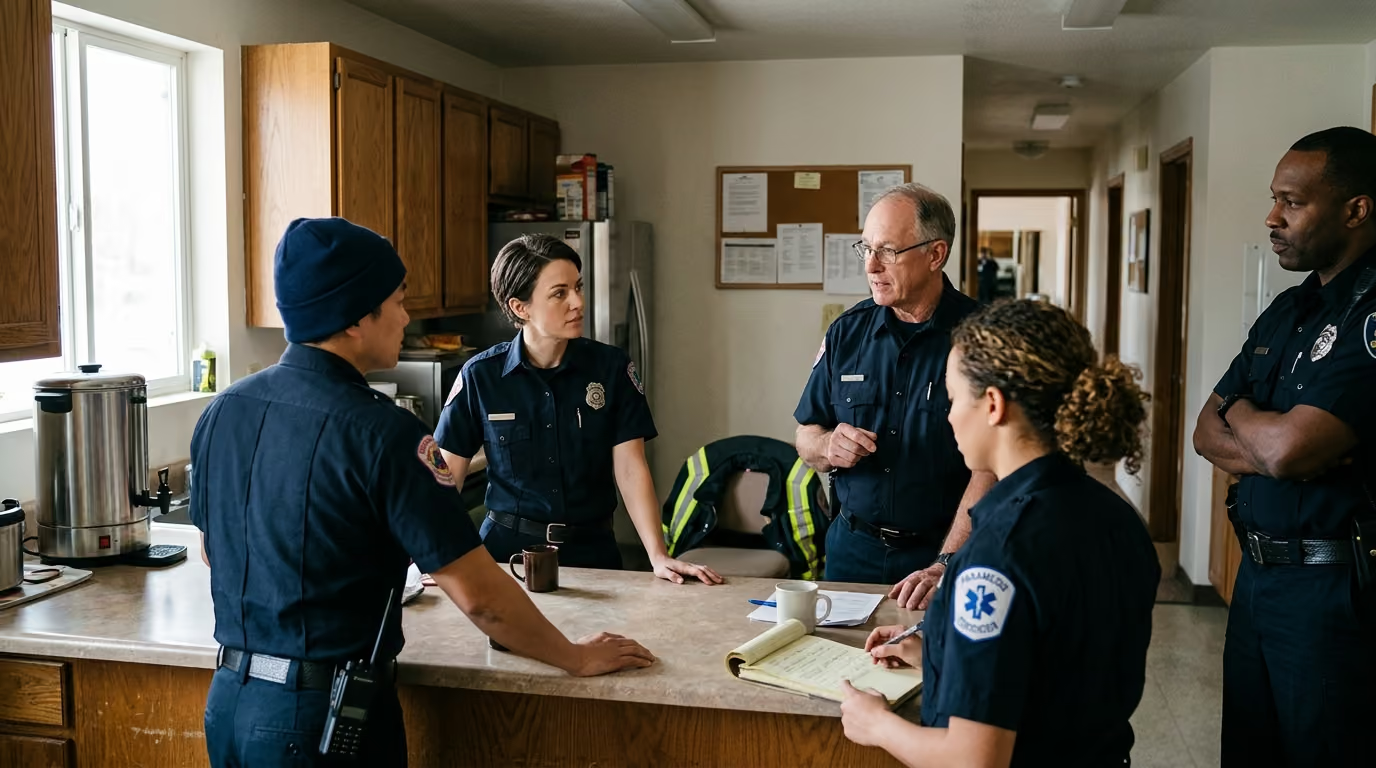

A resilient frontline crew emerges when emergency service leaders implement practical psychological safety frameworks that balance rigorous accountability with open error reporting.





If you or a colleague are in immediate danger, call 911 immediately. If you need urgent mental health support, call or text 988, press 1 for the Veterans Crisis Line, or text 838255. When managing acute distress, arrange the safe storage of firearms and medications together with a trusted colleague, family member, or licensed clinician.
Emergency service leaders often search for ways to build trust across crews without lowering operational standards. They ask how a company officer can maintain strict discipline on a fireground or medical scene while encouraging firefighters and paramedics to speak up about hazards, near misses, or personal distress.
The direct answer is that psychological safety is not about comfort, lower expectations, or lenient management. It is a shared belief among crew members that the team is safe for interpersonal risk-taking. On a high-performing emergency crew, psychological safety means personnel can raise safety, operational, ethical, or health concerns early enough for the team to act. Leaders respond to those concerns with respect, direct inquiry, and proportionate accountability. High standards and psychological safety work together to prevent catastrophic errors and support career longevity.
Psychological safety refers specifically to the anticipated interpersonal consequences of speaking or acting honestly. In emergency dispatch centres, fire stations, paramedic bases, and police squads, it dictates whether a responder expects humiliation, ridicule, career damage, or retaliation when they admit a mistake or question an order.
It does not mean that responders operate in a consequence-free environment. Emergency services require precise execution, high physical readiness, and immediate compliance with command during high-risk operations. A crew with high psychological safety can hold rigorous debriefs, enforce strict operational protocols, and issue immediate tactical corrections. The difference lies in whether personnel conceal errors out of fear or expose them so the organisation can adapt.
A functional safety culture separates human mistakes from deliberate violations. The Federal Aviation Administration and occupational safety researchers outline three distinct categories of behaviour:
When leadership punishes an honest calculation error the same way they punish reckless misconduct, personnel stop reporting problems. Reporting goes underground, leaving systemic flaws unaddressed until an avoidable tragedy occurs.
Psychological safety is frequently confused with interpersonal trust, team morale, or general permissiveness. While related, these concepts serve different functions:
Foundational research by organizational scholar Amy Edmondson established that team psychological safety is a primary driver of learning behavior in work teams. Her research revealed that teams reporting higher numbers of errors were often not making more mistakes. Instead, they possessed the interpersonal safety required to report, discuss, and correct their errors rather than hiding them.
In high-consequence environments, psychological safety directly influences team adaptability. Teams that discuss errors openly adjust their procedures faster, cross-check critical decisions more reliably, and display superior situational awareness under stress.
Research examining emergency medical services confirms the operational connection between safety culture and responder wellbeing. A multilevel study of EMS providers by Lee and colleagues found that a positive safety climate was directly associated with higher morale and lower depressive symptoms. Emotional exhaustion correlated with lower morale and elevated depressive symptoms. A strong safety climate buffered these negative effects, showing that occupational safety systems and responder health are closely linked.
Systematic reviews of help-seeking behavior among emergency responders reveal pervasive cultural expectations to hide distress or handle problems alone. Responders frequently fear that reporting mental health symptoms or asking for support will lead to losing operational status, facing peer ridicule, or stalling career progression. The research shows that formal support programs fail when local station culture penalizes vulnerability.
Epidemiological surveys highlight the urgency of addressing these cultural barriers. An umbrella review of emergency responder health identified PTSD symptom prevalence rates between 17 percent and 22 percent across firefighter and EMS cohorts. Furthermore, reports from the Substance Abuse and Mental Health Services Administration indicate that dual-role fire and EMS personnel report elevated rates of distress and suicide attempts compared to single-role counterparts.
National safety summits have pointed out that systemic surveillance for occupational stress injuries remains incomplete across emergency services. These findings confirm that psychological safety is a critical operational safeguard rather than a secondary workplace benefit.
Emergency service work introduces physical, cognitive, and structural pressures that distort communication. Standard business management advice fails when applied to structural firefighting, tactical law enforcement entries, mass casualty triage, or prolonged night shifts.
First responders operate within strict paramilitary command structures. While clear hierarchy is necessary during rapid-onset emergencies, it creates an inherent barrier to upward communication. Subordinate personnel often hesitate to voice critical observations if their agency treats every question as insubordination.
Shift work and circadian disruption compound this communication friction. Chronic sleep restriction, night operations, and unpredictable call volume impair emotional regulation and executive function. Fatigued leaders are more likely to react defensively to questions, while fatigued crew members are less likely to expend the cognitive effort needed to challenge an unsafe plan.
Physical load, thermal stress, and personal protective equipment also limit sensory perception on scene. An incident commander outside a structure cannot see what a nozzle team sees in a basement. A paramedic managing a pediatric resuscitation in a tight hallway cannot track every environmental hazard. When crews fear reprimand, they withhold weak signals, allowing isolated operational hazards to escalate into critical failures.
Operational demands also require effective physical conditioning and regular nutritional support. Crew readiness relies on systems like a practical shift nutrition framework to sustain baseline cognitive performance during long operational periods. When physiological baselines collapse, interpersonal patience declines, making psychological safety even harder to maintain.
To establish psychological safety within an emergency service organization, leadership must move beyond abstract concepts. The SAFE-R framework provides a structured model for operational crews, company officers, and department executives:
Leaders must explicitly state that identifying hazards, requesting cross-checks, and reporting near misses are core operational competencies. Silence must be framed as a systemic vulnerability rather than a sign of discipline.
Company officers should communicate clear operating principles to their crews:
Setting the standard requires defining zero-tolerance boundaries. Ridicule of junior members, retaliation against whistleblowers, and deliberate falsification of run reports must meet swift administrative intervention. World Health Organization guidelines on decent work in emergency services highlight that protecting responders from workplace harassment and arbitrary punishment is essential for operational sustainability.
Company officers and chief officers set the tone by how they handle unsolicited input, especially when the information disrupts the operational timeline. Leaders must actively draw out information from every crew member rather than assuming silence equals agreement.
When receiving unexpected feedback or hazard reports, leaders should follow a seven-step sequence:
During quiet periods between calls, crews can use between-call reset strategies to down-regulate sympathetic nervous system activation. This physical reset helps officers approach station communications with clarity and patience.
Emergency service agencies cannot rely on individual bravery alone to overcome rank hierarchy. Personnel need structured communication protocols that make speaking up an expected operational routine.
The TeamSTEPPS framework, developed by the Agency for Healthcare Research and Quality, provides the CUS graded assertiveness model. This tool gives junior personnel a standardized language to escalate safety concerns without sounding confrontational:
Departments should embed speaking-up triggers into daily operations:
When an operational failure or near miss occurs, the investigation process determines whether future incidents will be reported or concealed. A just-culture review evaluates the conditions surrounding human performance rather than searching for an individual to blame.
Fair reviews avoid the outcome bias trap, where the severity of the consequence dictates the severity of the punishment. A near miss that resulted in zero damage due to pure luck must be analyzed with the same rigor as an incident that caused equipment loss.
When systemic deficiencies are identified, leadership must close the loop by communicating findings back to the department. Agencies must state what was learned, what changes will be implemented in equipment or training, and who oversees the corrective measures. When leadership remains silent after an investigation, personnel assume reporting is pointless.
Psychological safety requires active maintenance. When an officer dismisses a valid concern, cuts off a junior member, or reacts with unwarranted anger, they must repair that trust through direct acknowledgment.
A professional repair statement is concise and accountable:
> "Earlier on the fireground, I cut you off when you raised a point about the water supply. I was focused on entry speed, but your observation was valid and my response was wrong. In the future, keep bringing those safety points to my attention."
Post-incident recovery also requires robust support systems. After difficult calls involving mass casualties, severe pediatric trauma, or colleague injuries, agencies must deploy layered support. Peer support programs, confidential mental health resources, and structured operational debriefs help crews process events constructively. For broader insights on building agency-wide resilience, review our guide on operational readiness through shared support systems.
Finally, leadership must publicly reinforce proactive reporting. Highlighting a crew that caught a medication error, called for an early structural evacuation, or reported a vehicle mechanical flaw normalizes risk communication across the entire department.
Examining realistic scenarios illustrates how psychological safety operates across different emergency branches.
A probationary firefighter on a search crew notices rapid heat buildup and heavy, pressurized smoke banking down from the ceiling of an upper floor. The company officer is focused on forcing an interior bedroom door.
A paramedic crew is treating a critically ill pediatric patient in respiratory failure. The primary medic, exhausted after 18 hours of continuous shift work, calculates a medication dosage that seems high to their partner.
A veteran dispatcher accepts a 911 call reporting a minor structure fire. A newer call-taker on an adjacent console enters conflicting information indicating that occupants are trapped on the second floor.
A police squad responds to a violent public disturbance involving weapons. After the scene is contained, an officer shows signs of severe acute shock, tremors, and cognitive disorientation. The crew must also navigate complex physical risks similar to the challenges detailed in our analysis of occupational violence and crew safety.
Building psychological safety across an emergency agency requires avoiding common administrative missteps.
Administrators often believe that announcing an open-door policy creates an open organization. In practice, front-line responders rarely visit an administrator's office to report safety issues if previous whistleblowers faced isolation or career penalties. Psychological safety is demonstrated by what happens out in the field and at the station table, not by administrative statements.
Forcing personnel to participate in deep emotional disclosure immediately following a critical incident can be counterproductive. World Health Organization and International Labour Organization guidelines recommend psychological first aid, practical support, and voluntary access to clinical care. Compulsory emotional debriefings can increase distress and cause personnel to withdraw. Support must be layered, accessible, and structured around responder needs over time.
Departments frequently run annual climate surveys and calculate high department-wide satisfaction averages. These macro-level numbers can hide profound dysfunction within specific stations, specialized units, or night shifts. Psychological safety varies significantly across individual supervisors. Leadership must analyze reporting rates and survey feedback across specific shifts, ranks, and demographic groups.
Leaders must be transparent about the exact boundaries of confidentiality. While internal peer discussions should remain private, certain disclosures legally require escalation. These include immediate risks of self-harm, child abuse, sexual harassment, or criminal conduct. Falsely promising absolute secrecy damages trust when an officer is later forced to act on mandatory reporting requirements.
Transforming departmental culture requires a structured, multi-phase plan over a twelve-month operational cycle.
Organizations should monitor three distinct categories of metrics to evaluate psychological safety accurately.
Use regular, anonymous pulse surveys to evaluate whether personnel believe they can:
Track concrete operational actions that demonstrate psychological safety in daily routines:
Examine long-term organizational health indicators that reflect cultural change:
When tracking these metrics, remember that an initial increase in reported near misses is often a sign of improving trust rather than declining performance. It indicates that personnel finally feel safe bringing hidden risks to light.
Psychological safety supports early mental health intervention, but peer support and supervisory empathy cannot replace clinical treatment. Company officers and team members must understand where peer support ends and professional clinical care begins.
First responders frequently encounter cumulative trauma, horrific scenes, and chronic physical strain. Understanding how cumulative duty fatigue degrades physical and emotional resilience helps crews identify when a colleague needs support.
Supervisors should initiate private check-ins when they observe specific warning signs:
During a check-in, the supervisor's role is not to diagnose mental health conditions. Their duty is to describe the objective performance changes they have observed, express direct support, assess immediate safety, and connect the responder with qualified, culturally competent clinical professionals.
Departments must establish relationships with licensed clinicians who understand the reality of shift work, emergency operational violence, and public safety culture. Treating mental health injuries with the same professional rigor as physical orthopedic injuries protects responders and the communities they serve.
Psychological safety is the operational condition that allows emergency responders to voice hazards, catch errors, and seek support before
stress or silence leads to catastrophe. It reinforces strict operational standards by making accurate communication possible across all ranks.
Stay connected for research-led guidance on duty fitness, shift-work sleep, injury recovery, stress, nutrition and career longevity. Practical ideas for first responders who want to stay capable on the job, recover well and protect their health for the long run.



Read practical guidance on first responder fitness, recovery, sleep, nutrition and resilience for demanding work and a long, active career.
read the blog



