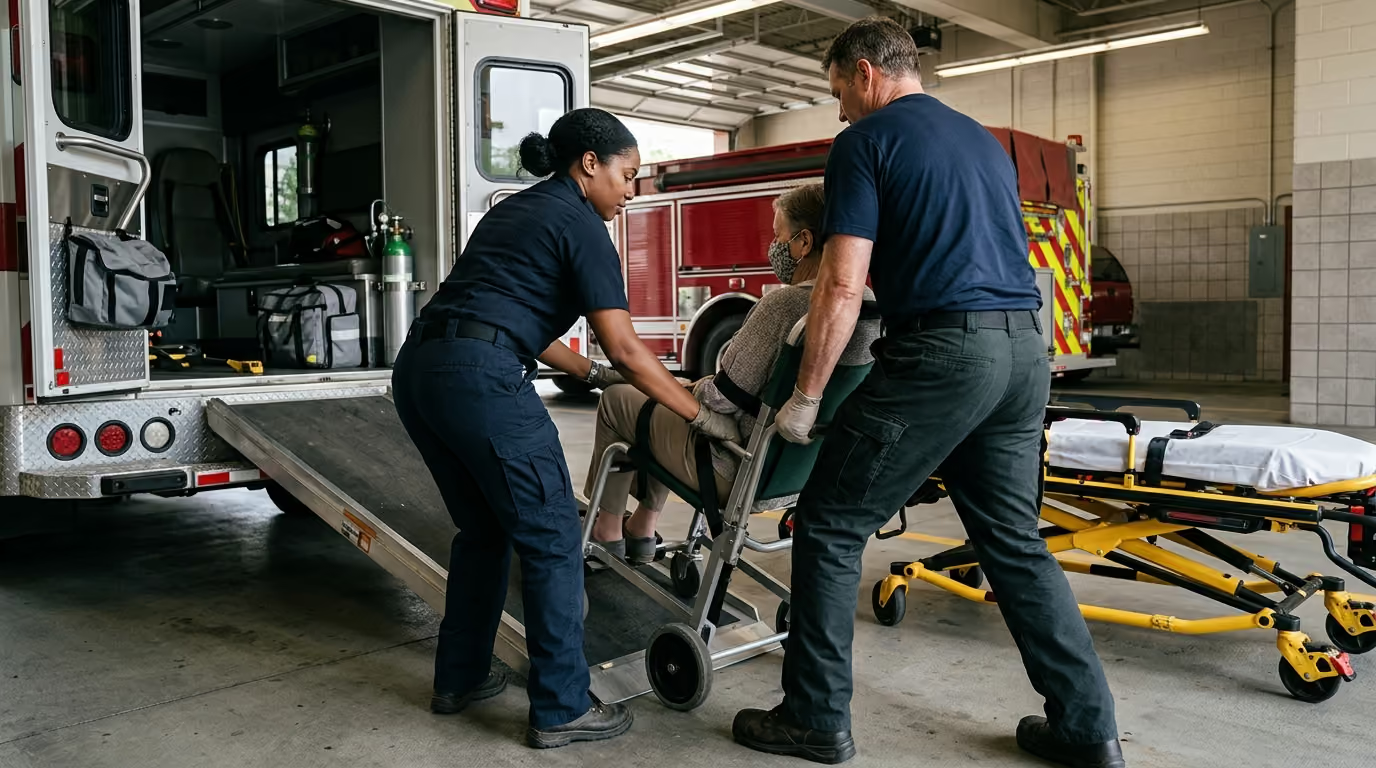

Roughly 90 percent of responder body-motion injuries involve moving patients, underscoring the necessity of structured threat assessments and transferable biomechanical lifting techniques.





Safe patient handling is not a single posture, a perfect lift, or a rigid set of biomechanical rules. It is an operational decision framework that balances life safety, responder protection, patient stability, and speed. It is not an assurance that emergency scenes can be made risk-free. Unpredictable environments, violent threats, structural collapses, and unstable medical crises routinely force crews to operate outside laboratory conditions.
The core objective is choosing the least hazardous movement that achieves the tactical goal. When responders treat patient handling as a risk-reduction process rather than a test of physical strength, they preserve career longevity and patient safety.
The fastest way to reduce patient-handling strain is to eliminate manual lifting whenever feasible. Responders should prioritize patient self-movement, friction-reducing slide sheets, stair chairs, and powered loading systems before attempting a manual lift. When manual handling cannot be avoided, crews must keep the load close to the body, eliminate trunk rotation, establish clear verbal leadership, and avoid treating a drag or slide as zero-effort movement.
Musculoskeletal injury remains one of the greatest occupational threats to emergency medical technicians, paramedics, and firefighters. National health and occupational safety data demonstrate that patient handling is the primary driver of physical wear and career-ending disability in emergency services.
According to data from the National Institute for Occupational Safety and Health, more than 22,000 emergency medical services workers visit emergency departments every year for work-related injuries. A four-year surveillance analysis indicated that approximately 89,000 emergency medical personnel received treatment in emergency departments. This yielded an injury rate of 8.6 injuries per 100 full-time workers, which is more than four times the national average for all occupational sectors.
Body-motion events represent the single largest injury category in emergency medical services. Research indicates that body-motion events account for an estimated 24,900 injuries among emergency medical personnel. Roughly 90 percent of these incidents involve lifting, carrying, or transferring patients and equipment. Furthermore, approximately 90 percent of those handling incidents involve lifting a patient directly.
Ambulance personnel face an extraordinary rate of overexertion injuries compared to clinical healthcare staff. Research shows ambulance workers experience an overexertion injury rate of 174 per 10,000 workers. Hospital workers experience an incidence rate of 68 per 10,000 workers, while nursing home employees experience 107 per 10,000 workers. The unpredictable physical environment of emergency response amplifies spinal loading beyond standard institutional baselines.
An analysis of occupational claims related to patient handling identified that 6.9 percent of all service injuries involved patient lifting, moving, or maneuvering without direct violence. Among those specific patient-handling claims, 63.4 percent resulted in at least one lost workday. The data revealed that 51.2 percent of handling claims occurred while moving a patient without a stretcher. Another 37.8 percent occurred while lifting or maneuvering a stretcher with or without a patient present.
Sprains and strains represent the overwhelming majority of these documented claims. In the claims analysis, sprains and strains accounted for 63.4 percent of injuries, while an additional 18.3 percent were classified separately under related strain categories. These soft tissue injuries degrade physical capability and accumulate across a career, reinforcing why systematic musculoskeletal injury and recovery principles must be built into regular operations.
System-level safe patient-handling programs yield measurable reductions in injury rates across healthcare environments. A systematic review evaluating safe patient-handling interventions reported an overall injury-rate ratio of 0.44 following program implementation. This represents an estimated 56 percent reduction in musculoskeletal injury risk when organizations combine equipment, policy, and structured movement training.
Industrial lifting guidelines often fail in emergency response because they assume predictable, symmetrical, and stable loads. A standard factory box has rigid corners, a fixed center of mass, and handles located at waist height. A patient is a dynamic, non-rigid human being whose weight shifts unpredictably during transport.
The revised patient-handling lifting equation from the National Institute for Occupational Safety and Health establishes a recommended weight limit of 35 pounds for most patient-handling tasks. This 35-pound recommendation applies to favorable lifting conditions where the load is held close to the torso. The recommended threshold drops substantially when a lift involves extended arms, forward bending, kneeling, trunk rotation, or shifts exceeding eight hours.
The classical industrial lifting equation cites a 51-pound maximum weight limit under ideal laboratory conditions. That figure assumes a compact object lifted with two hands directly in front of the body without twisting. Applying a 51-pound object limit to an unstable 200-pound patient on a wet bathroom floor creates an immediate biomechanical mismatch.
Patients introduce several variables that invalidate static load equations:
Emergency responders also face the cumulative fatigue of long shifts. Extended duty hours reduce spinal stabilizer endurance, slow reaction times, and compromise motor coordination. Understanding how shift length and circadian fatigue impair physical capacity helps explain why a lift that feels manageable at 0800 can cause tissue failure at 0400.
Clinical transfers in a hospital take place on level, clean floors with adjustable beds and overhead ceiling lifts. First responders rarely operate in controlled environments. Responders work in cramped bathrooms, steep stairwells, muddy ditches, highway medians, and burning structures.
Crews must categorize the operational urgency of the movement before touching the patient:
First responder gear adds significant physical burden to every movement. Structural firefighting gear, self-contained breathing apparatus, body armor, and duty belts shift the responder's center of gravity. Bunker gear restricts hip and knee flexion, forcing greater forward bending at the lumbar spine. Body armor limits thoracic spine rotation, which causes responders to twist at the vulnerable lumbar segments if footwork is neglected.
Environmental obstacles dictate the mechanical strategy. In a tight hallway, establishing a wide, symmetrical stance may be physically impossible. In those situations, forcing an idealized squat lift increases risk. The responder must adapt the movement strategy by changing the angle, using transfer sheets, or altering the equipment rather than forcing a textbook lift into an unsuitable space.
The decision to move a patient requires a systematic mental checklist. Responders can use the five-part framework of Threat, Patient, Task, Team, and Tools to select the safest operational path.
Determine why the patient must move right now. Is the scene actively hazardous, or is the environment controlled? Differentiating an emergency rescue from a routine transport prevents responders from using high-risk, uncoordinated drags when time is available to use mechanical aids.
Assess the physical and cognitive capacity of the patient. Can the patient follow verbal commands? Can they support partial body weight on their legs or push with their arms?
Identify medical red flags including spinal trauma, pelvic instability, open fractures, and hemodynamic collapse. A patient experiencing severe vertigo or profound weakness cannot be trusted to stand without sudden collapse. Assessing these factors prevents unexpected load drops during transfers.
Break the overall movement down into individual mechanical segments. A single transport often includes a lateral roll, a vertical lift from the floor, a horizontal slide to a stretcher, navigation through a doorway, and a descent down stairs.
The vertical lift may not be the most dangerous phase. Negotiating a tight corner or stepping over a raised threshold while supporting a stretcher often creates the highest spinal torque. Analyzing each segment allows the crew to pause, reset grips, and reposition before entering a high-hazard phase.
Assess the available manpower, physical capacity, and positional symmetry of the crew. Assigning more people to a lift does not guarantee safety if responders crowd each other or pull in conflicting directions.
Every team movement requires a designated verbal leader:
Clear communication serves as a mechanical safety control. When movement occurs without a shared cadence, one responder absorbs an unexpected portion of the load. This sudden force transfer frequently causes acute lumbar strain.
Select the equipment that minimizes manual lifting. The operational hierarchy should always move from least hazardous to most hazardous:
Integrating this hierarchy into standard operating procedures reduces unnecessary physical wear. Responders can support their longevity by pairing smart mechanics with structured training sessions around shift work to maintain physical capacity.
Biomechanical laws apply whether a responder is lifting a patient from a carpeted bedroom, carrying a stair chair, or dragging an unconscious victim from a vehicle. Applying core physical principles reduces spinal shear and joint stress across all operational tasks.
The distance between the load and the responder's spine dictates the length of the external moment arm. When a responder holds a 50-pound weight 10 inches from their chest, the torque experienced by the lower back is substantially lower than if that same weight is held 25 inches away. Reaching forward over a bed or leaning into a car seat multiplies the compressive forces on the lumbar intervertebral discs.
Keeping the load close does not mean compromising patient airway management or chest access. It means moving your feet closer to the target surface, stepping into the work zone, and avoiding lifting with outstretched arms. If you cannot get your feet close to the load, use a strap, sheet, or transfer device to bridge the distance.
A stable base of support provides the foundation for force transfer from the hips to the upper extremities. Responders should maintain a shoulder-width stance with a staggered foot position. A staggered stance allows forward and backward weight shifting, which reduces the need to flex the lumbar spine during pushing and pulling tasks.
The base of support must adapt to environmental constraints. In narrow spaces, a wide squat stance may be impossible. Responders should stagger their feet along the line of movement, brace the core musculature, and use stable structural objects for hand support when appropriate.
Simultaneous spinal flexion and rotation represents the most dangerous mechanical position for the human intervertebral disc. When the spine flexes forward and twists while supporting a load, the annulus fibrosus experiences high shear stress. This specific combination is a primary mechanism for disc herniation and acute facet joint impingement.
Responders must align their shoulders and hips before initiating any movement. If the transport path changes direction, move the feet and pivot the entire body. Never twist the torso to set a patient onto a stretcher or car seat while the feet remain planted in place.
Sliding an object horizontally requires less energy than lifting it against gravity. However, sliding is not entirely without risk. Horizontal sliding generates significant friction, which can produce substantial shoulder and spinal loads if poor technique is used.
Research from the National Institute for Occupational Safety and Health demonstrates that pulling a 105-pound patient from a bed to a stretcher using a standard bedsheet can generate peak forces between 832 and 1,708 pounds. This extreme force occurs due to friction between the sheets, mattress compression, and poor responder positioning. Responders must utilize low-friction transfer sheets, ensure the transfer surfaces are level, and position pulling handlers close to the target surface.
Spinal loads spike dramatically during sudden, ballistic movements. When a responder jerks a patient upward, the peak force experienced by the musculoskeletal system exceeds the static weight of the patient due to acceleration. Moving with a controlled, deliberate cadence allows the muscular system to maintain tension and protects passive spinal ligaments from sudden overload.
Each movement modality carries distinct mechanical advantages and injury risks. Selecting the correct method depends on the clinical status of the patient, the physical environment, and the availability of equipment.
Manual lifting involves supporting the patient's entire body weight against gravity using muscular effort. This includes floor-to-stretcher transfers, two-person ground lifts, and manual backboard raises.
Carrying combines vertical load support with walking, turning, and balancing across terrain. Common examples include two-person seat carries, four-person stretcher carries, and pack-strap carries.
Dragging moves a patient along a surface by pulling along their longitudinal axis. Common techniques include blanket drags, shoulder drags, webbing drags, and clothes drags.
Lateral transfers move a patient horizontally between two adjacent surfaces, such as a bed to a cot or a cot to an examination table.
Powered stretchers and hydraulic loading mechanisms use battery power to raise, lower, and load stretchers into ambulances.
Certain patient-handling situations present recurring injury patterns. Applying structured mechanical adaptations to these high-risk scenarios reduces acute tissue overload.
A conscious, uninjured patient who has fallen and cannot stand presents a common dispatch scenario. Rushing to perform a two-person manual underarm lift places the responders in a position of maximum lumbar flexion.
When a patient is trapped in a burning room or a vehicle exposed to oncoming traffic, immediate extraction overrides standard immobilization protocols.
Confined bathrooms restrict movement and prevent normal positioning. A responder standing between a toilet and a bathtub cannot establish a standard squat stance.
Transporting a patient down a flight of stairs generates severe downward acceleration and balance demands. The lower handler faces backwards while supporting a significant portion of the load.
Loading a manual stretcher into the back of an ambulance requires a combination of horizontal pushing and vertical lifting at an awkward shoulder height. Claims data confirm that 37.8 percent of patient-handling injuries occur during stretcher maneuvering and loading.
Developing strong positional awareness across these situations is essential. Responders can develop these movement foundations through regular duty fitness and physical capability routines that prioritize multi-planar stability and grip strength.
Preventing musculoskeletal attrition requires moving beyond individual lifting technique. Organizations must establish clear operational limits, policies, and equipment standards to safeguard frontline personnel.
Musculoskeletal injury prevention requires correcting several persistent industry misconceptions:
At the departmental level, safe patient handling requires four key components:
Responders who balance shift work with physical conditioning must also monitor their daily readiness. Learning how to manage training loads by autoregulating training around cumulative duty fatigue helps prevent off-duty gym injuries from compounding on-duty patient-handling strain.
First responder culture often encourages personnel to ignore physical discomfort and work through pain. This mindset frequently converts minor, treatable soft tissue strains into chronic, career-ending spinal pathology.
Responders must recognize clinical red flags that require immediate medical evaluation by a licensed healthcare professional:
Continuing to perform manual handling while experiencing acute neurological or structural symptoms dramatically increases the risk of permanent nerve damage. Responders must report these symptoms promptly to occupational health staff or their personal physician.
Return-to-duty decisions must be based on functional movement capacity rather than simple pain reduction at rest. A responder may feel comfortable walking on flat ground, yet lack the spinal stability required to control an unstable 180-pound patient on a stairwell. Functional rehabilitation should verify that the responder can safely brace, pivot, lift from ground level, and handle dynamic loads before returning to full frontline emergency duty.
Safe patient handling is an active decision process that balances operational urgency against biomechanical realities. Sustainable career capability requires eliminating manual lifting whenever possible, maintaining strict command communication, deploying mechanical aids consistently, and refusing to treat brute physical force as a substitute for sound operational mechanics.
A two-person manual lift of a 200-pound patient from the floor violates standard occupational safety limits. Even with weight evenly distributed, each responder handles approximately 100 pounds. This far exceeds the National Institute for Occupational Safety and Health recommended patient-handling limit of 35 pounds. Lifting from floor level forces deep lumbar flexion, dramatically increasing spinal compression. Crews should use transfer sheets, lifting cushions, slide boards, or additional personnel to stage the lift.
During an immediate emergency move, such as dragging an unconscious victim away from a vehicle fire, complete spinal immobilization is impossible. Responders should pull the patient straight along the long axis of their body. Grasp the patient under the armpits while cradling their head between your forearms, or secure a strap beneath the chest. This minimizes lateral bending and twisting of the neck while allowing rapid extrication from the hazard zone.
If a powered stretcher experiences battery failure or mechanical malfunction, transition immediately to manual mechanical protocols. Do not attempt to muscle the heavy powered frame solo. Deploy the manual release mechanism according to manufacturer instructions, ensure a minimum of two to four responders support the cot frame, and maintain standard verbal lift commands during all vertical transitions. Report the equipment failure immediately for maintenance.
Shift fatigue degrades motor coordination, slows reaction time, and exhausts the postural muscles that stabilize the spine. Research indicates that extended shifts lower safe handling thresholds, making tissues more susceptible to acute tears and disc injuries. Crews operating during late-night or extended hours should lower their threshold for requesting additional lift assistance and rely more heavily on mechanical aids like slide sheets and stair chairs.
Stay connected for research-led guidance on duty fitness, shift-work sleep, injury recovery, stress, nutrition and career longevity. Practical ideas for first responders who want to stay capable on the job, recover well and protect their health for the long run.



Read practical guidance on first responder fitness, recovery, sleep, nutrition and resilience for demanding work and a long, active career.
read the blog



