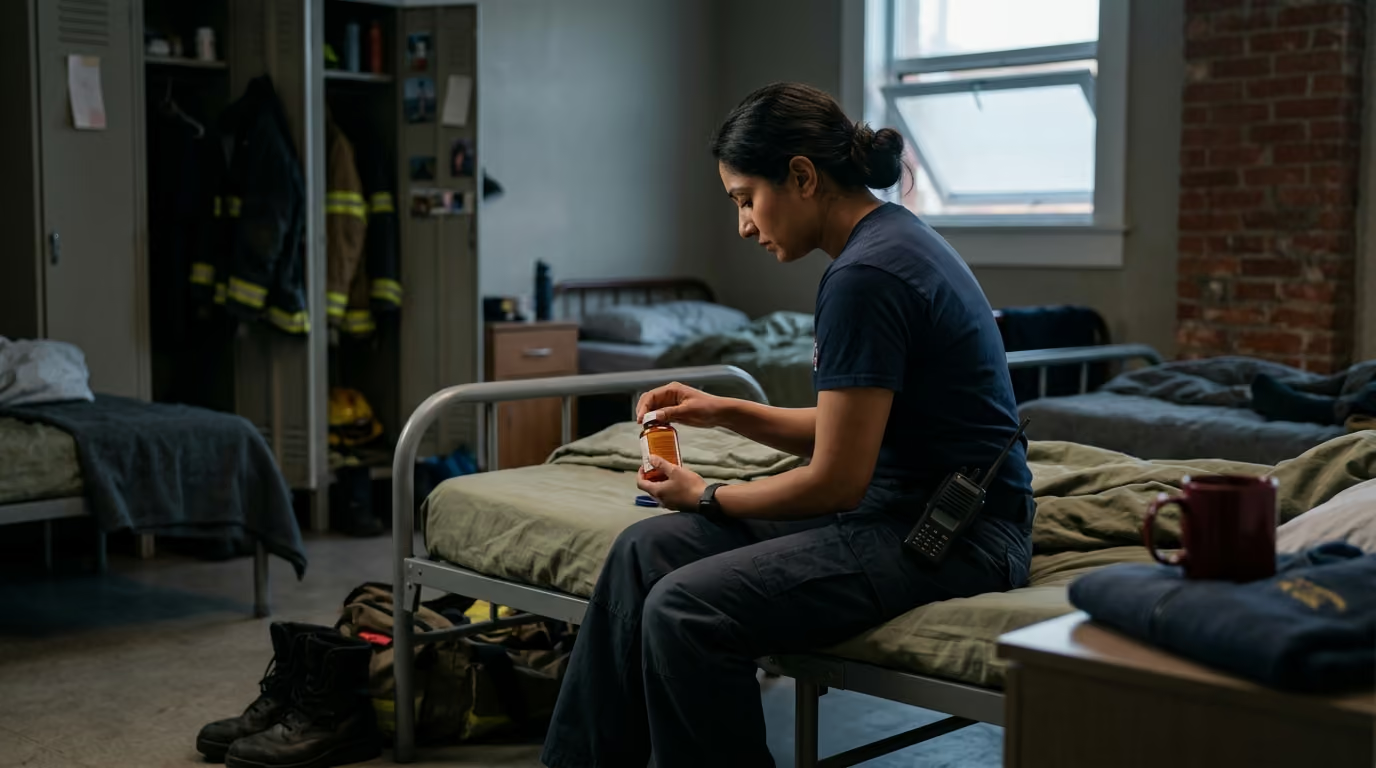

Popular supplements promise instant rest for shift workers, but true recovery requires understanding biological timing, ingredient evidence, and product quality over chemical sedation.





Most shift workers look for sleep supplements to fix daytime fatigue, but nutritional products cannot alter the physics of an unstable roster. Adding a pill to an erratic schedule addresses only one component of biological recovery. A supplement cannot add hours to a short turnaround between shifts. It cannot eliminate sirens, daylight exposure, or mandatory overtime.
A clear distinction exists between supporting sleep initiation and fixing circadian disruption. Sleep supplements are narrow, situation-specific tools rather than primary solutions. They work best when paired with schedule planning, dark rest environments, and strategic light management. When applied without addressing biological timing, they often produce grogginess rather than restorative sleep.
Understanding what these products can and cannot accomplish requires looking past commercial marketing. Evidence from occupational health agencies and clinical trials shows clear limits for every over-the-counter sleep aid.
Sleep is an active physiological process governed by two distinct internal mechanisms. The homeostatic sleep drive builds pressure to sleep for every hour a person stays awake. Meanwhile, the circadian timing system sends alerting signals that fluctuate across a twenty-four-hour cycle. When these two systems fall out of alignment during night shifts or rapid rotations, sleep becomes fragmented.
To evaluate any supplement, a worker must separate five distinct dimensions of rest:
A supplement might modestly reduce the time it takes to fall asleep. It does not automatically improve sleep architecture or create more off-duty hours.
Acute sleep loss occurs when a worker misses sleep on one or two shifts. Chronic sleep restriction develops over weeks or months of short rest intervals. Circadian misalignment happens when someone attempts to sleep while core body temperature rises and cortisol surges.
Night workers face an uphill biological battle during daytime sleep periods. Environmental noise, ambient room temperature, and daylight tell the brain to remain alert. The National Institute for Occupational Safety and Health (NIOSH) points out that shift work inherently conflicts with biological programming. Attempting to force sleep with heavy sedatives often masks exhaustion without clearing cumulative sleep debt.
The Centers for Disease Control and Prevention (CDC) recommends that adults obtain at least seven hours of sleep per day. To achieve this, NIOSH recommends at least ten consecutive hours off duty between shifts. This window accounts for commuting, meals, personal hygiene, and decompression.
When a worker has only six or eight hours between shifts, the primary bottleneck is sleep opportunity. No botanical extract or hormone can replace missing rest hours. Treating a short turnaround as a biochemical deficiency leads to excessive supplement use and increased side effects.
Melatonin is the most studied supplement marketed to shift workers. It is not a conventional sedative that forces the central nervous system into unconsciousness. Instead, melatonin is a chronobiotic hormone produced by the pineal gland to signal biological darkness. Its effectiveness depends heavily on timing, baseline light exposure, and individual circadian phase.
The American Academy of Sleep Medicine (AASM) evaluates melatonin for shift work with nuanced recommendations. The AASM provides conditional recommendations for melatonin in specific scenarios, based on low to very-low certainty evidence. These scenarios include managing daytime sleep disturbance after night work, supporting transitions back to nighttime sleep, and assisting pre-shift naps.
Taking melatonin at the wrong biological time can shift your internal clock in the wrong direction. A daytime worker taking melatonin at bedtime uses it to reinforce normal biological night. A night-shift worker taking it at 08:00 is introducing a darkness signal while the sun is rising.
Morning sunlight reaching the retina sends a strong awakening cue to the suprachiasmatic nucleus. If a worker drives home in bright sunlight, that light suppresses internal melatonin and promotes daytime alertness. Taking supplemental melatonin right after bright light exposure creates conflicting neurological signals. For comprehensive strategies on balancing rest windows, review our guide to building a shift-specific sleep plan.
Commercial melatonin products frequently provide doses ranging from 5 mg to 10 mg per serving. Physiological melatonin production in healthy adults creates blood levels corresponding to roughly 0.3 mg to 0.5 mg. High supplemental doses flood receptors, which may prolong grogginess long into the subsequent work shift.
Clinical reviews suggest using the lowest effective dose when trialing melatonin. Escalating the dose rarely solves daytime awakenings caused by noise, heat, or circadian alerting signals. It simply increases the risk of headaches, vivid dreams, and morning sluggishness.
The dietary supplement market offers dozens of non-hormonal sleep aids. Manufacturers frequently market these compounds for stress reduction, physical relaxation, and deeper sleep. An examination of the clinical literature reveals significant gaps between marketing claims and proven outcomes for shift workers.
Magnesium plays a vital role in cellular energy, neuromuscular transmission, and stress responses. Marketers often claim that forms like magnesium glycinate or magnesium threonate cure insomnia. However, systematic reviews of randomized controlled trials show that evidence for oral magnesium treating insomnia remains low to very-low certainty.
Magnesium supplementation may help individuals with an underlying dietary deficiency. It does not act as a reliable acute sedative for workers with normal mineral levels. Furthermore, supplemental magnesium can cause gastrointestinal distress and loose stools at higher doses.
Valerian root has a long history of traditional use as a calming herb. Modern clinical evaluations by the National Center for Complementary and Integrative Health (NCCIH) note that trial results remain inconsistent. The overall clinical value of valerian for chronic sleep disruption has not been demonstrated.
Valerian interacts with central nervous system pathways and can cause additive sedation when combined with other central depressants. Workers should avoid combining valerian with alcohol, prescription sleep aids, or sedating antihistamines.
Chamomile is widely consumed as a warm beverage to support evening wind-down routines. The calming effect often comes from the behavioral ritual, warmth, and deliberate relaxation time.
NCCIH reviews confirm that robust clinical trial evidence showing chamomile improves insomnia is lacking. While a warm cup of chamomile tea is a safe habit, it should be viewed as behavioral conditioning rather than a pharmacological intervention.
L-theanine is an amino acid found in green tea that influences neurotransmitters associated with relaxation. Systematic reviews indicate modest improvements in subjective sleep satisfaction at doses between 200 mg and 450 mg. However, these studies were largely conducted in non-shift populations without severe circadian disruption.
Glycine is an inhibitory amino acid that plays a role in core body temperature regulation during sleep onset. Small pilot studies suggest modest subjective improvements in sleep quality, but large-scale data in emergency personnel and shift workers are absent. Both compounds remain investigational options rather than established frontline treatments.
Cannabidiol (CBD) has gained popularity for post-shift relaxation, anxiety management, and pain relief. Despite wide availability, CBD is not an established treatment for shift-work sleep disorders. Clinical trials on sleep outcomes remain mixed, with variable dosing protocols across studies.
For emergency personnel, CBD presents unique occupational hazards. Supplement purity is notoriously inconsistent, and products marketed as pure CBD may contain trace levels of THC. This introduces significant career risk regarding occupational drug testing and department medical clearances.
The dietary supplement industry operates under regulatory frameworks that do not require pre-market efficacy or batch-level accuracy testing. Manufacturers are responsible for ensuring safety and labeling accuracy before products reach store shelves. Independent laboratory analyses reveal that sleep aids frequently fail to meet label claims.
A landmark 2017 study analyzed thirty-one commercial melatonin supplements purchased from retail outlets. The researchers found that actual melatonin content ranged from 83 percent below to 478 percent above the labeled claim. Lot-to-lot variability within the exact same brand reached as high as 465 percent.
Even more concerning, 26 percent of the tested supplements contained undeclared serotonin. Serotonin is a potent neurotransmitter that carries clinical risks, including the potential for serotonin syndrome when combined with prescription antidepressants.
Gummy supplements present the highest rates of manufacturing instability and dosing errors. A 2023 study evaluated twenty-five over-the-counter melatonin gummy brands. The researchers discovered that twenty-two out of twenty-five products were inaccurately labeled.
One gummy brand contained no detectable melatonin at all, while others contained up to 347 percent of the stated dose. Gummies degrade faster during storage, prompting manufacturers to deliberately overfill ingredients to meet expiration dates. This unpredictability makes precise, evidence-based dosing nearly impossible.
First responders face physical and operational demands that standard occupational sleep research rarely captures. Firefighters, paramedics, and police officers do not work predictable, quiet shifts. Their duties involve sudden acoustic alarms, heavy personal protective equipment, extreme heat stress, prolonged driving, and traumatic calls.
Applying sleep supplements in emergency services requires strict risk management. A groggy civilian working a desk job faces lower immediate safety risks than an engineer driving a fire engine or an officer carrying a sidearm. Understanding circadian strain and fatigue management is critical for tactical decision-making on shift.
Sleeping in a fire station or on-call room is fundamentally different from sleeping at home. Station sleep is characterized by hypervigilance, anticipating the next dispatch tone at any moment. Taking a sedating supplement while on duty creates unacceptable operational liability.
If an emergency call drops two hours after consuming a high-dose sleep aid, the responder faces severe cognitive impairment. Reaction times slow, situational awareness drops, and fine motor skills degrade. Sleep supplements should be reserved exclusively for off-duty recovery windows where uninterrupted rest is assured.
Structural firefighting and summer patrol duties significantly elevate core body temperature. The human body requires a drop in core temperature of roughly one to two degrees Fahrenheit to initiate restorative deep sleep. Attempting to force sleep with supplements without cooling down first yields poor sleep efficiency.
Nutrition timing also plays a profound role in metabolic recovery. Late-night heavy meals during night patrol impair daytime rest by keeping digestive processes active. Responders interested in metabolic timing should review strategies for meal timing during night shifts.
Before buying any sleep aid, a shift worker must methodically audit their sleep environment and daily habits. Jumping straight to supplements skips the foundational steps that drive biological rest.
Use this step-by-step decision framework to identify the root cause of sleep difficulty and select appropriate countermeasures.
Identify precisely where the breakdown occurs. Is the issue falling asleep after a morning commute, or waking up after only four hours? Is the schedule a stable night roster or a chaotic rotating shift pattern?
A worker struggling with early awakenings due to morning sunlight needs room-darkening shades and eye protection, not a higher dose of sedatives. Pinpointing the exact breakdown prevents unnecessary supplementation.
Before starting a supplement trial, verify that basic sleep hygiene practices are in place:
For comprehensive protocols on stimulant management, refer to our detailed resource on managing caffeine during night duty.
If environmental optimizations are complete and sleep initiation remains difficult, a structured trial may be warranted. Select a single-ingredient product certified by an independent laboratory like USP, NSF, or BSCG.
Start with the lowest available dose and maintain a consistent sleep log for two weeks. Record sleep onset latency, total sleep time, number of night awakenings, and subjective morning alertness. Never introduce multiple new supplements at the same time.
Dietary supplements carry physiological effects, contraindications, and potential drug interactions. Assuming a product is completely safe simply because it is sold over the counter is dangerous. First responders and shift workers taking prescription medications must exercise extreme caution.
Melatonin interacts with several major classes of medications. According to data from the National Institutes of Health (NIH), melatonin can increase bleeding risk in patients taking anticoagulants like warfarin. It can also alter drug effectiveness in individuals taking anticonvulsants or immunosuppressive medications.
Magnesium supplementation poses serious risks for individuals with underlying kidney impairment, as impaired kidneys cannot clear excess magnesium efficiently. High supplemental doses can also interfere with the absorption of certain antibiotics and cardiovascular medications.
A common pitfall among exhausted workers is combining over-the-counter sleep aids with alcohol or prescription sedatives. Combining valerian root, sedating antihistamines, and alcohol causes severe central nervous system depression.
Stacking these compounds impairs respiratory drive during sleep, increasing the frequency of sleep apnea events. It also ensures significant grogginess that persists well into the next shift, compromising driving safety and operational decision-making. If you need to browse broader occupational topics, explore our full library of shift work and sleep strategies.
Dietary supplements are designed for minor, transient sleep support in healthy individuals. They cannot treat underlying sleep disorders, chronic insomnia, or complex mental health conditions. When fatigue impairs daily functioning, professional medical evaluation is necessary.
Shift Work Disorder (SWD) is a recognized medical condition characterized by chronic insomnia and excessive sleepiness tied directly to a work schedule. It requires comprehensive clinical management rather than casual self-treatment.
Furthermore, obstructive sleep apnea is highly prevalent among emergency personnel due to physical build, neck circumference, and chronic systemic stress. A worker with untreated sleep apnea stops breathing repeatedly throughout the night. Taking sedatives in this scenario worsens airway collapse and deepens oxygen desaturation.
A board-certified sleep medicine physician can perform diagnostic polysomnography or home sleep apnea testing to identify the exact cause of sleep fragmentation. Effective clinical interventions include Cognitive Behavioral Therapy for Insomnia (CBT-I), tailored light therapy protocols, and prescription therapies managed under strict medical supervision.
Consulting an occupational medicine physician or primary care provider ensures that persistent fatigue is not driven by thyroid disease, cardiovascular issues, or clinical depression. Relying indefinitely on over-the-counter supplements simply delays effective, evidence-based care.
Building sustainable capability across a long emergency services career requires protecting foundational recovery habits rather than chasing quick fixes in a bottle.
Stay connected for research-led guidance on duty fitness, shift-work sleep, injury recovery, stress, nutrition and career longevity. Practical ideas for first responders who want to stay capable on the job, recover well and protect their health for the long run.



Read practical guidance on first responder fitness, recovery, sleep, nutrition and resilience for demanding work and a long, active career.
read the blog



