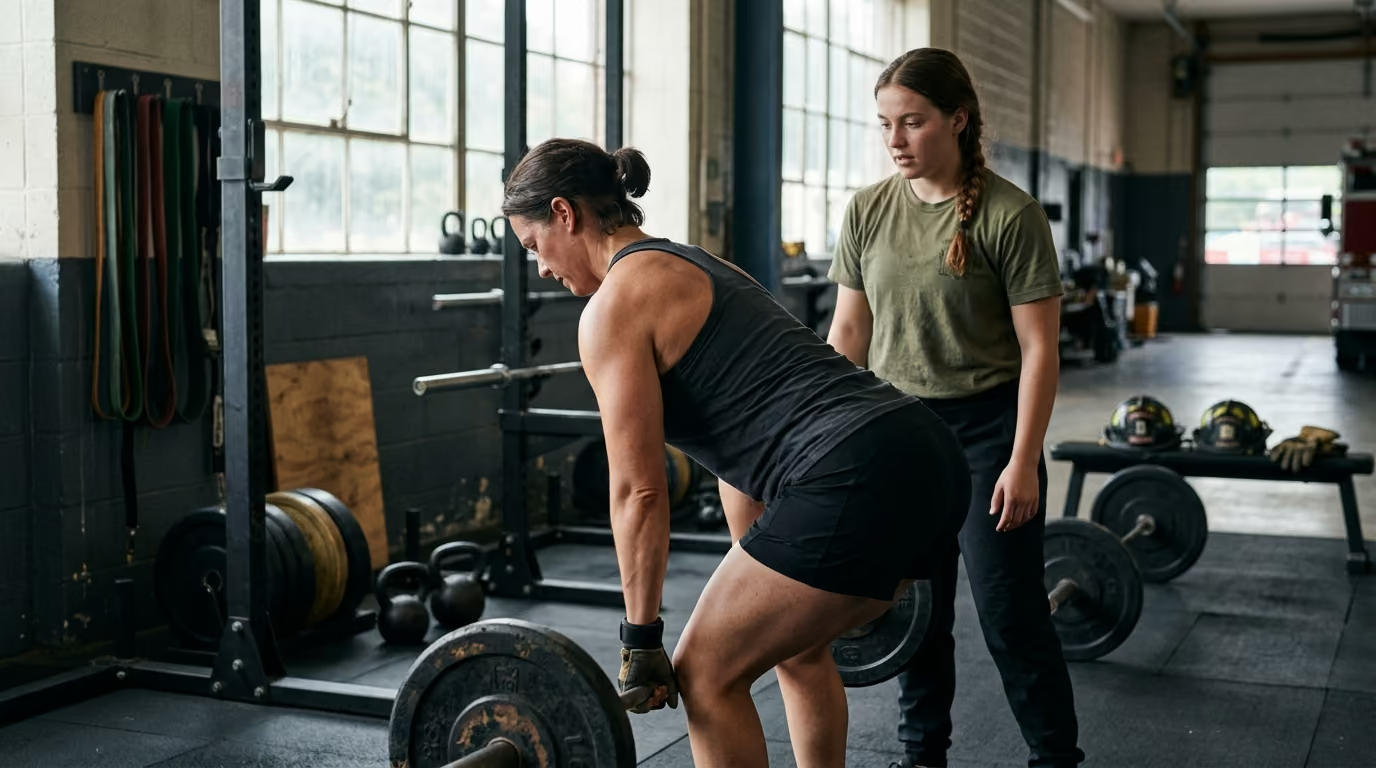

Dragging a victim down a hallway or forcing heavy doors requires tactical strength programming built around essential movement patterns, occupational demands, and smart exercise ordering.





Most strength programs are designed around a predictable calendar, reliable sleep, and a single competitive peak. For emergency responders, relying on rigid gym routines often leads to chronic fatigue, stalled progress, or injury. A firefighter, police officer, or paramedic cannot afford to spend their recovery capacity chasing arbitrary numbers that fail to transfer to physical calls.
A successful strength program for first responders is not a rigid template. It is a decision-making system based on occupational demands, biological recovery, and precise manipulation of training variables. By understanding how exercise selection, order, volume, intensity, tempo, rest, and progression interact, you can build a resilient body that performs under load and lasts across a multi-decade career.
The quick answer to effective tactical strength programming is simple. You must match training stress to operational requirements while keeping fatigue low enough to preserve on-duty capability. Instead of asking what routine builds the most muscle or adds the most weight to a single lift, ask which physical qualities you need to support on shift.
Scientific literature from the American College of Sports Medicine and the National Strength and Conditioning Association demonstrates that distinct adaptations follow specific loading parameters. Maximal strength responds best to heavier loads and longer rest periods. Muscular endurance develops through higher repetitions and shorter rest intervals. Power requires maximal movement velocity with submaximal loads and minimal fatigue. Structural capacity and muscle mass respond to total weekly volume completed with adequate proximity to muscular fatigue.
Evidence across tactical populations confirms that occupational task performance relies on multiple physical attributes simultaneously. Research examining firefighters, law enforcement personnel, and military operators shows that aerobic capacity, anaerobic power, absolute strength, grip endurance, and trunk stability all correlate with job performance. No single fitness test or training metric predicts field readiness on its own.
Because first responders face shifting schedules and unpredictable calls, your training variables must remain adaptable. When sleep is cut short or call volume spikes, keeping the same rigid exercise prescription increases injury risk without providing better adaptations. Controlling these variables intentionally allows you to adjust training stress while protecting long-term career durability.
First responder work combines sudden, high-intensity physical efforts with prolonged periods of lower-level exertion. A firefighter may need to force a heavy door, raise a ladder, drag an unconscious adult down a hallway, and climb stairs carrying forty to seventy pounds of gear. A police officer must sprint, navigate obstacles, control a resisting subject, and sit for hours in a patrol vehicle wearing a duty belt and body armor. Paramedics repeatedly lift, carry, and maneuver patients in tight, awkward spaces.
These tasks share several biomechanical and physiological characteristics:
To build an effective training plan, translate these field requirements into fundamental physical qualities. A victim drag requires hip hinge strength, horizontal pulling power, grip integrity, and anaerobic capacity. Climbing stairs in full gear demands unilateral leg strength, knee extensor endurance, and robust aerobic conditioning. Forcible entry relies on rotational power, anti-rotation trunk stability, and dynamic upper-body pressing force.
By mapping job tasks to physical qualities, you can select exercises that build the necessary strength reserve without accumulating unnecessary joint wear. You can explore structured options for these demands in our guide on duty-focused physical capability.
Organizing a training routine around isolated body parts makes little sense for emergency personnel. The body operates on shift as an integrated system. Exercise selection should prioritize foundational movement patterns that develop multi-joint coordination, structural balance, and transferable strength.
A comprehensive movement-pattern framework includes nine core categories:
These movements develop lower-body pushing power, quad strength, and knee stability. Useful variations include safety-bar squats, front squats, goblet squats, split squats, and step-ups. Unilateral squat variations are valuable for emergency responders because they build single-leg balance and directly mimic climbing stairs or navigating uneven terrain.
Hinge exercises train the posterior chain, including the glutes, hamstrings, and spinal erectors. Variations include conventional deadlifts, Romanian deadlifts, trap-bar deadlifts, and kettlebell swings. The trap-bar deadlift is often the most practical primary hinge for first responders because it distributes load between the knees and hips while reducing lumbar shear forces.
Horizontal presses develop the chest, anterior shoulders, and triceps. Options include barbell bench presses, dumbbell floor presses, push-up progressions, and standing landmine presses. Landmine presses provide high shoulder stability and require active trunk bracing, making them practical for personnel with past shoulder wear.
Pulling exercises strengthen the upper back, latissimus dorsi, and posterior rotators, which counter the rounded postures caused by wearing heavy gear or sitting in vehicles. Reliable choices include chest-supported rows, one-arm dumbbell rows, barbell bent-over rows, and seated cable rows.
Vertical movements develop overhead pressing strength and lat recruitment. Variations include standing overhead presses, push presses, pull-ups, chin-ups, and lat pulldowns. Responders with limited shoulder flexion or active impingement symptoms can substitute neutral-grip pulldowns or high-incline dumbbell presses.
Loaded carries build functional grip strength, scapular stability, and total-body tension under dynamic conditions. Practical options include bilateral farmer carries, unilateral suitcase carries, front-rack carries, sandbag carries, and weighted sled pushes or drags.
Emergency operations require the core musculature to resist unwanted movement rather than constantly flex the spine. Focus on anti-extension movements such as ab-wheel rollouts or planks, anti-rotation exercises like Pallof presses, and anti-lateral flexion drills like suitcase holds.
Power training trains the nervous system to produce force rapidly. Useful tools include medicine ball chest passes, overhead rotational slams, box jumps, kettlebell swings, and trap-bar jumps with light loads.
Grip is often the limiting factor during victim extrications and equipment hauling. Target grip through thick-handle holds, towel pull-ups, timed deadlift holds, and extended carry variations.
Balancing general strength exercises with specific task drills provides measurable progression while maintaining joint longevity. To balance these movements without overtraining, review our framework for minimum effective dose training.
The order in which you perform exercises determines the quality of the training stimulus. Performing complex or explosive movements when fatigued increases the risk of technical breakdown and decreases neurological output.
The standard sequencing rule moves from highest-skill, highest-velocity tasks toward lower-skill, higher-fatigue exercises.
The first major exercise in a workout receives the highest focus and produces the cleanest adaptations. If your current focus is building pure lower-body strength for stair climbing, place your primary squat or deadlift immediately after your warm-up. If your department requires explosive breaching capability, place medicine ball throws or power cleans first.
Hypertrophy research indicates that total muscle growth across a broad program is relatively flexible regarding exercise order when total volume is matched. However, strength, power, and technical development depend heavily on exercise sequence. The movements placed first will always show the greatest long-term performance gains.
Emergency personnel often face tight training windows. Pairing non-competing exercises allows you to maintain high training density without sacrificing performance on primary lifts.
Effective pairing strategies include:
Avoid pairing two exercises that place heavy demands on the exact same stabilizing muscles. For example, pairing a heavy barbell deadlift with a standing overhead press will exhaust the lower back and trunk stabilizers, compromising spinal positioning on both movements.
Training volume represents the total amount of work performed, calculated as sets multiplied by repetitions and load, or tracked as hard working sets per muscle group each week.
Volume is the primary driver of muscle hypertrophy and structural capacity. Research indicates an established dose-response relationship between weekly sets and muscular growth. General fitness literature frequently suggests twelve to twenty weekly sets per muscle group for trained individuals seeking maximal hypertrophy.
However, treating that upper range as a mandatory baseline for emergency responders is a mistake. Tactical athletes perform significant physical labor on duty, accumulate irregular sleep debt, and must complete concurrent cardiovascular conditioning. High lifting volumes create residual fatigue and delayed-onset muscle soreness that interfere with emergency calls.
For most first responders, a weekly volume of six to twelve hard sets per movement pattern is sufficient to build and maintain capability. Distributing this volume across two to three full-body sessions per week is often more manageable than using a high-volume single-muscle split.
When operational workload increases, training volume must adjust downward. Performing three high-quality sets of a compound movement preserves strength while leaving enough energy for a twelve-hour shift. Understanding how to organize your routine around demanding schedules is detailed in our guide to training around shift rotations.
Intensity has several definitions in strength and conditioning. In scientific terms, relative load intensity refers to the percentage of an individual's one-repetition maximum (%1RM). In practical terms, effort intensity describes how close a set is taken to momentary muscular failure, often measured using Repetitions in Reserve (RIR) or the Rating of Perceived Exertion (RPE) scale.
Different physical qualities require specific loading ranges:
Training to absolute failure causes significant central nervous system fatigue, prolonged muscle damage, and joint strain. For emergency personnel, sets on primary compound lifts should rarely go to failure.
Stopping most working sets at one to three repetitions in reserve develops strength and muscle tissue while minimizing lingering fatigue. Save higher-effort sets near failure for low-risk accessory movements, such as cable rows or dumbbell curls, where technical breakdown poses minimal risk. Learn more about managing fatigue on duty in our article on managing readiness and fatigue.
Tempo refers to the duration assigned to each phase of a repetition: the eccentric (lowering) phase, the isometric transition, and the concentric (lifting) phase. A tempo prescription of 3-1-1-0 represents a three-second lowering phase, a one-second pause at the bottom, a one-second concentric lift, and zero pause at the top.
Rest intervals between sets dictate the degree of phosphocreatine resynthesis, metabolic waste clearance, and neurological recovery that occurs before the next effort. Cutting rest intervals short is a common mistake among emergency responders who mistakenly believe that feeling breathless makes a
workout more functional.
When training for maximal strength or explosive power, insufficient rest diminishes mechanical force output. If your nervous system and muscles are not recovered, subsequent sets turn into conditioning drills rather than true strength or power training.
If you have limited time, using paired sets of non-competing exercises allows you to rest three minutes between squat sets while performing an upper-body row in the middle of the window. This approach protects output quality while keeping your total session time under forty-five minutes.
Progressive overload is the systematic increase in training stress over time to stimulate continuous adaptation. While progressing load is standard, increasing the weight on the bar every workout is unsustainable for emergency personnel managing unpredictable shifts.
Use multiple progression pathways depending on your current schedule and energy reserves.
Double progression is exceptionally reliable for first responders. Choose a target repetition range, such as six to eight repetitions across three sets. Keep the weight constant until you can perform eight clean repetitions on all three sets with good form. Once achieved, increase the load by two to five percent and drop back to three sets of six repetitions.
When you cannot safely add weight due to joint aches or accumulated shift fatigue, progress other variables:
Standard linear periodization assumes that physical stress can be planned cleanly over twelve to sixteen weeks. For first responders dealing with mandatory overtime, late calls, and circadian disruption, rigid periodization models often fail.
Flexible periodization adapts training loads based on daily physiological readiness rather than an unyielding calendar.
Use a three-tier model to adjust your planned session before touching a barbell:
Instead of dedicating months solely to high volume or heavy lifting, undulating periodization exposes the body to multiple training stimuli within the same week or two-week block.
A responder might complete:
This variety preserves multiple operational qualities simultaneously, preventing the loss of speed, power, or stamina while building strength. Sustaining these capabilities over time supports career-long durability.
Applying these programming principles requires assessing specific individual needs, training ages, and operational constraints.
Strength training supports physical readiness, but it is not a cure-all for operational wear. Studies evaluating first responder fitness demonstrate positive associations between aerobic fitness, muscular endurance, and reduced injury incidence. However, no training program guarantees absolute protection against physical trauma on the job.
Workload management, protective equipment design, emergency scene ergonomics, and environmental heat stress play major roles in operational safety. Training hard in the gym cannot fully compensate for chronic sleep deprivation or poorly managed occupational hazards.
Never attempt to train through sharp, localized joint pain, radiating neurological symptoms, or severe exhaustion. If you experience persistent musculoskeletal pain, decreased range of motion that impairs duty tasks, or symptoms of overtraining that do not resolve with rest, consult a licensed physical therapist or sports medicine physician. A qualified professional can assess biomechanical restrictions, provide targeted rehabilitation, and help you return to full duty capability safely.
To build sustainable physical capability for the demands of emergency service, use the following core principles to guide your programming decisions:
Sustainable strength programming creates an enduring physical reserve that protects your safety on duty and supports your long-term health beyond retirement.
Stay connected for research-led guidance on duty fitness, shift-work sleep, injury recovery, stress, nutrition and career longevity. Practical ideas for first responders who want to stay capable on the job, recover well and protect their health for the long run.



Read practical guidance on first responder fitness, recovery, sleep, nutrition and resilience for demanding work and a long, active career.
read the blog



