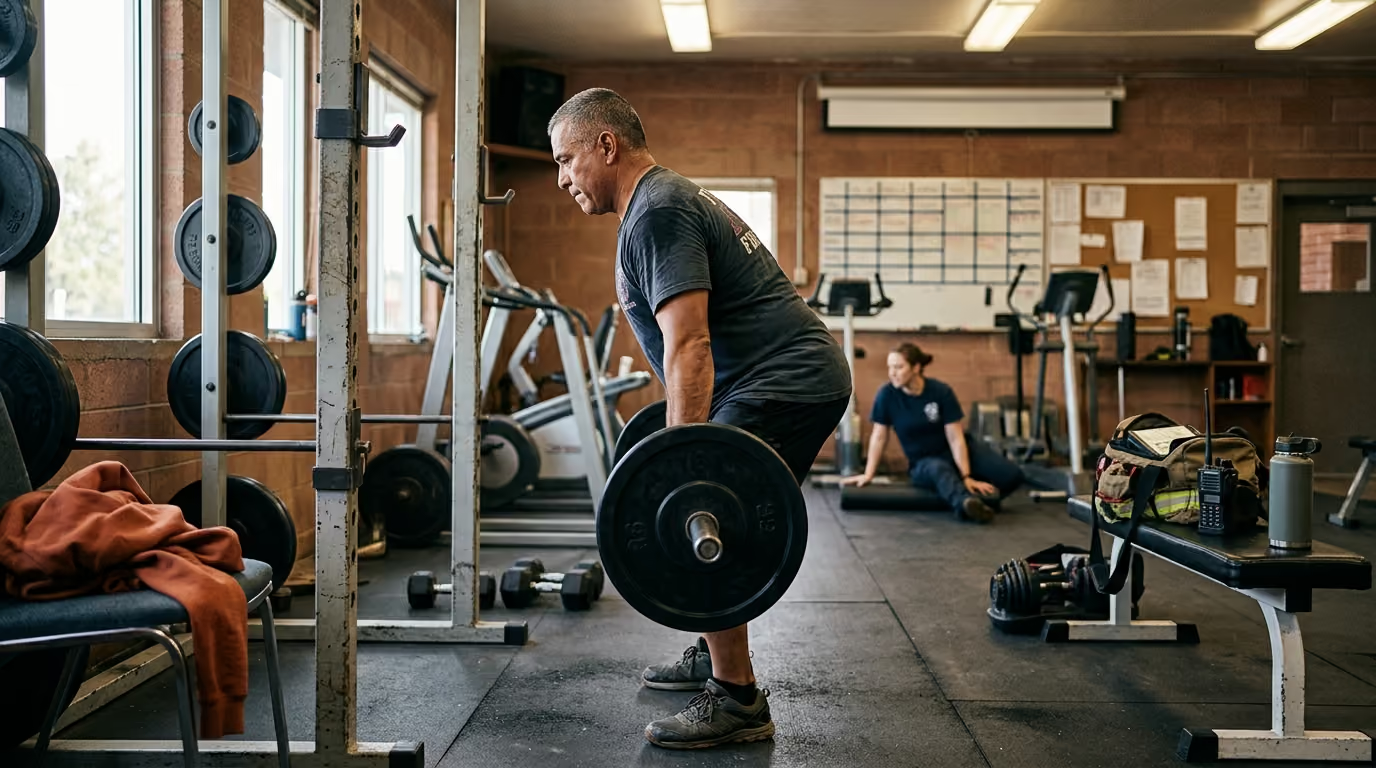

Lifelong strength training helps former first responders rebuild joint health, counter age-related muscle loss, and sustain functional power through adaptable weekly workouts.





You step off the apparatus floor or park the patrol cruiser for the final time. After decades of physical demands, the uniform comes off, but the physical history remains. Years of carrying heavy gear, descending stairwells with stretchers, wrestling combative subjects, and absorbing sudden impacts leave a distinct pattern of physical wear.
Many former firefighters, police officers, and paramedics enter retirement with cranky shoulders, stiff lower backs, and knees that click with every flight of stairs. The sudden shift away from operational readiness often creates confusion about how to train. Without a physical fitness standard or shift requirement, it is tempting to either maintain a punishing tactical routine or abandon heavy physical activity entirely.
Lifelong strength training after service is not about preserving peak operational capacity. It is a systematic health practice designed to preserve muscle mass, protect bone mineral density, maintain balance, and sustain daily independence across decades.
Strength training after emergency service shifts the primary goal from occupational performance to lifelong physical capability. The objective is no longer pulling hose lines or sprinting into uncertain scenes under load. The target is maintaining the ability to carry groceries, climb stairs, lift grandchildren, complete home projects, and recover from accidental stumbles without assistance or injury.
A successful post-service framework prioritizes movement quality, joint tolerance, and gradual progression over maximal poundages. By training basic movement patterns twice weekly, former responders can counter age-related muscle loss, stimulate bone growth, and rebuild tolerance in previously injured joints. This approach creates sustainable physical capacity without placing excessive strain on recovering connective tissues.
Aging brings distinct biological changes to skeletal muscle and bone tissue. Beginning around age 30, adults lose approximately 3 to 8 percent of their muscle mass per decade. This rate of decline accelerates significantly after age 60. By age 75, longitudinal data indicates that men lose between 0.80 and 0.98 percent of their muscle mass each year. Women at that age lose approximately 0.64 to 0.70 percent annually.
This involuntary loss of muscle mass, strength, and physical function is known as sarcopenia. Sarcopenia prevalence rises sharply with age, affecting between 11 and 50 percent of adults aged 80 and older depending on the diagnostic criteria used. Sarcopenia is not merely a cosmetic issue. It directly reduces walking speed, increases fall risks, and impairs the ability to rise from a low chair without using armrests.
Muscle power declines even faster than maximal muscle strength as people age. Power represents the ability to produce force quickly. When an older adult catches their balance after a trip, steps quickly over an obstacle, or moves out of the path of a moving object, they rely on fast muscular force production. Research published in the National Strength and Conditioning Association position statement highlights that power-focused training using moderate loads moved with rapid intent helps preserve these essential physical reactions.
Bone tissue also requires mechanical stimulation to maintain its structural density. The National Institute of Arthritis and Musculoskeletal and Skin Diseases notes that resistance exercise places direct mechanical tension on bones, which stimulates bone remodeling and helps preserve density. When combined with weight-bearing aerobic activity, progressive strength training protects against osteopenia and osteoporosis.
Systematic reviews examining older adults with sarcopenia demonstrate that resistance training reliably improves handgrip strength, knee extension force, gait speed, and timed-up-and-go scores. These functional improvements often occur even when visible changes in total muscle mass remain modest. Strength training functions as a vital medical intervention for preserving independent physical capability.
Emergency service careers place unique, asymmetric loads on the human body over long periods. Firefighter injury data consistently identifies the lower back and lower extremities as leading injury sites. Sprains, strains, and chronic joint wear are heavily linked to lifting, squatting, carrying uneven loads, and slipping or falling on irregular terrain. In some occupational reviews, firefighter injury rates exceed those of private-sector workers by more than three times.
Paramedics and emergency medical technicians perform heavy lifts in confined stairwells, awkward hallways, and small bathrooms. Police officers carry duty belts weighing fifteen to thirty pounds, which alters pelvic alignment and places constant mechanical strain on the lumbar spine and hips. Tactical entries, sudden vehicle pursuits, foot chases, and physical altercations introduce high-velocity trauma, joint dislocations, and soft-tissue tears.
These occupational exposures often leave retired responders with specific long-term challenges:
Occupational research also clarifies that high fitness scores alone do not make a person immune to injury. A systematic review evaluating emergency responders found only limited evidence linking basic physical fitness test scores directly to injury reduction, though higher aerobic fitness correlated with lower injury rates. Fitness is a single component of risk mitigation. Long-term durability requires sensible load management, movement mechanics, recovery, and medical care alongside physical training.
Navigating this physical legacy requires leaving behind the tactical bravado often fostered during active duty. Training after service is not a test of toughness. It is an intentional strategy to restore movement options and build tissue tolerance within your current physical realities.
To make strength training sustainable across middle age and older adulthood, your training plan should follow five foundational principles. These principles balance work capacity with joint longevity.
The World Health Organization recommends that all adults perform muscle-strengthening activities involving all major muscle groups on at least two days per week. For general cardiovascular health, guidelines recommend 150 to 300 minutes of moderate-intensity physical activity or 75 to 150 minutes of vigorous-intensity physical activity each week.
Retired responders do not need to spend two hours in a gym five days a week. Two focused full-body sessions per week provide sufficient mechanical stimulus to maintain strength and bone density. Building a sustainable baseline through a minimum effective training dose prevents the burnout and severe joint inflammation that often accompany high-volume bodybuilder or tactical routines.
Bodybuilding routines often isolate single muscles through dozens of repetitive sets. A functional longevity model organizes training around fundamental human movement patterns:
Training movement patterns builds strength that directly transfers to daily living tasks while allowing you to easily substitute joint-friendly variations.
Progressive overload is the gradual increase of stress placed upon the body during training. In younger athletic settings, progression almost always means adding weight to a barbell. In a lifelong training framework, progressive overload takes many forms:
Progression means improving movement capacity without provoking joint pain. If a knee flare-up prevents you from adding load to a squat, progressing your control and movement tempo at the current load is a meaningful victory.
Because muscle power declines faster than absolute strength, lifelong training must include intentional velocity work. This does not mean performing dangerous high-impact plyometrics or Olympic lifts with compromised joints.
Power training in later adulthood means moving moderate loads with explosive intent during the concentric (lifting) phase, followed by a controlled eccentric (lowering) phase. Standing up rapidly from a sturdy chair or pushing a sled with speed provides power stimulation with minimal joint impact. Combining power movements with simple balance drills near a stable support preserves the neuromuscular pathways that catch stumbles and prevent falls.
Training priorities naturally evolve across the lifespan. A lifelong framework adapts to these natural shifts:
A practical post-service training plan should be simple to execute, easy to recover from, and flexible enough to fit busy schedules. Two balanced full-body sessions per week represent the most efficient structure for most retired personnel.
This template uses standard gym equipment, such as dumbbells, cables, and machines, which allow for simple micro-adjustments in loading.
When getting to a gym is inconvenient, a complete resistance routine can be performed at home using resistance bands, a sturdy chair, a doorway, and a weighted backpack.
Avoid training to complete muscular failure. Grinding through reps with failing form significantly increases joint wear and soft-tissue injury risk without providing additional muscle-building benefits.
Use the Repetitions in Reserve (RIR) framework to manage your intensity:
By keeping 2 to 3 repetitions in reserve, you stimulate muscle protein synthesis and bone loading while leaving sufficient physiological resources for rapid recovery. When daily fatigue is high from poor sleep or lingering stress, modifying training sessions based on fatigue allows you to maintain consistency without overloading vulnerable joints.
Lifelong training requires modifying exercises around previous injuries rather than abandoning entire movement patterns. Below are practical strategies for working around common responder musculoskeletal issues.
Decades of lifting stretchers and wearing duty belts make the lumbar spine a sensitive area for many retirees.
Worn cartilage, meniscal trims, and chronic patellar tendinopathy are frequent consequences of jumping off rigs and running on hard concrete.
Rotator cuff repairs, acromioclavicular joint arthritis, and chronic impingement frequently limit traditional barbell bench pressing and military pressing.
Heavy tactical boots and repeated ankle sprains often leave retirees with restricted ankle dorsiflexion, which alters walking mechanics and increases knee and back stress.
Resistance training provides the mechanical signal for tissue adaptation, but adequate nutrition provides the raw structural materials for repair. As the body ages, it experiences anabolic resistance, meaning muscle tissue requires a stronger amino acid signal to stimulate muscle protein synthesis compared to younger adults.
The International Society of Sports Nutrition recommends an overall daily protein intake in the range of 1.4 to 2.0 grams of protein per kilogram of body weight per day for most active individuals. For an 80-kilogram (176-pound) retired responder, this equates to approximately 112 to 160 grams of protein daily. Other position statements suggest that intakes between 1.6 and 2.1 grams per kilogram can optimize muscle protein synthesis and recovery during consistent training blocks.
Distribute this protein evenly across your day rather than consuming it all in a single evening meal. Aim for 25 to 40 grams of high-quality protein per meal across three or four meals. High-quality sources containing adequate leucine (the amino acid that triggers protein synthesis) include eggs, chicken breast, lean beef, wild salmon, Greek yogurt, cottage cheese, tofu, and whey protein isolates.
Individuals with existing kidney disease, liver conditions, or specific metabolic disorders should consult their physician or a registered dietitian before increasing their daily protein targets.
Bone remodeling depends heavily on adequate micronutrient intake alongside weight-bearing exercise:
Nutrition supports training adaptations, but diet alone cannot preserve muscle and bone. Mechanical load remains the primary driver of physical capability.
Navigating the transition from active duty to retired life often involves unlearning old training habits that no longer serve your long-term health.
Many retired responders still judge their workouts by active-duty standards. They feel that if a session does not leave them completely exhausted, drenched in sweat, or gasping for breath, it was not worthwhile. This mindset leads to chronic overtraining, joint flares, and eventual burnout. Shift your measurement of success from exhaustion to consistency, movement quality, and next-day energy.
A one-repetition maximum (1RM) is an assessment tool used in competitive strength sports and certain tactical testing scenarios. It is entirely unnecessary for lifelong health and durability. Heavy singles place extreme stress on connective tissues and provide minimal additional muscle-building benefit compared to controlled sets of 6 to 12 repetitions with good reserve.
When an old back or knee injury flares up, the common reaction is either to push through the pain aggressively or to stop all physical activity for weeks. Both approaches are counterproductive. The correct response is active modification: temporarily reduce the load, decrease range of motion, switch to a supported variation, or focus on upper-body work while the lower-body joint calms down. Restoring blood flow through pain-free movement accelerates tissue recovery.
Some responders become so hyper-vigilant about protecting their lower back that they brace rigidly during simple daily tasks. While heavy lifting requires a neutral, braced spine, everyday life requires controlled bending, reaching, and twisting. Completely avoiding all spinal flexion creates fear of movement and weakness in the back musculature. Build gradual, unweighted mobility through gentle cat-cow stretches, bird-dogs, and light Jefferson curls before loading movement patterns heavily.
Most strength programs focus entirely on linear resistance movements like squats and presses while completely ignoring balance, gait, and reaction time. Balance is a motor skill that degrades quickly without practice. Spending three to five minutes per session on single-leg stances, tandem walking, and obstacle stepping dramatically reduces real-world fall risks.
Strength training is exceptionally safe when progressed sensibly, but it must operate within clear medical boundaries. Understand your personal health limits and recognize when symptoms require formal clinical evaluation.
Cease physical activity immediately and seek urgent medical assessment if you experience any of the following symptoms during or following exercise:
A standard post-exercise muscle ache should resolve within 24 to 48 hours. Seek an evaluation from a licensed physical therapist or orthopedic physician if you encounter:
Physical therapy should not be seen as an admission of physical decline. It is an opportunity to get an accurate mechanical assessment, address structural limitations, and receive tailored exercise regressions that allow you to continue training safely. You can find more comprehensive discussions within our career longevity and life after service resources to guide your overall health planning.
When dealing with chronic joint wear from active service, exploring foundational guidance on physical capacity and duty performance can help you understand how mechanical wear accumulates over time. If you struggle with energy management or lingering occupational fatigue, reviewing methods for managing cumulative fatigue provides valuable strategies for pacing your physical activity.
Revisit this framework whenever your life circumstances shift:
Lifelong strength training is an investment in your autonomy and independence. By training basic movement patterns consistently and respecting your body's recovery limits, you preserve the physical capability to live an active life for decades beyond service.
Stay connected for research-led guidance on duty fitness, shift-work sleep, injury recovery, stress, nutrition and career longevity. Practical ideas for first responders who want to stay capable on the job, recover well and protect their health for the long run.



Read practical guidance on first responder fitness, recovery, sleep, nutrition and resilience for demanding work and a long, active career.
read the blog



