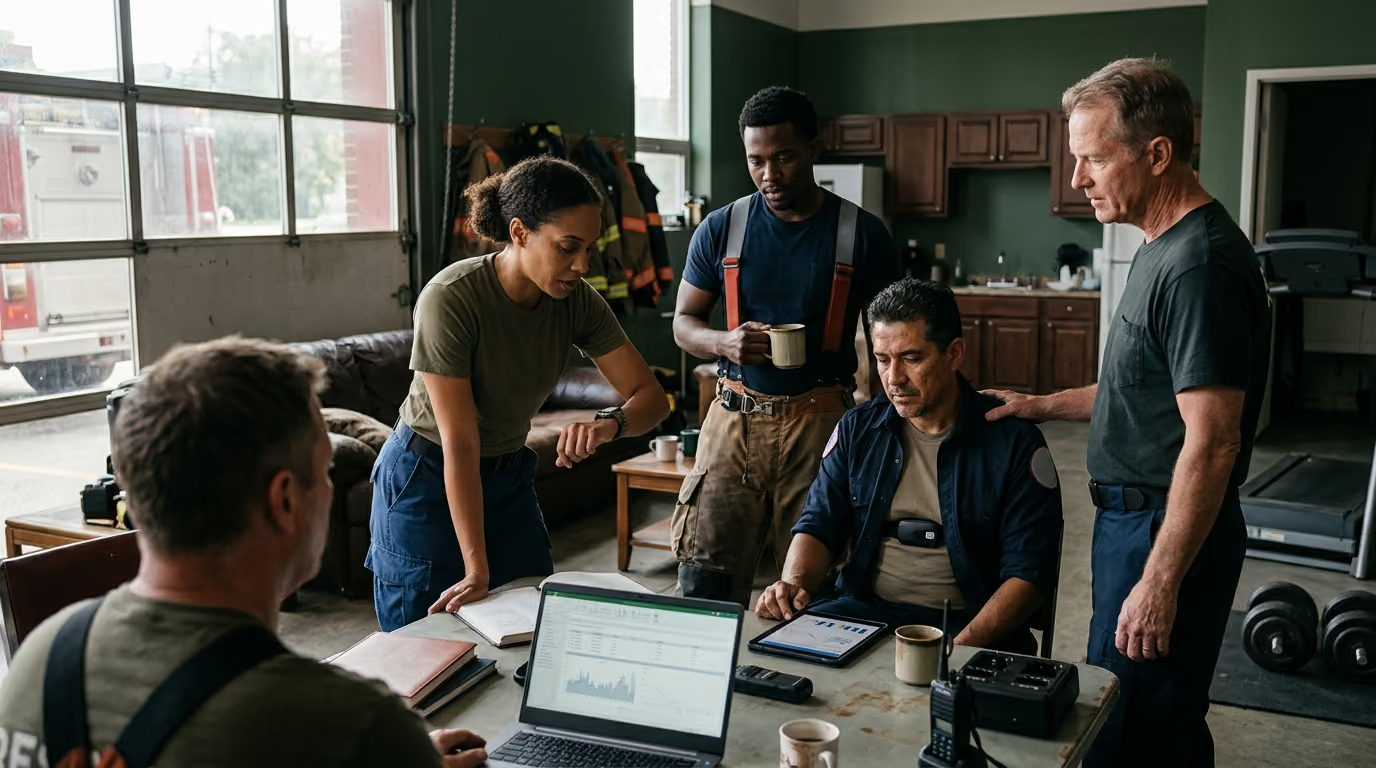

Effective stress and recovery monitoring helps emergency departments evaluate subjective reports, wearable sleep data, and cognitive tests to protect responder safety.





The tones drop at three in the morning during the fourth consecutive night shift. Your wrist device displays a green recovery score, indicating your body is prepared for high physical output. Yet as you climb into the cab, your eyes struggle to focus on the mobile data terminal. Your reaction time feels sluggish, and your mental clarity is clouded by accumulated sleep debt.
Relying on a single metric to gauge operational readiness creates a false sense of security. Human fatigue, physiological stress, and occupational strain are complex states that cannot be captured by one score.
A reliable stress and recovery tracking system uses triangulation. It combines brief subjective check-ins, objective sleep logs, periodic cognitive or physical performance checks, and detailed workload exposure records. When these four methods are evaluated together, emergency crews can identify rising risk and adjust daily habits before performance fails under pressure.
The evidence base for first responder recovery monitoring reveals significant variation in how occupational strain is evaluated. A comprehensive systematic review of emergency services operations examined 43 studies involving 6,373 personnel. Across these studies, researchers identified 186 distinct outcome measures used to assess fatigue and readiness. The research consists primarily of cohort and cross-sectional studies without pooled meta-analyses, reflecting wide differences in occupational environments and measurement tools.
The evidence demonstrates that stress and fatigue are multidimensional. They cannot be reduced to a single biological marker. To monitor personnel accurately, departments and individuals must separate distinct operational concepts:
The research confirms that an individual can be physically rested while experiencing high psychological distress. Conversely, a responder can feel motivated and calm while suffering severe cognitive impairment from sleep loss. Understanding these distinctions prevents teams from misinterpreting recovery data.
Subjective check-ins provide valuable qualitative context that sensors cannot capture. A responder can record perceived exhaustion, muscle soreness, joint stiffness, emotional tension, and confidence in their operational safety within two minutes.
Several validated instruments exist in the occupational literature. The Samn-Perelli Fatigue Scale evaluates immediate, real-time fatigue during active deployments. The Occupational Fatigue Exhaustion Recovery Scale separates acute fatigue, chronic fatigue, and inter-shift recovery quality. For broader evaluations, the Chalder Fatigue Scale measures physical and mental fatigue over a monthly timeframe. Daily sleep diaries capture immediate perceptions of rest quality following a tour.
Subjective reporting is inexpensive, fast, and adaptable across diverse operational settings. It identifies personal stressors, pain, illness, family disruptions, and psychological strain before these issues appear in physiological data. Subjective logs also allow responders to track how they adapt to changing shift patterns over time.
The primary weakness of self-reporting is that self-awareness declines as exhaustion deepens. In simulated structural firefighting trials, perceived exertion ratings did not consistently differ between rested conditions and acute sleep restriction. Personnel often reported that tasks felt manageable even while objective testing showed slower reaction times and reduced sustained attention.
Subjective check-ins are also susceptible to workplace culture and reporting bias. Personnel may underreport fatigue due to concerns over peer perception, station culture, or fear of being pulled from operational duties. Subjective scores must be interpreted alongside objective workload and sleep data rather than viewed in isolation.
Sleep tracking evaluates whether an individual is receiving adequate biological recovery between shifts. Research in emergency services consistently shows that personnel sleep below the general health recommendation of seven to nine hours per night. Among paramedics evaluated in occupational studies, 59.5% reported poor sleep quality, while 55.0% reported experiencing fatigue during active shifts.
Occupational sleep monitoring requires distinguishing between sleep opportunity and sleep obtained. Sleep opportunity represents the total time between scheduled shifts. Sleep obtained represents the actual duration of consolidated sleep after accounting for commuting, domestic responsibilities, circadian disruption, and sleep latency.
Consumer wearables and research actigraphy estimate sleep duration, sleep latency, wake after sleep onset, and nighttime awakenings. These tools help track long-term sleep debt, identifying cumulative sleep loss across extended deployments or rotating tours. Personnel can use these trends to build a shift-specific sleep plan that accommodates variable schedules.
Wearables evaluate movement and heart rate metrics, but they do not measure psychological restoration or operational focus. A device may record eight hours of sleep based on low movement, but the individual may still wake up unrefreshed. Undiagnosed sleep disorders, such as obstructive sleep apnea, create frequent micro-arousals that disrupt deep sleep without being captured by basic wrist actigraphy.
Wearables can also misclassify quiet wakefulness as light sleep. If a responder lies awake in bed experiencing hyperarousal after a distressing call, the device may report adequate sleep time. Sleep data must be combined with subjective rest ratings to evaluate true sleep recovery.
Performance testing uses objective behavioral tasks to identify functional deficits. These assessments evaluate whether nervous system output, reaction speed, or physical capacities have deteriorated under operational fatigue.
The five-minute Psychomotor Vigilance Task is the most widely supported cognitive test in emergency responder research. The assessment measures sustained visual attention and reaction speed. When personnel experience acute sleep restriction or extended wakefulness, their average reaction times slow and attentional lapses increase significantly.
Cognitive batteries administered after overnight shifts show measurable declines in working memory, psychomotor speed, visual tracking, and complex attention. These objective changes often occur before the responder consciously recognizes their mental impairment.
Physical fatigue extends beyond perceived muscular soreness. Research evaluating structural firefighters across repeated 24-hour cycles showed significant declines in rapid force production within the first 50 milliseconds of muscular contraction. Maximum isometric strength remained stable, but the ability to generate force rapidly was compromised.
Physical readiness also shows in motor coordination and balance. Retained and on-call firefighters demonstrated greater fatigue-related postural sway and balance instability than full-time personnel in occupational assessments. This highlights how irregular, fragmented call schedules create physical fatigue that can impair movement safety on emergency scenes.
Standard performance tests evaluate isolated functions under quiet conditions. A five-minute vigilance test does not evaluate complex incident command, dynamic risk assessment, scene management, or tactical communication. Responders can often summon brief surges of adrenaline to pass a short test despite significant underlying exhaustion. Testing provides useful trend data, but it should not be treated as a comprehensive assessment of field competence.
Workload monitoring tracks the physical and psychological demands placed on personnel over time. Tracking operational volume helps explain why readiness markers drop, establishing a clear link between duty exposure and recovery debt.
Epidemiological studies in emergency services demonstrate clear associations between extended work hours and operational hazards. Working beyond 40 hours per week is correlated with higher fatigue indices and safety-compromising actions. Shifts lasting 12 hours or longer are associated with an elevated risk of adverse events, showing an odds ratio of 3.01 compared to shorter shifts.
Fatigue-related safety studies across emergency medical services and fire rescue report significant risks:
These findings show that operational volume serves as a reliable early indicator of system fatigue. Research on circadian timing and shift length confirms that call volume occurring between midnight and 06:00 carries a higher recovery cost than the same volume during daytime hours.
Workload records document the external work performed, but they do not measure the internal biological strain experienced by an individual. Two firefighters may complete the same structure fire response, yet experience different physiological impacts based on aerobic fitness, hydration status, environmental heat, and prior sleep debt. Workload logs identify operational exposure, while subjective and physiological markers show how the individual is managing that load.
Heart rate variability measures the variation in time between consecutive heartbeats. It is widely used to evaluate autonomic nervous system regulation. Higher baseline variability generally indicates robust parasympathetic activity, while suppressed variability reflects sympathetic dominance and physiological strain.
Research involving wildland firefighters during multi-day deployments demonstrates that suppressed heart rate variability correlates with operational strain. Studies recorded negative correlations between variability and subjective sleepiness around -0.60, as well as fatigue correlations around -0.55. Lower variability was also associated with reduced total sleep time, showing a correlation of 0.28.
These findings support using resting heart rate variability to monitor recovery trends over multi-day tours. A progressive drop in baseline variability across several mornings suggests accumulated physiological fatigue, prompting the need for proactive rest strategies.
Heart rate variability cannot serve as an independent determinant of operational readiness. During a 14-day wildland deployment, changes in heart rate variability did not reliably predict simple, choice, or discrimination reaction times. The research has not established a universal threshold that separates safe operational capacity from dangerous impairment.
Autonomic metrics are easily influenced by external factors, including measurement position, breathing rate, ambient temperature, dehydration, acute caffeine intake, and minor infections. Resting heart rate alone is similarly unreliable, as it fails to distinguish between thermal stress, physical fatigue, sleep restriction, or anxiety. Physiological data provides helpful trend indicators, but it should not be used as an absolute pass or fail metric.
Interpreting recovery data requires avoiding several common assumptions that lead to flawed operational decisions.
Commercial readiness scores combine sleep duration, resting pulse, and autonomic data into a single algorithm. Responders often assume a high score guarantees sharp operational capability. However, an algorithm cannot detect psychological trauma, mental burnout, or the cognitive slowing caused by circadian disruption. Relying entirely on a wearable score can lead personnel to overlook genuine cognitive fatigue.
Responders often pride themselves on operational grit. Adrenaline can mask deep physical exhaustion during emergency calls. Personnel frequently report feeling prepared for work despite carrying significant sleep debt. Using autoregulation strategies helps adjust training volume to actual physiological readiness rather than perceived motivation. For structured implementation, see this autoregulation guide for first responders.
A common assumption is that standard days off automatically eliminate occupational fatigue. Research on wildland firefighters demonstrated that two days of scheduled rest did not return fatigue ratings to baseline after sustained deployments. Off-duty hours are frequently occupied by domestic responsibilities, second jobs, family care, and disrupted sleep schedules. Physical and mental recovery requires intentional rest practices rather than simply being off the clock.
To monitor recovery effectively without creating excessive administrative work, emergency service personnel can use a five-layer monitoring system. This framework organizes data collection into distinct operational levels.
Personnel complete a one-minute self-assessment before starting duty and prior to evening sleep. The check-in tracks sleepiness, physical soreness, mental clarity, and perceived recovery on simple numerical scales. Between calls, responders can use an active between-call stress reset to release tension and stabilize autonomic function.
Track total sleep obtained across the previous 24 hours, alongside rolling 72-hour sleep totals. Identify whether rest occurred in a single consolidated block or fragmented periods. Note whether daytime sleep was required following overnight call volume to monitor circadian strain.
Use objective reaction assessments, such as a mobile five-minute psychomotor vigilance task, at baseline and during demanding multi-day tours. Compare current scores against the individual's rested baseline rather than population averages. Significant increases in reaction lapses signal the need for proactive fatigue management.
Log duty hours, consecutive shifts worked, thermal exposures, heavy physical extrications, and calls occurring between midnight and 06:00. This exposure record helps explain sudden drops in physical or mental readiness.
Monitor subtle operational warnings, including equipment miscues, driving hesitation, communication friction, or documentation errors. These events indicate that accumulated fatigue is affecting job performance.
The following models illustrate how to interpret conflicting data across the monitoring layers.
Recovery monitoring systems are designed to provide operational context, not clinical diagnoses. Monitoring tools should inform smart scheduling, training adjustments, and peer check-ins. They should never be used as punitive measures against personnel reporting exhaustion.
Fatigue tracking must never override basic safety rules. If an individual displays pronounced physical unsteadiness, severe cognitive delays, or extreme sleepiness, they should not operate emergency vehicles or make safety-critical tactical decisions. Personal grit cannot compensate for the neurological impairments caused by severe sleep debt.
When monitoring data reveals persistent, long-term disruptions that do not respond to schedule adjustments or rest periods, specialized medical or psychological support is warranted. Responders showing signs of sleep apnea, chronic insomnia, or enduring post-traumatic stress should be evaluated by qualified healthcare professionals. For additional operational recovery frameworks, explore our injury prevention and recovery and stress and mental performance resources.
Revisit this monitoring framework whenever your operational schedule changes, such as moving from eight-hour shifts to 24-hour rotations, or prior to extended wildfire or disaster deployments. Review these principles if your department experiences an increase in near misses, training injuries, or communication breakdowns during emergency responses.
Sustainable duty capability is built on reliable monitoring, honest self-assessment, and structured recovery practices. Tracking operational strain across multiple layers protects your health, sharpens your tactical focus, and supports a long career in emergency services.
Stay connected for research-led guidance on duty fitness, shift-work sleep, injury recovery, stress, nutrition and career longevity. Practical ideas for first responders who want to stay capable on the job, recover well and protect their health for the long run.



Read practical guidance on first responder fitness, recovery, sleep, nutrition and resilience for demanding work and a long, active career.
read the blog



