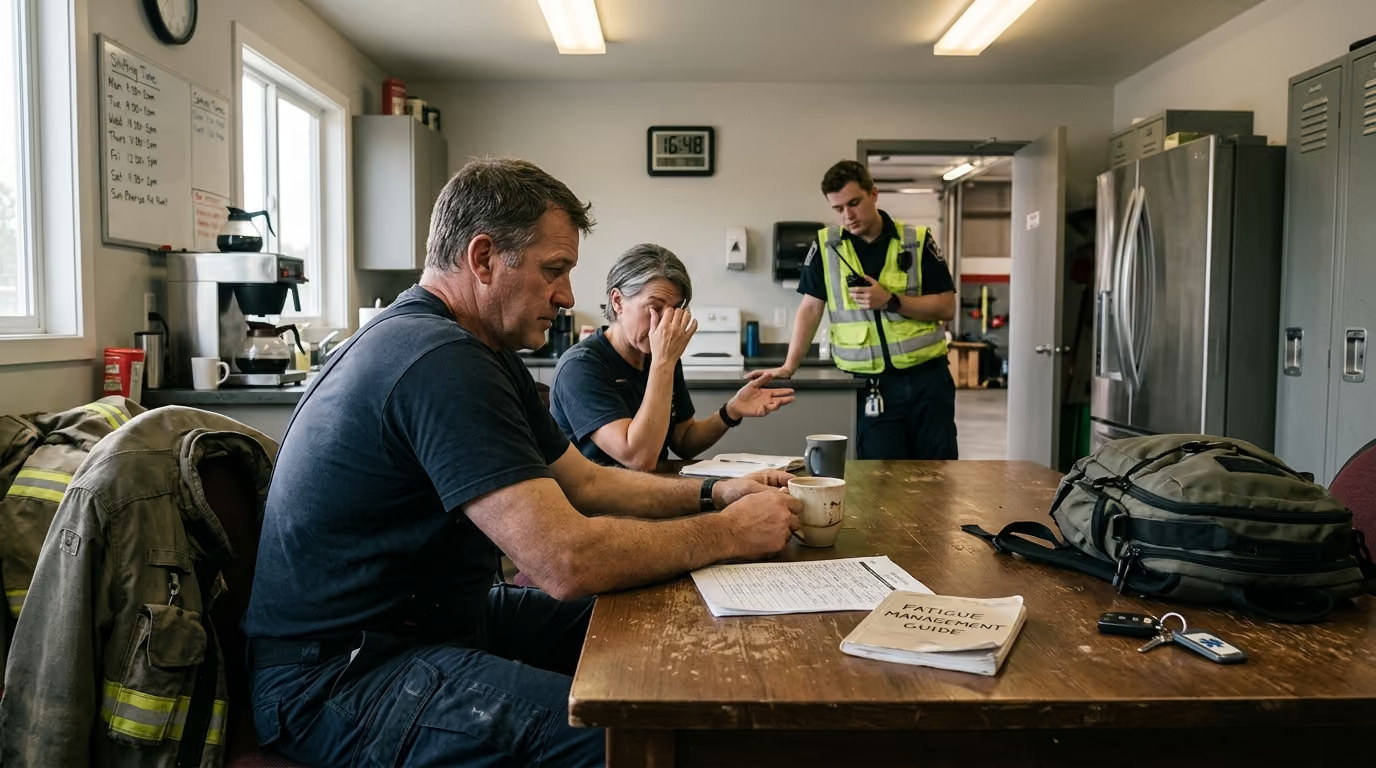

Working extended night shifts impairs critical reaction times, demanding structured risk assessments and practical operational controls across high-risk emergency duties.





You are seventeen hours into a twenty-four-hour shift. It is 03:45, and the tones drop for a motor vehicle collision with entrapment on the highway. You slide into the driver seat of the heavy apparatus, your eyes burning and your thinking noticeably sluggish. You feel committed to the job, but your brain is fighting heavy biological sleep pressure. Willpower can keep you standing, but it cannot restore degraded reaction time, restore divided attention, or eliminate blind spots in your situational awareness.
Fatigue on duty is an operational hazard rather than a personal weakness or character flaw. Managing it requires identifying sleep debt, understanding circadian low points, applying task-based controls, and building layered safety systems across every operational phase.
Workplace safety models in emergency services and healthcare historically treated fatigue as an individual endurance problem. Modern occupational science treats fatigue as a predictable physiological risk that degrades human performance. NIOSH defines fatigue as a state of weariness, tiredness, or lack of energy resulting from nonstandard schedules, extended wakefulness, and demanding work.
To manage this hazard effectively, organizations and individuals must separate related terms that are often conflated:
A professional can be severely fatigued without nodding off immediately. High motivation, intense calls, and adrenaline can temporarily mask fatigue symptoms. Once that acute stimulation fades, the underlying neurobehavioral impairment returns immediately.
The operational objective across emergency services is not the total elimination of fatigue. Emergency deployments, overnight calls, and critical incidents make periods of fatigue unavoidable. The practical objective is to identify when fatigue is developing, recognize when it reaches dangerous thresholds, and implement operational controls before it causes an accident or injury.
Fatigue operates across five distinct dimensions that compound one another during duty:
Extensive research across occupational health, transportation, and public safety demonstrates clear links between fatigue and operational error. The American Academy of Sleep Medicine states that adults require at least seven hours of sleep per night to maintain daytime alertness, motor coordination, and metabolic health. When regular sleep falls below this threshold, objective cognitive performance declines steadily.
Research on sleep restriction demonstrates that sleeping an average of 5.6 hours per night over several days doubles reaction-time impairment. It also increases attention lapses by fivefold. Subjectively, individuals report that they have adapted to the shorter sleep schedule, but objective testing reveals ongoing performance degradation. Subjective perception of alertness is an unreliable indicator of operational readiness.
The National Institute for Occupational Safety and Health reports that working nonstandard schedules outside the hours of 7 a.m. to 6 p.m. significantly increases accident risks. Compared to standard day shifts, accident and error risks rise by approximately 15% on evening shifts and 28% on night shifts. Night-shift personnel also report inadequate sleep 60% more often than day-shift colleagues.
OSHA notes that nearly 15 million Americans work full-time irregular, night, or rotating shifts. Extended duty hours and overtime create substantial safety hazards:
Fatigue plays a massive role in transportation incidents. The National Highway Traffic Safety Administration reported over 91,000 police-reported drowsy-driving crashes in a single year, resulting in roughly 50,000 injuries and hundreds of deaths. Because fatigue leaves no physical trace at an accident scene, these figures likely represent only a fraction of total occurrences. Fatigued driving crashes are frequently logged as unexplained lane departures or general inattention.
In clinical and emergency care settings, the Agency for Healthcare Research and Quality characterizes fatigue as a latent hazard that directly increases medical errors. Staff nurses working shifts longer than 12.5 hours experience significantly elevated error rates. Overtime, weekly work hours exceeding 40 hours, and consecutive short sleep periods compound these risks. When fatigue degrades working memory, clinical handoffs, procedural steps, and medication calculations become vulnerable to critical errors.
First responders and shift workers face operational realities that standard workplace safety guidelines rarely address. A 24-hour fire rotation, a rotating law enforcement shift, or a twelve-hour paramedic schedule imposes extreme demands on human physiology. Understanding how shift lengths and circadian timing interact is essential for maintaining crew safety.
A core operational challenge is the difference between nominal off-duty time and actual sleep opportunity. A schedule that provides eight hours between assignments does not provide eight hours of sleep. Commute times, meals, family responsibilities, decompression, personal hygiene, and household tasks reduce actual rest. When environmental heat, daylight, neighborhood noise, or post-shift physical pain fragment daytime sleep, total restorative sleep drops even further.
Emergency services also involve severe autonomic nervous system swings. A crew may spend hours in a low-activity state, experience an abrupt surge of sympathetic arousal during a high-acuity call, and then return to an administrative baseline. This physiological whiplash increases central nervous system fatigue. After the adrenaline subsides, workers experience an acute crash in vigilance that makes apparatus operation and equipment maintenance particularly dangerous.
Circadian biology creates predictable windows of high operational vulnerability. The primary biological low occurs during the early morning hours, typically between 02:00 and 06:00. During this window, core body temperature drops, reaction times slow, and the biological drive for sleep reaches its daily peak. A secondary, smaller dip in alertness occurs in the early afternoon.
Early morning shift starts, such as a 06:00 duty briefing, truncate slow-wave and rapid eye movement sleep. Personnel must wake during a circadian low to commute, arriving on duty with acute sleep restriction before their shift begins. Combining early starts with rotating patterns prevents the circadian pacemaker from adapting to any single schedule.
Relying on guesswork or individual stoicism to determine fitness for duty is an unsafe operational practice. Crews should evaluate operational fatigue through a systematic model that accounts for interacting physiological and environmental factors.
A practical fatigue risk model evaluates six core variables:
Assess total sleep obtained over the previous 24 hours and the preceding three days. Has the individual achieved the baseline seven hours, or have they accumulated a progressive sleep debt? Sleep fragmentation from overnight calls must be subtracted from total bed rest.
Track the number of continuous hours awake before executing a safety-critical task. Extended wakefulness beyond 16 to 18 hours produces cognitive and psychomotor degradation comparable to blood alcohol concentrations at or above legal operating limits.
Determine where the duty task falls within the 24-hour biological cycle. Tasks performed between 02:00 and 06:00 carry elevated baseline risk compared to identical tasks performed at 10:00.
Account for total hours worked across the week, consecutive night shifts, extreme physical exertion, heat strain, and high mental workload. Heavy gear, thermal stress, and prolonged standing accelerate cognitive and physical depletion.
Evaluate the quality of recent rest periods. Did the worker sleep in a dark, quiet, climate-controlled room, or was sleep disrupted by alarms, family demands, illness, or physiological stress?
Match the evaluated fatigue state against the operational task. Driving an emergency vehicle, entering a burning structure, performing advanced airway management, or calculating pediatric drug dosages carry severe consequences if an error occurs. Administrative paperwork or routine station cleaning carry low consequence.
This model can be expressed conceptually:
Fatigue Risk = Homeostatic Sleep Pressure + Circadian Strain + Workload Exposure - Recovery Quality and Controls
When sleep pressure and circadian strain are high, the task consequence must be mitigated by operational controls.
Applying operational controls requires concrete protocols tailored to specific emergency response domains. Organizations should implement structured safety buffers rather than relying on self-assessment.
Driving is often the most dangerous activity a fatigued responder performs. Sleep loss impairs lane maintenance, speed regulation, hazard recognition, and reaction speed.
Clinical errors under fatigue stem from reduced working memory, attention lapses, and impaired clinical calculation speed.
Fireground safety requires physical stamina, environmental awareness, and split-second tactical decisions. Physical exhaustion and thermal strain rapidly amplify sleep-related cognitive deficits.
Maintaining physical capability is necessary for duty performance, but training while severely sleep-deprived increases injury risk. Sleep debt degrades balance, motor control, and spinal stabilization.
Incident commanders and supervisors experiencing severe fatigue tend to narrow their attention, rely on rigid thinking, and overlook changing operational risks.
Countermeasures are temporary tools designed to sustain alertness during high-risk windows. They do not eliminate underlying sleep debt or restore baseline neurobehavioral function. They should never be used to justify unsafe scheduling or excessive shift lengths.
Brief naps are the most effective short-term intervention for reducing sleep pressure during long duty periods. A scheduled nap provides genuine biological recovery that chemical stimulants cannot match.
Caffeine is an adenosine receptor antagonist that temporarily blocks the brain from sensing sleep pressure. A Cochrane systematic review found that caffeine can improve cognitive performance and reduce errors in shift workers. However, the review identified no conclusive evidence that caffeine prevents occupational injuries.
Light exposure is the primary environmental signal that synchronizes the human circadian clock. Manipulating light helps manage alertness on duty and promotes daytime sleep.
Metabolic function slows during the biological night, altering insulin sensitivity and gastrointestinal motility.
Several persistent myths across first responder and healthcare cultures compromise operational safety and undermine effective fatigue management.
Many professionals believe that dedication, professional pride, and focus can overcome physiological fatigue. Motivation allows a responder to force themselves to stay awake, but it cannot restore degraded neural processing speed, widen a narrowed visual field, or prevent microsleeps. Sleep need is an uncompromising biological drive identical to the need for water or oxygen.
A common administrative assumption is that eight hours of scheduled release time equals eight hours of rest. Off-duty periods must accommodate commuting, nutrition, family obligations, and physiological unwinding. Providing eight hours off duty often yields only four to five hours of actual sleep opportunity. Schedule design must account for the total realistic recovery window.
Responders often claim they are completely safe to operate because they do not feel sleepy. Research demonstrates that chronically sleep-restricted individuals experience a plateau in subjective sleepiness while their objective reaction-time errors and attention lapses continue to climb. How you feel is an inadequate gauge of how safely you can perform.
Relying on energy drinks, pre-workout supplements, and continuous coffee gives individuals a false sense of security. Stimulants mask subjective fatigue while fine motor precision, peripheral awareness, and emotional regulation remain degraded. Chemical stimulants are an operational buffer, not a substitute for biological sleep.
Proponents of extended 24-hour or 48-hour shifts often argue that longer schedules improve operational continuity and reduce handoff errors. While handoffs do introduce communication risks, extended hours dramatically elevate fatigue-related procedural and driving errors. Organizations must balance continuity against the documented risks of extended wakefulness, rather than assuming longer shifts are inherently superior.
Relying entirely on individual willpower to manage fatigue is an organizational failure. Sustainable operational safety requires a structured Fatigue Risk Management System (FRMS). The International Civil Aviation Organization outlines comprehensive FRMS principles that apply directly to emergency response and healthcare agencies.
An effective organizational fatigue management framework consists of seven integrated pillars:
The agency must establish a formal policy defining fatigue as an operational hazard. The policy must outline explicit procedures for reporting fatigue without fear of disciplinary action or professional embarrassment.
Personnel and leadership require regular training on sleep physiology, circadian biology, sleep disorder recognition, and countermeasure use. Education must extend to families to help protect sleep opportunities during off-duty hours.
Agencies should evaluate shift patterns, mandatory overtime policies, and call volume distributions to identify structural fatigue risks. Shift supervisors should perform real-time fatigue assessments during extended multi-alarm incidents or severe weather deployments.
Incorporate structural safety buffers, such as mandatory double-checks for medications, driver rotations, and minimum staffing thresholds that prevent chronic overtime dependency.
Departments should provide dedicated, quiet, temperature-controlled sleeping areas in stations, supply active cooling equipment for fireground rehabilitation, and support strategic shift napping.
Organizations must track both leading and lagging fatigue indicators:
Reviewing national occupational fatigue reports offers clear baselines for measuring these organizational indicators.
Post-incident investigations should evaluate crew sleep history, time awake, and shift duration alongside physical evidence. Incident reviews must determine whether fatigue contributed to errors without defaulting to individual operator blame.
Managing fatigue requires distinguishing normal shift-work tiredness from undiagnosed sleep disorders. Research published in the Journal of Clinical Sleep Medicine revealed that 37.2% of operational firefighters screened positive for at least one clinical sleep disorder.
The documented screening rates included:
Personnel who screened positive for a sleep disorder had double the risk of motor vehicle crashes. They were also 2.4 times more likely to fall asleep while driving compared to colleagues who screened negative.
Responders who consistently obtain seven to eight hours of bed rest but continue to experience severe daytime fatigue, morning headaches, chronic snoring, or witnessed breathing pauses should seek a clinical evaluation. Occupational health programs should provide confidential, accessible pathways for formal sleep studies. Diagnosing and treating obstructive sleep apnea with positive airway pressure therapy restores cognitive performance, reduces cardiovascular strain, and significantly lowers on-duty vehicle crash risks.
Fatigue management is ultimately about career longevity and operational excellence. Operational longevity requires abandoning the belief that exhaustion proves dedication. Pushing through severe fatigue without operational controls endangers your crew, your patients, and the public you swore to protect.
Review this operational guide whenever you transition to a new shift pattern, notice an increase in near-miss events during driving or patient care, or find your crew relying heavily on stimulants to complete routine duty tasks.
Long-term capability requires treating sleep as a non-negotiable operational asset. By designing safer schedules, applying structured controls to high-risk tasks, and building supportive organizational systems, emergency service professionals can protect their health and serve their communities safely throughout a long, sustainable career.
Stay connected for research-led guidance on duty fitness, shift-work sleep, injury recovery, stress, nutrition and career longevity. Practical ideas for first responders who want to stay capable on the job, recover well and protect their health for the long run.



Read practical guidance on first responder fitness, recovery, sleep, nutrition and resilience for demanding work and a long, active career.
read the blog



