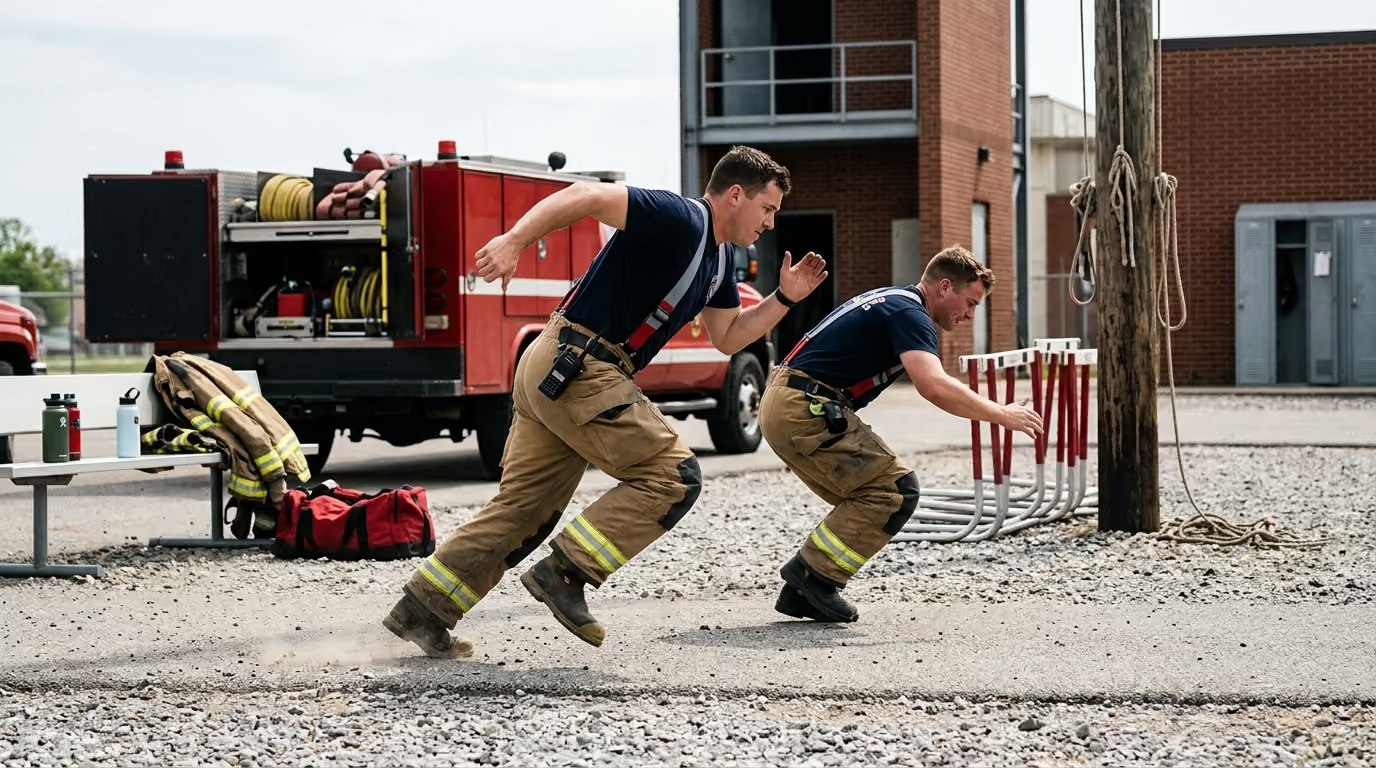

First responders build explosive acceleration, safer braking mechanics, and field-ready agility under duty loads with targeted strength and shift-based speed programming.





Usable speed for emergency personnel is not the same as track sprinting. It is not measured by a 40-yard dash on a dry, level surface in lightweight running shoes. In emergency services, usable speed means accelerating rapidly from awkward positions, stopping abruptly before hazards, changing direction with control, and repeating these efforts while wearing heavy gear on unpredictable ground.
Developing this capability requires a clear understanding of the difference between top-end sprinting and short-burst acceleration. It requires dedicated attention to deceleration, which places unique mechanical demands on the muscular and skeletal systems. This comprehensive guide details the biomechanical evidence, strength requirements, programming frameworks, and field drills needed to build durable, operational speed across a long career.
Sprint performance consists of distinct mechanical phases: acceleration, maximal velocity, and deceleration. A systematic review of sprint mechanics published in track and field research demonstrates that the physical qualities governing initial acceleration differ substantially from those governing upright, maximal-velocity sprinting. For emergency personnel, most operational movements occur over distances between 5 and 20 meters. Responders rarely reach true top-end velocity before needing to stop, turn, or execute a physical task.
Mechanical analysis shows that acceleration relies heavily on horizontal external force production. During the first steps of a sprint, the body leans forward to direct force backward into the ground, propelling the center of mass forward. This relationship between horizontal force application and short-distance speed is well established in sports biomechanics literature. Research analyzing the mechanical determinants of sprinting indicates that horizontal force production directly influences both straight-line acceleration and change-of-direction performance.
Deceleration, by contrast, requires the body to absorb and redirect momentum. High-intensity braking generates vertical ground-reaction forces that can reach nearly six times body weight. These impact forces are roughly 2.7 times greater than the peak forces recorded during maximal acceleration. Braking also produces rapid eccentric loading on the quadriceps, hamstrings, calves, and surrounding connective tissues.
Studies investigating the link between acceleration, deceleration, and change of direction show that straight-line sprint speed does not automatically produce effective braking or turning ability. While a rapid 10-meter sprint provides the foundation for closing distance quickly, deceleration requires distinct neuromuscular coordination and eccentric strength. Without specific braking training, a responder may generate high approach velocity but lack the mechanical control to stop safely near vehicles, doorways, or patients.
Operational constraints fundamentally change how the human body moves. Tactical equipment, structural turnout gear, self-contained breathing apparatus, and heavy boots alter posture, center of mass, and stride mechanics. Research examining police recruits found that wearing an occupational load of just 5 kilograms significantly reduced 10-meter acceleration, Illinois agility times, and 300-yard shuttle performance. When external loads increased to 10 kilograms, sprint endurance and change-of-direction capacity declined further.
External loads also increase braking demands. Because momentum is the product of mass and velocity, carrying 15 to 30 kilograms of equipment substantially lengthens the distance required to stop. Research on tactical load carriage shows that external weight reduces both power and agility while increasing ground-reaction impact during abrupt stops. When responders attempt to stop suddenly in full gear, the musculoskeletal system must absorb both the body weight and the carried equipment.
Fatigue introduces another layer of mechanical disruption. A study on firefighter sprinting biomechanics found that external weight and fatigue alter movement symmetry and joint kinetics. Fatigued responders carrying load demonstrated compensatory mechanics, relying heavily on increased push-off power from the dominant hip and ankle. These compensations increase energy expenditure and elevate the risk of soft-tissue strain.
Occupational standards reflect these multifaceted demands. The Candidate Physical Ability Test developed by the International Association of Fire Chiefs and the International Association of Fire Fighters evaluates candidates across eight sequential events, including stair climbs, hose drags, equipment carries, and rescue drags. Candidates perform these tasks wearing a 50-pound vest, with an extra 25 pounds added during the stair climb. Success in such settings depends on moving efficiently under load, managing momentum, and maintaining technical control rather than chasing pure unloaded track speed.
Surface conditions present a final operational challenge. Real-world emergency scenes feature wet pavement, loose gravel, mud, slick tile, stairs, and debris. High horizontal forces that work on a rubberized track will cause slipping on compromised surfaces. Effective field performance requires the ability to read terrain, shorten braking steps, and lower the center of mass before initiating a turn or stop.
Acceleration training for first responders should focus on the first three to five steps. In tactical and emergency scenarios, the ability to create sudden separation or close a short gap determines whether an objective is achieved safely. Building this quality requires mastering three distinct phases: projection, transition, and continuation.
Projection refers to the initial push off the ground. The responder must drive the ground away through triple extension of the hip, knee, and ankle while maintaining a forward torso angle. Transition involves the gradual, controlled rising of the torso over successive steps rather than popping straight up on the first stride. Continuation occurs when the responder reaches an upright posture while maintaining forward momentum without overstriding.
Starting positions must reflect occupational reality. Athletes on a track start from standardized blocks, but first responders start from awkward, non-standard positions. Acceleration sessions should incorporate varied starts to build adaptable horizontal power:
Distance selection must match operational demands. Most sprint volume should stay within 5 to 20 meters. A structured progression moves through specific distance bands:
Quality must always take priority over fatigue during pure acceleration work. If ground contact becomes noisy, stride length shortens, or the torso collapses, the session should end. Training high-speed mechanics in an exhausted state degrades motor patterns and reduces rate of force development. Responders seeking structured ways to integrate these sprint bursts alongside shift constraints can consult our guide on programming high-output capacity workouts alongside low-fatigue maintenance sessions.
Deceleration is an active motor skill that requires substantial eccentric muscular strength. Stopping safely does not mean simply cutting power and waiting for friction to slow the body. It requires the nervous system to coordinate rapid force absorption across the ankle, knee, hip, and spine. When a responder brakes poorly, force is transmitted straight into passive joint structures, increasing the risk of patellar tendinopathy, ACL stress, and ankle sprains.
Effective deceleration mechanics require several distinct adjustments:
Responders should train four primary braking strategies depending on situational constraints. Multi-step braking is the most versatile strategy, especially when wearing heavy duty gear or operating on slick surfaces. Single-step braking is reserved for emergency stops where immediate halting is required, though it carries higher mechanical stress. Brake-and-go drills develop the transition between braking and re-acceleration. Brake-to-task drills train the responder to sprint, stop within a designated zone, and immediately perform a job-specific movement such as dropping to a knee or hoisting a tool.
Deceleration drills should follow a gradual progression:
Progress the challenge by increasing the entry speed rather than drastically shortening the stopping zone. Forcing athletes to stop in unrealistically short distances before establishing eccentric strength creates excessive joint stress. For more on developing physical resilience to withstand these mechanical forces, explore our resources on injury-resilient training principles for first responders.
Change of direction (COD) and agility are distinct qualities. Planned COD involves pre-determined movement pathways where the responder knows when and where to turn. Reactive agility requires visual or auditory processing, rapid decision-making, and an immediate physical response. Both qualities must be developed systematically.
Planned shuttle drills build the mechanical foundation for turning. They teach athletes how to drop the hips, plant the outside foot, push off the inside edge, and re-accelerate along a new vector. Research analyzing the mechanical determinants of change of direction shows that COD ability is heavily influenced by the ability to generate force in the horizontal plane during both braking and propulsion.
The following planned drills develop foundational change-of-direction mechanics:
Once mechanical competence is established, training must incorporate perception and job tasks:
Coaching must emphasize foot placement. A common technical error is planting the outside foot too far outside the body line, which creates high lateral knee torque. Responders should keep their feet positioned under the pelvis, maintaining a wide base of support and lowering the center of mass to redirect momentum cleanly.
Sprint speed and braking ability are built on a foundation of relative strength, rate of force development, and eccentric capacity. A responder who lacks lower-body strength will struggle to direct horizontal force into the ground during acceleration and will lack the muscular braking power required to decelerate safely under load.
Heavy bilateral and unilateral lifting develops the raw force potential required for explosive movement. Key exercises include:
Because braking generates severe impact forces, targeted eccentric training is essential for soft-tissue durability:
Translating gym strength into sprint speed requires horizontal power development and ankle-complex stiffness:
Responders balancing shift fatigue with physical conditioning should adopt a minimal effective dose approach. Combining two to three compound strength movements with short sprint work yields substantial performance gains without overtaxing recovery. Learn more about balancing these training elements in our article on the minimum effective dose training framework for emergency crews.
Designing a speed program for first responders requires balancing stimulus and recovery around rotating shifts, disrupted sleep, and emergency calls. High-intensity sprinting places heavy demands on the central nervous system and requires adequate rest to maintain movement quality.
A balanced three-session weekly model separates high-output speed work from tactical conditioning:
Speed training requires strict volume control. Responders must terminate sprint sessions when output declines. Continuing to sprint in a fatigued state teaches poor mechanics and elevates the risk of hamstring or adductor pulls.
When sleep is severely disrupted after difficult night shifts, high-speed sprinting should be replaced with low-impact sled drags, mobility work, and steady aerobic capacity. For practical strategies on adjusting training volume around duty fatigue, read our detailed guide on managing training readiness and autoregulation for emergency services.
Monitoring speed and deceleration ensures that training produces usable field qualities rather than hollow numbers. A comprehensive assessment battery evaluates both straight-line acceleration and braking control, comparing unloaded outputs against loaded performance.
Responders can run the following field tests every 8 to 12 weeks:
Comparing unloaded and loaded metrics provides clear programming direction. If a responder shows a performance drop greater than 10 percent when wearing gear while maintaining clean form, training should prioritize heavy sled pushes, loaded carries, and relative strength. If the braking distance expands significantly under load, the athlete requires more eccentric quadriceps and hamstring capacity.
Analyzing real-world movement patterns helps identify underlying physical limitations:
To explore foundational conditioning strategies that maintain readiness across an entire career, visit our collection on duty fitness for emergency professionals.
High-intensity acceleration and deceleration training carries inherent orthopedic demands. Sprinting and abrupt braking place substantial stress on the hamstrings, adductors, patellar tendons, Achilles tendons, and plantar fascia. Pushing through acute pain or severe movement breakdown compromises safety and operational readiness.
Safety requires respecting several foundational guardrails:
While regular physical training builds durability, certain symptoms warrant evaluation by a licensed physical therapist, sports medicine physician, or orthopedic specialist:
Working with a qualified sports clinician ensures that underlying soft-tissue restrictions, mechanical asymmetries, or tendon issues are addressed before returning to high-intensity field training.
No. Training exclusively in heavy gear can degrade mechanics, reduce peak velocity, and cause excessive joint fatigue. The most effective approach uses unloaded training to build raw speed and braking mechanics, then introduces light-to-moderate gear periodically to verify transfer and build load tolerance.
Deceleration training builds eccentric muscular strength, which allows the muscles to absorb and dissipate kinetic energy safely. By strengthening the quadriceps, hamstrings, and calves in lengthened, force-absorbing positions, the body relies on muscular contraction to slow down rather than transmitting high impact forces into ligaments, cartilage, and tendons.
Yes, provided the volume, intensity, and progression are managed appropriately. Older or heavier personnel should begin with low-impact horizontal work such as sled pushes, sled drags, and multi-step braking drills at moderate speeds before progressing to unconstrained maximal sprints and sharp directional cuts.
Rest intervals should be generous, typically 45 to 60 seconds for every 10 meters sprinted. The objective of speed training is neural output and movement quality, not metabolic exhaustion. If rest periods are too short, the session turns into conditioning, degrading stride mechanics and reducing power production.
Building usable field speed is not about chasing track records or enduring exhausting sprint punishment. It is about developing the horizontal power to accelerate rapidly, the eccentric strength to stop under control, and the mechanical durability to repeat both while carrying duty equipment across a long, healthy career.
Stay connected for research-led guidance on duty fitness, shift-work sleep, injury recovery, stress, nutrition and career longevity. Practical ideas for first responders who want to stay capable on the job, recover well and protect their health for the long run.



Read practical guidance on first responder fitness, recovery, sleep, nutrition and resilience for demanding work and a long, active career.
read the blog



