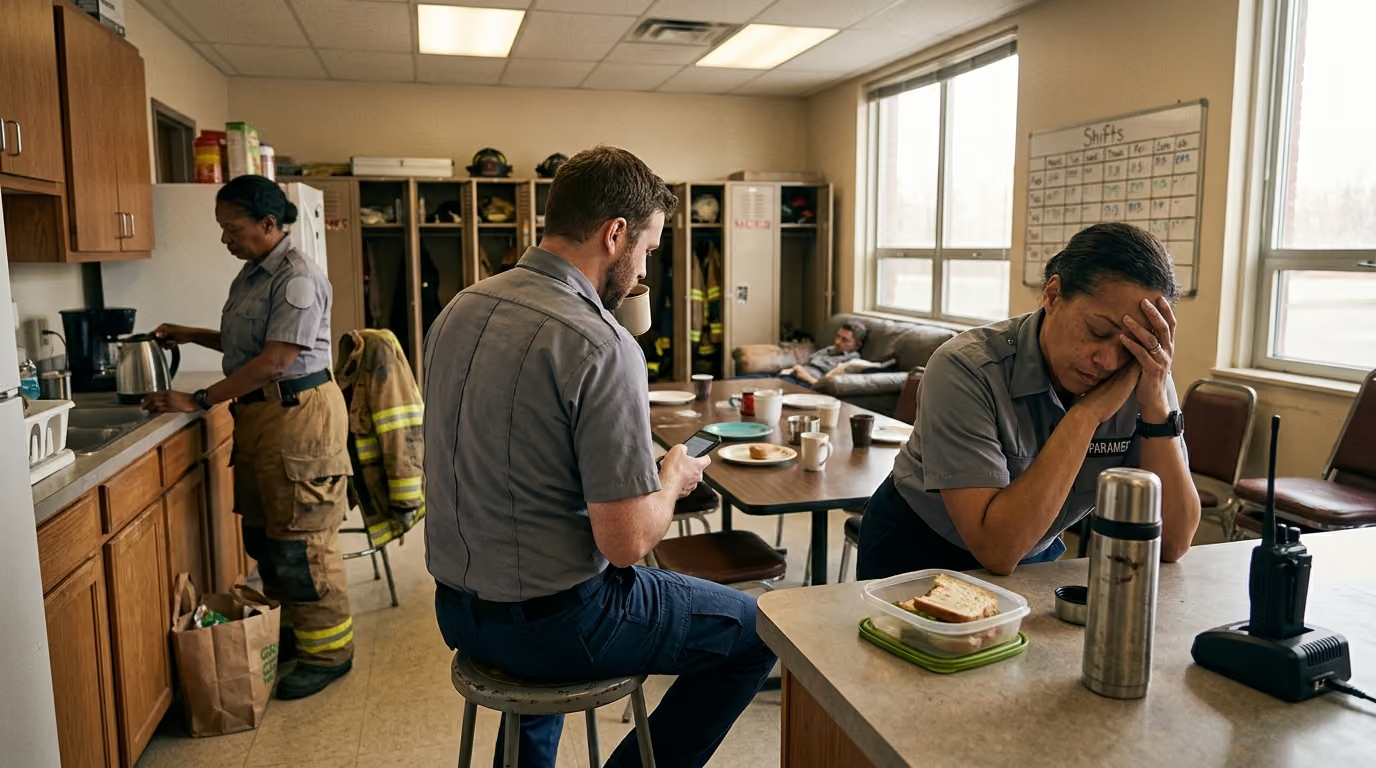

Shift-work recovery planning helps emergency personnel systematically counteract cumulative sleep debt, protect vital sleep windows, and calculate readiness between demanding duty shifts.





How do you build an effective shift-work recovery plan when call volume, irregular hours, and family life constantly disrupt your schedule? The most reliable approach is to treat recovery as a dynamic risk-management system rather than a fixed sleep checklist. An effective framework evaluates your actual sleep opportunity, job demands, commuting safety, and physical readiness across a rolling 24-hour to 48-hour window. It allows you to adjust training, nutrition, sleep timing, and duty readiness based on real fatigue rather than rigid habits.
Shift work alters the relationship between your internal biological clock and external environmental demands. The human circadian system regulates body temperature, hormone secretion, digestion, and alertness across a 24-hour cycle. When you work at night or wake during the early morning, you must remain alert while your internal biology promotes sleep. Later, you must attempt to rest during the day when alerting signals promote wakefulness.
This mismatch creates two distinct physiological challenges. First, homeostatic sleep pressure builds continuously during waking hours. Second, circadian timing dictates when your brain is biologically prepared to initiate and sustain deep sleep. A shift worker can experience extreme homeostatic exhaustion while remaining unable to sleep during daylight hours. This occurs because the biological clock continues sending daytime alerting signals to the brain.
Understanding the difference between sleep opportunity and sleep obtained is fundamental to occupational health. Sleep opportunity represents the total window available between shifts after subtracting non-work tasks. Sleep obtained is the actual duration of consolidated rest achieved during that window. Sleep efficiency measures the percentage of the available window actually spent asleep.
Research from the National Institute for Occupational Safety and Health indicates that 37.6 percent of surveyed workers report short sleep duration. Among night-shift workers, that figure rises to 61.8 percent. Furthermore, 30.7 percent of night workers report poor sleep quality, and 22.3 percent experience severe daytime sleepiness. These statistics demonstrate that fatigue in irregular schedules is not a personal failure. It is an occupational exposure requiring systematic management.
Emergency service schedules place unique demands on the human nervous system. Firefighters, police officers, paramedics, and dispatchers routinely operate under unpredictable workloads. A 12-hour or 24-hour shift may feature prolonged periods of low activity punctuated by sudden, high-stress emergency responses. These interruptions trigger acute sympathetic nervous system activation, elevating heart rate and core temperature.
When alarms activate during the biological night, the body experiences abrupt awakenings that disrupt sleep architecture. Even if an emergency responder spends eight hours in a station bunk, fragmented sleep produces severe cognitive and physical deficits. Repeated call interruptions prevent the brain from completing full sleep cycles, limiting slow-wave and rapid eye movement stages.
Extended shifts and quick returns compound this physiological burden. A quick return occurs when a worker has less than 11 hours off between consecutive duties. When you subtract a 45-minute commute, post-shift hygiene, meal preparation, and family duties, the true sleep opportunity often shrinks below five hours. Over successive shifts, this creates cumulative sleep debt that degrades reaction time, emotional regulation, and physical capacity.
Physical occupational loads add further complexity. Wearing heavy ballistic vests, structural firefighting gear, or duty belts increases energy expenditure and thermal strain. Prolonged vehicle patrol creates spinal loading and muscular stiffness. An effective recovery plan must address both neuromuscular fatigue and circadian disruption without assuming ideal resting conditions. You can explore comprehensive shift work sleep and recovery resources to understand these systemic demands in detail.
Current scientific literature provides clear evidence regarding fatigue mitigation, schedule design, and occupational health outcomes. The American Academy of Sleep Medicine and occupational health researchers have evaluated numerous strategies to counter circadian disruption. The evidence base includes strong operational recommendations, conditional interventions, and long-term epidemiological associations.
Strategic napping represents one of the strongest evidence-backed interventions. Systematic reviews demonstrate that planned naps before or during night shifts significantly improve alertness, psychomotor performance, and vigilance. Short naps of 15 to 30 minutes reduce immediate sleep pressure while minimizing post-awakening sleep inertia. Longer naps of approximately 90 minutes allow for a complete sleep cycle, supporting physical restoration before an overnight duty.
Light management protocols provide conditional benefits when applied correctly. Exposure to bright light during the first half of a night shift can suppress melatonin and enhance alertness. Restricting morning light exposure using dark sunglasses on the drive home helps prevent unwanted circadian phase delays. However, occupational health experts emphasize that light-based interventions require precise timing to avoid disrupting daytime sleep attempts.
Epidemiological research highlights the long-term health trade-offs associated with sustained shift work. Systematic reviews and meta-analyses associate fixed night work with a 44 percent higher relative risk of ischemic heart disease. Research also identifies higher rates of hypertension, metabolic dysfunction, and systemic inflammation among long-term night workers. These findings represent statistical associations rather than direct single-cause proof. They highlight why structured recovery planning is vital for first responder career longevity.
Regarding physical activity, clinical reviews demonstrate that moderate exercise supports sleep quality and reduces general fatigue across rotating shifts. However, high-intensity exercise performed under acute sleep deprivation can elevate cardiovascular stress and injury risk. Training must be adjusted to match current biological capacity rather than executed rigidly.
A resilient recovery plan functions as a closed-loop system rather than a static checklist. It consists of four distinct operational stages: Assess, Protect, Strategic Recovery, and Review.
Every recovery cycle begins with an objective assessment of the upcoming 24 to 48 hours. Before committing to workouts, household projects, or social obligations, review your baseline numbers. Identify your shift start and finish times, actual sleep obtained over the previous two days, and total call interruptions.
Assess both physical and cognitive demands. A shift with multiple complex technical calls imposes greater neurological fatigue than a quiet administrative duty. Evaluate your upcoming commute duration, family caregiving duties, and scheduled training sessions. Finally, identify the next safety-critical task you must perform, such as emergency vehicle driving or clinical decision-making.
The primary sleep period must be scheduled and defended like any critical operational assignment. Treating daytime sleep as leftover time guarantees chronic sleep restriction. Once your off-duty window begins, minimize unnecessary administrative delays and transition toward sleep quickly.
Protecting this window requires physical and social barriers against disruption. Use high-quality blackout shades or an eye mask to eliminate environmental light. Maintain bedroom temperatures between 65 and 68 degrees Fahrenheit to assist the body's natural cooling process during sleep. Use earplugs or dedicated white noise machines to block neighborhood and household sounds. Coordinate explicit quiet hours with family members to prevent non-emergency interruptions.
When the primary sleep window is constrained, integrate secondary recovery tools. Strategic recovery includes planned naps, deliberate light exposure, tailored nutrition, and modified physical activity.
If your daytime sleep was truncated to five hours, schedule a 30-minute nap in the late afternoon before reporting for duty. Align your nutrition by consuming easily digestible meals prior to night work, avoiding large, high-fat meals during the biological night. Match your physical movement to your recovery state, prioritizing mobility and aerobic flush sessions over maximal lifting.
Operational conditions change rapidly in emergency services. A recovery plan that looked adequate at the start of a shift may fail after an unexpected call volume surge. Review your physical and cognitive state at key transition points.
Reassess your plan immediately following difficult emergency incidents, extended overtime, or near-miss safety events. If your obtained sleep was significantly lower than anticipated, downgrade your planned physical training and eliminate non-essential tasks. Treat recovery as an ongoing feedback loop where plans adapt to operational reality.
To simplify operational decision-making, you can use a basic scoring method called the Recovery Load Index. This tool helps you evaluate eight key lifestyle and operational factors. It is not a clinical diagnostic test, but a practical method to quantify total strain.
Score each domain from 0 (low strain) to 2 (high strain):
When your score falls into the Green zone, your nervous system can handle normal training loads, social activities, and standard duty preparation. In the Amber zone, you must actively protect your main sleep window and consider scaling back training intensity. In the Red zone, non-essential physical stressors and unnecessary driving must be eliminated.
Standard routines often collapse when emergency service demands escalate. The following decision protocols provide clear instructions for adapting your recovery based on specific operational disruptions.
This scenario occurs when you obtain under five hours of sleep due to environmental issues or scheduling delays, but duty demands were manageable.
Focus on preventing cumulative sleep debt from extending into the next 24 hours. Keep hydration steady and consume balanced meals containing lean proteins and complex carbohydrates.
In this scenario, total bunk time may appear acceptable on paper, but frequent tones or alarms prevented deep, restorative sleep cycles.
Do not assume that spending eight interrupted hours in a bunk equals eight hours of restorative rest. Acknowledge the neurological disruption and reduce all optional physical and cognitive loads.
Following complex rescues, severe trauma calls, or prolonged structure fires, emergency responders experience both intense physical exhaustion and psychological activation.
The sympathetic nervous system remains elevated long after a critical call ends. Rushing immediately into heavy workouts or high-stress domestic situations increases injury risk and delays psychological processing. You can read more about systematic fatigue baselines in the CDC fatigue research and shift protocols.
When severe fatigue coincides with a long drive home, the commute represents the single highest operational safety hazard of your day.
A recovery plan that successfully prepares you for the next shift is useless if you crash on the journey home. Make commute safety an uncompromised operational gate.
Working three or four consecutive 12-hour or 24-hour night shifts produces severe compounding fatigue that requires a multi-day management strategy.
Avoid swinging abruptly back to early morning awakenings on your first day off. Shifting your sleep schedule back and forth over a 48-hour window worsens circadian disruption and lengthens recovery time.
Physical fitness is essential for occupational performance and injury resistance in emergency services. However, physical training is a biological stressor that draws upon the same systemic recovery reserves as shift work. Layering high-volume or high-intensity workouts onto severe sleep deprivation accelerates overtraining, elevates injury risk, and degrades immune function.
To manage this balance safely, categorize your training days into three distinct readiness tiers based on your Recovery Load Index:
Green days occur when your sleep was consolidated, your operational stress was low to moderate, and your Recovery Load Index is four or lower.
On these days, your nervous system is fully prepared for higher physical demands. You can safely execute heavy multi-joint strength training, explosive Olympic lifting, sprint intervals, and high-intensity tactical conditioning. Autoregulation should still guide your sets, but you have the biological capacity to drive fitness adaptations.
Amber days occur when sleep was shortened to five or six hours, duty volume was moderately elevated, or your Recovery Load Index falls between five and eight.
On these days, shift your goal from building new capacity to maintaining existing fitness without accumulating excess fatigue. Reduce total training volume by 30 to 50 percent while keeping movement quality high. Focus on submaximal compound lifts kept several repetitions shy of failure, moderate aerobic work, and core stability drills. For detailed programming strategies, refer to our shift-work training decision model.
Red days occur when you experience severe sleep debt, consecutive busy nights, high emotional trauma, or a Recovery Load Index of nine or higher.
On Red days, hard training is contraindicated. Attempting high-load or high-velocity exercise under severe neurological fatigue dramatically impairs motor control, increasing the risk of acute muscle tears and spinal injuries. Limit physical activity to light mobility routines, tissue flossing, gentle walking, and focused breathwork. Your primary training goal on a Red day is systemic nervous system recovery, not metabolic conditioning.
Optimizing your physical environment and home life is critical for sustainable shift-work recovery. Relying on sheer willpower to overcome poor sleeping conditions is ineffective against circadian biology.
Light is the most powerful synchronizer of the human circadian clock. When completing a night shift, wear dark, polarized sunglasses during your morning commute to prevent bright sunlight from triggering daytime wakefulness pathways. In the bedroom, install true blackout curtains to eliminate all external light. Even minor light exposure through thin blinds can penetrate eyelids and degrade rapid eye movement sleep.
Acoustic management is equally vital. Daytime environments feature higher ambient noise from traffic, lawn care, and family activity. Utilize a dedicated sound conditioner producing steady white, pink, or brown noise to mask sudden environmental spikes. Pair this with custom-molded or high-grade foam earplugs. Configure personal mobile devices to allow only emergency departmental bypass calls while silencing general notifications.
Managing nutrition and meal timing stabilizes metabolic function during irregular shifts. Avoid consuming heavy, high-fat meals during the biological night when gastrointestinal motility and insulin sensitivity are naturally reduced. Instead, rely on light, protein-rich snacks during duty hours, and save your primary meal for the post-sleep window. For specific meal scheduling guidelines, consult our resource on practical shift-work nutrition strategies.
Family and household coordination must be approached systematically. Shift-work recovery is a household logistics challenge, not an individual habit. Work with family members to establish non-negotiable sleep blocks following overnight duties. Post a visible sign on the bedroom door indicating your wake-up time. In return, schedule focused, uninterrupted family time during your fully recovered off-duty windows.
Fatigue management is ultimately about operational safety and survival. Emergency responders are trained to manage high-risk scene dynamics, yet many neglect the extreme hazard of drowsy driving.
According to data summarized by the National Highway Traffic Safety Administration, drowsy driving contributes to an estimated 91,000 police-reported crashes annually. These incidents result in approximately 50,000 injuries and 800 fatalities each year. Emergency service personnel returning home after grueling 24-hour shifts or back-to-back night rotations represent a high-risk demographic for these catastrophic events.
To protect yourself and the public, implement an uncompromising commute decision gate before leaving your station or facility:
If you experience any of these warning signs, you are medically unsafe to operate a motor vehicle. Pull over into a secure parking lot and set an alarm for a 20-minute nap. Alternatively, request transport from a colleague, use a ride-share service, or utilize public transit. Never attempt to overcome severe neurobiological sleep pressure with rolled-down windows, loud music, energy drinks, or personal willpower.
It is essential to distinguish ordinary occupational fatigue from formal medical sleep disorders. Experiencing acute tiredness following an exceptionally busy night shift is a normal physiological response. However, chronic, unresolving sleep disruption requires clinical evaluation.
Shift Work Disorder is a recognized circadian rhythm sleep-wake disorder defined within the International Classification of Sleep Disorders, Third Edition. Its diagnostic criteria include:
If you consistently struggle to fall asleep or stay asleep despite ideal environmental conditions, seek professional medical guidance. Similarly, if you experience uncontrollable sleepiness during safety-critical tasks, severe mood changes, or persistent brain fog, formal evaluation is warranted.
Consult a licensed physician or board-certified sleep specialist. A comprehensive clinical assessment can identify or rule out underlying conditions such as obstructive sleep apnea, restless legs syndrome, or clinical mood disorders. Professional medical evaluation ensures targeted care while protecting your health and operational capability.
Maintaining an emergency services career while protecting your physical and mental health requires a structured, dynamic approach to fatigue. By replacing rigid checklists with an adaptive framework, you can match your daily training, nutrition, and rest to the true demands of your schedule. Sustainable operational readiness is built upon consistent, evidence-based habits that protect your capability today while ensuring long-term health for the future.
Stay connected for research-led guidance on duty fitness, shift-work sleep, injury recovery, stress, nutrition and career longevity. Practical ideas for first responders who want to stay capable on the job, recover well and protect their health for the long run.



Read practical guidance on first responder fitness, recovery, sleep, nutrition and resilience for demanding work and a long, active career.
read the blog



