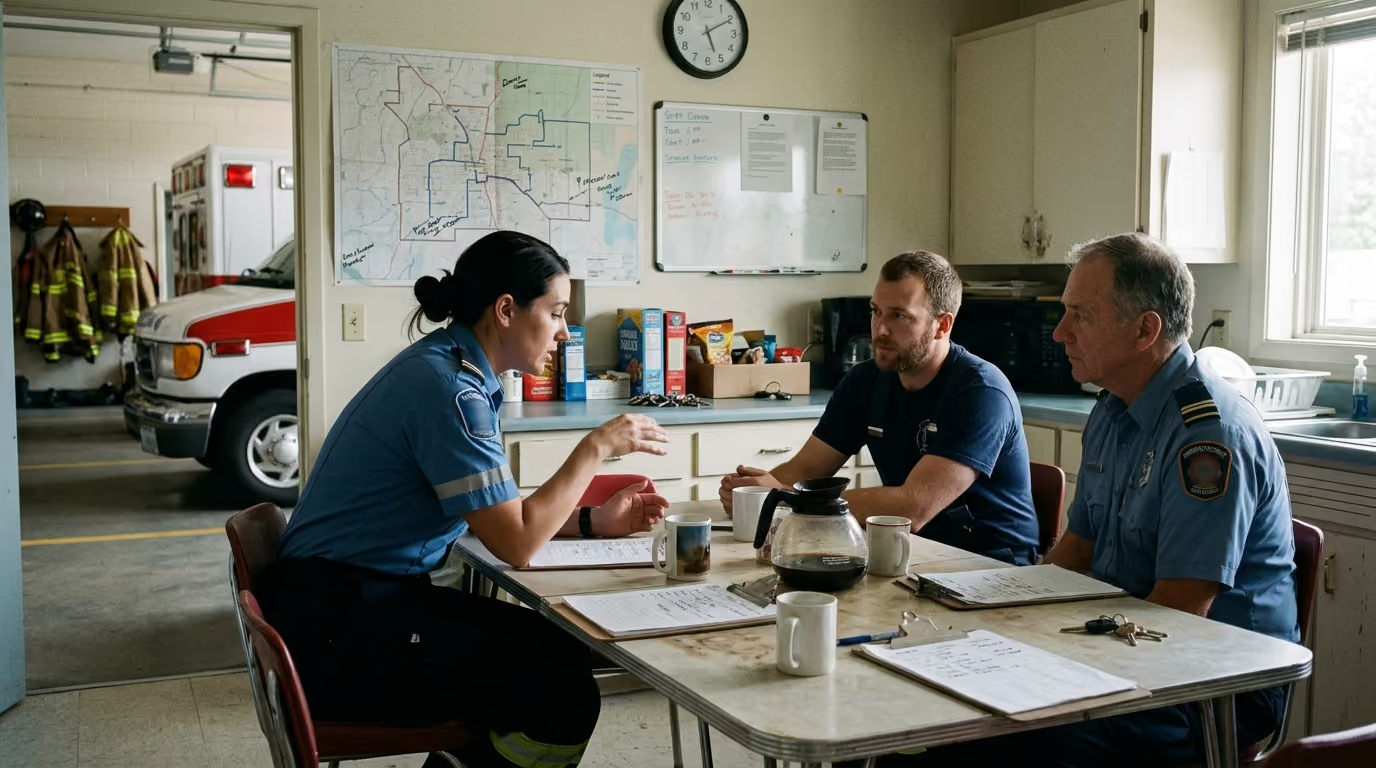

Responders often chase additional data to resolve operational uncertainty, but structured cognitive frameworks and bias mitigation deliver better emergency decisions.





Dispatch tones drop at 03:15 for an unspecified residential incident. The caller is frantic, reporting shouting and possible smoke, but hangs up before giving clear details. En route, the radio traffic updates the call from a possible structure fire to an assault, then to a potential hazardous materials exposure. You arrive on scene in the dark with fragmented information, conflicting reports from bystanders, and an escalating operational clock.
Operating under missing, conflicting, or fast-changing information is a standard condition of emergency response. Working effectively with uncertainty requires moving away from the urge to force immediate certainty. It means maintaining safe, provisional momentum while systematically testing your assumptions against reality.
When emergency responders treat uncertainty as a problem to eliminate before acting, two failure modes emerge. Responders either freeze while waiting for complete clarity, or they rush into premature closure by locking onto the first explanation that comes to mind. Sustainable operational capability relies on treating uncertainty as a workable condition. You can make disciplined, structured choices even when the operating picture remains incomplete.
Uncertainty is not merely an absence of facts. In emergency services, uncertainty is a subjective state of doubt that can delay or block critical decisions. It occurs when available information is missing, inconsistent, unreliable, or too complex to process quickly. This condition directly shapes how commanders, crew leaders, and frontline personnel interpret risk and choose actions.
To manage uncertainty on scene, responders must separate several related operational concepts. These terms are often blended together, but they require different tactical responses:
Research into emergency operations distinguishes between two primary sources of uncertainty. Recognizing which type you face dictates the proper solution.
Endogenous uncertainty originates from the incident itself. It includes changing fire conditions, unstable structures, unconfirmed casualty numbers, unknown hazardous substances, and unpredictable civilian behavior. When facing endogenous uncertainty, the remedy is technical reconnaissance, scene assessment, physical monitoring, and direct observation.
Exogenous uncertainty originates from the response system itself. It includes unclear command structures, incompatible radio channels, delayed mutual-aid arrival times, and differing operational terminology between police, fire, and ambulance crews. When facing exogenous uncertainty, the remedy is clarifying command roles, standardizing communication protocols, confirming resource allocations, and establishing unified objectives.
Decades of cognitive and occupational research show that uncertainty alters brain function and decision mechanics. When responders understand these physiological shifts, they can rely on structured protocols rather than raw intuition.
Stress is not simply external pressure. Research defines stress as an appraisal process occurring when perceived operational demands exceed perceived personal and team resources. When a responder views an ambiguous call with adequate training, structured protocols, and reliable team support, the brain appraises the situation as a demanding but manageable task.
Conversely, when an ambiguous call is paired with role confusion, isolated decision-making, and heavy fatigue, the brain appraises uncertainty as a direct threat. This threat appraisal triggers an acute stress response that directly shapes cognitive function.
Under high acute stress, the perceptual field narrows. Research published in emergency service reviews demonstrates that acute stress causes performance deficits on complex cognitive tasks and impairs verbal memory.
This attentional narrowing has functional trade-offs:
Because acute stress limits active working memory, responders naturally lean on familiar scripts and initial cues. Without structured review mechanisms, this cognitive narrowing leads directly to operational blind spots.
Evidence indicates that acute stress heightens subjective risk assessment, which can skew operational priorities. Responders facing intense stress may overestimate low-probability hazards while overlooking quiet, high-probability risks.
Systematic reviews show that while chronic conditions like post-traumatic stress do not degrade baseline performance on well-drilled, automatic skills, they can alter risk perception in scenarios requiring open-ended professional judgment. High acute stress can cause responders to see catastrophic danger in ambiguous cues, or conversely, cause them to discount genuine hazards due to sensory overload.
Uncertainty does not occur in a vacuum. It interacts with the physical realities of shift work, disrupted sleep cycles, and extended operational timelines.
Shift schedules and emergency calls disrupt normal circadian biology. Systematic reviews of emergency medical personnel report that approximately 72 percent of surveyed paramedics experience poor sleep quality, while 30 percent suffer from excessive daytime sleepiness. Across public safety sectors, research reveals high prevalence rates for shift-work disorder, obstructive sleep apnea, and chronic insomnia.
Real-time monitoring of emergency clinicians shows that pre-shift sleep averages only 6.2 hours, dropping to 3.4 hours during active shifts. Fatigue and difficulty with concentration peak during early morning hours, particularly during 24-hour shifts.
When fatigue depletes cognitive reserve, the brain struggles to process ambiguous information:
Managing operational uncertainty requires acknowledging that tired personnel cannot reliably process complex, unstructured data streams without external decision aids.
During extended incidents, such as major weather events, large hazardous materials responses, or multi-jurisdictional searches, uncertainty often morphs from a lack of data into information overload. Inquiries into major emergency responses have highlighted that unstructured, unverified, and duplicate information creates cognitive paralysis for commanders.
When dispatch logs, field reports, mutual-aid messages, and bystander accounts flood command posts without filtering, decision quality plummets. More data does not automatically yield better situational awareness. A functioning operating picture requires converting raw field data into categorized, decision-relevant intelligence.
When emergency crews confront high uncertainty under time pressure, predictable cognitive patterns can undermine effective operations. Recognizing these traps allows teams to establish conscious countermeasures.
Decision inertia is the failure to execute a necessary action, revise a plan, or commit to an operational path when conditions demand movement. Research shows that high uncertainty frequently drives responders to seek redundant information that has no bearing on the immediate choice.
Responders stuck in decision inertia will repeatedly ask dispatch for updates that cannot be verified, re-convene briefings without new data, and avoid taking bounded, precautionary steps. Delaying action is appropriate when a decision is irreversible and critical clarity is imminent. It becomes dangerous decision inertia when the delay itself allows conditions to deteriorate unchecked.
The opposite of decision inertia is premature closure. This occurs when responders latch onto the first plausible explanation and immediately stop assessing the scene.
For instance, if a dispatch log reads "unresponsive diabetic," an arriving crew may anchor on hypoglycemia. They might overlook signs of head trauma, asymmetric pupils, or environmental toxins because the initial label provided a comforting sense of certainty.
Anchoring bias over-weights the first piece of information received. Combined with confirmation bias, responders then actively look for cues that validate their initial impression while dismissing contradictory findings as anomalies.
Experimental research into crisis management confirms that experienced decision-makers remain susceptible to framing effects, normalcy bias, and plan-continuation bias.
Experience enhances intuitive pattern recognition, but it does not grant immunity to cognitive bias under acute stress. Structured operational habits serve as an essential safeguard for crews of all experience levels.
Managing uncertainty requires reliable mental models that convert ambiguous field observations into actionable steps. Responders do not need complex theoretical frameworks on scene. They need simple, repeatable communication and planning habits.
To avoid both decision inertia and premature closure, crews can apply the eight-step Uncertainty-to-Action Cycle during dynamic responses:
This cycle replaces vague discussions with structured operational language:
> "What we know is that smoke is pushing from the eaves under moderate pressure. Our current working hypothesis is an attic fire. We do not yet know the exact seat of the fire or structural integrity of the roof. Until we confirm access, we will advance a protective line into the hallway and conduct an interior search. We will review our posture in five minutes or immediately if conditions darken."
Standardizing how information is communicated prevents implicit assumptions from being mistaken for verified ground truth. Teams can structure verbal updates and briefing boards across four discrete categories:
By labeling an assumption aloud, the responder signals to the entire crew that the operational plan is provisional and subject to change.
On extended calls, working memory saturation and plan-continuation bias often take hold. Implementing a brief operational pause allows command teams to recalibrate their situational awareness. Responders can integrate a structured pause using the active post-incident transition strategies developed for high-tempo operations.
During a two-minute reset, the team addresses seven focused questions:
This reset clears cognitive clutter, disrupts tunnel vision, and provides a clear forum for updating tactics without undermining command authority.
For individual responders working on the frontline, cognitive narrowing can happen rapidly when an unexpected hazard appears. The Stop, Scan, State protocol provides a three-second personal reset:
This simple habit supports personal regulation, helping personnel deploy practical grounding techniques to steady attention before committing to high-risk physical actions.
Effective communication under uncertainty is not about projecting false infallibility. True command competence involves clearly defining what is known, what is uncertain, and what specific actions are being taken.
Using vague language like "maybe," "could be," or "looks okay" creates confusion in multi-unit operations. Conversely, assigning exact mathematical probabilities to dynamic events creates false precision. Response teams should adopt calibrated confidence categories:
Pairing calibrated language with immediate action orders gives crews clear direction while keeping them vigilant for changes.
In high-noise, high-consequence environments, transmitted messages are frequently misheard or misinterpreted. The National Incident Management System highlights closed-loop communication as an essential tool to prevent errors.
A complete closed-loop interaction consists of four clean steps:
This standard reduces exogenous uncertainty, verifying that instructions are accurately processed across agency lines.
Joint emergency operations require interoperable communication frameworks to reduce confusion between police, fire, and ambulance services. The METHANE reporting format, developed under major incident interoperability doctrine, provides a structured summary for ambiguous, developing scenes:
Using standardized reporting systems keeps disparate response teams aligned around a single common operating picture.
Operating effectively with uncertainty requires strict safety boundaries. Uncertainty is an operational condition to navigate, not an excuse to take reckless risks with personnel safety.
Emergency response involves taking calculated risks to protect life and property. A calculated risk operates under a clear, provisional plan with defined escape routes, continuous monitoring, and structured accountability.
Negligence occurs when responders push into high-hazard environments with high uncertainty, zero operational triggers, and no plan for withdrawal if conditions change. When critical unknowns involve life safety, responders must take a defensive or holding posture until key hazards are identified.
Every provisional plan must feature explicit, observable triggers that automatically alter the operational posture. Relying on subjective feelings like "we will back out if it feels bad" invites plan-continuation bias.
Triggers must be tied to objective, observable physical markers:
Explicit triggers eliminate the need for complex deliberations during critical moments. When the trigger condition occurs, the planned adaptation executes immediately.
Maintaining capability under prolonged uncertainty requires balancing physical recovery with operational demands. Crews cannot maintain high vigilance when sleep deprivation, thermal stress, and nutritional deficits compound.
Operational readiness requires building structured physical resilience before difficult calls occur. Responders should balance high-intensity duty demands with autoregulated physical training sessions to protect their baseline physical capacity.
Furthermore, sustaining mental performance on extended calls requires deliberate attention to nutrition. Crews can maintain stable blood glucose and avoid energy crashes by using structured shift nutrition strategies during long staging windows.
Uncertainty, acute stress, and severe sleep disruption place measurable strain on the human nervous system. While operational frameworks protect on-scene judgment, emergency service organizations must maintain formal systems to support personnel health and operational sustainability.
Fatigue cannot be treated as an individual willpower issue. When an organization permits back-to-back 24-hour shifts with relentless call volume, cognitive deficits and safety incidents are predictable mathematical outcomes.
Departments must implement institutional fatigue controls:
Recognizing that fatigue impairs central nervous system function allows agencies to treat rest as an operational safety requirement rather than a luxury.
Following complex, ambiguous calls, organizations should conduct structured post-incident reviews that evaluate the quality of the decision-making process rather than focusing solely on outcomes. An outcome can be successful by luck despite poor decisions, or unfavorable despite sound, uncertainty-aware judgment.
Operational reviews should examine:
This learning focus reduces blame, builds psychological safety, and strengthens adaptive capability for future incidents.
Repeated exposure to high-uncertainty, high-threat incidents can lead to cumulative stress injuries. While trained responders manage acute scene stress effectively, persistent symptoms require professional evaluation.
Responders should consider consulting a qualified, licensed healthcare professional or mental health clinician when experiencing:
Accessing professional care is an essential component of career longevity. Emergency personnel can also benefit from
agency-wide operational support systems that normalize seeking clinical care without career penalty or stigma.
Operating effectively with uncertainty is not about eliminating doubt from emergency services. It is about building personal and organizational systems that function reliably when doubt is present.
By distinguishing facts from assumptions, establishing observable review triggers, communicating with calibrated precision, and maintaining physical readiness, responders can take decisive action without falling into premature certainty. This disciplined approach protects frontline safety, sharpens command execution, and preserves long-term capability across an entire emergency response career.
Revisit this resource when preparing for promotional exams, updating standard operating guidelines for ambiguous calls, or establishing fatigue-management policies within your response agency. Mastering operational uncertainty ensures that when conditions are at their most ambiguous, your response remains structured, disciplined, and safe.
Stay connected for research-led guidance on duty fitness, shift-work sleep, injury recovery, stress, nutrition and career longevity. Practical ideas for first responders who want to stay capable on the job, recover well and protect their health for the long run.



Read practical guidance on first responder fitness, recovery, sleep, nutrition and resilience for demanding work and a long, active career.
read the blog



