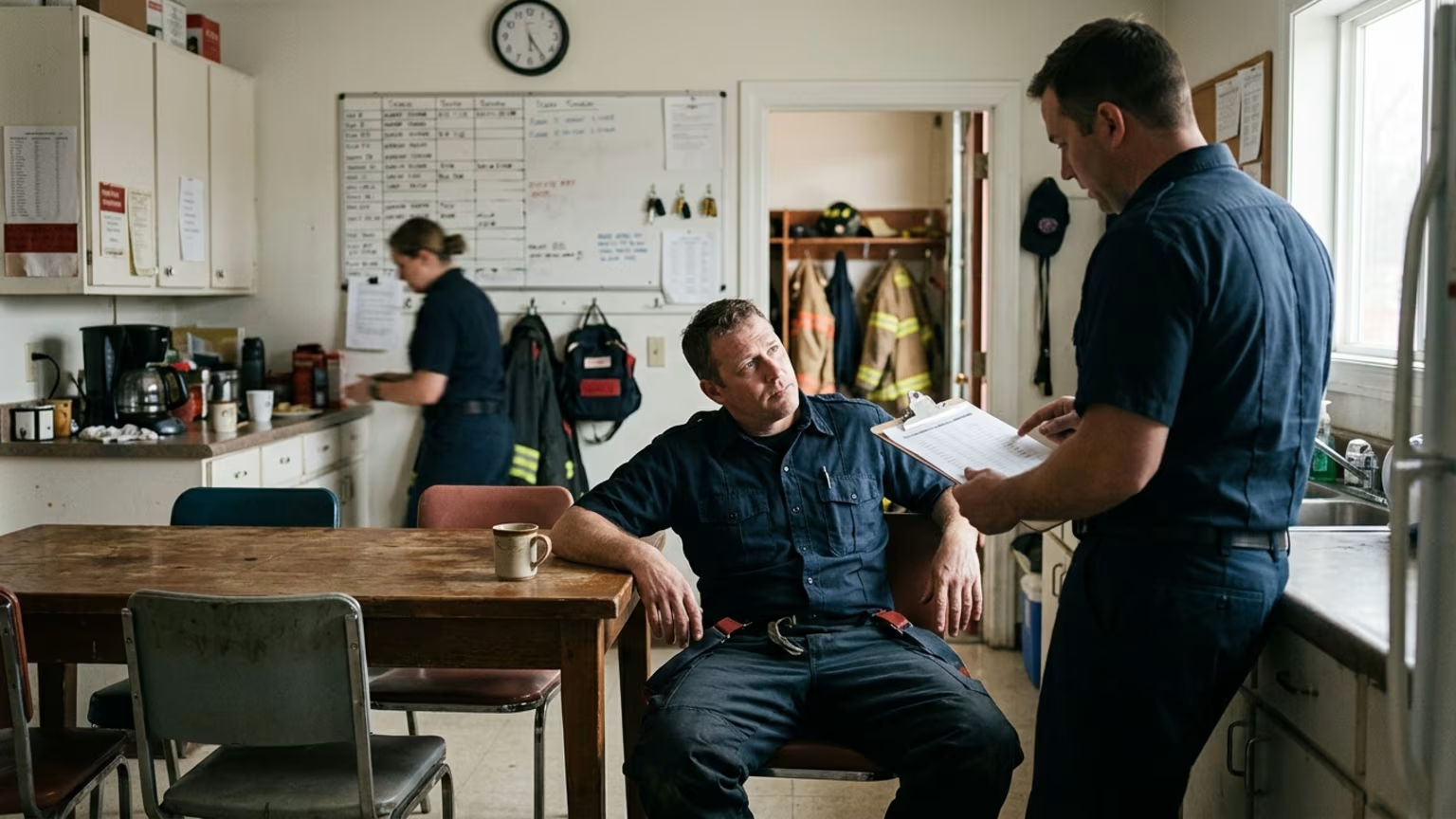

A recent scheduling article puts fatigue risk on the roster. We assess its recovery recommendations and the wider EMS guidance summarized by JEMS.





On October 17, 2026, OHSE.ca published “Fatigue Risk Management Strategies Start With Better Scheduling.” The article was updated on October 18, 2026. Its central recommendation is to address fatigue through roster design rather than expect workers to compensate after their opportunity to sleep has already been constrained.
The practitioner article identifies emergency response as a safety-sensitive setting. It recommends limiting consecutive night shifts and avoiding short turnarounds between duties. It also calls for tighter control of overtime and additional recovery time after intense workloads or emergency callouts.
For first responders, the useful question is operational: does the schedule leave a realistic opportunity to recover before the next duty period?
OHSE.ca makes a case for protecting sleep opportunity through scheduling. It does not report an emergency-service trial or evaluate a particular department’s roster. The publication is therefore a prompt to examine working arrangements rather than evidence that its exact recommendations have already reduced incidents in emergency services.
The broader EMS context comes from JEMS. In “Heroics: A Poor Substitute for Readiness,” JEMS describes fatigue as a “system-level safety hazard.” Its account of evidence-based EMS fatigue-risk guidance refers back to a 2018 publication, so that underlying guidance is not a new development.
JEMS reports that cited EMS research found the following associations among fatigued workers compared with non-fatigued workers:
These figures describe associations rather than proof that fatigue alone caused each outcome. They are also findings reported by JEMS rather than an independent assessment of the underlying studies here. Their value is in supporting attention to fatigue as a safety concern, not predicting an individual responder’s risk.
The scheduling thresholds also need clear boundaries. OHSE.ca’s advice to avoid turnarounds shorter than 10 to 12 hours is a recommendation rather than a universal legal requirement or proven safety cutoff. The sources do not establish a universally optimal roster or guarantee better health from any single scheduling change.
For first responder wellness, the article shifts attention from an ideal recovery routine to the time available to carry it out. OHSE.ca’s argument is that a roster can constrain rest before an individual makes any choices about sleep. That puts scheduling alongside personal habits in the discussion about readiness.
This distinction matters when nights, overtime and emergency callouts are treated as separate issues. The article asks schedulers to consider them as parts of the same recovery picture. A gap between duties should be examined in the context of the work surrounding it rather than treated as sufficient simply because it appears on a roster.
OHSE.ca also recommends accounting for commuting time. Time away from the workplace and time available for sleep are not interchangeable. A schedule review that considers travel is asking a more useful question than one that stops at the recorded end and start of duty.
That is an organizational concern rather than a judgement about a responder’s discipline. Raising a schedule-related loss of sleep opportunity can be a fitness-for-duty and safety discussion. Rescuris’s guidance on bringing recovery concerns into workplace conversations addresses that broader advocacy task.
For readers focused on maintaining physical capability across a career, the relevant starting point is the operational condition: whether duty leaves room for recovery. There is no need to turn the scheduling discussion into a medical promise to make it worth having.
OHSE.ca’s recommendations translate into several practical review questions for department leaders and schedulers. These are areas to examine rather than a ready-made protocol. The aim is to identify foreseeable pressure on sleep opportunity and determine where recovery arrangements can be improved.
The article recommends limiting consecutive night shifts. Its focus is not merely whether an individual shift appears manageable. The sequence of duties also belongs in the review.
A useful scheduling discussion therefore asks how night duties are grouped and what recovery follows them. The article does not supply a specific maximum number of consecutive nights. Departments would need to resolve that question within their own operational context rather than attach an unsupported number to the recommendation.
OHSE.ca recommends avoiding short intervals between shifts. Its additional point about commuting makes this more than a calculation between roster entries.
The operational question is whether the interval leaves a usable opportunity for recovery. Looking at the scheduled finish and next start is a beginning. Considering the travel attached to those duties makes the review more realistic.
For responders raising this concern, the schedule and commute provide concrete details for the conversation. The issue is the opportunity available between duties rather than whether someone should simply try harder to sleep.
The article calls for close control of overtime during demanding periods. That places additional duty within the fatigue review rather than outside it.
A review should therefore consider overtime alongside the underlying roster. Looking only at the planned pattern would leave out one of the pressures that OHSE.ca specifically identifies.
The practical question is how overtime changes the recovery opportunity the original schedule appeared to provide. This keeps the discussion focused on working arrangements without assuming that willingness to work additional hours settles the fatigue concern.
OHSE.ca recommends allowing additional recovery time after intense workloads or emergency callouts. That moves the review beyond the published roster to what actually happened during duty.
Emergency response involves unpredictable call volume. The practical task is to manage foreseeable fatigue risk and provide recovery where operationally feasible rather than promise uninterrupted rest after every callout.
A department-level discussion can ask what recovery arrangements exist after unusually demanding work and whether those arrangements can be used. This is a review question supported by the article’s recommendation, not a claim that any particular department has adopted such a process.
JEMS describes a broader agency-level approach than roster design alone. It summarizes five countermeasures from the EMS fatigue-risk guidance:
The shift-duration recommendation addresses a different issue from OHSE.ca’s proposed interval between shifts. One concerns the length of duty. The other concerns the opportunity to recover before returning. Keeping that distinction clear prevents separate recommendations from becoming an invented combined rule.
JEMS presents caffeine and naps as components of a broader approach rather than substitutes for adequate sleep opportunity or sound scheduling. These are agency-level considerations here, not individual dosing advice or a personal sleep prescription.
Taken together, the sources support examining the roster while also considering fatigue monitoring and protected rest opportunities. Education has a place in that approach. It should not become a reason to leave the scheduling questions unanswered.
The distinction is between helping workers manage fatigue and making workers solely responsible for it. JEMS’s system-level framing supports the former without reducing the issue to personal resilience. Rescuris’s analysis of workplace approaches to EMS fatigue provides related operational context.
The most useful follow-up questions are about implementation and outcomes. How often do planned recovery intervals remain available once overtime and callouts are included? Does a department’s fatigue review account for commuting? Can staff use the recovery arrangements described in its plans?
Evaluation would also need to distinguish changes in scheduling from changes in reported fatigue or safety outcomes. A revised roster is an operational change. Whether that change delivers its intended result is a separate question requiring evidence.
The same distinction applies to the additional measures summarized by JEMS. Access to a countermeasure and the opportunity to use it are different matters. Examining both would make a review more informative than simply recording whether a measure appears in policy.
For now, OHSE.ca’s article offers a clear starting point: examine the work pattern before placing the full burden of recovery on the worker. The continuing question is whether the recovery time shown on a roster becomes recovery time that responders can actually use.
A roster review has to account for rest that duty can interrupt; Rescuris carries that question into research-led coverage of shift-work sleep. For emergency-service professionals dealing with nights, overtime and unpredictable calls, its editorial guidance connects evidence-aware recovery options with long-term health rather than short-term performance alone.
Rescuris publishes evidence-aware guidance for firefighters, police officers, paramedics and other first responders on fitness, recovery, sleep, nutrition, stress resilience and long-term capability.





Read practical guidance on first responder fitness, recovery, sleep, nutrition and resilience for demanding work and a long, active career.
read the blog
