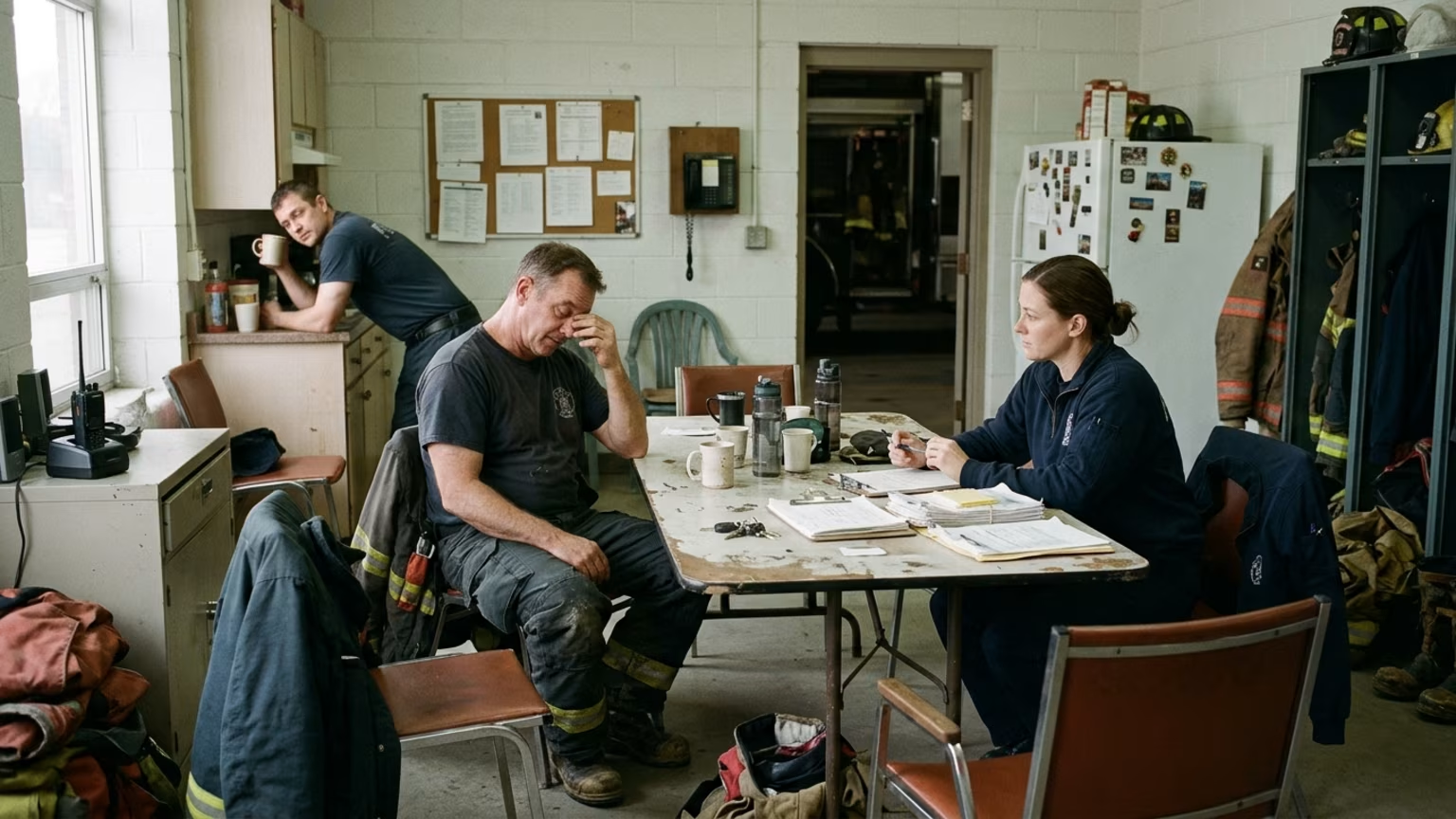

The FBU wildfire survey raises questions about welfare access and fatigue rules. Read the findings, evidence limits and implications for responder recovery.





On October 21, 2026, the Fire Brigades Union (FBU) published survey findings that placed welfare access and fatigue management firmly within the wildfire preparedness debate. The union reported 2,218 responses from its members. Respondents included wholetime firefighters, retained duty system (RDS) personnel and control-room staff.
In the FBU survey, 84% of respondents supported legal requirements for proper welfare and fatigue management at wildfire scenes. That result raises a concrete operational question: should arrangements for welfare and rest be planned safety provisions rather than conditions responders have to hope will be available?
According to the FBU’s published survey account, 50% of respondents considered welfare facilities during wildfire deployment insufficient. Only 7% described them as fully adequate. Those descriptions concern the adequacy of provision, not simply whether facilities existed.
Welfare was part of a wider set of concerns. The FBU reported that 69% of respondents felt significantly under-equipped, while 8% felt fully equipped. These findings place the call for fatigue management alongside concerns about the resources available to do the work.
The union also reported that 98% wanted increased funding for their local fire service after the summer’s wildfires. Meanwhile, 71% fully supported recruiting at least 5,000 more firefighters over the coming years. These were respondents’ views on funding and recruitment, not an independent calculation of the resources required.
FBU General Secretary Steve Wright argued that firefighters were being sent to wildfires without appropriate equipment, proper welfare facilities or enough colleagues to work safely. He called for a joined-up approach supported by national strategy, investment and recruitment. Those are the union leader’s characterisations and proposals.
Taken together, the findings present welfare as part of the deployment system. The editorial significance is not that respondents asked for a better personal recovery routine. They expressed support for formal requirements governing the conditions around wildfire work.
The BBC report, published on October 21, 2026, carried the headline “Firefighters 'knowingly put at risk' during summer wildfires”. That wording conveys the seriousness of the reported concerns. Assessing the survey still requires separating respondent experience from policy preference and demonstrated outcomes.
The FBU identifies the respondents and their broad roles but does not describe a probability sampling method or provide a response rate. The results therefore describe the participating members rather than a demonstrated representative sample of all UK firefighters. They should not be presented as workforce-wide prevalence estimates.
The published findings do not report sleep duration, fatigue-related incidents or tests of particular shift and rest schedules. They also do not establish that legal requirements have been enacted or specify the content of a proposed standard. Support for regulation is a survey finding, not proof that a particular requirement improves health or safety.
These boundaries give the findings a clear role. They document concerns among responding members and substantial support within that group for a legal approach. They provide a basis for asking more precise operational questions rather than selecting a tested fatigue-control programme.
For responder wellness, the useful distinction is between advice about recovery and the opportunity to recover. The FBU findings direct attention towards the second issue. The question becomes whether deployment arrangements make welfare usable during the work itself.
This matters to how fatigue is discussed. A response centred only on individual habits would leave the reported concerns about facilities and resources outside the conversation. The survey instead invites scrutiny of the conditions surrounding the responder, including whether basic welfare access has been accounted for in planning.
The control-room responses make that point particularly concrete. The FBU says some control-room members described unreasonable working hours and difficulty taking food breaks or using the bathroom during wildfire pressures. Their accounts put welfare questions beyond the fireground as well as at the incident scene.
That broader perspective is relevant when considering relief arrangements alongside recovery during prolonged deployments. Rest provision is not only a question of identifying a place or a nominal break. The operational discussion also needs to address whether people can actually step away from their responsibilities to use what has been provided.
For readers in police or ambulance services, the transferable question is about access and responsibility rather than the survey percentages. Who accounts for welfare when work continues beyond its expected window? Framing the issue this way keeps the discussion focused on working conditions rather than personal toughness.
An operational discussion should stay close to the problems respondents described. That means considering access to welfare alongside staffing and equipment rather than treating fatigue management as a separate message delivered to individuals. The following areas are questions for planning and review, not a prescribed shift protocol.
The distinction between providing a facility and making it accessible deserves attention. For a service reviewing its arrangements, the relevant question is whether people can use welfare provisions under the deployment’s actual conditions. Food breaks and bathroom access are concrete starting points because control-room respondents specifically raised them.
A review could ask where an arrangement exists on paper but becomes difficult to use during sustained demand. It could also distinguish concerns about the facility itself from concerns about being able to leave a role. These are different planning problems even when both appear under the broad heading of welfare.
This is a useful connection with an organisational approach to fatigue management. The focus remains on the work arrangements around recovery rather than assuming that advice alone resolves an access problem.
Wright’s account links welfare concerns with staffing and equipment. It is reasonable to discuss these subjects together while keeping their purposes distinct. Recruiting personnel or supplying equipment does not by itself define what proper welfare provision should include.
The practical planning question is how the proposed arrangements would work alongside the resources available to deliver them. Who would organise access? How would responsibilities be covered while personnel used the provision? These questions follow from the reported concerns without assuming a particular staffing formula or departmental policy.
Keeping the discussion connected also avoids reducing the issue to the responder’s behaviour. Rescuris’s coverage of work demands and recovery decisions offers a related editorial perspective: duty demands belong in the recovery conversation.
Including control-room personnel changes the scope of the conversation. A welfare discussion organised only around the incident location would not address every concern captured by the responses. Their reported difficulty taking basic breaks deserves attention in its own right.
An operational review could therefore keep the experiences of different roles visible rather than compressing them into a single account of wildfire duty. The questions asked of personnel at the scene may differ from those asked of staff sustaining the response elsewhere. Both groups should remain visible when interpreting this survey.
The next useful step is to make the proposed requirements specific enough to assess. “Proper welfare” communicates an objective, but an operational discussion needs a clear description of what would be provided and who would be accountable for delivery.
Several questions remain open:
A meaningful evaluation would connect a defined provision with an observable outcome. It could examine whether personnel were able to use planned welfare arrangements rather than recording only that those arrangements existed. Keeping different roles visible would help prevent a single overall result from obscuring distinct experiences.
The FBU survey gives this debate a clear starting point: responding members reported welfare concerns and supported a legal approach to fatigue management. The unresolved task is to turn that demand into clearly described arrangements whose delivery and effects can be assessed. That is where the discussion can move from concern towards accountable provision.
Deployment planners and crew supervisors face the daily task of considering wildfire welfare; Rescuris adds research-led editorial guidance on sleep and recovery. For emergency-service professionals facing nights and rotating shifts, its guidance helps assess recovery options around overtime and unpredictable calls without treating long-term health as secondary to duty fitness.
Rescuris publishes evidence-aware guidance for firefighters, police officers, paramedics and other first responders on fitness, recovery, sleep, nutrition, stress resilience and long-term capability.





Read practical guidance on first responder fitness, recovery, sleep, nutrition and resilience for demanding work and a long, active career.
read the blog
