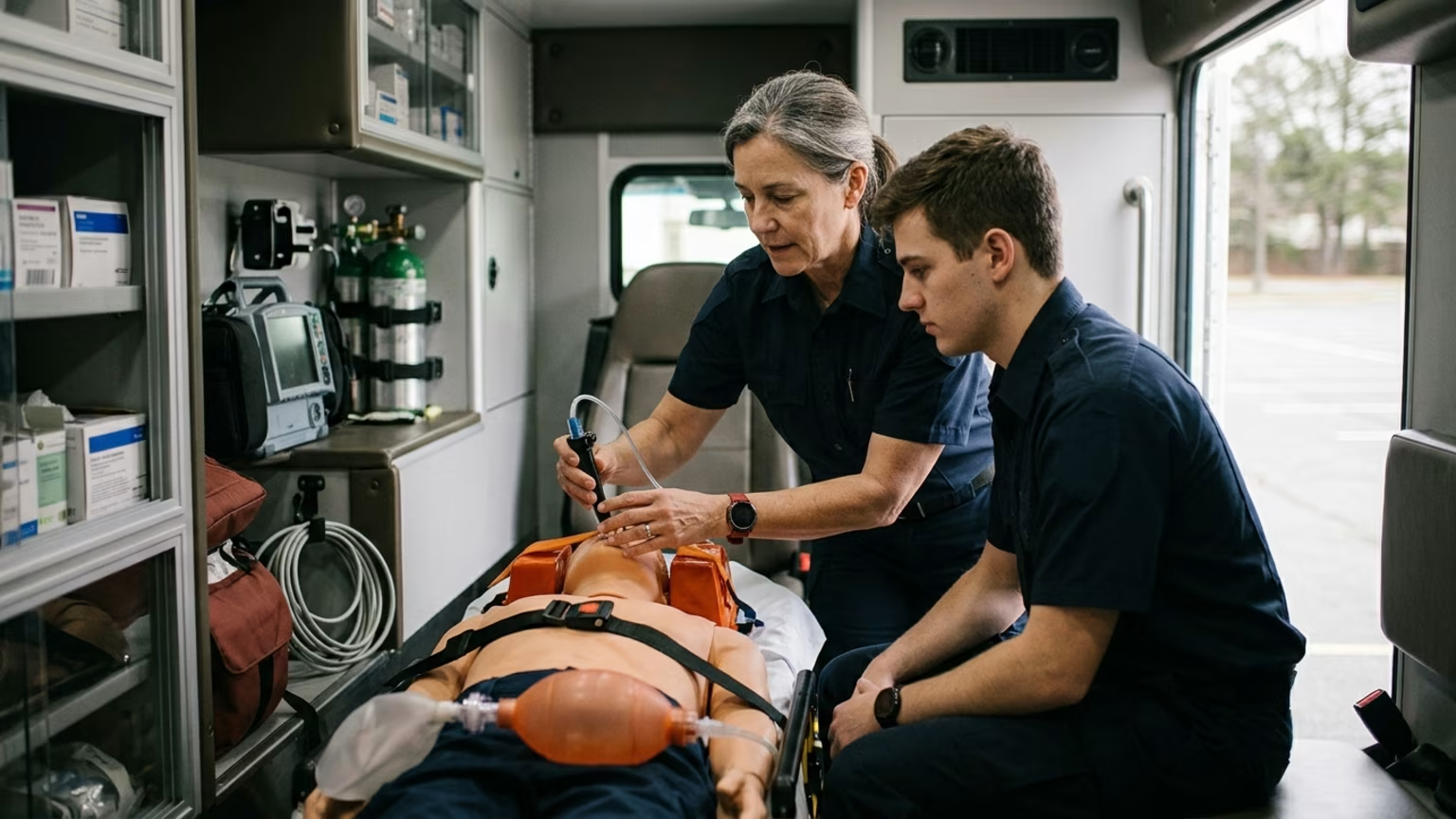

A recent profile shows how paramedics can extend their careers and manage physical fatigue by transitioning into clinical precepting and teaching roles.





On September 23, 2026, Luther College published a new article by Kate Frentzel detailing how one paramedic built a lasting career by moving into education. The piece profiles Ben Feldkamp and his progression from frontline medic to a faculty position at Inver Hills Community College in Minnesota. The profile outlines a practical pathway for emergency personnel to sustain engagement as they progress through their careers. It shows how transitioning into a teaching role can provide meaning long after the initial excitement of field responses fades.
The central takeaway from the new profile is that mentoring the next generation offers experienced paramedics a reliable source of professional purpose. Feldkamp began his journey studying biology on a pre-med track at Luther College. He then earned an EMT certification and subsequently completed a paramedic program at Inver Hills Community College. During his first few years in the field, he focused intently on learning to function in uncomfortable situations.
He quickly had to adapt to becoming the senior medical provider on complex calls while still feeling relatively new to the profession. This rapid immersion into high-stakes decision making is a common experience for emergency medical personnel. As those initial years passed, the daily reality of paramedicine shifted dramatically for him. Feldkamp noted that the appeal of novelty can fade after emergency providers have seen similar situations many times over.
Paramedicine intrinsically combines elements of public service and direct healthcare delivery. Feldkamp noted that the specific field situation often determines which of these aspects is most prominent on any given call. Navigating this dynamic environment requires intense focus and rapid skill acquisition during the early stages of a career. Once those skills are mastered, the lack of a clear upward trajectory can leave many capable providers feeling stagnant.
This occupational reality prompts a difficult question about how to build a meaningful long-term career in a high-stress environment. The profile quotes Feldkamp recalling an unidentified study that placed the average paramedic career at just four to five years. While this specific figure lacks formal citation in the profile, it reflects a real concern regarding provider longevity. To extend his own time in the profession, he turned toward overseeing students and found profound new motivation.
Feldkamp initially transitioned from medic to preceptor to supervise students during their clinical on-the-job training. He found that precepting sparked his deep interest in explaining complex concepts and watching new providers learn. He wanted not only to teach but to become a highly effective educator for incoming professionals. When a faculty position eventually opened at Inver Hills Community College, he moved into formal academia.
Moving into an educator role directly alters a first responder's daily operational exposure and physical recovery cycle. Full-time field work requires constant occupational alertness and exacts a heavy physical toll on the body. Transitioning to a teaching role can help mitigate this strain while keeping seasoned personnel actively engaged in the profession. The profile notes that Feldkamp did not leave the field entirely to pursue education.
He continues to work several EMS shifts each month alongside his teaching responsibilities. This blended approach offers a practical way to manage the intense physical demands of emergency medical services over time. By reducing total field hours, paramedics can better manage chronic sleep disruption and the physical wear of irregular shifts. Agencies looking to retain experienced personnel might view partial teaching roles as a highly effective tool for extending career longevity.
Maintaining some active clinical shifts means educators keep their practical medical skills sharp. It also allows them to bring current field realities directly back into their classrooms for students. This structural change provides a much more predictable schedule for the veteran provider. Rotating shifts and unpredictable overnight calls make consistent physical recovery very difficult for aging responders.
A scheduled teaching position offers a stable routine that supports better long-term health and physical stress management. Personnel can use this newly found stability to implement a robust long term cardiovascular health program. Furthermore, a predictable academic schedule allows responders to better manage their nutritional intake. Providers can establish a consistent shift nutrition framework to prevent the metabolic strain associated with erratic meal timing.
Adjusting to a hybrid role also forces a reevaluation of daily physical readiness standards. When a provider spends fewer days wearing heavy gear or lifting patients, their baseline strength requirements change. They must intentionally program gym sessions to maintain job capacity for their remaining emergency shifts. Utilizing a targeted occupational training regimen helps them retain the critical physical conditioning required for active field duty.
The traditional narrative surrounding emergency medical services often treats the profession as a young person's temporary game. Many providers assume that once the excitement of running calls diminishes, the only viable option is to leave the field completely. Feldkamp’s specific career trajectory challenges this binary thinking entirely. His experience suggests that the loss of novelty does not have to equal total burnout.
Instead, this natural loss of excitement can serve as a transition point toward leadership and instruction. Early-career providers are typically drawn to the excitement and unpredictability of chaotic emergency responses. As field situations become increasingly routine, that original source of motivation naturally declines. The profile illustrates that teaching provides a completely different intellectual challenge to replace that fading novelty.
The focus shifts from executing a flawless medical intervention to helping a student understand the underlying mechanics of a call. This requires a different type of mental engagement that can be deeply rewarding for experienced medics. Furthermore, the profile challenges the idea that being a good medic automatically makes someone a good teacher. Feldkamp explicitly noted his intense desire to learn how to be a good educator.
The emphasis on constant action also obscures the tremendous value of accumulated clinical wisdom. Seasoned paramedics possess a deep understanding of scene management that cannot be fully captured in textbooks. By moving into education, these veterans can systematically pass down this nuanced operational knowledge. This transfer of experience improves the standard of care for the entire community while validating the veteran's career.
This important distinction is critical for departments attempting to build out their internal training programs. Precepting requires incredible patience, strong verbal communication skills, and the ability to break down complex medical procedures. Acknowledging teaching as a separate professional discipline encourages medics to pursue deliberate professional development. It validates the idea that mastering education is a distinct, respectable career phase.
Paramedics approaching the mid-career phase can begin making actionable adjustments to evaluate their actual interest in teaching. The first step is to seek out informal mentoring opportunities within their current department or agency. Seasoned providers can volunteer to review run reports with newer colleagues or offer guidance during quiet station downtime. These small interactions help individuals accurately gauge their own patience and aptitude for explaining clinical concepts.
It also provides immediate value to the agency without requiring a formal operational role change. If these informal experiences are positive, medics can then volunteer to become official field preceptors. Overseeing a student's live on-the-job experience is the most direct way to test a transition into clinical education. Preceptors must learn to balance immediate patient care with active instruction in real time.
This dual responsibility forces experienced providers to articulate the clinical reasoning behind their split-second actions. It serves as an excellent proving ground for anyone considering a future faculty position at a training institution. Departments and training programs should simultaneously assess their local capacity to support these professional development pathways. Command staff must recognize that mentoring is not a universal solution for every fatigued or burned-out employee.
Agencies should identify personnel who genuinely want to teach and provide them with the necessary structural support. This might include adjusting shift schedules to safely accommodate proper low fatigue maintenance sessions for the preceptors. It could also involve offering dedicated administrative time for preceptors to complete mandatory student evaluations. Proper resource allocation helps both the supervising preceptor and the student succeed in the field.
While Feldkamp’s individual profile offers a compelling pathway, the broader emergency services sector requires more structured analysis. Future industry studies should track whether formal mentoring programs measurably reduce employee turnover across different regional agencies. Researchers need to look beyond personal satisfaction to evaluate the physical impacts of blended field and teaching roles. It remains unclear if reducing field hours to teach directly improves objective sleep quality or cardiovascular health.
Additionally, the profession must rigorously examine how to support educators who maintain part-time active clinical shifts. Balancing academic responsibilities with active emergency response requires specific scheduling protocols to prevent a new form of burnout. It requires understanding when to modify a training workload versus when to focus entirely on shift work sleep risks. Tracking these physiological outcomes will help departments design better, evidence-based long-term retention frameworks.
Readers must avoid treating a search for professional meaning as a complete substitute for addressing serious occupational health needs. A renewed sense of purpose does not magically erase the physical toll of chronic sleep deprivation or joint wear. Until broader data becomes available, the transition from medic to preceptor remains a highly personal career choice. However, it currently serves as one proven option for professionals seeking to build a sustainable legacy in emergency medicine.
Shifting from full-time field response to clinical mentorship alters a provider's daily physical recovery window, and Rescuris delivers practical guidance to support those changing operational constraints. Understanding testosterone and hormone claims without assuming testing or treatment is right for everyone frequently challenges emergency personnel as they attempt to extend their career longevity, but our research-led analysis helps readers successfully plan for physical capability after years of shift work.
Rescuris publishes evidence-aware guidance for firefighters, police officers, paramedics and other first responders on fitness, recovery, sleep, nutrition, stress resilience and long-term capability.






Read practical guidance on first responder fitness, recovery, sleep, nutrition and resilience for demanding work and a long, active career.
read the blog
