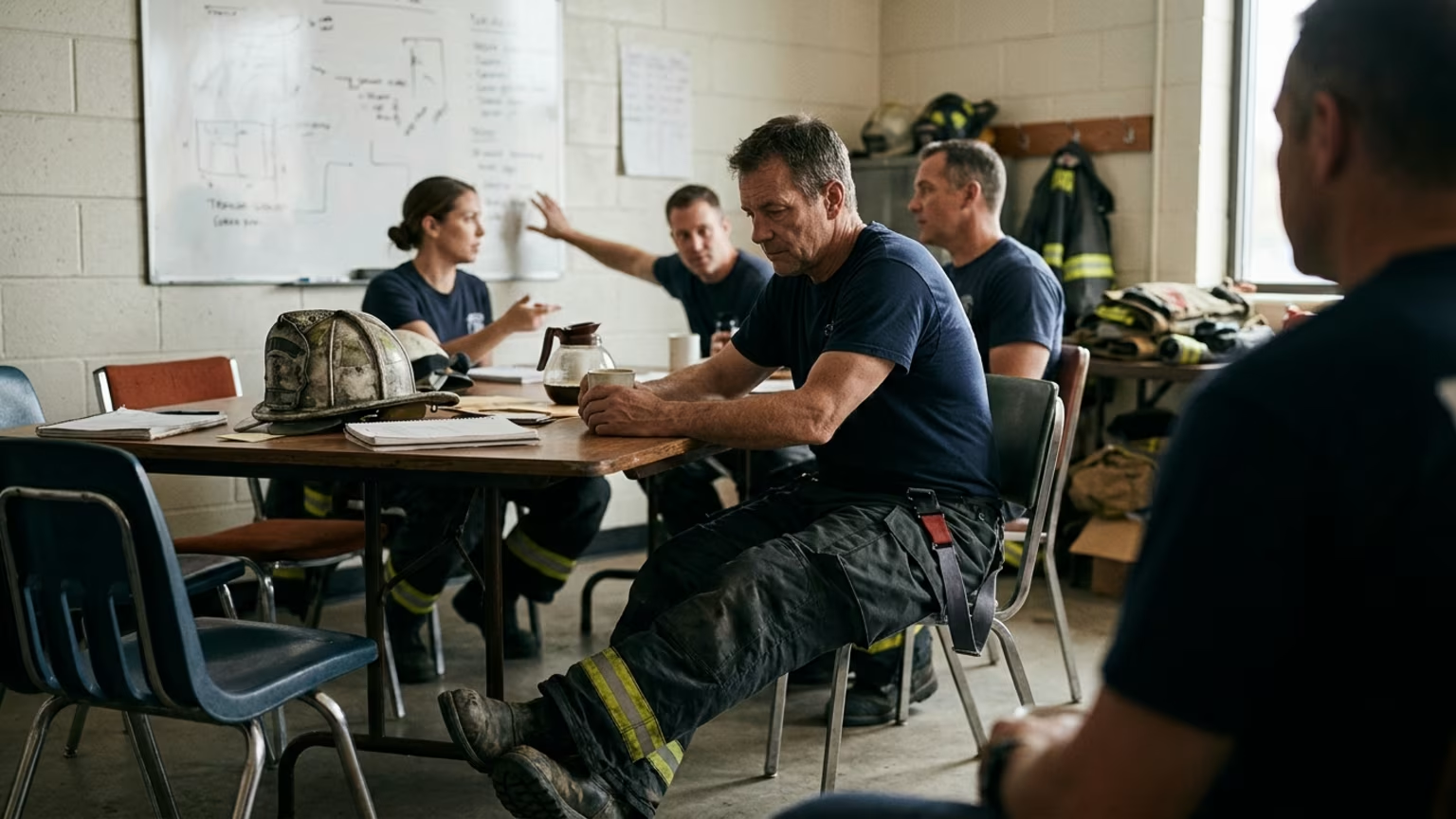

An evidence-led look at CRACKYL’s competence argument, after-action reviews and the distinction between operational learning and mental-health care.





On October 23, 2026, CRACKYL Magazine published Jacob Ryks’s opinion article “Harder to Hurt: Combating PTSD with Fire Service Competency.” Ryks is a firefighter, HazMat specialist and instructor. He argues that preparation can build confidence and that candid reviews after calls can help departments identify training needs.
The article places operational learning inside a discussion about mental resilience. For first responders, the useful question is how to apply that argument without turning confidence into another performance standard people must meet after a difficult incident. That requires separating the author’s perspective from the wider intervention evidence.
Ryks’s central formulation is that “competence builds confidence.” He connects preparation before an incident with reflection afterward. In his account, accountability means identifying mistakes and areas for improvement so that departments can turn those findings into training.
Tailboard discussions and after-action reviews are part of that proposal. Their role is to make an operational problem specific enough to address. Rather than leaving personnel with a broad instruction to become more resilient, the argument directs attention toward what can be learned and practised.
Ryks also draws on personal experience. He writes that he spent 38 days at the IAFF Center of Excellence in summer 2025. He explicitly acknowledges that this experience is not formal mental-health education. His perspective should therefore be read as a practitioner’s argument informed partly by his own experience.
The useful operational proposition is narrower than the article’s PTSD-focused title might suggest: preparation and reflection may give firefighters a clearer basis for confidence in their work. Ryks also acknowledges that not every chaotic or tragic event can be prepared for. His proposal leaves room for learning without claiming complete control over an incident.
The CRACKYL article is not a clinical trial or a validated PTSD-prevention intervention. It supports reporting Ryks’s view about competence and confidence. It does not demonstrate that operational training or a particular after-action-review format prevents PTSD or improves mental-health outcomes.
A fire-service study published in the Journal of Traumatic Stress provides a separate piece of evidence. Researchers examined TRiM training for peer supporters in risk assessment and referral. They reported short-term improvements in participants’ self-reported capability and related knowledge. Formal use of the procedure remained minimal at follow-up.
Those findings concern different outcomes from Ryks’s argument. Feeling more capable after peer-support training is not the same finding as showing improved mental health among the people receiving support. Limited subsequent use also raises an implementation question: completing training and putting a formal process into practice are separate achievements.
A 2026 systematic review of interventions for emergency call handlers found a limited and heterogeneous evidence base. That means the evidence varied across the interventions examined. Its call-handler focus also deserves attention when applying the discussion to firefighters or other frontline personnel.
Taken together, these sources support a careful distinction between practitioner reasoning, perceived skills and demonstrated health outcomes. They offer reasons to examine preparation and support processes seriously. They do not establish one settled resilience solution for emergency services.
For work shaped by unpredictable calls and demanding conditions, the attraction of Ryks’s argument is its focus on something concrete. A training need can become a subject for operational learning. That is a different conversation from telling personnel that they simply need a stronger mindset.
The distinction matters because accountability can be interpreted in different ways. Ryks explicitly says his proposal is not intended to blame people who are struggling. That qualification should remain attached to his argument rather than disappearing when it is reduced to a slogan about competence.
An editorial reading of his proposal should keep the object of scrutiny clear: the operational issue under discussion. The question is what preparation or practice might address that issue. Distress should not become evidence that someone failed to train adequately. Nor should a tragic outcome serve as a shortcut for judging an individual’s effort.
This is also relevant to making decisions amid operational uncertainty. A review can examine decisions without pretending that every outcome was controllable. The aim should be to identify a useful learning opportunity rather than produce a reassuring explanation for everything that happened.
For those responsible for crew wellbeing, this creates two legitimate areas of attention: operational development and individual health. Neither needs to compete with the other. A person can have something to learn from a call and also have a separate reason to seek professional support.
The narrow practical use supported by Ryks’s article is to identify skills or process gaps and connect them with future training. His proposal does not require treating every difficult call as evidence of a training failure. It asks departments to examine what happened and identify where preparation could improve.
An editorial translation of that argument has three parts:
These are principles for interpreting the article, not a prescribed department protocol. The sources do not supply a tested review format to reproduce. The practical emphasis is on a clear connection between an identified issue and an appropriate training response.
Terminology also needs care. In this context, an operational review means examining performance for learning purposes. It should not be presented as psychological treatment merely because the incident was distressing. Calling two activities a “debrief” does not make their purposes interchangeable.
That boundary belongs in discussions of bringing stress awareness into officer development. Leaders considering the competence argument need language that permits honest operational discussion without requiring them to make clinical judgments about personnel. A review can identify a training issue without settling a health question.
For personal concerns, assessment and care decisions belong with a qualified mental-health professional. Extra drills should not become an admission requirement for that conversation. Readers who have left active duty may also find value in planning how to work with a clinician after service.
The TRiM findings add a useful operational question to this discussion: what happens after people complete training? For any proposed support process, a department’s assessment should distinguish having trained personnel from having a process that personnel actually use. That is an implementation issue to examine rather than a result to assume.
The central open question is whether the confidence described in Ryks’s argument translates into meaningful benefits after difficult incidents. How would that confidence be assessed? Does it persist over time? Which outcomes would show that operational learning helped beyond improving a person’s immediate view of their own preparation?
The review process itself also needs scrutiny. Which approaches help personnel identify mistakes while keeping the discussion developmental? How do participants describe the experience compared with those leading it? A useful evaluation would distinguish an improvement in operational skills from a change in wellbeing rather than treating either as proof of the other.
Implementation deserves equal attention. The fire-service TRiM study makes actual use a relevant question for support initiatives. Further assessment should ask how operational learning connects with access to support and whether those connections work in practice. Those are questions about delivery as well as the content of training.
The most informative follow-up would show what happened after a review: what changed in preparation, whether support processes were used and how personnel assessed the experience. That would move the discussion beyond an appealing argument toward evidence about what departments and their people gained.
Choosing how to act on a training review is an operational decision; Rescuris places that choice beside recovery needs and lasting physical capability. Its research-led editorial coverage helps emergency-service professionals assess conflicting performance advice with long-term health in view, without treating toughness as a health standard or assuming that more training answers every recovery question.
Rescuris publishes evidence-aware guidance for firefighters, police officers, paramedics and other first responders on fitness, recovery, sleep, nutrition, stress resilience and long-term capability.






Read practical guidance on first responder fitness, recovery, sleep, nutrition and resilience for demanding work and a long, active career.
read the blog
