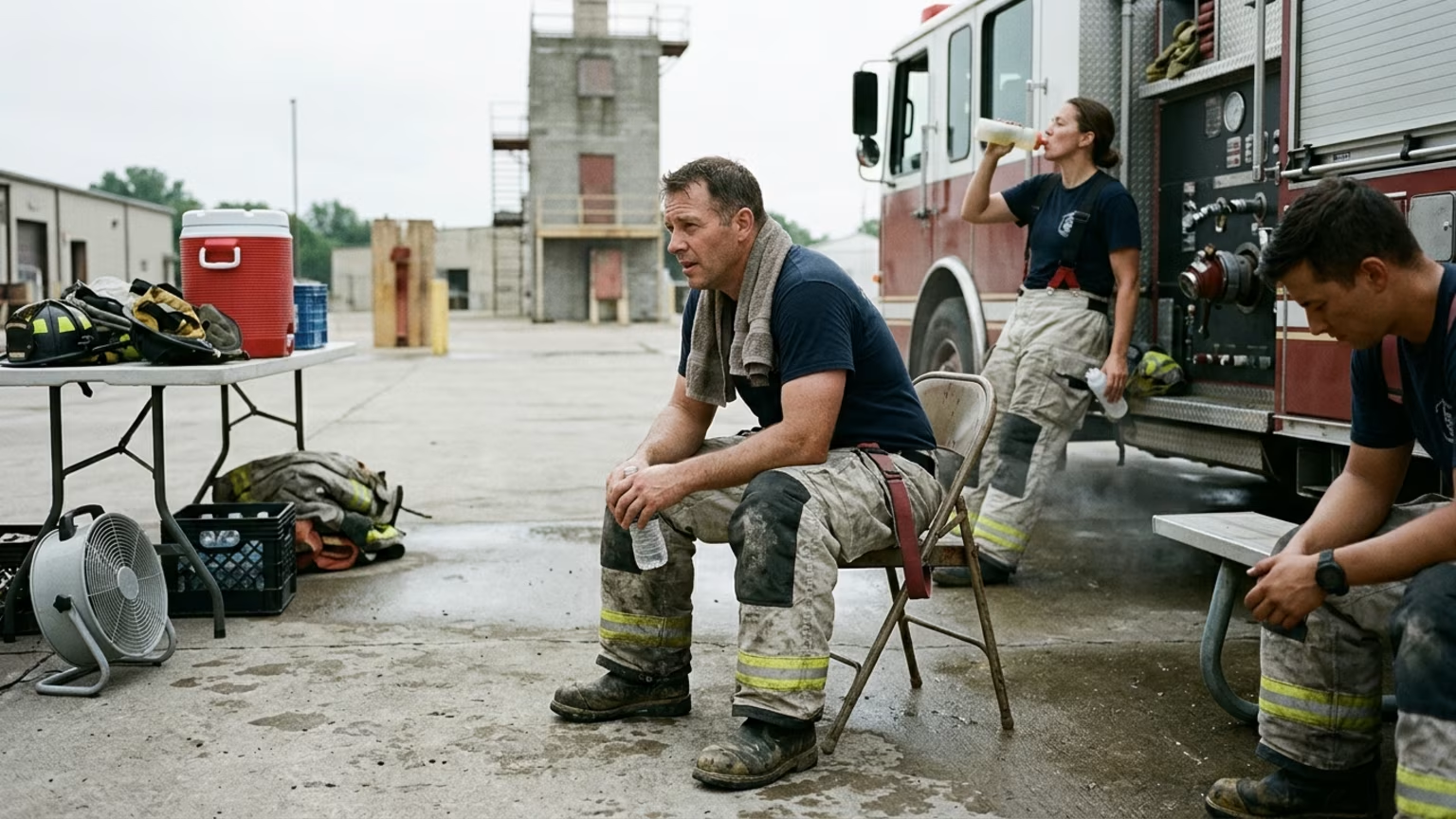

A Firefighter Nation account and a shipboard simulation put training intensity, disrupted sleep and recovery capacity in context.





On October 19, 2026, Firefighter Nation published “The Tank Was Never Empty” by Paul Shoemaker. Identified in the article as a lieutenant with Aurora (Colorado) Fire Rescue, he describes reconsidering years of frequent exercise alongside limited sleep and other demands. His argument is that training intensity should reflect the recovery available.
That is a useful question for a workforce whose training has to coexist with unpredictable calls and interrupted sleep. The article’s relevance is not that it supplies a better way to work harder. It asks whether hard training is serving its purpose when recovery is already under pressure.
Shoemaker writes that he had served in the fire service for just under 20 years. He sometimes trained twice a day, including on shift. At times he slept “two hours, if that” after work, training and calls.
The change he describes is not abandoning fitness. It is replacing the assumption that more exercise is automatically beneficial with a plan that accounts for recovery. His clearest line is: “If recovery isn’t there, intensity isn’t either.”
Shoemaker also points to sleep, consistent nutrition and stress management. In his account, these belong beside training rather than outside the discussion of performance. The “tank” in the title is a metaphor for accumulated demands, not a clinical measurement of readiness.
This is practitioner testimony. The article provides no measured training outcomes, statistical analysis or formal training prescription. Its recommendations describe his experience and priorities rather than a demonstrated result from a tested program.
Shoemaker also reports a diagnosis of non-Hodgkin’s lymphoma. His account does not establish that training volume, inadequate recovery or a particular occupational exposure caused his cancer. That distinction keeps his medical history from becoming an unsupported warning about exercise.
A separate report adds a measured performance finding to this discussion. On October 15, 2026, the Chartered Institute of Ergonomics & Human Factors (CIEHF) published “Fighting fires and fatigue.” It summarised a laboratory-based shipboard firefighting simulation comparing participants who had been fatigued by prior exercise with rested participants.
According to CIEHF:
CIEHF also reports lower peak-strength results in the fatigued groups. Its account describes added perceived and physiological strain when heat was involved.
This pairing matters because the comparison was between rested participants and groups fatigued before the task. The finding concerns the cost of arriving at that task already fatigued. It is not a comparison between people who train regularly and people who do not.
The setting matters. These are findings from a shipboard simulation, not expected delays for structural firefighters or other emergency-service roles. CIEHF also notes the difficulty of predicting shipboard call timing.
Read together, the reports support considering physical preparation and immediate fatigue in the same discussion. CIEHF describes exercise as part of preparing emergency crews for firefighting’s physical and mental load. The point is not to present exercise itself as harmful.
For a firefighter, that creates a planning tension: training matters but so does the condition in which demanding duty begins. For police officers and ambulance personnel, the useful connection is the planning question rather than the firefighting task itself.
Shoemaker’s account suggests keeping sleep, duty demands and life stress visible when considering intensity. This frames the issue around physical capability across a career rather than making completion of a hard session the only goal.
Sleep is especially visible in Shoemaker’s reflection because he describes training while anticipating that rest would be disrupted. His story moves that foreseeable disruption into the planning discussion instead of treating it as something unrelated to the workout. For a responder weighing training around duty, this makes the question broader than motivation: what demands are already present, and what opportunity exists to recover from the planned effort?
The useful question is whether the training plan acknowledges the work and recovery surrounding it.
The assumption under challenge is Shoemaker’s own: more training must mean better preparation. His change of course shifts attention from how much exercise he can fit in to what that exercise is meant to achieve.
That is different from replacing one rigid rule with another. A blanket commitment to less training would miss the same issue as a blanket commitment to more. Neither tells a responder whether the planned workload fits its purpose and the recovery available.
A purpose-driven plan also makes sleep and stress harder to dismiss as separate wellness topics. In Shoemaker’s framing they are part of the training conversation. That is a useful change in focus without making recovery a test of discipline or personal toughness.
The practical contribution is a set of questions to bring into training planning. Drawn from Shoemaker’s priorities, they focus on context rather than a target number:
These questions connect with fitting training around irregular shifts. They keep the work schedule in view instead of assuming that every planned session will be followed by predictable recovery.
They also connect with protecting recovery over a demanding career. A discussion that includes pressures outside the gym is closer to Shoemaker’s account than one that treats the workout as an isolated event.
Personal medical questions belong with a qualified clinician or occupational health professional. A qualified coach can discuss training goals and workload without replacing that care.
The unresolved issue is how to turn a sound planning principle into an approach that produces reliable results. Which signs of recovery should guide decisions? How should interrupted sleep and unpredictable duty be weighed against a training goal?
CIEHF reports that the study authors suggested rotational duty cycles, mandatory recovery periods and fitness/recovery monitoring. The intervention evidence presented here is limited: those suggestions are not shown to be validated solutions across fire services or emergency-service settings.
That leaves organisational questions as well as training questions. How would a proposed approach work when call timing is uncertain? Could a recovery period be delivered consistently within the setting where it was being considered?
Another gap sits between measuring fatigue and acting on it. A proposed monitoring system might identify a demanding period without showing which training adjustment would help. Evidence that monitoring changes a score would also need to be separated from evidence that it preserves meaningful task performance. The question is not only whether more information can be collected but whether that information leads to a useful decision.
For active and retired responders, the longer-term question is just as practical: can recovery-informed training support sustained capability across changing roles and life after service?
Weighing a hard workout against an interrupted night is a training decision; Rescuris brings research-led context to the sleep and recovery questions around it. For emergency-service professionals working nights or unpredictable schedules, its editorial coverage connects duty fitness with shift-work sleep so readers can assess conflicting advice without making short-term performance the only priority.
Rescuris publishes evidence-aware guidance for firefighters, police officers, paramedics and other first responders on fitness, recovery, sleep, nutrition, stress resilience and long-term capability.





Read practical guidance on first responder fitness, recovery, sleep, nutrition and resilience for demanding work and a long, active career.
read the blog
