
A function-first injury-management framework for first responders, covering symptom tracking, load changes, occupational assessment and job-specific recovery.





The useful starting point is cumulative exposure rather than blame for one difficult lift. The research describes responders repeatedly combining external loads with awkward positions and equipment handling. Protective equipment and long shifts add further demands. Incomplete recovery belongs in that same workload picture.
NIOSH's safe patient handling and mobility guidance provides the strongest institutional foundation for managing musculoskeletal risk. It directs attention toward workplace policies and procedures rather than relying only on individual effort. For patient-handling work, the relevant question is how the task is organized as well as how the worker performs it.
The NFPA's firefighter fatality reporting concerns deaths, not the frequency of ordinary shoulder, back or other musculoskeletal injuries. Its overexertion or strain category includes fatal heart attacks and other medical events. The NFPA also revised its 2024 fatality total when further records became available. These figures are therefore inappropriate as estimates of chronic pain prevalence or career-ending injury risk.
That distinction matters because a fatality category cannot establish how likely a recurring shoulder ache is to become disabling. The editorial lesson is narrower: physical stress deserves serious occupational attention. It is not a basis for assigning a prognosis to an individual symptom.
NFPA 1550 brings emergency-responder occupational safety and health requirements together across multiple service settings. Its scope includes fire and rescue alongside EMS and other emergency operations. That supports a department-level approach to health management rather than treating every injury concern as a private fitness problem.
These findings do not establish an autonomic nervous-system mechanism or a stress-hormone effect. The useful nervous-system discussion is narrower: sleep and stress belong in symptom monitoring, while changes in coordination or neurological function require clinical attention. An occupational statistic should not become a biological diagnosis.
Recurring discomfort does not automatically mean progressive tissue damage. Symptoms can fluctuate with workload, sleep and stress. Equipment and recovery can also influence the pattern. The practical question is whether that pattern is changing what the responder can reliably do.
A change in stride may matter during stair work. Reduced grip or restricted movement may alter carrying and patient handling. Difficulty kneeling or getting up from the floor may affect another set of duties. These observations connect symptoms to daily capacity without requiring the responder to guess which tissue is responsible.
Monitoring should therefore include movement quality and next-shift function, not just how uncomfortable a training session felt. A responder who completes a task through compensation has provided different information from one who completes it comfortably and reliably. For the broader planning context, tracking fatigue alongside fitness keeps capability and recovery in the same conversation.
The LIFE Study stands for Longitudinal Inquiry into Fire and EMS Health. According to the National Registry of Emergency Medical Technicians, it will follow firefighters and EMS clinicians to investigate occupational exposures and injuries alongside stress and other health outcomes. Its purpose is to examine how these risks accumulate and intersect across careers.
The study's launch does not yet provide outcome data or identify which injuries will limit a career. Its value at this stage is the longitudinal question it asks. A symptom that returns across shifts deserves a timeline, not just an isolated description of the latest uncomfortable workout.
The research-supported planning framework starts with changes in movement and task capacity. An ache receives closer attention when it alters lifting mechanics or confidence under load. Restriction and compensation are more useful observations than a vague description of feeling worn out.
A shift-level review can document:
These observations are for monitoring rather than diagnosis. New neurological symptoms or major trauma warrant urgent medical evaluation. So do deformity, rapidly increasing swelling or loss of bowel or bladder control. Chest pain, severe shortness of breath or fainting also require urgent medical evaluation rather than a training adjustment.
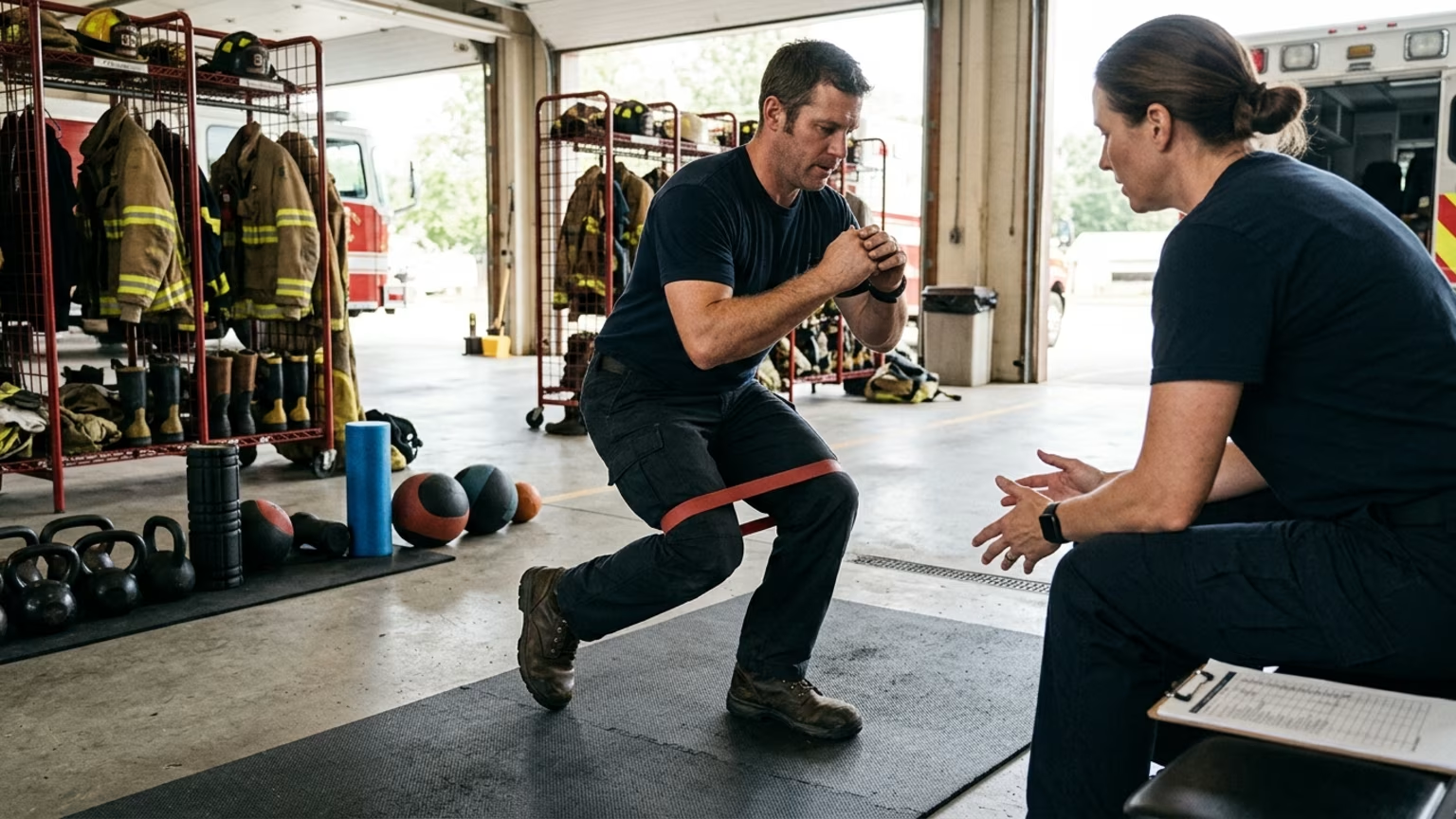
The framework favors reducing the aggravating exposure while preserving tolerable movement. That differs from repeatedly testing the same painful pattern at full intensity. It also differs from assuming that all activity must stop indefinitely.
Training modifications described in the research include:
These are categories of modification, not a personal rehabilitation prescription. The appropriate choice depends on the symptom and the task. A planned return to tolerable movement is a different behavior from ignoring a worsening pattern because the session remains technically possible.
NIOSH's guidance makes the task environment part of the response. For patient handling, workplace review can consider mechanical aids and how lifting is organized. The research framework also identifies team lifting and changes to a load's height or position as options where operations permit.
Other options include rotating demanding tasks and reviewing equipment configuration. These decisions must fit the operational setting rather than become an improvised personal workaround. NFPA 1550's broad occupational-health scope supports keeping the organization involved when symptoms affect safe task performance.
Workload discussions also belong within boundaries that protect recovery capacity. The purpose is to address the exposure rather than judge whether a responder is willing to tolerate it.
A short symptom log gives recurring problems a usable timeline. The research framework proposes recording observations across several shifts or training sessions rather than relying on memory during an appointment.
Useful entries include:
The log is not a self-diagnosis tool. Its purpose is to give an occupational-health clinician or rehabilitation professional more information than “it hurts sometimes.” Recording next-shift function also keeps duty performance visible alongside the immediate training response.
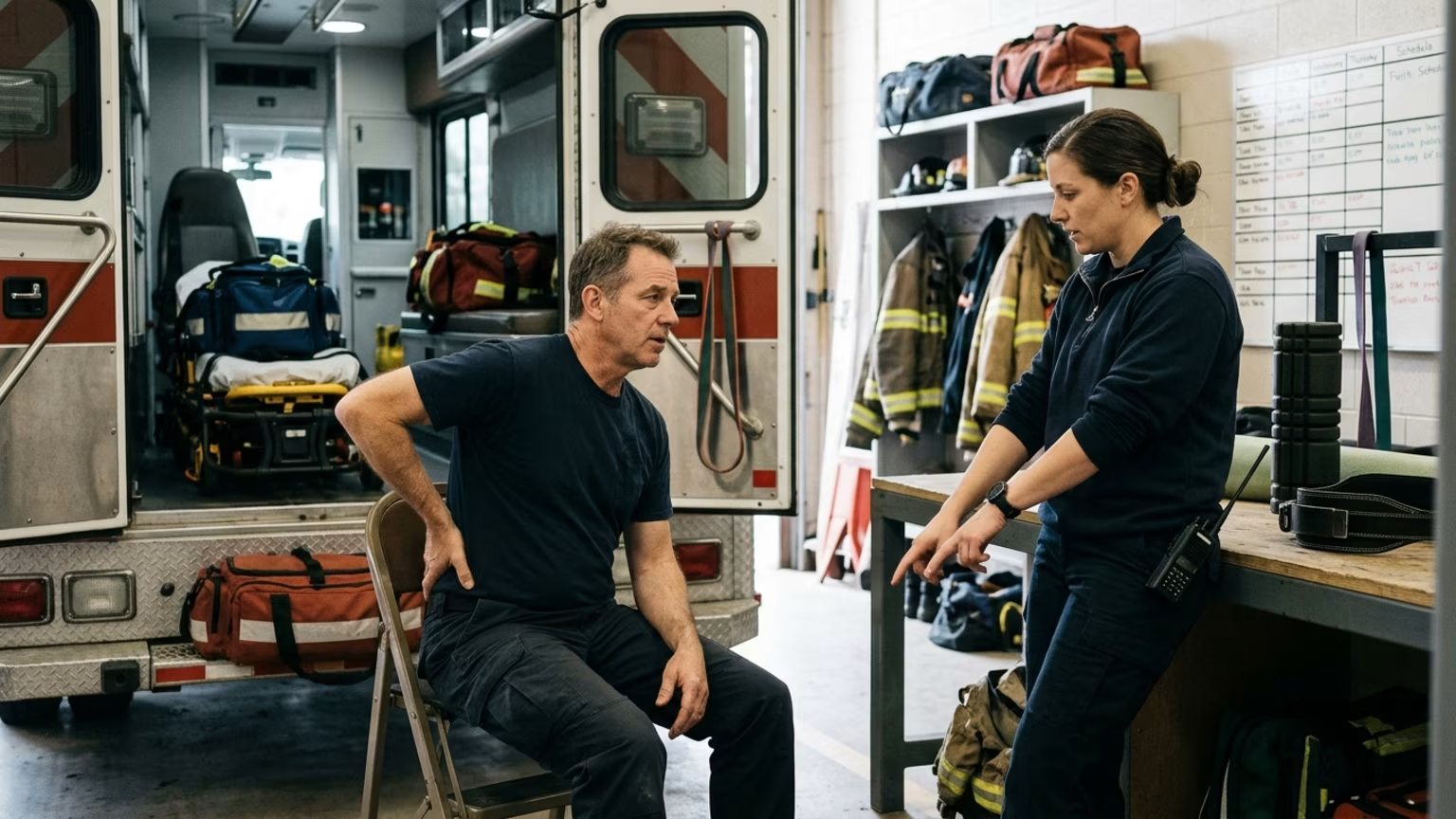
Assessment becomes appropriate when symptoms persist or repeatedly return with the same duty. Progressive restriction and compensation also matter. Sleep disturbance or reduced work capacity are further reasons to seek assessment, as is failure to improve after sensible modification.
A job-relevant assessment should consider the actual demands of the role. That includes equipment configuration and PPE alongside shift patterns. Patient handling and driving or sitting exposure may also matter. The specific tasks that must be performed safely should remain central.
A qualified clinician determines whether imaging or medication is indicated. Formal rehabilitation and work restrictions are also clinical decisions, as is specialist referral. “Wear and tear” should not be used as an online explanation that closes off assessment of a recurring problem.
The research offers a field-planning sequence rather than a validated universal return-to-duty protocol. The treating clinician and department process should determine restrictions and clearance criteria. Within that structure, progression can connect basic movement with the actual demands of the job.
The proposed sequence is:
Depending on the role, later assessment may involve loaded stairs or patient handling. Carrying and dragging may be relevant for other duties. Kneeling and overhead work can require their own assessment. Comfortable ordinary gym movement is not the same assessment as completing those operational tasks.
This is where adapting training across a career becomes useful context: the goal is dependable capacity rather than a return to an unchanged workout plan at any cost.
A first-responder-focused practitioner framework recommends brief mobility work and task-specific strengthening alongside protection of available sleep. This is practitioner guidance rather than a controlled trial proving that the package prevents injury or shortens recovery. It offers a practical way to organize limited recovery opportunities.
The research framework advises against stacking maximal training with heavy duty exposure and sleep loss while a symptom remains unresolved. During demanding shift patterns, the relevant adjustment may be less training intensity rather than an additional exhausting session. Training volume returns as symptoms and next-shift function become stable within the agreed plan.
Recurring symptoms deserve attention when they change function: protect career-long capacity by managing exposure and rebuilding job performance rather than repeatedly proving tolerance.
Recurring pain becomes a planning problem when short-term performance advice overlooks long-term health, and Rescuris approaches that conflict through research-led guidance. Its coverage connects duty fitness with injury recovery and career longevity, giving emergency-service professionals clearer options for maintaining physical capability within demanding schedules without treating exhaustion as a measure of commitment.
Rescuris publishes evidence-aware guidance for firefighters, police officers, paramedics and other first responders on fitness, recovery, sleep, nutrition, stress resilience and long-term capability.





Read practical guidance on first responder fitness, recovery, sleep, nutrition and resilience for demanding work and a long, active career.
read the blog
