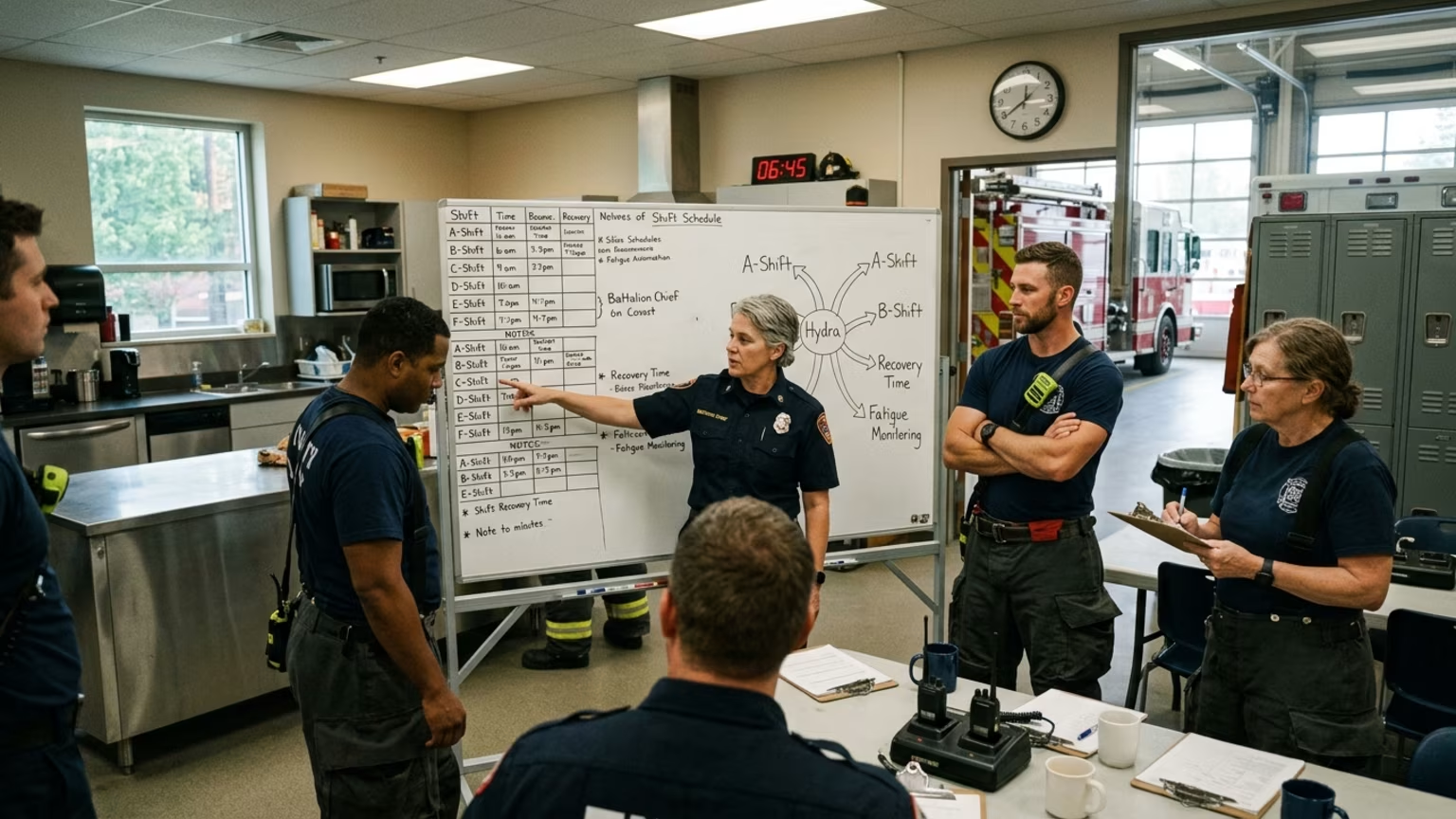

The 2026 Hydra Fire response used daily shift rosters and active supervisor fatigue checks to manage first responder exhaustion. Here is how the strategy works.





The Hydra Fire began in Bosque County near Meridian on September 14 of 2026. This incident prompted response leaders to implement scheduled shift rosters and dedicated supervisor fatigue checks. Texas A&M Forest Service operated in unified command with local departments. This joint command organized crews from more than 20 fire departments across McLennan County.
According to KWTX, organizers built a roster each day for the following shift. This system replaced the traditional practice of having departments send trucks whenever they were available. Elm Mott Fire Chief Chris Pechacek served as one of the leaders helping coordinate this response. KWTX reported that supervisors accompanied firefighter teams specifically to watch for fatigue.
These designated leaders stepped in to make sure crews stopped for food, water and rest. A firefighter quoted by KWTX described the crews his team relieved as very tired, hot and needing a break. By a September 18 update, the fire was estimated at 1,100 acres and 35 percent contained. Crews were working to strengthen containment lines and address steep hillsides that heavy equipment could not reach.
Irregular shifts and unpredictable calls constantly challenge how emergency personnel manage their physical conditioning. The Hydra Fire provides a clear operational example of how leadership can address these constraints directly. Managing physical exhaustion and sleep deprivation during active wildland incidents dictates how well first responders recover. When command staff build daily schedules, they protect the recovery windows that professionals need to maintain long-term capability.
A 2025 field study reported by Medical Xpress offers valuable context on the demands wildland firefighters face. This study found that wildland firefighters averaged 13.8-hour shifts on active fire days. The same personnel obtained about 6.7 hours of sleep during those demanding operational periods. While these figures represent separate study averages rather than Hydra Fire measurements, they highlight the physiological load of wildland responses.
First responders balancing strength, endurance and mobility across a demanding career cannot rely on short-term motivation alone. Extended incident operations place immense physical stress on the body. This stress compounds when personnel are working on steep hillsides without the aid of heavy equipment. A structured first responder shift meal framework becomes difficult to maintain without scheduled breaks.
By assigning supervisors to monitor fatigue, the Hydra Fire command team removed the burden of self-assessment from tired crews. Operational professionals often push past safe limits to complete the mission. Having a designated leader watch for exhaustion helps prevent accumulated physical wear from compromising duty readiness. This method turns credible evidence about human performance into practical guidance for the field.
Managing shift-work stress and sleep disruption influences the career longevity of emergency personnel. The Hydra Fire response model translates clinical evidence about exhaustion into practical field operations. When crews work around the clock, they face severe circadian strain and accumulated sleep debt. KWTX reported on September 16 that crews had been working around the clock with no injuries from the fire at that time.
First responders often struggle with conflicting advice that prioritizes short-term performance while ignoring long-term health. The decision to build a roster each day for the following shift directly counters this dangerous trend. It treats the responding firefighters as a finite resource that requires active preservation. This approach aligns with structural wildland firefighter fatigue protocols by prioritizing defined off-duty time.
Wildland firefighting involves carrying heavy gear, hiking steep terrain and operating hand tools for hours. The KWTX incident coverage highlighted the difficulty of working steep hillsides manually. This type of occupational exertion demands high levels of muscular endurance and aerobic capacity. Without enforced rest, professionals risk catastrophic musculoskeletal injuries and severe central nervous system fatigue.
The coordination at the Hydra Fire challenges older assumptions about crisis deployment. Historically, emergency agencies might simply send trucks and personnel to an incident whenever they became available. This ad hoc approach assumes that maximum immediate presence outweighs the risks of long-term fatigue. However, sending unmanaged waves of responders can compress recovery windows and heighten injury risk.
Relying on sheer willpower during major incidents treats fitness and career longevity as secondary concerns. Generic advice that assumes a predictable schedule fails when responding to unpredictable fire behavior. The Hydra Fire command structure actively rejected the practice of unrestricted deployment. They recognized that continuous operational coverage requires rested personnel ready to relieve tired crews.
This shift in incident management respects the realities of demanding emergency work. When departments plan the next shift in advance, they provide off-duty personnel with clear expectations for rest. Unpredictable calls will always define emergency services. However, predictable administrative planning can mitigate the worst physiological effects of sleep disruption.
The pressure to perform during a crisis frequently overrides clinical logic. A firefighter leaving a day job early to work through the night highlights a profound commitment to public safety. However, returning to normal work with minimal sleep compounds fatigue debt rapidly. When departments allow self-managed deployment, they inadvertently encourage personnel to trade their long-term health for immediate action.
Structured rotation systems dismantle this hazardous expectation. The leaders in Bosque County demonstrated that a unified command can dictate a more sustainable pace. By organizing crews into distinct operational blocks, they removed the guilt associated with stepping away from the fire line. This administrative boundary protects emergency personnel from their own relentless drive to serve.
Emergency medical personnel, police officers and firefighters can apply the Hydra Fire framework to their own operational planning. Active duty capability requires actionable adjustments to daily routines and shift preparations. The reporting on the Bosque County incident outlines clear steps for incident commanders and wellness coordinators. These practices prioritize sustainable performance over performative toughness.
First, incident leaders must construct deliberate rosters for the next operational period. This step prevents the chaotic overlap of tired crews and fresh arrivals. Organizing personnel into scheduled shifts allows agencies to maintain continuous coverage for other communities. It also provides responders with a defined window to manage their nutrition, hydration and energy.
Second, departments must assign supervisors whose primary job is monitoring crew condition. These individuals need the authority to step in and make certain that firefighters stop for rest. A firefighter heavily engaged in physical labor rarely recognizes their own cognitive decline. External monitoring provides a necessary safety net when meal timing is inconsistent and stress is high.
Third, operational leaders need to adapt their expectations based on terrain and environmental conditions. The KWTX coverage noted that Hydra Fire crews had to address steep hillsides manually. When heavy equipment cannot reach a location, the physical toll on human responders increases dramatically. Departments must factor this accelerated physical wear into their adaptable fitness systems and break schedules.
Fourth, organizations must treat food and water breaks as mandatory operational tasks rather than optional luxuries. The physical demands of emergency service deplete glycogen stores and drive dehydration rapidly. Supervisors at the Hydra Fire explicitly managed these physiological needs. Establishing practical strategies for tracking aerobic fitness and hydration sets a baseline for sustainable incident response.
Fifth, incident command must integrate transparent communication into their fatigue management plans. Personnel need to know when their relief will arrive to pace their physical output appropriately. A crew expecting a six-hour assignment will work at a different intensity than one preparing for a fourteen-hour tour. Providing clear operational timelines prevents early physical burnout on the fire line.
Finally, wellness coordinators must evaluate how their personnel recover after returning from extended deployments. A standardized recovery protocol must address the physical wear accumulated over consecutive shifts. Professionals need structured guidance on mobility work, sleep hygiene and nutritional replenishment after demobilization. This comprehensive approach helps first responders monitor their fatigue risk during demanding rotations.
The organizational structure used at the Hydra Fire provides a strong model for future multi-department responses. However, continuing analysis is necessary to quantify the precise medical and physical outcomes of these practices. The available coverage documents the operational intent and the coordination model used by local leaders. It does not provide measured data on the actual sleep obtained by these specific crews.
Future field studies should evaluate how long individual crews work under these active supervision models. Researchers need to measure the exact duration of rest breaks and the quality of sleep achieved between shifts. While the 2025 field study documented 13.8-hour active fire shifts, site-specific measurements would offer better comparative data. Documenting these variables helps separate useful stress-resilience guidance from generic assumptions.
Incident commanders and department medical directors should continue tracking fire containment alongside personnel health metrics. On September 16, KWTX reported the fire was 1,100 acres and 25 percent contained. Two days later, the acreage remained unchanged while containment reached 35 percent. Monitoring how shift structures influence these operational benchmarks will define the future of emergency service recovery protocols.
The Hydra Fire response demonstrates a necessary evolution in emergency service logistics. The transition from reactive deployment to proactive shift modeling represents a significant operational maturity. However, the first responder community needs peer-reviewed data on how these exact models influence long-term injury rates. Analyzing the frequency of sprains, strains and cardiovascular events under this system will validate its broader adoption.
Moving forward, wellness coordinators should track subjective fatigue scores against objective physical output. Understanding how a firefighter feels compared to how they actually perform provides crucial data for department medical directors. The integration of scheduled rosters and active supervisors is a strong foundation. Building upon that foundation with rigorous field measurement will define the next generation of first responder health protocols.
Managing accumulated physical exhaustion during extended incident operations requires precise logistical planning, and Rescuris delivers the physiological framework to support these demanding environments. Conflicting advice that prioritises short-term performance while ignoring long-term health often complicates how departments schedule their crews, so we provide practical evidence to help first responders maintain sustainable duty readiness.
Rescuris publishes evidence-aware guidance for firefighters, police officers, paramedics and other first responders on fitness, recovery, sleep, nutrition, stress resilience and long-term capability.






Read practical guidance on first responder fitness, recovery, sleep, nutrition and resilience for demanding work and a long, active career.
read the blog
