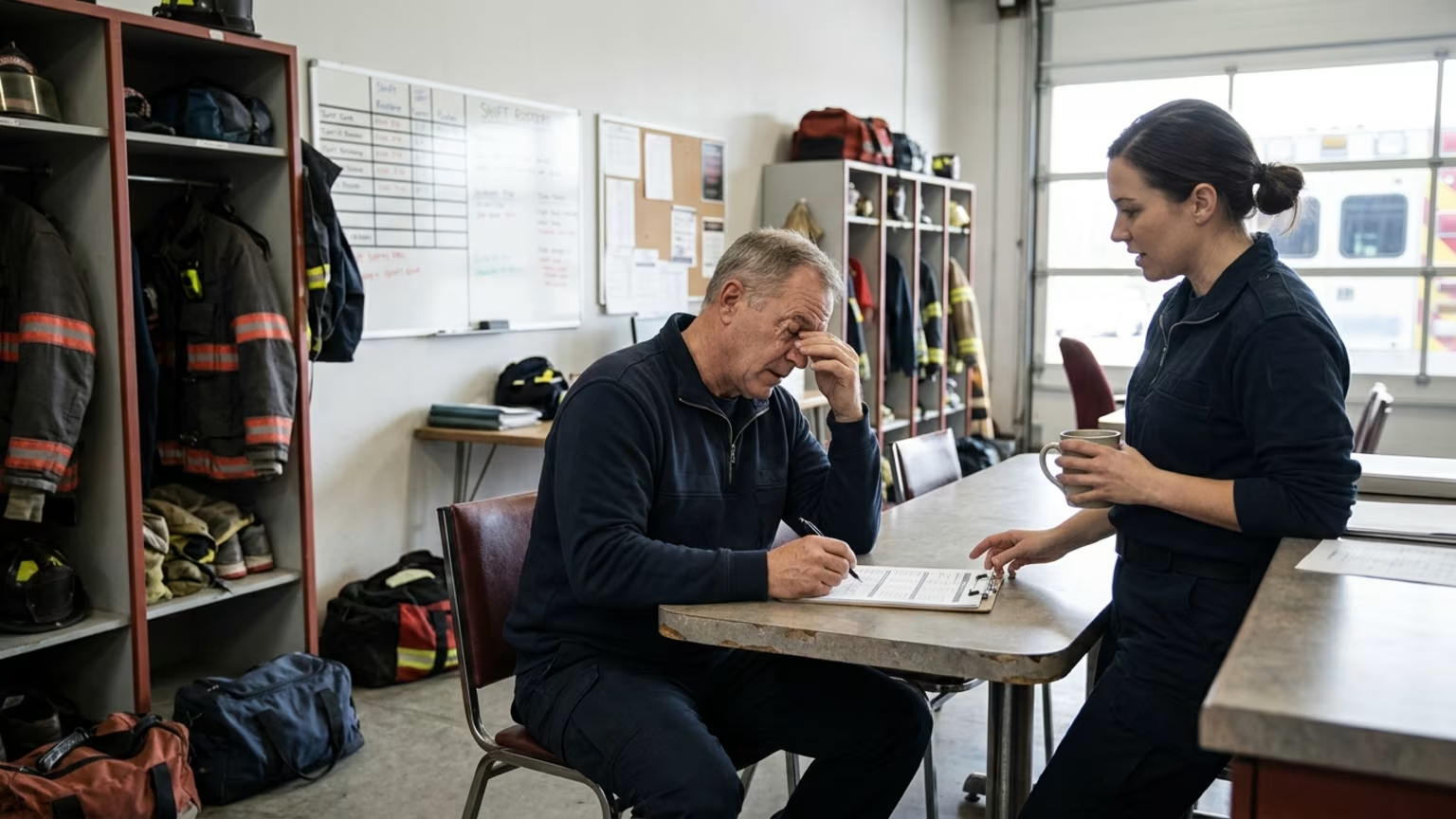

Review fatigue and injury evidence, then use department-level questions about sleep, conditioning, task preparation, equipment and symptom reporting.





Lifting technique is a narrow starting point for a broad prevention conversation. A systems approach also asks how work is scheduled, how readiness is considered and what support surrounds demanding tasks. For Rescuris, that means discussing physical capability alongside recovery rather than treating them as competing priorities.
The clearest quantitative evidence available here comes from the JEMS article Heroics: A Poor Substitute for Readiness. It reports research connecting fatigue with occupational injury among EMS workers. That makes fatigue relevant to an injury-prevention discussion without making it the explanation for every injury.
The survey finding concerns severe mental or physical fatigue at work. It is not simply a report that personnel sometimes felt tired outside duty. For an agency reviewing readiness, that distinction directs attention toward working conditions as well as personal recovery habits.
The injury comparison also needs its original label: 1.9 times the odds of occupational injury. It should not become a claim that fatigue doubles back injuries or predicts an individual responder's injury probability.
JEMS reports the underlying research without supplying its full methods in the material summarized here. The EMS result is an adjusted association rather than proof of causation. Its outcome is occupational injury generally, not specifically musculoskeletal injury or injury to a particular joint.
Those boundaries leave a useful conclusion: fatigue belongs in the prevention conversation. They do not establish how much any particular fatigue measure would reduce back or joint injuries.
For a responder's nervous system, the distinction between a measured outcome and an inferred mechanism matters. The reported findings concern fatigue, occupational injury and disability time. They do not describe changes in autonomic nervous-system function or establish a specific physiological pathway.
The practical interpretation should therefore stay functional. Mental fatigue and physical fatigue both belong in a discussion about readiness for demanding work. Neither needs to be recast as a proven nervous-system disorder to deserve attention.
At department level, useful questions include whether fatigue is acknowledged before planned physical work and whether personnel can raise concerns without the discussion becoming a judgement about commitment. These are planning questions rather than a medical assessment.
This also changes the editorial focus. Instead of asking only whether someone knows the correct movement, a broader review asks what conditions surround that movement. Sleep opportunity and recovery planning belong beside the task itself.
The fire-department trial reported by JEMS offers a different kind of evidence from the EMS survey. It was randomized and involved nearly 1,200 firefighters. Its intervention combined sleep education with screening for sleep disorders.
JEMS reports fewer firefighters reporting an injury and nearly half as much paid disability-time use. The disability-time finding is not a claim that injuries were cut in half. These are separate outcomes and should remain separate when discussing the program.
The program also needs to remain a combined intervention. Its reported results should not be assigned entirely to education or entirely to screening. For department leaders, the relevant question is whether sleep health is addressed through an organized approach rather than through reminders to get more rest.
Screening is not the same as diagnosing or treating a sleep disorder. Decisions about an individual's symptoms and clinical care belong with a qualified health professional. The organizational discussion concerns how access to appropriate support fits into readiness planning.
The checklist below combines the fatigue-management measures described by JEMS with practical questions about the wider work system. It is a discussion framework, not a tested injury-reduction protocol. The available findings do not validate a particular warm-up routine, equipment choice, team-handling method or symptom-reporting process.
JEMS presents fatigue risk management as an organizational issue. The guidance it describes includes limiting shifts to less than 24 hours, providing nap opportunities and educating personnel about fatigue. The article also discusses fatigue monitoring as something agencies could consider.
These are agency-level considerations rather than universal scheduling rules for every service or jurisdiction. A department review can ask:
The central question is whether responsibility extends beyond telling personnel to sleep better. Further discussion of protecting recovery capacity around demanding work can support that planning conversation.
A conditioning review can ask whether training reflects the physical demands of the role across a career. That is different from assuming that a demanding session is automatically useful or that fitness alone resolves injury risk.
Questions for a training lead include:
These questions connect duty fitness with long-term capability without presenting a specific exercise prescription. Rescuris's material on organizing training around duty cycles provides a related starting point for that discussion.
Preparation deserves a place on the checklist without turning an untested warm-up into a promised safeguard. The useful review concerns what the task requires and how applicable safe-work practices are communicated.
A department or training team can ask:
The aim is to make preparation discussable. It is not to claim that a particular sequence prevents injury or that emergency work always permits a predictable preparation window.
A systems discussion should leave room for questions about the task, available equipment and assistance. These are practical review prompts rather than findings from the fatigue research.
Useful questions include:
This keeps the review broader than individual strength or technique. It also avoids assigning every prevention responsibility to the person performing the physical work.
A prevention checklist can ask how personnel raise symptoms without claiming that the cited research tested reporting systems. The practical issue is whether a responder knows where to take a concern and what happens next.
Questions for the department include:
A checklist cannot diagnose pain or determine fitness for duty. For a related editorial framework, see Rescuris's discussion of bringing musculoskeletal symptoms into readiness decisions.
The value of this checklist is its scope, not a claim that every item has equal evidence behind it. Fatigue management has reported research support here. The other questions organize a broader departmental conversation about preparation and responsibility.
A useful closing question for that conversation is whether conditioning, sleep and work practices are being considered together. Separate initiatives may address separate concerns. A systems review asks how those initiatives fit the realities of the same working day.
Treat fatigue as a readiness concern and lifting technique as one part of a wider prevention plan, not the whole plan.
An injury-prevention checklist that overlooks interrupted sleep leaves a central recovery problem outside the discussion. Rescuris connects evidence on shift-work sleep with duty fitness and career longevity, helping emergency-service professionals assess options around nights and unpredictable calls while keeping physical capability and long-term health in view.
Rescuris publishes evidence-aware guidance for firefighters, police officers, paramedics and other first responders on fitness, recovery, sleep, nutrition, stress resilience and long-term capability.





Read practical guidance on first responder fitness, recovery, sleep, nutrition and resilience for demanding work and a long, active career.
read the blog
