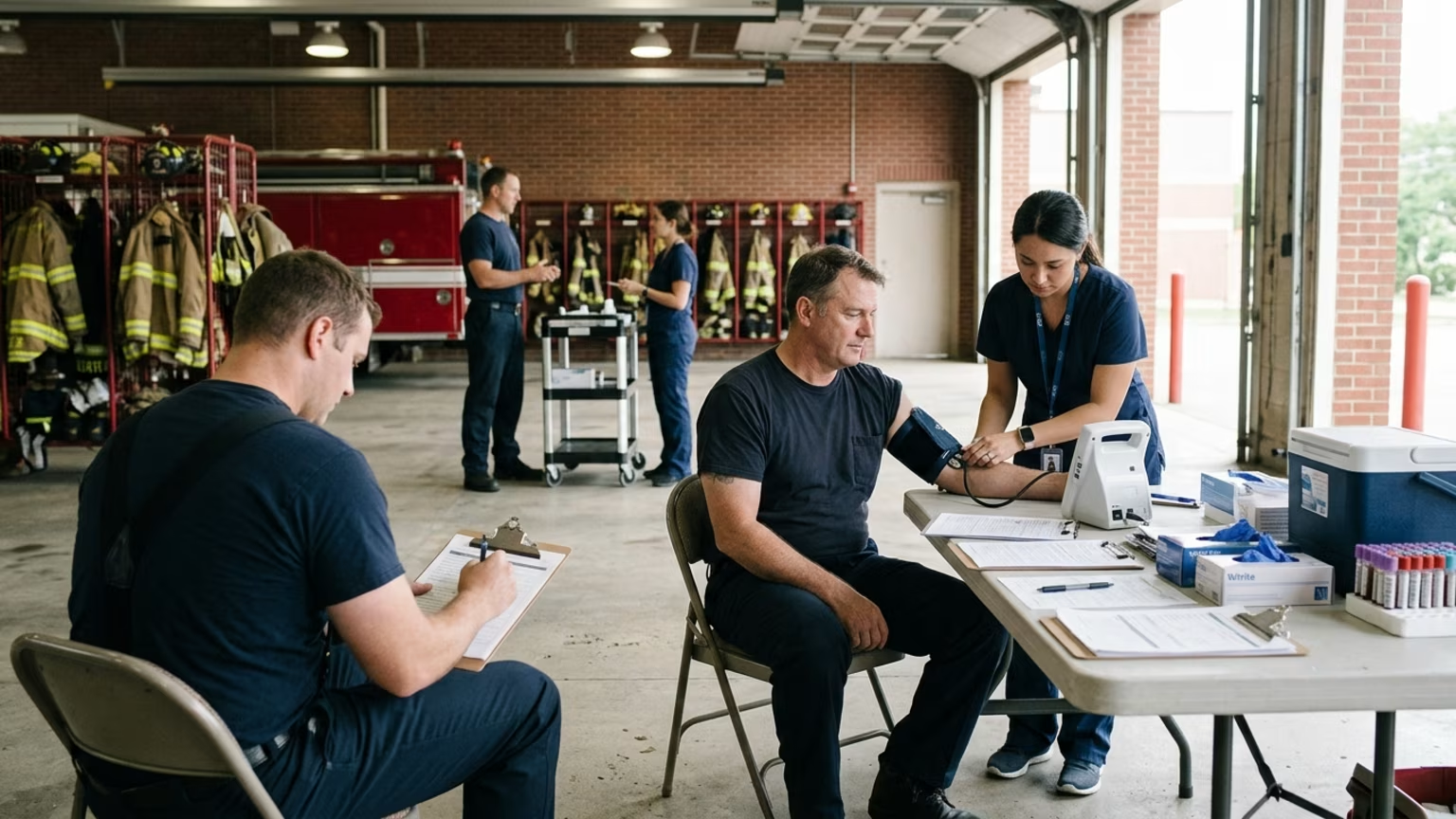

Minnesota funded Mn-FIRE's planned firefighter ultrasound study. Review its aims, screening trade-offs and physician follow-up.





On September 18, 2026, Northern News Now reported that Mn-FIRE received $1 million for a statewide firefighter ultrasound screening study. The funding came through a Minnesota Department of Public Safety announcement dated September 16, 2026. According to the report, Mn-FIRE plans to screen 2,000 firefighters and collect data on the health issues they are experiencing.
The announcement brings firefighter health research into a funding package that also supports equipment and training. For firefighters thinking about a long career, the relevant development is the planned opportunity to participate in screening. The clinical value of that opportunity is a separate question from the decision to fund it.
According to Northern News Now, the other reported allocations include:
These are separate purposes within the funding package. The equipment and training allocations should not be read as money available for medical screening. Keeping those categories distinct gives readers a clearer account of what the state is supporting.
The one-time study funding also differs from an existing health-support commitment. KSTP reported that the Hometown Heroes Assistance Program provides $4 million annually for firefighter work-related health issues following its approval in 2021. That reporting also described Mn-FIRE's training on cancer, cardiac issues and emotional trauma. The new screening allocation and the annual assistance program are distinct commitments.
Northern News Now reported that Mn-FIRE described the planned screening as free. The ultrasound examinations would include the liver and heart, along with the carotid artery. The report identified cancer and heart issues as health risks motivating the initiative.
The stated research purpose is to collect information about health issues among participating firefighters. That makes this both a screening opportunity and a data-gathering effort. A planned participant count describes the intended reach of the study, not the number of health conditions found.
Mn-FIRE Board President Mike Dobesh told Northern News Now that firefighters may wait until something hurts before seeing a physician. He said the study aims to produce data that can inform decisions within Minnesota's fire service. Those comments describe his view of the problem and the initiative's purpose, rather than a measured finding about firefighter behavior.
The available coverage describes a planned study and reports no results or diagnostic-accuracy data. Eligibility criteria and the exact ultrasound protocol are unspecified. The number of screenings per participant and a follow-up timeline are also unstated. The announcement does not establish improved medical outcomes or a basis for workload restrictions or return-to-duty criteria.
That boundary matters when interpreting the phrase “early detection.” In the funding story, early detection is a goal. Assessing the study requires looking at what it eventually finds and how those findings are evaluated, rather than treating the goal as an accomplished result.
A separate September 2026 report on firefighter cancer screening cautioned that screening can produce false-positive results and unnecessary biopsies. It also described the possibility of treating cancers that might never become dangerous. According to that report, benefits and risks vary by cancer type and patient.
Those trade-offs make the number of examinations an incomplete measure of success. A useful assessment asks whether a finding led to appropriate care and whether the process justified its burdens. Those are questions for evidence and medical judgment, not for a funding headline.
The same report cited a National Institute for Occupational Safety and Health study of nearly 30,000 career firefighters in Chicago, Philadelphia and San Francisco. It reported 9% more cancer diagnoses and 14% more cancer deaths than expected from general U.S. population rates. Those figures concern that study population and comparison, not Minnesota firefighters or every type of cancer.
This broader evidence helps explain the interest in firefighter health research. It does not validate a particular screening method by itself. Occupational risk evidence and evidence about the usefulness of a screening approach answer different questions.
For first responder wellness, the operational significance is an investment in access to health information. The study's stated data-gathering purpose also puts a research question alongside the individual screening encounter. One concerns the participating firefighter's health, while the other concerns what the collected information may reveal about the group.
Career longevity deserves that wider frame. Immediate capability is only one part of the discussion. Health information and physician-led care belong in the conversation about a working life and the years after service, rather than being treated solely as tools for keeping someone available for the next assignment.
This is why the story fits within a discussion of health across a firefighter's career. The funding is relevant to people, not just to a participation target. A department's interest in staffing and an individual's need for medical assessment are different considerations.
The editorial implication is to keep three questions separate:
Separating those questions avoids turning a research announcement into a readiness judgment. It also gives the initiative room to be assessed on its stated purpose instead of attaching employment consequences that the announcement never described.
The same distinction is useful when reading about career-long occupational health tracking. Gathering information and demonstrating a health benefit are different tasks. Both deserve attention, but one should not be presented as proof of the other.
For police officers and EMS professionals following this story, the transferable lesson is about interpreting evidence. It is not a reason to adopt Minnesota's planned ultrasound approach. The useful comparison is how clearly an initiative separates access, research aims and individual medical care.
Northern News Now reported that firefighters whose screenings raise health concerns will be encouraged to consult their physicians to develop a plan of care. That is the practical follow-up described in the coverage. It places the next medical decision with qualified care rather than with the screening announcement itself.
A screening finding and a diagnosis are not interchangeable. The reported pathway is to bring a concern into a physician-led assessment. The study should therefore be understood as a source of information for that conversation, not as a substitute for the conversation.
Useful discussion topics follow directly from that distinction:
These are questions for a clinician, not a suggested sequence of tests. They do not prescribe a treatment or a change in training. Personal medical decisions require an assessment of the individual rather than an assumption based on participation in a statewide study.
The practical message is narrower than a general wellness checklist. The reported next step is physician follow-up when a concern is identified. There is no need to attach an exercise routine or a shift-recovery schedule to that message to make it useful.
Clear communication also keeps the person at the center of the process. A study's need to collect data and a participant's need to understand a finding are related, but they are not the same task. The medical conversation addresses the latter.
The most useful next development would be transparent reporting of what the screening effort found and what happened after concerns were identified. That would move the discussion beyond the funding amount and intended participation. It would also provide a stronger basis for assessing the initiative's contribution to firefighter health.
Questions worth following include:
These questions look beyond attendance. They ask whether the information collected had practical medical value. Answering them would be more meaningful than relying on the appeal of proactive screening alone.
The wider guidance question remains relevant too. The September 2026 cancer-screening report described a lack of uniform, nationally accepted recommendations tailored to firefighters' occupational exposures. It said a working group hoped to begin releasing evidence-informed recommendations in 2027. That was a stated aim, not a confirmed publication date.
The working group's effort and the Minnesota study address related but different needs. One concerns screening recommendations, while the other concerns information from a planned screening initiative. Readers should assess each against its own purpose rather than expecting either announcement to settle the whole occupational-health discussion.
For career longevity, the evidence worth following is the connection between screening and medical evaluation. Beyond that lies the central question: do the documented outcomes support the value of the approach for the firefighters taking part?
Deciding how screening information fits into a long career calls for perspective beyond the next tour, which Rescuris brings through research-led performance and recovery coverage. When conflicting advice puts immediate output ahead of lasting health, its editorial guidance helps emergency-service professionals weigh evidence while keeping physical capability and career longevity in the same discussion.
Rescuris publishes evidence-aware guidance for firefighters, police officers, paramedics and other first responders on fitness, recovery, sleep, nutrition, stress resilience and long-term capability.





Read practical guidance on first responder fitness, recovery, sleep, nutrition and resilience for demanding work and a long, active career.
read the blog
