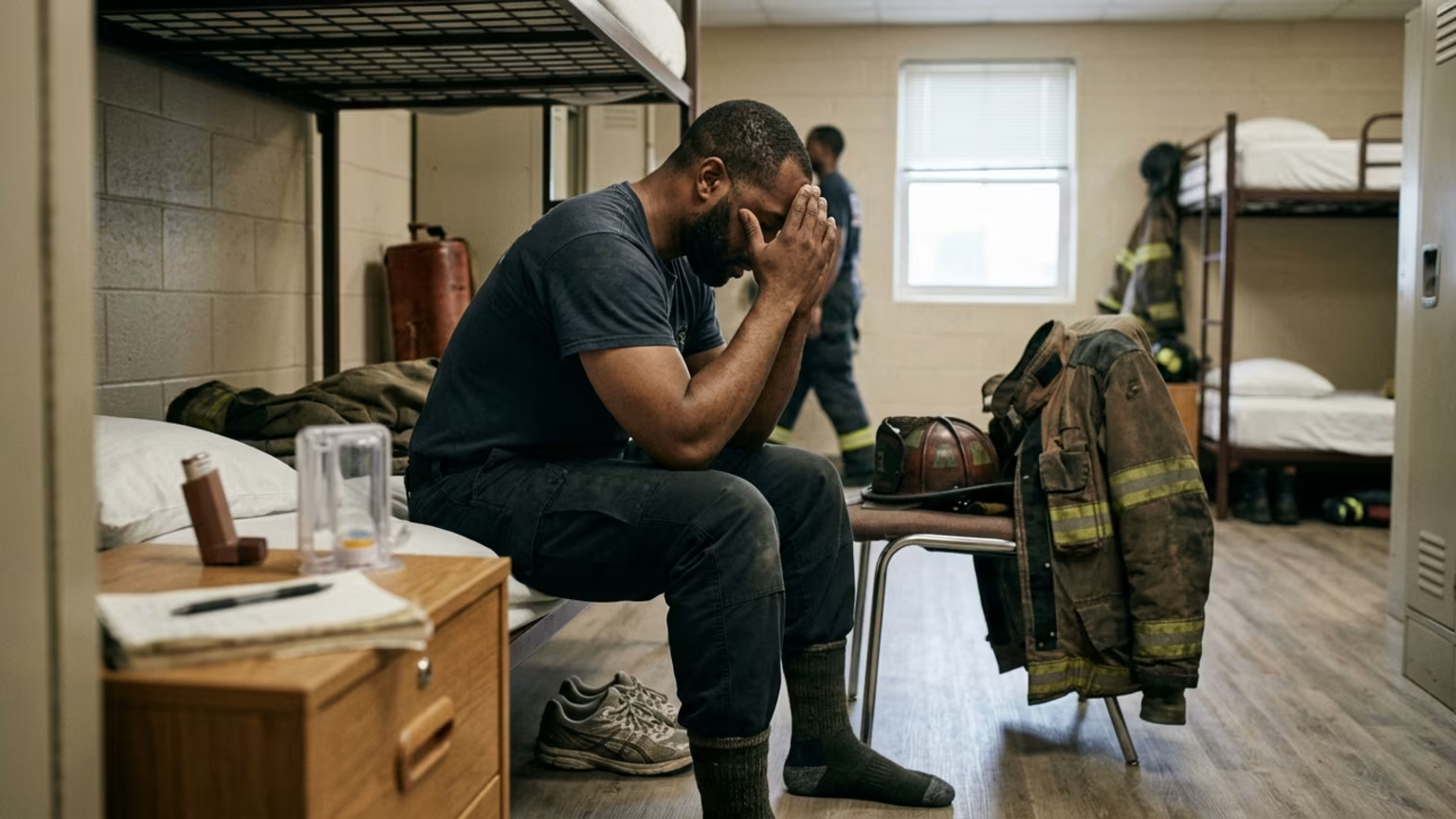

A September 2026 NIOSH report details prolonged respiratory recovery and reactive airway disease in four California responders after a 2025 EV battery fire.





In September 2026, the National Institute for Occupational Safety and Health released a report detailing an April 2025 incident where a damaged Tesla Model 3 battery entered thermal runaway. The official occupational-health investigation describes how smoke from this lithium-ion vehicle fire caused prolonged respiratory illness for multiple responding personnel in California.
According to the NIOSH document, five individuals sought immediate medical care following their exposure to a dense smoke plume. The documented exposure duration for these individuals varied from a few seconds to up to five minutes depending on their proximity. Four of these affected personnel, comprising three firefighters and one command officer, remained unable to return to duty. This work restriction was still actively in effect during the investigation in spring 2026.
This timeline represents a profound recovery period of approximately 11 months following the initial response to the crash. The fifth affected firefighter experienced a much shorter clinical course and returned to work within a few days. Treating pulmonologists evaluated the four personnel who reported persistent and work-limiting symptoms throughout the year. These specialists formally diagnosed the delayed responders with reactive airway disease secondary to inhalation injury.
The primary complaint limiting their return to active status was severe shortness of breath on exertion. This specific impairment directly interfered with their ability to perform essential firefighting duties safely on the fireground. The physiological impact was highly measurable during clinical evaluations conducted months after the initial hazardous event. During a supervised 100-meter walk about three months post-exposure, one firefighter’s oxygen saturation dropped to 86 percent.
This individual required supplemental oxygen during exertion to maintain safe physiological parameters during routine physical tasks. The report notes this supplemental oxygen requirement was still ongoing at the time of the spring 2026 investigation. While respiratory distress was the primary barrier to duty, the personnel reported a wide array of other symptoms. The NIOSH report details that affected personnel also experienced persistent cough, profound fatigue and unexpected palpitations.
Medical evaluations documented elevated blood pressure, severe nausea, frequent headaches and recurrent dizziness among the injured crew members. Several responders also reported experiencing new cognitive difficulties or mood complaints following the incident. The specific symptoms and clinical findings varied significantly among the four affected personnel as their recoveries progressed. Fire Engineering’s coverage likewise describes the Sacramento-area event and the four responders who remained out of work.
Their coverage highlights the medical recommendations provided to these individuals during their extended absence from the firehouse. Treating providers recommended standard inhalers and structured pulmonary rehabilitation to manage symptoms while the lungs healed. However, the department lacked a written, standardized return-to-operational-duty protocol to guide this rehabilitation process. This absence of formal policy created structural hurdles for returning the injured members to active service.
These clinical findings require a distinct translation into daily physical training and duty readiness protocols for emergency departments. The investigation clearly shows that apparent recovery at rest does not equal cardiovascular readiness for the physical demands of the job. Operational clearance must rely on targeted exertional testing rather than the mere passage of time away from the station. Returning an individual to operational tasks must be handled as a strictly individualized fitness-for-duty decision.
The absence of a tested department-wide rehabilitation protocol creates significant challenges for returning injured personnel to the line safely. Medical providers can prescribe pulmonary rehabilitation, but departments must integrate those treatments into functional occupational assessments. Training coordinators must understand how reactive airway disease impacts a responder operating under heavy physical loads. A standard physical assessment may miss severe exertional limitations if cardiovascular stress tests are not utilized.
Protocols must adapt to the reality that chemical inhalation injuries often present with delayed, compounding symptoms that complicate recovery. Departments cannot treat toxic exposure recovery with the same timelines applied to common musculoskeletal injuries or joint sprains. The prolonged absence of four experienced personnel places immense pressure on remaining shift workers who must cover the scheduling gaps. This structural strain makes effective shift-work recovery protocols essential for maintaining overall agency readiness.
Incorporating respiratory capacity baselines into annual assessments helps supervisors measure genuine operational capability over the course of a career. Standardized tracking allows occupational health officers to monitor incremental improvements during a prolonged recovery phase. This objective data prevents premature return-to-work authorizations that could endanger the responder or their crew on future calls. Detailed clinical oversight is the safest path for returning to shift work after leave.
This investigation severely challenges the operational assumption that hazard zones dissolve once active flames are extinguished and contained. The April 2025 incident began as a response to a single-vehicle crash involving a Tesla Model 3. The high-speed impact resulted in more than 400 battery cells being scattered across the adjacent roadway. Emergency personnel completed their initial scene containment and proceeded to the vehicle recovery phase.
During this transition, some responders removed their personal protective equipment and self-contained breathing apparatus to improve mobility. They assumed the immediate chemical and thermal threats had been successfully neutralized by the initial suppression efforts. However, the damaged battery pack entered a violent thermal runaway state while being loaded onto a tow truck. This delayed reaction rapidly released a dense, low-lying smoke plume directly into the breathing zones of unprotected personnel.
The timing of this exposure upends traditional post-suppression safety timelines for electric vehicle responses and highway cleanups. Standard operating procedures frequently allow for the downgrading of respiratory protection during cleanup and transport operations. This incident proves that compromised lithium-ion batteries harbor unpredictable, delayed-release toxic threats long after the initial crash. Assuming a scene is secure based solely on the absence of visible fire invites severe occupational injury.
Incident commanders must reevaluate how they define a secure perimeter during complex battery recovery operations. The delayed off-gassing phase requires maintaining high-level protective postures well into the towing and removal process. Relying on visual cues to determine atmospheric safety is fundamentally flawed during thermal runaway events. Modern emergency response frameworks must treat the entire lifecycle of a damaged battery as an active hazard.
Applying these findings requires immediate, actionable adjustments to daily routines and incident command structures across emergency response agencies. NIOSH specifically recommends keeping firefighters on respiratory protection within hazard-control zones during all handling phases. This includes suppression, battery removal and any operations where thermal runaway or off-gassing remains a possibility. Commanders must abandon fixed-distance perimeters and establish incident-specific hazard-control zones based on continuous risk assessments.
All responding personnel must receive updated training to recognize early physical indicators of battery thermal runaway before failures occur. If a responder develops new symptoms after a suspected exposure, they must seek prompt medical evaluation immediately. Departments need to implement written procedures to report, document and medically evaluate all potential chemical exposures. Delaying evaluation due to mild initial symptoms can complicate the diagnosis of reactive airway disease.
Preliminary exposure reduction must become a mandatory step executed directly at the incident scene rather than back at the station. Responders must systematically isolate contaminated personal protective equipment before leaving the hazard zone to prevent cross-contamination. This contaminated gear must be stored outside of vehicle passenger compartments during the return trip to the station. Proper handling of gear is critical for maintaining respiratory health after emergency service exposure and minimizing secondary inhalation risks.
Furthermore, departments must enforce rigorous medical monitoring for all active personnel exposed to these toxic environments. NIOSH recommends annual physical examinations designed to thoroughly assess ongoing firefighter fitness for duty across all ranks. The report advises that existing annual-examination policies currently reserved for hazardous materials team members should be strictly enforced. These expanded physicals help detect subtle respiratory changes, aiding in the continuous task of managing physical wear.
While this investigation provides critical operational insights, several areas require continuing analysis and long-term tracking by safety organizations. NIOSH explicitly cautions that this case series of five medically affected personnel is extremely small. The sample size is insufficient to establish typical or universal health effects following electric vehicle battery exposures. The broader incidence of prolonged illness following such events remains an unquantified metric within occupational health.
A significant limitation of this incident was the complete absence of environmental sampling during the response effort. Because no air monitoring occurred, the report could not determine the exact chemical composition of the smoke plume. This lack of data made it impossible to identify which specific substance caused the varied clinical symptoms among the firefighters. Future studies must incorporate real-time atmospheric sampling to establish definitive toxicological links.
The medical community also lacks an established, standardized testing or treatment protocol for lithium-ion battery smoke inhalation. The NIOSH report notes that the timing of toxic-metal blood testing may have affected diagnostic accuracy in this case. Tests conducted too long after the exposure might fail to detect transient heavy metals or chemical markers in the bloodstream. Developing time-sensitive, specific biological screening protocols remains a priority for emergency occupational medicine.
Ultimately, these findings concern one specific incident and should not be used to predict every exposure outcome. The documented reactive airway disease highlights a severe potential consequence, but clinical courses will vary by individual. First responders and health officers must monitor emerging federal guidance regarding evidence-based pulmonary rehabilitation standards for inhalation injuries. Tracking these clinical developments helps agencies build better return-to-work protocols for their personnel recovering from toxic exposures.
Returning to physical readiness after a complex respiratory injury demands clear coordination between clinical guidance and operational schedules. Managing nutrition, hydration and energy when meal timing is inconsistent remains equally critical for maintaining that baseline resilience. Rescuris provides the research-led strategies needed to sustain long-term physical capability without sacrificing recovery.
Rescuris publishes evidence-aware guidance for firefighters, police officers, paramedics and other first responders on fitness, recovery, sleep, nutrition, stress resilience and long-term capability.






Read practical guidance on first responder fitness, recovery, sleep, nutrition and resilience for demanding work and a long, active career.
read the blog
