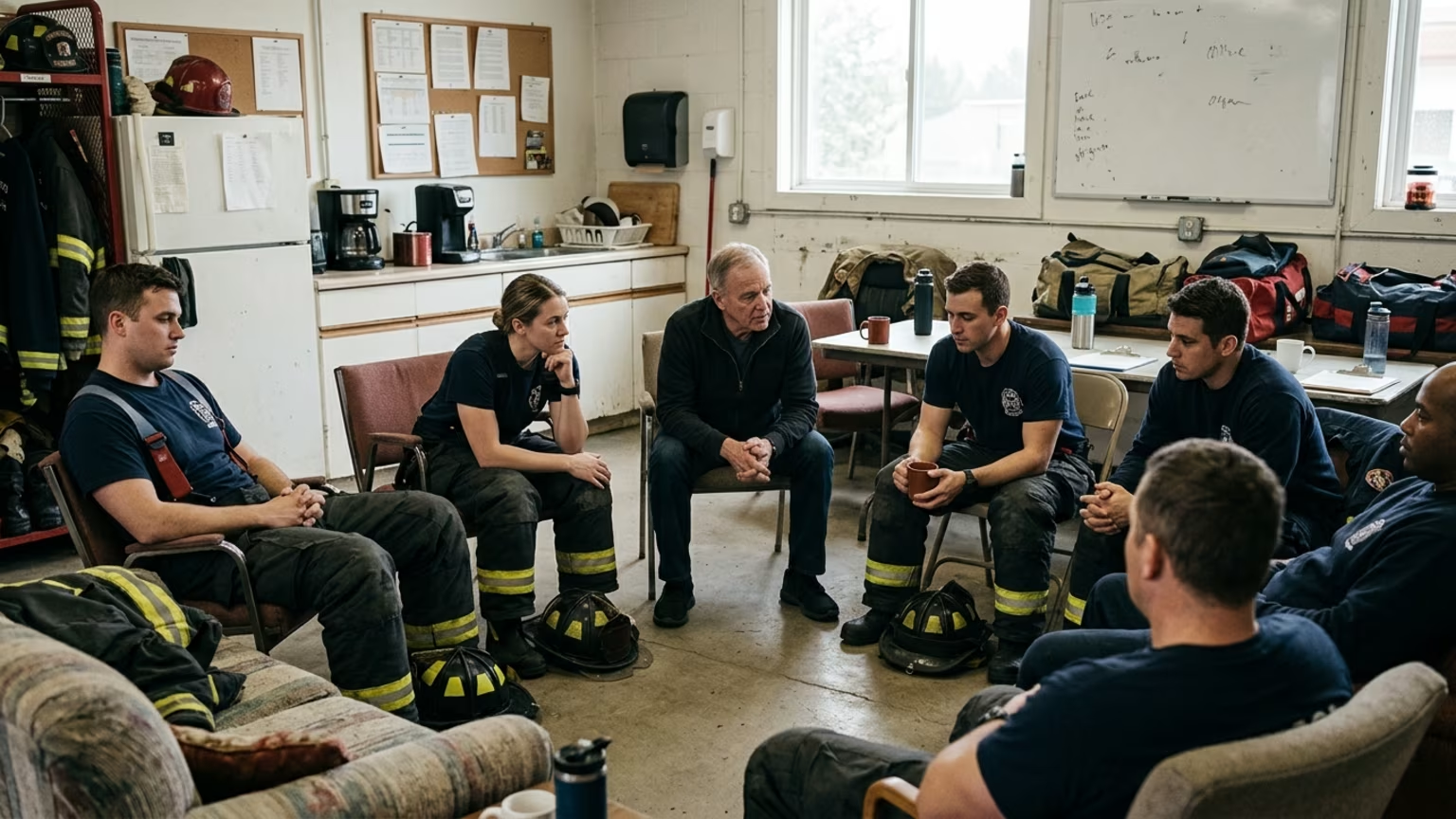

Following the deadly Riverdale fire, Utah agencies prioritized operational relief through interagency shift coverage and structured peer support for responders.





If you are in immediate danger, call 911. For 24/7 support, call or text 988 and press 1 for the Veterans Crisis Line, or text 838255.
On Thursday, October 1, fire and police crews responded to a fatal house fire in Riverdale, facing a difficult scene that required immediate intervention. Following the tragedy, local agencies mobilized to provide the responding firefighters, police officers, dispatchers and investigators with structured peer support. Riverdale Fire Chief Hennessy outlined these available resources as part of a coordinated effort, which included neighboring agencies offering shift coverage to give exposed personnel necessary time off.
The initial emergency call for the incident was reported shortly before 2 a.m. at a home near 4600 South and 1150 West. Responding crews arrived at approximately 1:46 a.m. to initiate rescue and firefighting operations. Four members of the family died in the fire, including the father and three children, while four other family members were hospitalized. The Fox 13 report from October 1 noted that one hospitalized child was in critical condition, and the fire's cause remained under investigation.
While Chief Hennessy stated that no firefighters were injured during the rescue operation, the operational toll extended well beyond the primary fire crew. The Fox 13 report identifies police officers, firefighters, dispatchers, investigators and other local authorities as personnel facing the difficult scene and its aftermath. In response to the community tragedy, Chief Hennessy detailed a combination of operational relief and structured communication for the involved personnel. He identified critical-incident stress debriefings and peer support as specific available resources.
He described peer support as a direct way for personnel with relevant experience to communicate with their colleagues. Furthermore, Chief Hennessy noted that other agencies offered to cover shifts so the affected crews could take time off. Hennessy actively encouraged personnel who were struggling to reach out, framing the use of these available resources as a sign of strength. The coverage also reports that grief counseling was made available to students at affected local schools, representing a community response distinct from the specialized resources for responders.
The actions taken by Utah agencies reflect a practical shift in how departments manage recovery after severe occupational exposures. Relying solely on individual resilience often fails to account for the physical and biological realities of emergency work. Responding to a fatal incident at 1:46 a.m. severely disrupts sleep architecture while spiking stress hormones. When crews face these biological extremes, structured operational relief becomes a necessary logistical tool for maintaining long-term physical capability.
Providing time off allows the central nervous system a required window to return to a baseline physiological state. Emergency personnel operate in environments where situational awareness dictates survival. When a crew is forced to process severe visual and auditory trauma without adequate downtime, their cognitive load remains artificially high. Providing operational relief severs this feedback loop. It allows the body to clear accumulated stress hormones before the next shift begins.
By accepting interagency shift coverage, the Riverdale department treated recovery as an operational requirement rather than a personal preference. This structural support helps responders process a complex event without the immediate pressure of returning to active duty. The inclusion of dispatchers and investigators in the support model is also a critical operational step. Treating the entire chain of response as a single unit protects everyone involved in the operation.
Similar to the protocols required for sustained support and operational recovery after line-of-duty deaths, a coordinated system protects the entire workforce. Agencies that align their local protocols with structured state frameworks and operational support create a more capable department.
Historically, post-incident recovery in emergency services relied heavily on pushing through the remainder of a shift rotation. The response in Riverdale challenges the older assumption that simple downtime or informal venting is sufficient for recovery. By formally integrating critical-incident stress debriefings and defined peer support, the department moves away from isolated coping mechanisms. This structured connection replaces the expectation that professionals should simply absorb the impact of a difficult scene.
Emergency personnel frequently deal with chronic sleep disruption and compounding physical strain from unpredictable schedules. Expecting them to process a fatal event while maintaining operational readiness ignores the limits of human biology. Over time, rotating shifts and overtime demands deplete the physical reserves required to handle severe traumatic exposure. Relying entirely on informal coping mechanisms leaves personnel vulnerable to delayed injury recognition and chronic burnout.
Furthermore, relying on interagency shift coverage overturns the idea that a single department must bear continuous staffing burdens alone. When neighboring agencies cover shifts, the affected department can prioritize physical and mental recovery without compromising community safety. This collaborative model demonstrates how emergency response agencies build operational readiness through shared support systems. The responsibility for returning to duty shifts from the individual professional to the broader agency framework. Operational protocols that mandate recovery time prevent the accumulation of severe physical and mental fatigue across a career.
Agencies looking to update their post-incident protocols can draw practical lessons from the Riverdale response. First, departments should establish clear agreements with neighboring agencies for reciprocal shift coverage. Having these operational agreements in place before a difficult call allows supervisors to grant immediate time off. This prevents scrambling for staffing while crews are still managing the immediate aftermath of a severe scene. Pre-planned coverage guarantees that physical recovery can begin the moment the operational debriefing concludes.
Second, peer support frameworks must explicitly include every professional role exposed to the event. As seen in the Riverdale response, dispatchers and investigators require structured communication access just like the fire crews. The dispatcher who fields the initial early-morning emergency call experiences a severe biological stress response. Leaving dispatchers or peripheral investigators out of the peer support matrix creates critical gaps in departmental recovery.
Establishing a structured framework for safe peer conversations guarantees that leaders account for the entire response chain. Third, command staff must clearly communicate the availability of critical-incident stress debriefings as a standard procedure. Chief Hennessy set a direct example by framing the use of available resources as a sign of strength. When leadership actively promotes structured support, it removes the friction of asking for help.
Professionals navigating irregular shifts and compounding fatigue need clear permission to step off the floor. Removing the stigma around taking time off protects long-term career longevity. Finally, the physical environment during granted time off remains a critical factor in returning to duty. Personnel taking leave should focus on basic biological recovery to counter the immediate physiological strain. Prioritizing hydration, adequate nutrition and consistent sleep windows is necessary after a severe load.
While agencies handle the shift coverage, the individual can focus entirely on resetting their physical capability.
While the Riverdale response provides a clear example of immediate organizational support, tracking long-term effectiveness remains necessary. The current reporting does not specify the exact format of the critical-incident stress debriefings utilized. Furthermore, the available information does not measure the clinical outcomes or the duration of the time off provided. The Fox 13 article notes that resources were offered, but it does not detail how many personnel used them.
As agencies implement these debriefing models and peer frameworks, ongoing analysis of their impact on long-term retention is required. It is crucial to distinguish between a tactical operational review and a psychological recovery debriefing. While an operational review focuses on the mechanics of the response, critical-incident stress debriefings center on the human impact. Measuring the distinct outcomes of both approaches will help departments allocate resources more effectively in the future.
Future tracking will need to evaluate how structured peer support directly impacts physical recovery in the months following a tragedy. Departments must evaluate whether early interagency shift coverage translates into fewer prolonged absences later in a career. As agencies refine their systems-based approaches, objective analysis of time-off durations and return-to-duty metrics will be essential. Clear outcome data will eventually define the next standard of care for emergency responders.
For now, the combination of trusted peer contact and operational relief serves as a highly practical starting point. Establishing consistent benchmarks for these interventions will eventually allow command staff to refine resource allocation. Departments must document which support formats yield the most sustainable return-to-duty outcomes over multiple years. Evaluating this data without bias is essential for the long-term health of the workforce.
Relying on interagency shift coverage and structured debriefings after a community tragedy is a vital operational decision, and turning that immediate relief into sustainable routines is where our work begins. Facing the challenge of separating useful stress-resilience guidance from motivational slogans or mental-health stigma, Rescuris delivers evidence-led frameworks built for unpredictable schedules. We help first responders protect their long-term physical capability after demanding duty.
Rescuris publishes evidence-aware guidance for firefighters, police officers, paramedics and other first responders on fitness, recovery, sleep, nutrition, stress resilience and long-term capability.






Read practical guidance on first responder fitness, recovery, sleep, nutrition and resilience for demanding work and a long, active career.
read the blog
